
Puchaczov/Musoq
Puchaczov/Musoq has 507 GitHub stars and 22 forks. GitHot measured 0 stars in 24 hours. Last checked 2026-11-10 04:24 UTC. Last push 2026-11-08.
SQL Runtime without any database
What you can do
- Query rows - SELECT or FROM-first queries, DISTINCT, WHERE, ORDER BY, NULLS FIRST/NULLS LAST, SKIP, TAKE.
- Choose output columns - */alias.*, column-name LIKE/NOT LIKE, EXCLUDE, REPLACE, and RENAME.
- Compute and match values - CASE, postfix :: casts, ?? fallback, null-safe IS DISTINCT FROM, LIKE/RLIKE, and multi-field any/all pattern matching.
- Group and aggregate - GROUP BY, GROUP BY ALL, positional grouping, HAVING, DISTINCT aggregates, and aggregate FILTER.
측정된 스타 증가
- in 24h
- 0
- in 7 days
- 업데이트 지연
- in 15 days
- 업데이트 지연
- in 1 month
- 업데이트 지연
서로 겹치는 기간의 순증가량이며 일별 합계가 아닙니다. 측정값이 없으면 비워 둡니다. 스타는 관심도를 나타내며 품질을 보장하지 않습니다.
README.md
OriginalMusoq
Liberate SQL from the database.
SQL is too useful to be confined to a database.
Musoq is a SQL query engine for files, logs, Git repositories, APIs, and operating-system resources. I use it when I have a question about data and don't want to write a script just to answer it. Providers expose that data as typed rows and columns, so there is no need to import it into a database first.
You can also describe the structure of a binary file or text record. At runtime, Musoq generates the parser code that reads it, then exposes the decoded fields as columns in the same query.
I increasingly use Musoq through agents such as Codex and Claude Code, with dedicated Musoq skills. I ask a question, the agent checks what data and functions are available and writes a query, and I can read, validate, and reuse the SQL. I am shaping Musoq around that way of working.
Examples · SQL features · Reusable queries · Experiments · How it works · Documentation



With Musoq, you can:
- Query data where it is. Use SQL to filter, group, and join the rows a provider reads from a source.
- Describe how to read a format. Declare the layout of text or binary data, let Musoq generate the parser, and query the decoded fields.
- Join records across sources. Match parsed log events to deployment records, or decoded packet identifiers to a device inventory.
- Let an agent check what is available. It can inspect sources and functions, write a query, and use the results or diagnostics to work out what to ask next.
See it in action
The examples use Musoq's SQL dialect. The example collection includes runnable queries, inputs, and expected results.
Search several patterns, then group the matches
Search for ERROR and WARN in the same source call, then count the matches for each label with SQL.
param(root: string = './docs/examples/readme/fixtures')

select m.PatternId as Level, Count(*) as Occurrences
from search.many($root, patterns: array {
    (id: 'ERROR', pattern: 'ERROR'),
    (id: 'WARN', pattern: 'WARN')
}, options: (scope: (include: array { '*.log' }))) m
group by m.PatternId
order by Level
| Level | Occurrences |
|---|---|
| ERROR | 3 |
| WARN | 1 |
Requires the Search provider. The example collection includes the log fixtures, execution commands, and queries that extract fields from matching lines.
For these two literal patterns, ripgrep plus PowerShell grouping produces the same totals:
rg --no-config -o --no-filename -g '*.log' 'ERROR|WARN' ./docs/examples/readme/fixtures |
    Group-Object -NoElement |
    Sort-Object Name
-o emits each matching occurrence. Group-Object counts them by matched text; the SQL query groups them by pattern label. Here the labels and matched text are both ERROR and WARN.
A decoded length determines the payload size
Read Kind and Size from the header, then use Size to determine how many payload bytes follow. The decoded fields become queryable columns.
binary Header {
    Kind: byte,
    Size: short le,
    Payload: byte[Size]
};

with input as (
    select FromHexToBytes('010300AABBCC') as Data
    from system.dual()
)
select
    h.Kind as Kind,
    h.Size as Size,
    Length(h.Payload) as PayloadBytes
from input i
cross apply Interpret<Header>(i.Data) h
Result: Kind = 1, Size = 3, PayloadBytes = 3.
Requires the System provider. Binary declarations also support nested records, arrays, and conditional fields.
The binary/text specification is still quite experimental. I added it because I often work with columns containing text or binary data that I need to analyze. I wanted to describe those formats once and use the description both as documentation and as a parser. The idea takes inspiration from Kaitai Struct: I declare the shape, Musoq generates the parser, and I can query the decoded fields immediately.
Parsed text becomes queryable columns
The Entry declaration names the fields in each line. Parse exposes those fields through APPLY, so the query can select Level and Message and order the result by Level.
text Entry {
    Level: token,
    _: whitespace,
    Message: rest
};

select e.Level as Level, e.Message as Message
from values {
    (Line: 'INFO ready'),
    (Line: 'ERROR retry failed')
} s
cross apply Parse<Entry>(s.Line) e
order by Level
| Level | Message |
|---|---|
| ERROR | retry failed |
| INFO | ready |
This example uses inline input. Text declarations also support more complex formats and tolerant parsing.
SQL features at a glance
The examples above only show a few parts of the language. Here is a quick overview:
| What you can do | Available syntax |
|---|---|
| Query rows | SELECT or FROM-first queries, DISTINCT, WHERE, ORDER BY, NULLS FIRST/NULLS LAST, SKIP, TAKE. |
| Choose output columns | */alias.*, column-name LIKE/NOT LIKE, EXCLUDE, REPLACE, and RENAME. |
| Compute and match values | CASE, postfix :: casts, ?? fallback, null-safe IS DISTINCT FROM, LIKE/RLIKE, and multi-field any/all pattern matching. |
| Group and aggregate | GROUP BY, GROUP BY ALL, positional grouping, HAVING, DISTINCT aggregates, and aggregate FILTER. |
| Join sources | INNER, LEFT, RIGHT, FULL OUTER, CROSS, SEMI, and ANTI joins; IS PRESENT/IS MISSING for unmatched sides. |
| Find nearest matches | ASOF JOIN, ASOF LEFT JOIN, and TIE BREAK BY. |
| Compose queries | WITH CTEs, WITH RECURSIVE, and derived tables. |
| Use subqueries | Scalar and correlated subqueries; IN/NOT IN, EXISTS/NOT EXISTS, and ANY/SOME/ALL comparisons. |
| Calculate over windows | Ranking, offset, aggregate, and value functions; OVER, PARTITION BY, named WINDOW definitions, ROWS/RANGE frames, and QUALIFY. |
| Combine results | UNION, UNION ALL, INTERSECT, and EXCEPT; optional comparison keys for the distinct set operations. UNION ALL keeps every row. |
| Expand collections | CROSS APPLY, OUTER APPLY, and WITH ORDINALITY. |
| Reshape data | Static PIVOT and UNPIVOT. |
| Supply reusable inputs | Inline VALUES, arrays, named records, typed param/params inputs, and compile-time let constants. |
| Declare types and sources | Query-local ENUM/FLAGS ENUM and TABLE/COUPLE source declarations. |
| Inspect available data | DESC for schemas, columns, arguments, and functions; DESC QUERY for result metadata. |
| Parse records | binary/text declarations; Interpret/Parse and tolerant TryInterpret/TryParse through APPLY. Still experimental. |
Musoq uses its own SQL dialect. The language specifications below describe the exact syntax and limits.
Diagnostic-aware compilation reports likely mistakes, including null-sensitive predicates such as where Name not in ('Alice', NULL) and impossible implicit conversions (MQ5025).
From a question to a reusable query
I want to ask a question, let an agent work through the data, and keep the SQL it used to answer it. That query should be something I can read, check, and run again.
Experiments with Musoq
One thing I enjoy about Musoq is how quickly I can try an idea. Here is one of those experiments.
Reading SQLite data without the SQLite API
Here, an agent uses Musoq's binary format declarations and SQL to extract values from a SQLite table, directly from the file's raw bytes. It does not use the SQLite API.
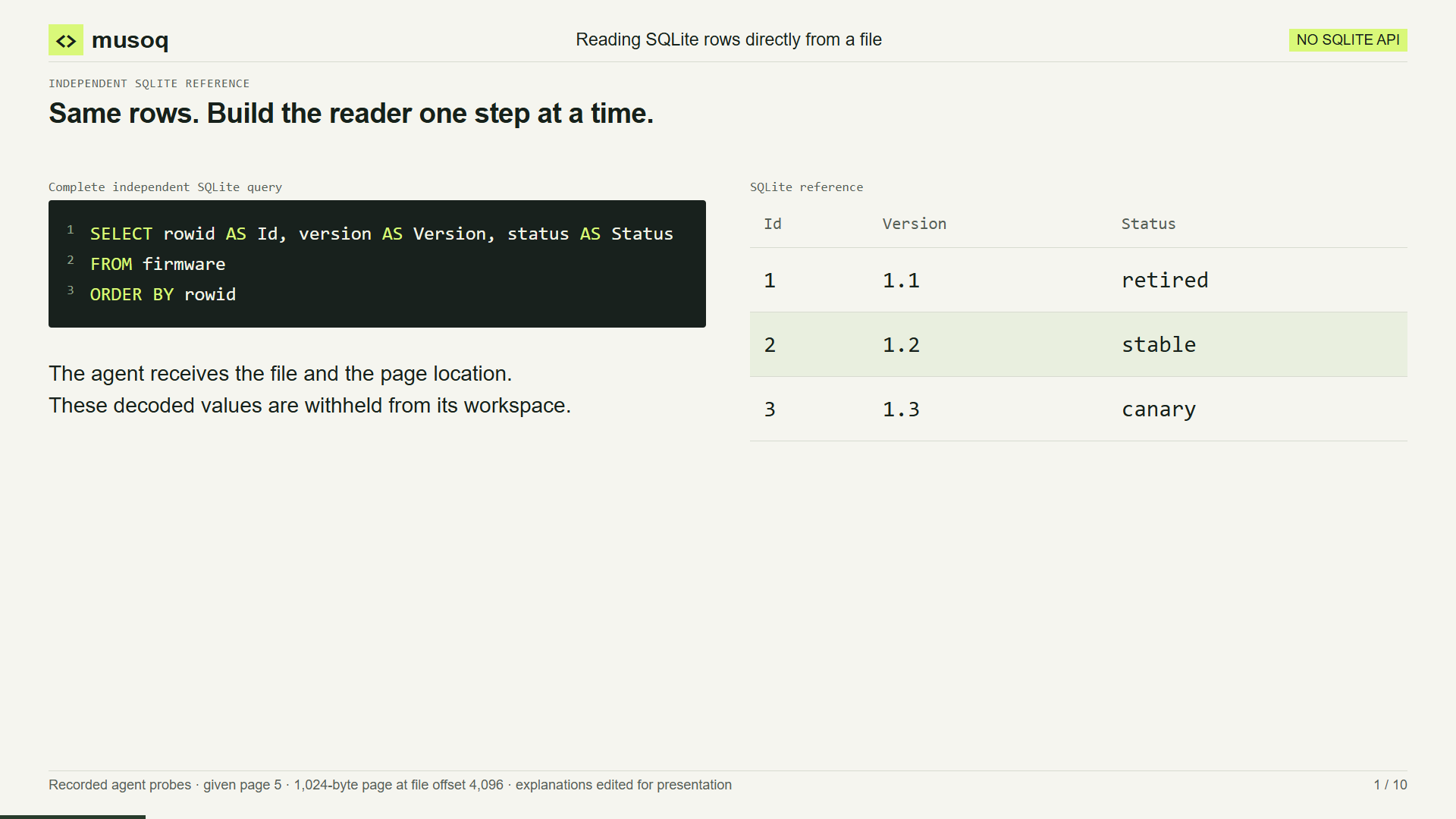
Have a look at the full script in the experiment companion. It takes a database file and table name, finds where the data is stored, and extracts the rows.
How a query runs
The diagram shows how Musoq generates C# from a new SQL query, compiles it into a .NET assembly, and runs it to return rows. Cached queries can reuse earlier compilation work. The engine uses provider metadata to bind and plan the query; finding a source's columns and types can itself require reading the input.
flowchart TD
    SQL[/SQL query/] --> Lexer

    subgraph Frontend["Parse and bind"]
        Lexer[Lexer] -->|Token stream| Parser[Parser]
        Parser --> AST["Parser AST"]
        AST --> Schemas["Prepare text/binary schemas<br/>when declared"]
        Schemas --> Binding["Normalization, binding,<br/>type inference and rewrites"]
        Binding --> TypedAST["Typed AST"]
    end

    subgraph Planning["Plan the query"]
        Logical["Logical query plan"] --> LogicalOpt["Logical optimization"]
        LogicalOpt --> Planner["Derive query properties<br/>and plan source interactions"]
        Planner --> Physical["Build physical query plan"]
        Physical --> PhysicalOpt["Physical-plan optimization"]
        PhysicalOpt --> Strategies["Finalize execution strategies"]
        Strategies --> ExecutionIR["Lower to Execution IR"]
        ExecutionIR --> IROpt["Optimize Execution IR<br/>and finalize execution layout"]
    end

    subgraph Compilation["Render, compile and load"]
        TargetChecks["Target analysis and validation"] --> CSharp
        CSharp["C# renderer:<br/>Roslyn syntax tree"] --> Roslyn["Roslyn compilation"]
        Roslyn --> Artifact["Compiled .NET artifact<br/>IL assembly"]
        Artifact --> Activate["Load assembly and create runnable"]
    end

    TypedAST --> Logical
    IROpt --> TargetChecks
    Schemas -.->|Interpreter source| CSharp
    Activate --> Run["CompiledQuery.Run()<br/>.NET runtime execution"]
    Run --> Results[/Tabular results/]

    Contracts[("Provider metadata<br/>and capabilities")] -.->|Columns, types, functions| Binding
    Contracts -.->|Source planning| Planner
    Sources[(Data sources)] -->|Records| Run
AST means abstract syntax tree; IR means intermediate representation. Roslyn emits an IL assembly, and the .NET runtime handles JIT compilation of its generated methods.
Providers supply contracts and records
Each provider tells Musoq which source methods, columns, types, and functions it exposes. Musoq uses that information to resolve field access and function calls. The provider reads the data; Musoq applies the SQL operations to the returned records.
An agent can inspect that information before writing a query. It can check the source methods and their arguments, the returned fields, and the available functions, then write SQL using what it found.
The engine compiles the operations
Musoq parses SQL, prepares any text or binary schemas, and resolves names and types. It builds and optimizes logical and physical plans, chooses execution strategies, then lowers the plan into Execution IR. After optimizing that IR, it generates C#. Roslyn compiles the code into a .NET assembly. Musoq loads it, creates a runnable query, and binds the source providers before execution.
The runtime handles iteration, joins, grouping, ordering, and intermediate state. This is the work I want it to take care of automatically. I can review the SQL without also having to check another set of loops and indexes written by an agent.
The compiler and runtime check the query against the language rules and provider contracts. I still need to check whether it answers the question I meant to ask.
Parsed fields join the same query
Text and binary declarations describe how to read a record. Parse and Interpret expose its fields through APPLY, so the rest of the query can use them. A decoded identifier can be a join key; a parsed timestamp can be compared with deployment times; a payload field can be filtered or aggregated.
The language is designed for read-only investigation: reading source data and computing answers from it.
Performance
Musoq already compiles generated query assemblies with Roslyn's OptimizationLevel.Release. The .NET JIT then compiles their methods to native code. Release compilation is the starting point. The plan and generated code still determine how much data is read, how much work is repeated, and how much memory is allocated.
The engine currently applies several kinds of optimization:
| Area | Current approach |
|---|---|
| Process less data | Move filters earlier where semantics allow, prune unused projections, and request supported filtering/projection from capable providers. |
| Choose suitable operators | Use hash joins for eligible equality conditions, sort-merge strategies for supported range conditions, and bounded top-N ordering for eligible ORDER BY/TAKE queries. |
| Reuse stable computations | Fold constant expressions, reuse repeated expressions, and move stable calculations out of loops where their inputs do not change. |
| Reduce intermediate allocations | Remove unused CTEs, fuse eligible single-use pipelines and read-once CTEs, and provide capacity hints for intermediate collections. |
| Use parallel execution selectively | Parallelize supported filtering, projection, aggregation, and independent CTE work when compilation options and safety checks permit it. |
These choices depend on query shape, compilation options, and source contracts.
Planning uses rules and available row-count information. It does not currently perform a global cost-based search over alternative join orders. Providers can supply useful estimates, but files, APIs, and live system resources do not necessarily expose reliable statistics or support reading the same data again.
Musoq also does not automatically cache arbitrary source or plugin calls. A changing file, a volatile field, a nondeterministic function, or a correlated source can make apparently repeated work produce different results. Moving or reusing that work must preserve the query's meaning and the source's evaluation contract.
The current execution model is primarily row-oriented and managed.
The benchmark suite measures execution, first compilation, warmed compilation, and artifact loading separately. I care about both a query I run once to answer a question and one I keep running, so compilation time matters too. I want to try an optimization, measure its time and allocations before and after, and check that the results stay correct.
AI Usage
I started Musoq long before LLMs became everyday tools. I had questions about data, and writing Python or other scripts to answer them was tedious. I wanted to express those questions in SQL and let the runtime do the work.
I don't like writing loops. I want the runtime to handle iteration and bookkeeping automatically. When I am investigating data, I want to concentrate on the question and the answer.
For a long time, I struggled to give Musoq as much time as I wanted. AI has helped me focus on what the language should do and how its architecture should work, while the model handles much of the detailed implementation.
AI also makes the original idea more important to me. For these questions, I find SQL easier to validate than a generated Python script. There is less code to read, and the compiler and runtime enforce the language's rules. I can focus on whether the query asks the right question, while the engine takes care of iteration, accumulation, and matching records.
I increasingly see agents as the primary users of Musoq. I want to ask a question, have an agent read the documentation and inspect the sources, and get back a query I can understand, validate, and reuse. I want to keep using that query after the conversation ends.
Many of the questions I return to only need to read data and compute a result. They have no reason to change the underlying data. That is why Musoq's query language is read-only by design.
Current goals
Right now, I want to get out of alpha and release a stable 17.x.y core engine. The language already does most of what I need, so I am pausing new syntax features for a while and concentrating on stability, correctness, and thorough testing.
In my own use, the current alpha is already much more stable than the last stable release. I still want to test it more thoroughly before calling it stable.
I am also working on the benchmark infrastructure so I can measure individual language features and queries that combine them. Right now, I am focusing on:
- Measuring execution time and allocations across different query shapes and input sizes.
- Reducing allocations in the generated code and runtime.
- Avoiding unnecessary work and checking which changes produce measurable improvements.
I also want to find out how far I can get with AI-driven implementation. Tests and measurements will help me decide which changes to keep. There are lots of ideas to try, and testing them properly will take time.
At some point, I want to try native C++ alongside the managed runtime, vectorization where the row-oriented engine can benefit, and generating IL directly instead of going through C#. There will probably be other approaches I haven't thought of yet or will find in someone's article. Trying them and seeing what works is part of the fun.
Musoq already does most of what I wanted it to do. I really enjoy watching an agent read the specification and documentation, understand what is available, and produce a query I can use. Now I want to make that experience dependable and find out how much further the runtime can go.
Documentation and ecosystem
- Core SQL language specification — syntax, joins, recursive CTEs, functions, and diagnostics.
- Binary and text interpretation — declarative parsing inside SQL.
- Data-source providers — the separate provider ecosystem, including Search.
License
Musoq is available under the MIT License.
관련 프로젝트 살펴보기
Asabeneh/30-Days-Of-Python
30 Days of Python 프로그래밍 챌린지는 Python 프로그래밍 언어를 30일 동안 배우기 위한 단계별 가이드입니다. 이 챌린지는 100일 이상 걸릴 수 있습니다. 자신의 속도에 맞춰 진행하세요. 다음 동영상도 도움이 될 수 있습니다: https://www.youtube.com/channel/UC7PNRuno1rzYPb1xLa4yktw
78,486 스타grafana/grafana
개방적이고 조합 가능한 옵저버빌리티 및 데이터 시각화 플랫폼입니다. Prometheus, Loki, Elasticsearch, InfluxDB, Postgres 등 여러 소스의 메트릭, 로그, 트레이스를 시각화합니다.
77,790 스타redis/redis
실시간 데이터 기반 애플리케이션을 구축하는 개발자에게 Redis는 가장 선호되고, 가장 빠르며, 기능이 가장 풍부한 캐시, 데이터 구조 서버이자 문서 및 벡터 쿼리 엔진입니다.
77,332 스타apache/superset
Apache Superset는 데이터 시각화 및 데이터 탐색 플랫폼입니다.
75,455 스타