
MemoriLabs/Memori
MemoriLabs/Memori has 17,542 GitHub stars and 3,961 forks. GitHot measured +36 stars in 24 hours, +131 in 7 days, and +404 in 15 days. Last checked 2026-11-11 02:09 UTC. Last push 2026-10-03.
Memori는 에이전트 중심의 메모리 인프라입니다. LLM에 종속되지 않는 계층으로, 에이전트 실행과 대화를 프로덕션 시스템을 위한 구조화된 영구 상태로 변환합니다. 엔터프라이즈용으로 구축된 Memori는 기존 데이터 인프라를 교체하지 않고 함께 사용할 수 있으며, 관리형 클라우드, 단일 테넌트 클라우드, VPC 및 온프레미스 환경에 배포할 수 있습니다.
측정된 스타 증가
- in 24h
- +36
- in 7 days
- +131
- in 15 days
- +404
- in 1 month
- 업데이트 지연
서로 겹치는 기간의 순증가량이며 일별 합계가 아닙니다. 측정값이 없으면 비워 둡니다. 스타는 관심도를 나타내며 품질을 보장하지 않습니다.
README.md
Original
Memory from what agents do, not just what they say.
Memori plugs into the software and infrastructure you already use. It is LLM, datastore and framework agnostic and seamlessly integrates into the architecture you've already designed.
→ Memori Cloud — Zero config. Get an API key and start building in minutes.






Choose memory that performs

Getting Started
Installation
TypeScript SDK
npm install @memorilabs/memori
Python SDK
pip install memori
Quickstart
Sign up at app.memorilabs.ai, get a Memori API key, and start building. Full docs: memorilabs.ai/docs/memori-cloud/.
Set MEMORI_API_KEY and your LLM API key (e.g. OPENAI_API_KEY), then:
TypeScript SDK
import { OpenAI } from 'openai';
import { Memori } from '@memorilabs/memori';

// Requires MEMORI_API_KEY and OPENAI_API_KEY in your environment
const client = new OpenAI();
const mem = new Memori().llm
  .register(client)
  .attribution('user_123', 'support_agent');

async function main() {
  await client.chat.completions.create({
    model: 'gpt-4o-mini',
    messages: [{ role: 'user', content: 'My favorite color is blue.' }],
  });
  // Conversations are persisted and recalled automatically in the background.

  const response = await client.chat.completions.create({
    model: 'gpt-4o-mini',
    messages: [{ role: 'user', content: "What's my favorite color?" }],
  });
  // Memori recalls that your favorite color is blue.
}
Python SDK
from memori import Memori
from openai import OpenAI

# Requires MEMORI_API_KEY and OPENAI_API_KEY in your environment
client = OpenAI()
mem = Memori().llm.register(client)

mem.attribution(entity_id="user_123", process_id="support_agent")

response = client.chat.completions.create(
    model="gpt-4o-mini",
    messages=[{"role": "user", "content": "My favorite color is blue."}]
)
# Conversations are persisted and recalled automatically.

response = client.chat.completions.create(
    model="gpt-4o-mini",
    messages=[{"role": "user", "content": "What's my favorite color?"}]
)
# Memori recalls that your favorite color is blue.
Explore the Memories
Use the Dashboard — Memories, Analytics, Playground, and API Keys.
[!TIP] Want to use your own database? Check out docs for Memori BYODB here: https://memorilabs.ai/docs/memori-byodb/. For disposable BYODB development databases, see the TiDB Zero provisioning guide: docs/memori-byodb/databases/tidb.mdx.
LoCoMo Benchmark
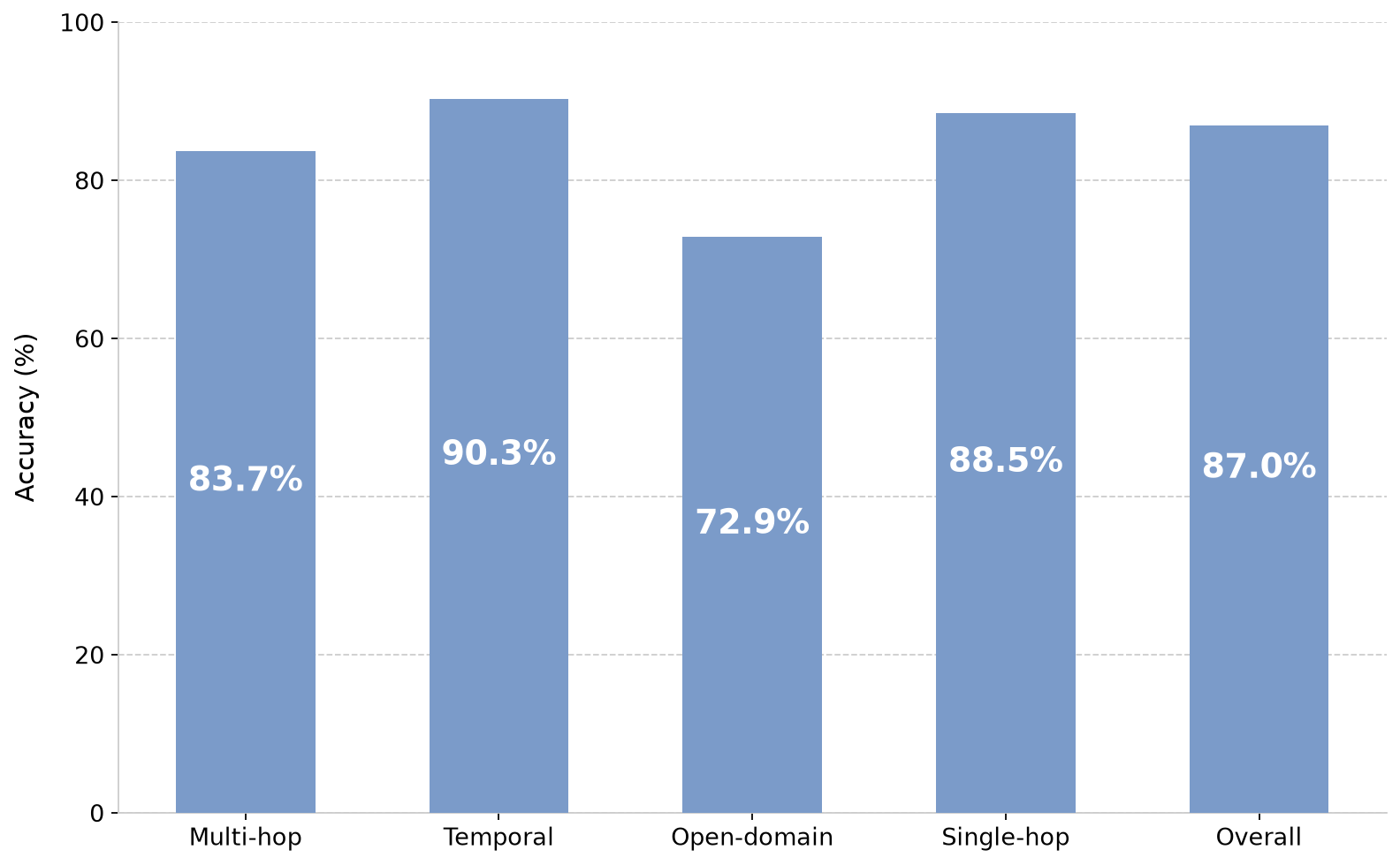
Memori was evaluated on the LoCoMo benchmark for long-conversation memory and achieved 87% overall accuracy while using an average of 721 tokens per query. That is just 2.8% of the full-context footprint, showing that structured memory can preserve reasoning quality without forcing large prompts into every request.
Compared with other retrieval-based memory systems, Memori outperformed Zep, LangMem, and Mem0 while reducing prompt size by roughly 67% vs. Zep and lowering context cost by more than 36x vs. full-context prompting.
Read the benchmark overview, see the results, or download the paper.
OpenClaw (Persistent Memory for Your Gateway)
By default, OpenClaw agents forget everything between sessions. The Memori plugin fixes that. It automatically captures structured memory from conversation and agent execution after each turn — including tool calls, decisions, and outcomes — and makes it available for agents to recall on demand.
No changes to your agent code or prompts are required. The plugin hooks into OpenClaw's lifecycle, so you get structured memory, agent-controlled recall, and Advanced Augmentation with a drop-in plugin.
openclaw plugins install @memorilabs/openclaw-memori
openclaw plugins enable openclaw-memori

openclaw memori init \
  --api-key "YOUR_MEMORI_API_KEY" \
  --entity-id "your-app-user-id" \
  --project-id "my-project"

openclaw gateway restart
For setup and configuration, see the OpenClaw Quickstart. For architecture and lifecycle details, see the OpenClaw Overview.
Hermes Agent (Persistent Memory Provider)
Memori also ships as a Hermes Agent memory provider. It captures completed conversations in the background and gives Hermes explicit memori_recall and memori_recall_summary tools for agent-controlled recall.
pip install hermes-memori
hermes-memori install

hermes config set memory.provider memori
HERMES_HOME="${HERMES_HOME:-$HOME/.hermes}"
mkdir -p "$HERMES_HOME"
echo "MEMORI_API_KEY=YOUR_MEMORI_API_KEY" >> "$HERMES_HOME/.env"
echo "MEMORI_ENTITY_ID=your-app-user-id" >> "$HERMES_HOME/.env"
MEMORI_PROJECT_ID is optional; when omitted, the provider uses Hermes' active project context for scoping.
For setup and configuration, see the Hermes Quickstart. For architecture and lifecycle details, see the Hermes Overview.
MCP (Connect Your Agent in One Command)
Your agent forgets everything between sessions. Memori fixes that. It remembers your stack, your conventions, and how you like things done so you stop repeating yourself.
Works for solo developers and teams. Your agent learns coding patterns, reviewer preferences, and project conventions over time. For teams, that means shared context that new engineers pick up on day one instead of absorbing tribal knowledge over months.
If you use Claude Code, Cursor, Codex, Warp, or Antigravity, you can connect Memori with no SDK integration needed:
claude mcp add --transport http memori https://api.memorilabs.ai/mcp/ \
  --header "X-Memori-API-Key: ${MEMORI_API_KEY}" \
  --header "X-Memori-Entity-Id: your_username" \
  --header "X-Memori-Process-Id: claude-code"
For Cursor, Codex, Warp, and other clients, see the MCP client setup guide.
Attribution
To get the most out of Memori, you want to attribute your LLM interactions to an entity (think person, place or thing; like a user) and a process (think your agent, LLM interaction or program).
If you do not provide any attribution, Memori cannot make memories for you.
TypeScript SDK
mem.attribution("12345", "my-ai-bot");
Python SDK
mem.attribution(entity_id="12345", process_id="my-ai-bot")
Session Management
Memori uses sessions to group your LLM interactions together. For example, if you have an agent that executes multiple steps you want those to be recorded in a single session.
By default, Memori handles setting the session for you but you can start a new session or override the session by executing the following:
TypeScript SDK
mem.resetSession();
// or
mem.setSession(sessionId);
Python SDK
mem.new_session()
# or
mem.set_session(session_id)
Supported LLMs
- Anthropic
- Bedrock
- DeepSeek
- Gemini
- Grok (xAI)
- OpenAI (Chat Completions & Responses API)
(unstreamed, streamed, synchronous and asynchronous)
Supported Frameworks
- Agno
- LangChain
- Pydantic AI
Supported Platforms
- DeepSeek
- Nebius AI Studio
Examples
For more examples and demos, check out the Memori Cookbook.
Memori Advanced Augmentation
Memories are tracked at several different levels:
- entity: think person, place, or thing; like a user
- process: think your agent, LLM interaction or program
- session: the current interactions between the entity, process and the LLM
Memori's Advanced Augmentation enhances memories at each of these levels with:
- attributes
- events
- facts
- people
- preferences
- relationships
- rules
- skills
Memori knows who your user is, what tasks your agent handles and creates unparalleled context between the two. Augmentation occurs in the background incurring no latency.
By default, Memori Advanced Augmentation is available without an account but rate-limited. When you need increased limits, sign up for Memori Advanced Augmentation or use the Memori CLI:
# Install the CLI via pip to manage your account
python -m memori sign-up <email_address>
Memori Advanced Augmentation is always free for developers!
Once you've obtained an API key, set the following environment variable (used by both Python and TypeScript SDKs):
export MEMORI_API_KEY=[api_key]
The Memori CLI uses your exported environment first, then fills missing values from a .env file in the directory where you run the command.
Managing Your Quota
At any time, you can check your quota using the Memori CLI (works for both SDKs):
python -m memori quota
Or by checking your account at https://app.memorilabs.ai/. If you have reached your IP address quota, sign up and get an API key for increased limits.
If your API key exceeds its quota limits, we will email you and let you know.
Command Line Interface (CLI)
The Memori CLI is the unified tool for managing your account, keys, and quotas across all SDKs. To use it, execute the following from the command line:
# Requires Python installed
python -m memori
This will display a menu of the available options. For more information about what you can do with the Memori CLI, please reference Command Line Interface.
Contributing
We welcome contributions from the community! Please see our Contributing Guidelines for details on:
- Setting up your development environment
- Code style and standards
- Submitting pull requests
- Reporting issues
Support
Memori Enterprise
Memori Enterprise is built for any enterprise running production agents, particularly high-volume ones such as internal SDLC.
Recently, a major project management platform automating QA with AI agents faced severe inefficiency as its agents suffered from session amnesia, repeatedly burning excessive tool calls.
By integrating Memori's agent-native memory layer in a secure private VPC, the platform captured execution traces to stop redundant discoveries and improve run over run.
This deployment delivered:
- $2.1M/year reduction in token spend on just one QA automation workflow
- Material soft ROI including increases in accuracy, reduction in latency, and reduction in human in the loop review
Following this success, this enterprise has already identified four additional high-priority agentic workflows for Memori integration.
Please email us at [email protected] if you'd like a preview.
License
Apache 2.0 - see LICENSE
관련 프로젝트 살펴보기
affaan-m/ECC
에이전트 실행·제어 프레임워크를 위한 성능 최적화 시스템. Claude Code, Codex, Opencode, Cursor 등을 위한 스킬, 본능, 메모리, 보안, 연구 우선 개발을 제공합니다.
301,468 스타NousResearch/hermes-agent
당신과 함께 성장하는 에이전트
262,771 스타multica-ai/andrej-karpathy-skills
Andrej Karpathy가 관찰한 LLM 코딩의 함정을 바탕으로 Claude Code의 동작을 개선하는 단일 CLAUDE.md 파일입니다.
232,266 스타firecrawl/firecrawl
웹과 그 너머의 데이터로 AI 에이전트를 강화합니다. 초지능을 위한 라이브러리를 구축하고 있습니다. 🔥
200,932 스타