
MVIG-SJTU/pointSIFT
소개
포인트 클라우드의 3D 의미론적 분할을 위한 모듈입니다.
창작 및 미디어측정된 스타 증가
- in 24h
- 0
- in 7 days
- 0
- in 15 days
- 기록 수집 중
- in 1 month
- 기록 수집 중
서로 겹치는 기간의 순증가량이며 일별 합계가 아닙니다. 측정값이 없으면 비워 둡니다. 스타는 관심도를 나타내며 품질을 보장하지 않습니다.
README.md
OriginalPointSIFT: A SIFT-like Network Module for 3D Point Cloud Semantic Segmentation
Created by Mingyang Jiang, Yiran Wu, Tianqi Zhao, Zelin Zhao, Cewu Lu (corresponding author).
Introduction
PointSIFT is a semantic segmentation framework for 3D point clouds. It is based on a simple module which extract featrues from neighbor points in eight directions. For more details, please refer to our arxiv paper.
PointSIFT is freely available for free non-commercial use, and may be redistributed under these conditions. For commercial queries, contact Cewu Lu.
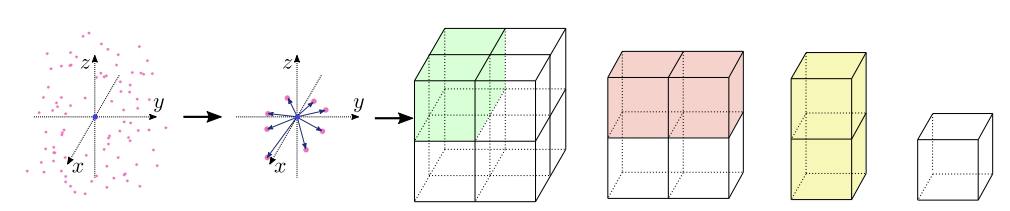
Installation
In our experiment, All the codes are tested in Python3.5(If you use Python 2.7, please add some system paths), CUDA 8.0 and CUDNN 5.1.
- Install TensorFlow (We use v1.4.1).
- Install other python libraries like h5py
- Compile TF operator (Similar to PointNet++). Firstly, you should find Tensorflow include path and library paths.
    import tensorflow as tf
    # include path
    print(tf.sysconfig.get_include())
    # library path
    print(tf.sysconfig.get_lib())
Then, change the path in all the complie file, like tf_utils/tf_ops/sampling/tf_sampling_compile.sh
Finally, compile the source file, we use tf_sampling as example.
    cd tf_utils/tf_ops/sampling
    chmod +x tf_sampling_compile.sh
    ./tf_sampling_compile.sh
Usage
If you want use our model in your own project. After compiling the TF operator, you can import it easily. Here shows a simple case.(we take batch_size * num_point * input_dim as input and get batch_size * num_point * output_dim as output)
import tensorflow as tf
# import our module
from tf_utils.pointSIFT_util import pointSIFT_module
# input coordinates
xyz = tf.tf.placeholder(tf.float32, shape=(batch_size, num_point, 3))
# input features
point_feature = tf.tf.placeholder(tf.float32, shape=(batch_size, num_point, input_dim)
# setting phases
is_training = tf.placeholder(dtype=tf.bool, shape=())
# setting searching radius (0.1 as an example)
radius = 0.1
_, out_feature, _ = pointSIFT_module(xyz, point_feature, radius, output_dim, is_training)
Training and evaluating on ScanNet
- All the data can be download from here. They are the same as PointNet++.
- Train the data:
python train_and_eval_scannet.py
If you have multiple GPU:
CUDA_VISIBLE_DEVICES=0,1,2,3 python train_and_eval_scannet.py --gpu_num=4
Citation
Please cite the paper in your publications if it helps your research:
@misc{1807.00652,
Author = {Mingyang Jiang and Yiran Wu and Tianqi Zhao and Zelin Zhao and Cewu Lu},
Title = {PointSIFT: A SIFT-like Network Module for 3D Point Cloud Semantic Segmentation},
Year = {2018},
Eprint = {arXiv:1807.00652},
}
관련 프로젝트 살펴보기
불러오는 중…