
HadarDavidson/colored-noise-sampling
HadarDavidson/colored-noise-sampling has 47 GitHub stars and 3 forks. Star changes are not measured yet. Last checked 2026-11-13 00:07 UTC. Last push 2026-09-26.
Official Implementation of "Colored Noise Diffusion Sampling" - NeurIPS 2026 Oral
측정된 스타 증가
- in 24h
- 기록 수집 중
- in 7 days
- 기록 수집 중
- in 15 days
- 기록 수집 중
- in 1 month
- 기록 수집 중
서로 겹치는 기간의 순증가량이며 일별 합계가 아닙니다. 측정값이 없으면 비워 둡니다. 스타는 관심도를 나타내며 품질을 보장하지 않습니다.
README.md
OriginalColored Noise Diffusion Sampling (CNS) - NeurIPS 2026 Oral
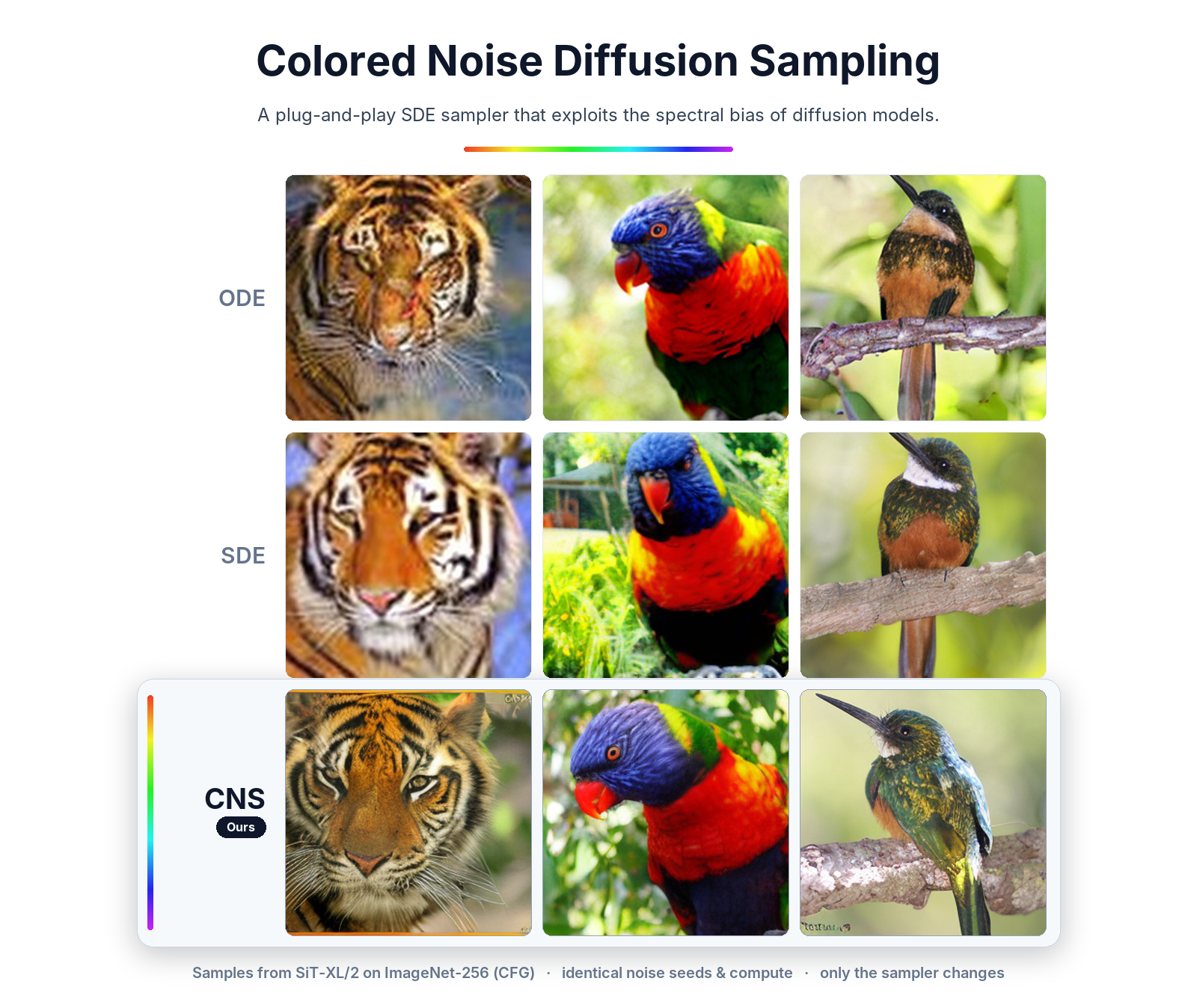
A plug-and-play SDE sampler that actively exploits the spectral bias of diffusion models
Colored Noise Diffusion Sampling
Hadar Davidson, Noam Issachar, Sagie Benaim
The Hebrew University of Jerusalem
Overview
Diffusion models generate images with a spectral bias: low-frequency global structure is resolved early in the sampling trajectory, while high-frequency detail emerges only at the very end. Standard SDE solvers ignore this dynamic entirely — they inject uniform white noise at every step, wasting the finite stochastic energy budget on frequency bands that are already structurally resolved.
CNS reconsiders SDE inference as a targeted energy transfer. At each step, it measures how "built" each frequency band is via a precomputed progress index γ(f, t) ∈ [0, 1], and dynamically routes injected noise energy toward the bands with the largest remaining structural deficit. A strict global variance-conservation constraint (mean β² = 1) ensures the modified SDE still converges to the target data distribution.
The result is a strictly plug-and-play sampler substitution — same model, same number of steps, only the noise injection changes.
Setup
Clone and install — the environment is identical to SiT:
git clone https://github.com/HadarDavidson/colored-noise-sampling.git
cd colored-noise-sampling
conda env create -f environment.yml
conda activate SiT
Download the reference batch for FID evaluation from OpenAI:
# ImageNet 256×256 reference statistics
wget https://openaipublic.blob.core.windows.net/diffusion/jul-2021/ref_batches/imagenet/256/VIRTUAL_imagenet256_labeled.npz
Pipeline
CNS requires a pre-computed gamma matrix that encodes how each radial frequency band progresses over the sampling trajectory. We include ready-to-use matrices in gamma_matrix/, but you can also recompute them yourself.
Step 1 — Compute the gamma matrix (optional)
Run ODE spectral analysis to accumulate the γ(f, t) matrix. The script iterates until the per-frequency 99.9% confidence interval converges, then saves the raw matrix inside the sample folder:
# Unguided
torchrun --nnodes=1 --nproc_per_node=4 sample_ddp.py ODE \
    --model SiT-XL/2 \
    --num-sampling-steps 250 \
    --analyze-spectrum \
    --min-spectrum-samples 4096

# Guided (e.g. cfg=1.5)
torchrun --nnodes=1 --nproc_per_node=4 sample_ddp.py ODE \
    --model SiT-XL/2 \
    --num-sampling-steps 250 \
    --cfg-scale 1.5 \
    --analyze-spectrum \
    --min-spectrum-samples 4096
A SLURM script is provided for cluster use: compute_gamma_matrix_sbatch.sh.
Step 2 — Scale the gamma matrix
After the raw matrix is saved, open scale_gamma_matrix.ipynb to apply the empirical relaxations (progression scaling, optional smoothing) and produce the final .pt file used by CNS.
Pre-scaled matrices are already provided in gamma_matrix/ for the published configurations:
| File | Use |
|---|---|
gamma_matrix/gamma_matrix_scaled.pt |
Unguided (cfg = 1.0) |
gamma_matrix/gamma_matrix_scaled_cfg_1.5.pt |
Guided (cfg = 1.5) |
Step 3 — Run CNS sampling
Pass --cns to enable colored noise injection. CNS operates in SDE mode only.
Quick start — reproduce published results:
bash run_cns_best_results.sh unguided   # FID 6.27
bash run_cns_best_results.sh guided     # FID 1.98
bash run_cns_best_results.sh all        # both + SDE baselines
Manual — unguided (FID 6.27):
torchrun --nnodes=1 --nproc_per_node=4 sample_ddp.py SDE \
    --model SiT-XL/2 \
    --num-sampling-steps 250 \
    --cfg-scale 1.0 \
    --sampling-method Euler \
    --diffusion-form sigma \
    --last-step Mean \
    --last-step-size 0.04 \
    --cns \
    --gamma-matrix-path gamma_matrix/gamma_matrix_scaled.pt \
    --power-gamma 0.75 \
    --gamma-matrix-divider 1.73 \
    --alpha-tilting 0.15 -0.5 \
    --alpha-tilting-use-fnorm \
    --alpha-exponential-interpolation \
    --alpha-exponential-interpolation-sharpness 0.75 \
    --energy-scale 0.98
Manual — guided (FID 1.98, cfg = 1.5):
torchrun --nnodes=1 --nproc_per_node=4 sample_ddp.py SDE \
    --model SiT-XL/2 \
    --num-sampling-steps 250 \
    --cfg-scale 1.5 \
    --sampling-method Euler \
    --diffusion-form sigma \
    --last-step Mean \
    --last-step-size 0.04 \
    --cns \
    --gamma-matrix-path gamma_matrix/gamma_matrix_scaled_cfg_1.45.pt \
    --sqrt-gamma \
    --gamma-matrix-divider 25.0 \
    --alpha-tilting -0.1 0.03 \
    --alpha-tilting-use-fnorm \
    --energy-scale 0.998
CNS Flags Reference
| Flag | Type | Default | Description |
|---|---|---|---|
--cns |
flag | off | Enable Colored Noise Sampling (SDE only) |
--gamma-matrix-path |
str | gamma_matrix/gamma_matrix_scaled.pt |
Path to the pre-scaled γ(f, t) matrix |
--gamma-matrix-divider |
float | 1.0 | Divides γ values before computing the noise schedule; higher values reduce the coloring effect |
--power-gamma |
float | 1.0 | Power applied to the residual energy (1 − γ) before normalization |
--sqrt-gamma |
flag | off | Shorthand for --power-gamma 0.5; applies sqrt to residual energy |
--energy-scale |
float | 1.0 | Global scale on the final noise std after unit-std normalization; used to fine-tune the heat–contraction balance |
--alpha-tilting |
float(s) | 0.0 | Frequency tilt applied to the colored spectrum. One value → constant tilt; two values start end → time-varying tilt |
--alpha-tilting-use-fnorm |
flag | off | Guide tilt by normalized frequency position (recommended when using two-value tilting) |
--alpha-exponential-interpolation |
flag | off | Use exponential (vs. linear) interpolation between the two alpha values |
--alpha-exponential-interpolation-sharpness |
float | 4.0 | Sharpness of the exponential alpha interpolation curve |
For reproducible ODE/SDE/CNS comparison (same initial latents across all methods):
| Flag | Type | Default | Description |
|---|---|---|---|
--per-iter-seed |
flag | off | Seeds each batch independently so ODE, SDE, and CNS all start from identical noise realizations |
Evaluation
After sampling, compute FID using the OpenAI evaluator:
python evaluator.py VIRTUAL_imagenet256_labeled.npz <sample_folder>.npz
evaluator.py is from the OpenAI guided-diffusion repository and is included in this repo for convenience.
To generate 50K samples across N GPUs:
torchrun --nnodes=1 --nproc_per_node=N sample_ddp.py SDE \
    --model SiT-XL/2 \
    --num-fid-samples 50000 \
    [... CNS flags ...]
Results
Unguided ImageNet-256
| Model | Sampler | FID ↓ | sFID ↓ | IS ↑ |
|---|---|---|---|---|
| SiT-XL/2 | ODE | 14.39 | 10.54 | 99.32 |
| SiT-XL/2 | SDE | 8.26 | 6.32 | 131.65 |
| SiT-XL/2 | CNS (Ours) | 6.27 | 4.73 | 147.33 |
Guided ImageNet-256 (CFG)
| Model | Sampler | CFG | FID ↓ | sFID ↓ |
|---|---|---|---|---|
| SiT-XL/2 | SDE | 1.5 | 2.06 | 4.49 |
| SiT-XL/2 | CNS (Ours) | 1.5 | 1.98 | 4.46 |
Acknowledgements
This codebase builds on:
- SiT (Ma et al., ECCV 2024) — model architecture, training code, and SDE/ODE sampling infrastructure.
- OpenAI guided-diffusion — FID/sFID/IS/Precision/Recall evaluation suite (
evaluator.py).
Citation
@misc{davidson2026colorednoisediffusionsampling,
      title={Colored Noise Diffusion Sampling},
      author={Hadar Davidson and Noam Issachar and Sagie Benaim},
      year={2026},
      eprint={2605.30332},
      archivePrefix={arXiv},
      primaryClass={cs.CV},
      url={https://arxiv.org/abs/2605.30332},
}
License
This project is under the MIT license. See LICENSE for details.