
BioPandas/biopandas
BioPandas/biopandas has 762 GitHub stars and 125 forks. GitHot measured 0 stars in 24 hours and 0 in 7 days. Last checked 2026-11-24 11:38 UTC. Last push 2026-10-17.
측정된 스타 증가
- in 24h
- 0
- in 7 days
- 0
- in 15 days
- 기록 수집 중
- in 1 month
- 기록 수집 중
서로 겹치는 기간의 순증가량이며 일별 합계가 아닙니다. 측정값이 없으면 비워 둡니다. 스타는 관심도를 나타내며 품질을 보장하지 않습니다.
소개
pandas DataFrame에서 분자 구조 다루기
개발 도구README.md
Original

Working with molecular structures in pandas DataFrames


Links
- Documentation: https://BioPandas.github.io/biopandas/
- Source code repository: https://github.com/rasbt/biopandas
- PyPI: https://pypi.python.org/pypi/biopandas
- How to contribute: https://biopandas.github.io/biopandas/CONTRIBUTING/
- Changelog: ./docs/sources/CHANGELOG.md
If you are a computational biologist, chances are that you cursed one too many times about protein structure files. Yes, I am talking about ye Goode Olde Protein Data Bank format, aka "PDB files." Nothing against PDB, it's a neatly structured format (if deployed correctly); yet, it is a bit cumbersome to work with PDB files in "modern" programming languages -- I am pretty sure we all agree on this.
As machine learning and "data science" person, I fell in love with pandas DataFrames for handling just about everything that can be loaded into memory.
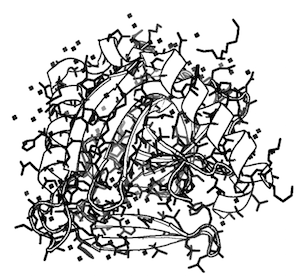
So, why don't we take pandas to the structural biology world? Working with molecular structures of biological macromolecules (from PDB and MOL2 files) in pandas DataFrames is what BioPandas is all about!
Examples

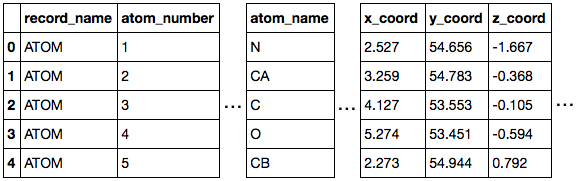
# Initialize a new PandasPdb object
# and fetch the PDB file from rcsb.org
>>> from biopandas.pdb import PandasPdb
>>> ppdb = PandasPdb().fetch_pdb('3eiy')
>>> ppdb.df['ATOM'].head()
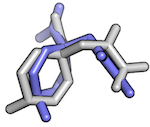

# Load structures from your drive and compute the
# Root Mean Square Deviation
>>> from biopandas.pdb import PandasPdb
>>> pl1 = PandasPdb().read_pdb('./docking_pose_1.pdb')
>>> pl2 = PandasPdb().read_pdb('./docking_pose_2.pdb')
>>> r = PandasPdb.rmsd(pl1.df['HETATM'], pl2.df['HETATM'],
                       s='hydrogen', invert=True)
>>> print('RMSD: %.4f Angstrom' % r)

RMSD: 2.6444 Angstrom
Quick Install
- install the latest version (from GitHub):
pip install git+git://github.com/rasbt/biopandas.git#egg=biopandas - install the latest PyPI version:
pip install biopandas - install biopandas via conda-forge:
conda install biopandas -c conda-forge
Requirements
For more information, please see https://BioPandas.github.io/biopandas/installation/.
Cite as
If you use BioPandas as part of your workflow in a scientific publication, please consider citing the BioPandas repository with the following DOI:
- Sebastian Raschka. Biopandas: Working with molecular structures in pandas dataframes. The Journal of Open Source Software, 2(14), jun 2017. doi: 10.21105/joss.00279. URL http://dx.doi.org/10.21105/joss.00279.
@article{raschkas2017biopandas,
  doi = {10.21105/joss.00279},
  url = {http://dx.doi.org/10.21105/joss.00279},
  year  = {2017},
  month = {jun},
  publisher = {The Open Journal},
  volume = {2},
  number = {14},
  author = {Sebastian Raschka},
  title = {BioPandas: Working with molecular structures in pandas DataFrames},
  journal = {The Journal of Open Source Software}
}
관련 프로젝트 살펴보기
불러오는 중…