
BICLab/SpikingBrain-7B
BICLab/SpikingBrain-7B has 1,432 GitHub stars and 197 forks. GitHot measured 0 stars in 24 hours, 0 in 7 days, and +5 in 15 days. Last checked 2026-11-23 10:22 UTC. Last push 2026-05-14.
측정된 스타 증가
- in 24h
- 0
- in 7 days
- 0
- in 15 days
- +5
- in 1 month
- 기록 수집 중
서로 겹치는 기간의 순증가량이며 일별 합계가 아닙니다. 측정값이 없으면 비워 둡니다. 스타는 관심도를 나타내며 품질을 보장하지 않습니다.
소개
스파이킹 브레인에서 영감을 받은 대규모 모델로, 하이브리드 효율적 어텐션과 MoE 모듈, 스파이크 인코딩을 아키텍처에 통합합니다.
개발 도구README.md
OriginalSpikingBrain:Spiking Brain-inspired Large Models
📄 Technical Report: Chinese | English
🚀 Arxiv: arXiv:2509.05276
🧩 Models: Available Models
🔗 Demo: OpenBayes贝式计算
📢 News
- 2026-04: 🚀 We released SpikingBrain2.0, with comprehensive upgrades to architecture and training token efficiency, along with broader support for downstream applications. Check it out at BICLab/SpikingBrain2.0.
- 2026-03: 🎉 Our paper "SpikingBrain: Spiking Brain-inspired Large Models" has been accepted by TMLR 2026!
- 2025-09: SpikingBrain repository is created.
About SpikingBrain
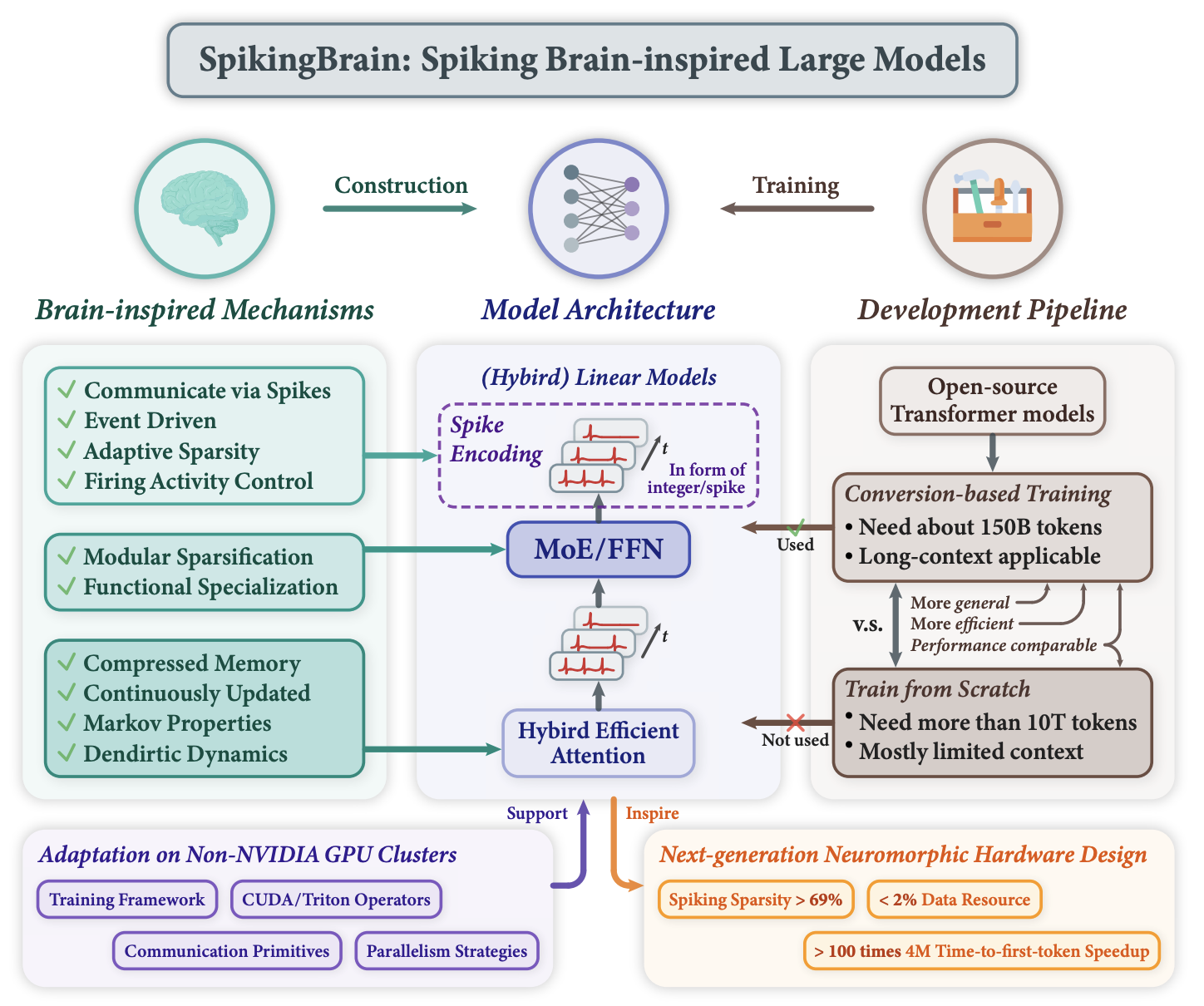
Inspired by brain mechanisms, SpikingBrain integrates hybrid efficient attention, MoE modules, and spike encoding into its architecture, supported by a universal conversion pipeline compatible with the open-source model ecosystem. This enables continual pre-training with less than 2% of the data while achieving performance comparable to mainstream open-source models. We further adapt frameworks, operators, parallel strategies, and communication primitives for non-NVIDIA (MetaX) clusters, ensuring stable large-scale training and inference. SpikingBrain achieves over 100× speedup in TTFT for 4M-token sequences, while spiking delivers over 69% sparsity at the micro level. Combined with macro-level MoE sparsity, these advances provide valuable guidance for the design of next-generation neuromorphic chips.
Project Structure
This repository provides the full implementation and weights of SpikingBrain-7B, including the HuggingFace version, vLLM inference version, and quantized version, enabling flexible deployment and research across different scenarios.
SpikingBrain-7B/
├── hf_7B_model/ # HuggingFace version
├── hf_7B_VLM/   # VLM Model HuggingFace version
├── run_model/   # Model run examples
├── vllm_hymeta/ # vLLM plugins and inference support
├── W8ASpike/    # Quantized inference version
├── setup.py
├── requirements.txt
└── README.md
vLLM-HyMeta
vllm-hymeta is the plugin adaptation of HyMeta (Hybrid Models built on MetaX GPUs) for the vLLM inference framework, providing efficient inference support on NVIDIA GPUs.
By leveraging the plugins mechanism in vLLM, hardware backends can be integrated in a modular fashion, bringing the following benefits:
Decoupled codebase: Backend-specific code remains independent, keeping the vLLM core cleaner.
Reduced maintenance cost: vLLM developers can focus on general functionality without being affected by backend-specific implementations.
Faster integration: New backends can be integrated quickly and evolve independently with less engineering effort.
Container Deployment (NVIDIA)
git clone https://github.com/BICLab/SpikingBrain-7B.git
cd SpikingBrain-7B
docker build -t spiking-brain:7b-v1.0 .
docker run -itd \
    --entrypoint /bin/bash \
    --network host \
    --name <container_name> \
    --shm-size 160g \
    --gpus all \
    --privileged \
    -v /host_path:/container_path \
    spiking-brain:7b-v1.0
Recommended environment for installing vllm-hymeta on NVIDIA GPUs:
torch==2.7.1
transformers==4.55.2
triton==3.3.1
flash_attn==2.7.3
flash-linear-attention==0.1
vllm==0.10.0
scipy
pyyaml
decorator
setuptools
setuptools-scm
Run with vLLM
You can serve a model with vLLM in the simplest way using the following command:
vllm serve <your_model_path> \
  --served-model-name <model_name> \
  --gpu-memory-utilization <ratio> \
  --block-size <size> \
  --dtype bfloat16 \
  --port <port_number>
You may also set --tensor-parallel-size and --pipeline-parallel-size when launching if you want to run with multiple GPUs.
W8ASpike
W8ASpike is the quantized inference version of SpikingBrain-7B, aiming to reduce inference cost under low-precision settings and explore the potential of Spiking Neural Networks (SNNs).
The current implementation adopts pseudo-spiking, where activations are approximated as spike-like signals at the tensor level, rather than true asynchronous event-driven spiking on neuromorphic hardware.
Pseudo-spiking: Efficient approximation at the tensor level, suitable for prototyping and research.
True-spiking: Requires asynchronous hardware and event-driven operator support, which is beyond the scope of this repository.
The activation spike encoding process here is inspired by the pseudo-spiking interfaces from BICLab/Int2Spike. For additional PyTorch-based spiking interfaces, please refer to the Int2Spike library.
Available Models
The model weights are hosted on ModelScope. Please select the appropriate version based on your needs:
- Pre-trained model (7B): https://www.modelscope.cn/models/Panyuqi/V1-7B-base
- Chat model (7B-SFT): https://www.modelscope.cn/models/Panyuqi/V1-7B-sft-s3-reasoning
- Vision-language model (7B-SFT): https://www.modelscope.cn/models/sherry12334/SpikingBrain-7B-VL
- Quantized weights (7B-W8ASpike): https://www.modelscope.cn/models/Abel2076/SpikingBrain-7B-W8ASpike
Usage
Example scripts are provided in run_model/ for running the model with the released checkpoints.
Hugging Face
Load withAutoModelForCausalLMand use as a standard CausalLM (forward or generation); seerun_model/run_model_hf.py.
For the SFT model, a chat template is used; seerun_model/run_model_hf_chat_template.py.vLLM
Perform inference using the provided vLLM Hymeta plugin; seerun_model/run_model_vllm.pyand the vLLM Hymeta section.
Please make sure to remove theauto_mapfield fromconfig.json. Specifically, delete the following block if it is present:
"auto_map": {
  "AutoConfig": "configuration_gla_swa.GLAswaConfig",
  "AutoModelForCausalLM": "modeling_gla_swa.GLAswaForCausalLM"
}
For tested environment, please refer to requirements.txt.
Performance Evaluation
Table 1: Performance evaluation of the SpikingBrain-7B pre-trained model. All models are tested with the HuggingFace framework and evaluated using a perplexity-based method. Except for Qwen2.5, the other baselines are trained on limited Chinese data, resulting in clear disadvantages on CMMLU and C-Eval.
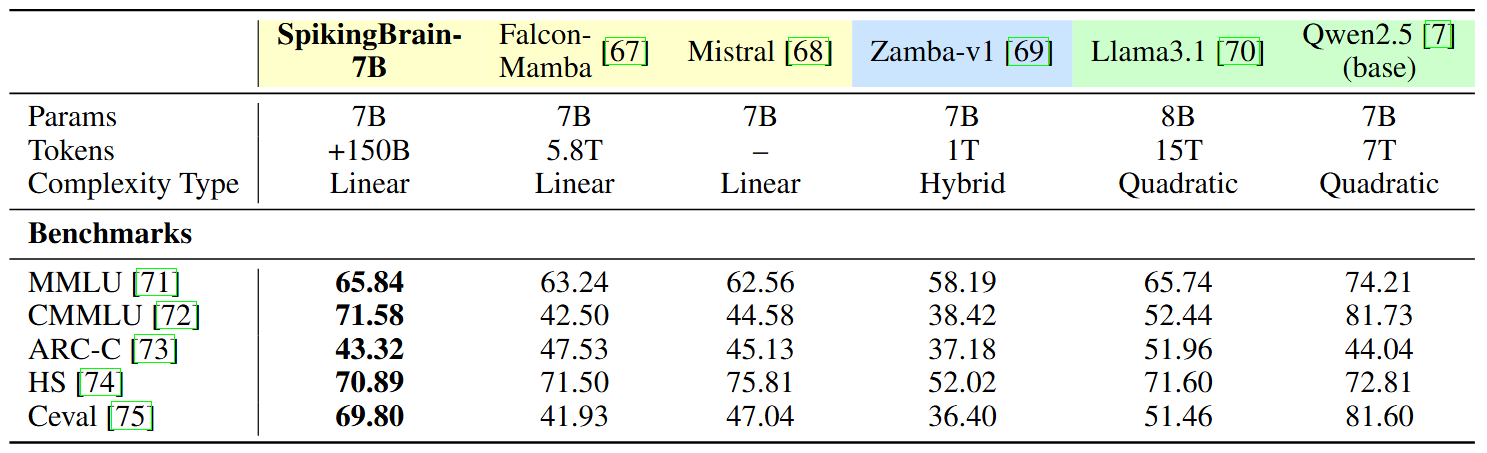
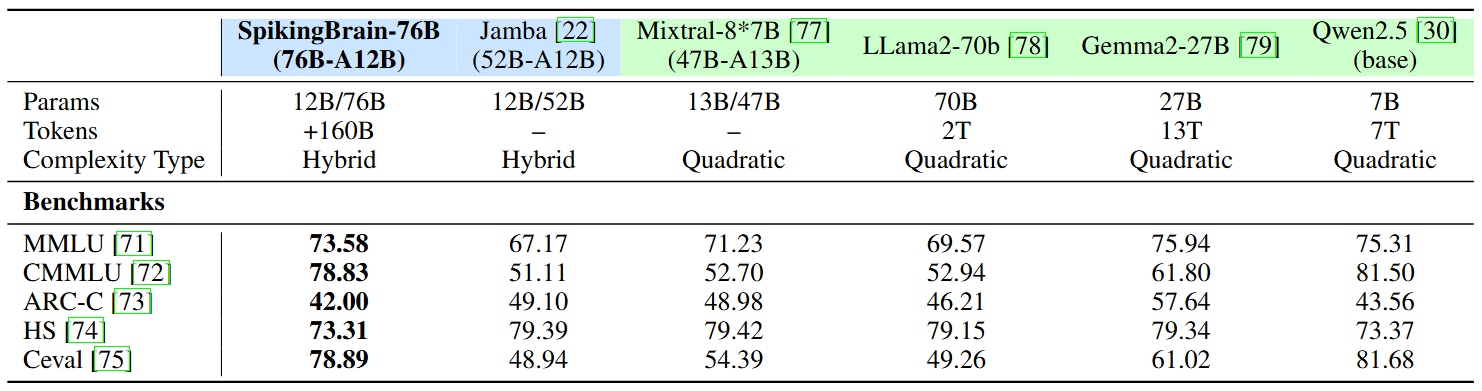
Table 2: Performance evaluation of the SpikingBrain-76B pre-trained model. All models are tested with the vLLM framework and evaluated using a perplexity-based method. Except for Qwen2.5, the other baselines are trained on limited Chinese data, resulting in clear disadvantages on CMMLU and C-Eval.
Citation
If you find our work useful, please consider citing SpikingBrain:
@article{pan2025spikingbrain,
  title={SpikingBrain: Spiking Brain-inspired Large Models},
  author={Pan, Yuqi and Feng, Yupeng and Zhuang, Jinghao and Ding, Siyu and Xu, Han and Liu, Zehao and Sun, Bohan and Chou, Yuhong and Qiu, Xuerui and Deng, Anlin and others},
  journal={arXiv preprint arXiv:2509.05276},
  year={2025}
}
관련 프로젝트 살펴보기
불러오는 중…