
ATTron/astroz
소개
Astrodynamics and Spacecraft Toolkit. Features fast orbit prop, celestial precession, CCSDS parsing, RF parsing, fits image parsing, and more!
개발 도구측정된 스타 증가
- in 24h
- 0
- in 7 days
- 0
- in 15 days
- 기록 수집 중
- in 1 month
- 기록 수집 중
서로 겹치는 기간의 순증가량이며 일별 합계가 아닙니다. 측정값이 없으면 비워 둡니다. 스타는 관심도를 나타내며 품질을 보장하지 않습니다.
README.md
Original

Astronomical and Spacecraft Toolkit Written in Zig
astroz is an astrodynamics and spacecraft toolkit with a fast SGP4/SDP4 propagator at its core.
| Orbital Mechanics | Spacecraft Ops | Astronomy |
|---|---|---|
| SGP4/SDP4 propagation | CCSDS packets | FITS parsing |
| TLE & OMM parsing | VITA49 packets | WCS coordinates |
| Orbital maneuvers | Attitude determination | Star precession |
| Force models (J2-J4, drag, SRP, third-body) | CSPICE ephemeris | Celestial bodies |
| Dormand-Prince 8(7) integrator | Monte Carlo sims |
Performance
SGP4 (near-earth) or SDP4 (deep-space) is picked per satellite from its orbital period. Satellites are propagated 8 at a time with SIMD (AVX512, or AVX2/SSE at 4 wide), and constellations are split across threads in time-major order. ASTROZ_THREADS sets the thread count; the default is every available core.
Single-Threaded (1.2M propagations, single satellite)
| Implementation | Props/sec | Speedup vs python-sgp4 |
|---|---|---|
| astroz | 30.8M | 11x |
| Rust sgp4 | 5.1M | 1.8x |
| heyoka | 3.8M | 1.3x |
| satkit | 3.5M | 1.2x |
| python-sgp4 | 2.8M | 1x |
Multi-Threaded Constellation (13,478 satellites × 1,440 times)
| Implementation | 1 Thread | 16 Threads |
|---|---|---|
| astroz | 37.7M/s | 303M/s |
| heyoka | 15.7M/s | 155.6M/s |
| Rust sgp4 (rayon) | 4.4M/s | 47.9M/s |
| satkit | 3.5M/s | 3.5M/s |
| python-sgp4 | 2.7M/s | 2.7M/s |
Measured on an AMD Ryzen 7 7840U (16 threads), each implementation in its fastest configuration (SIMD, pre-allocated outputs, batch mode). The scripts for astroz, Rust sgp4 and python-sgp4 are in benchmarks/ (see the Justfile).
The Cesium visualization example propagates the whole active catalog (about 13,000 satellites) at interactive rates. There is a live demo.
Accuracy
What the test suite checks (zig build test):
| Component | Reference | Tolerance |
|---|---|---|
| SGP4 | Vallado AIAA 2006-6753 vectors | 10 m position, 1 mm/s velocity |
| SDP4 (GPS, GEO, HEO) | python-sgp4 | 10 m position |
| SGP4 over one day | python-sgp4 | 100 m position, 0.1 m/s velocity |
| J2 acceleration | Analytical | 1% |
| Two-body propagation | Analytical Kepler | 1 m after one orbit |
| Two-body energy | Conservation | 1e-10 relative over 100 orbits |
CI also checks the Python bindings against python-sgp4 to within 1 m.
With CSPICE enabled: zig build test -Denable-cspice=true
Python
Wheels are published for Linux (x86_64, arm64) and macOS (arm64), Python 3.10 to 3.14:
pip install astroz
astroz.api follows the python-sgp4 API and also handles deep-space (SDP4) satellites:
from astroz.api import Satrec, jday, WGS72

line1 = "1 25544U 98067A   24127.82853009  .00015698  00000+0  27310-3 0  9995"
line2 = "2 25544  51.6393 160.4574 0003580 140.6673 205.7250 15.50957674452123"
sat = Satrec.twoline2rv(line1, line2, WGS72)

jd, fr = jday(2024, 5, 6, 12, 0, 0.0)
error, position, velocity = sat.sgp4(jd, fr)
The Python README covers batch propagation, the high-level propagate/screen API, orbital mechanics helpers and numbers for migrating from python-sgp4.
Usage
Requires Zig 0.17.0.
- Fetch the package so it gets recorded in your
build.zig.zon. Pin a release tag or commit for reproducible builds, or follow the latestmain:
# pinned to a tag or commit
zig fetch --save https://github.com/ATTron/astroz/archive/<tag-or-commit>.tar.gz

# latest main
zig fetch --save git+https://github.com/ATTron/astroz
- Wire the
astrozmodule into your compile step inbuild.zig:
const astroz = b.dependency("astroz", .{ .target = target, .optimize = optimize });
exe.root_module.addImport("astroz", astroz.module("astroz"));
- Propagate a satellite.
Satellitepicks SGP4 or SDP4 for you:
const astroz = @import("astroz");

var tle = try astroz.Tle.parse(tle_string, allocator);
defer tle.deinit();

const sat = try astroz.Satellite.init(tle, astroz.constants.wgs84);
const result = try sat.propagate(60.0); // minutes from epoch
const pos = result[0]; // [x, y, z] km
const vel = result[1]; // [vx, vy, vz] km/s
Examples
Run them all with zig build example, or only compile them with zig build build-examples.
Zig
sgp4.zig: TLE and OMM parsing (including six-digit catalog numbers), SGP4 one time and eight at once with SIMD,
Satellitepicking SGP4 or SDP4, and the Earth-fixed position.constellation.zig: a mixed near-earth and deep-space constellation propagated in batches, then screened for close approaches with
Screening.numerical_propagation.zig: one orbit propagated with two-body (RK4 and Dormand-Prince 8(7)), with J2, and with J2, solar radiation pressure and Sun/Moon gravity. Uses SPICE ephemeris when built with
-Denable-cspice=trueafterzig build fetch-kernels.spacecraft.zig: impulse, plane change and phase change maneuvers and how they change the orbit, then attitude propagation.
mission_design.zig: Earth to Mars by Hohmann and bi-elliptic transfer, the transfer propagated, and Monte Carlo statistics on it.
packets.zig: building and parsing CCSDS packets and parsing a VITA 49 stream.
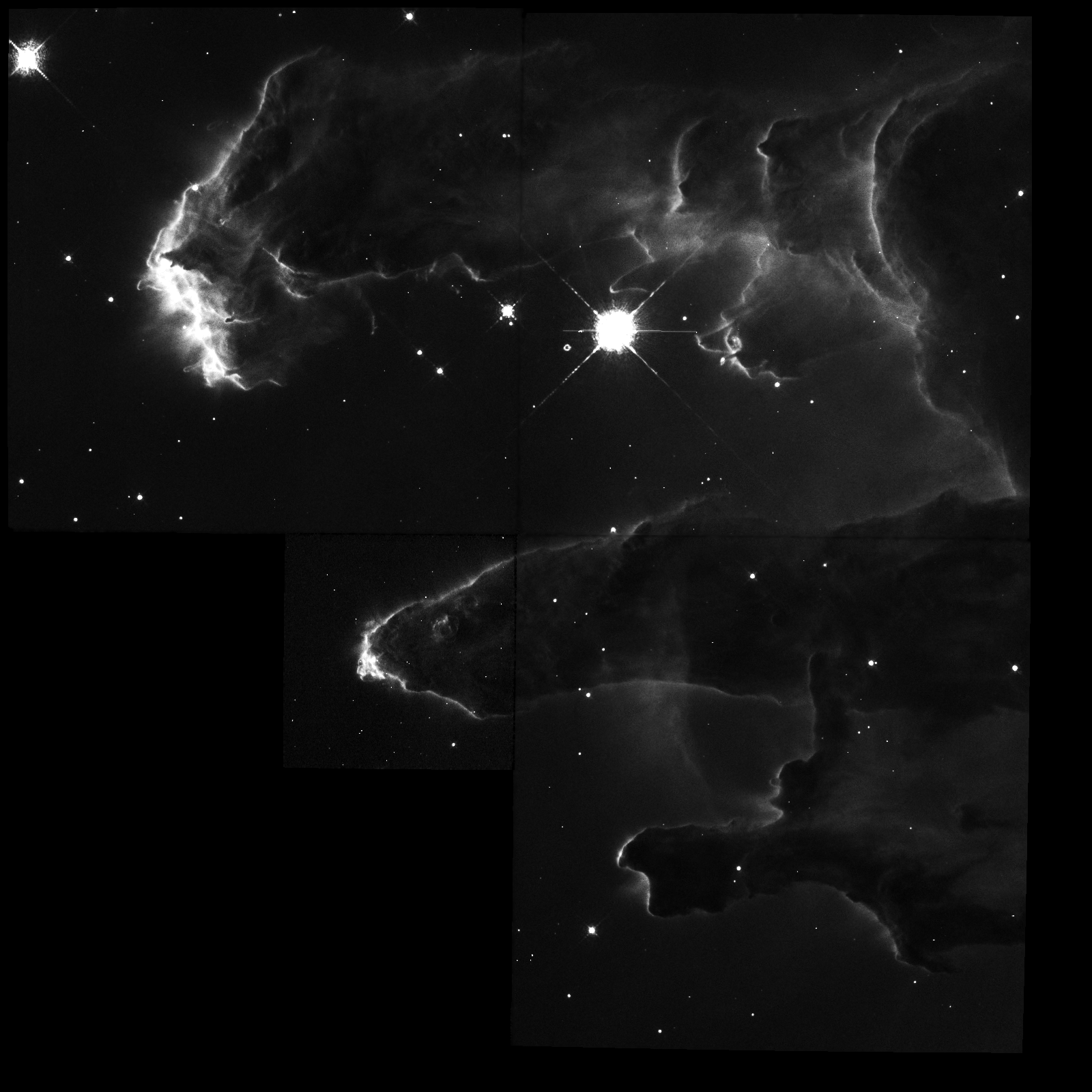
astronomy.zig: star precession and reading a FITS image into a PNG.
Python
- python_sgp4.py: the python-sgp4 compatible API.
- constellation.py: loading a constellation from CelesTrak or a TLE/OMM file, propagating to Earth-fixed and geodetic coordinates, and screening it for close approaches.
- orbital_mechanics.py: circular-orbit numbers, Hohmann and bi-elliptic transfers, Lambert's problem and numerical propagation with J2.
- Cesium visualization (live demo): the active catalog propagated and rendered in Cesium.
관련 프로젝트 살펴보기
불러오는 중…