
ARISE-Initiative/robosuite
ARISE-Initiative/robosuite has 2,709 GitHub stars and 795 forks. GitHot measured +1 stars in 24 hours and +12 in 7 days. Last checked 2026-11-11 08:43 UTC. Last push 2026-07-11.
robosuite: 로봇 학습을 위한 모듈형 시뮬레이션 프레임워크 및 벤치마크
측정된 스타 증가
- in 24h
- +1
- in 7 days
- +12
- in 15 days
- 업데이트 지연
- in 1 month
- 업데이트 지연
서로 겹치는 기간의 순증가량이며 일별 합계가 아닙니다. 측정값이 없으면 비워 둡니다. 스타는 관심도를 나타내며 품질을 보장하지 않습니다.
README.md
Originalrobosuite
[Homepage] [White Paper] [Documentations] [ARISE Initiative]
Latest Updates
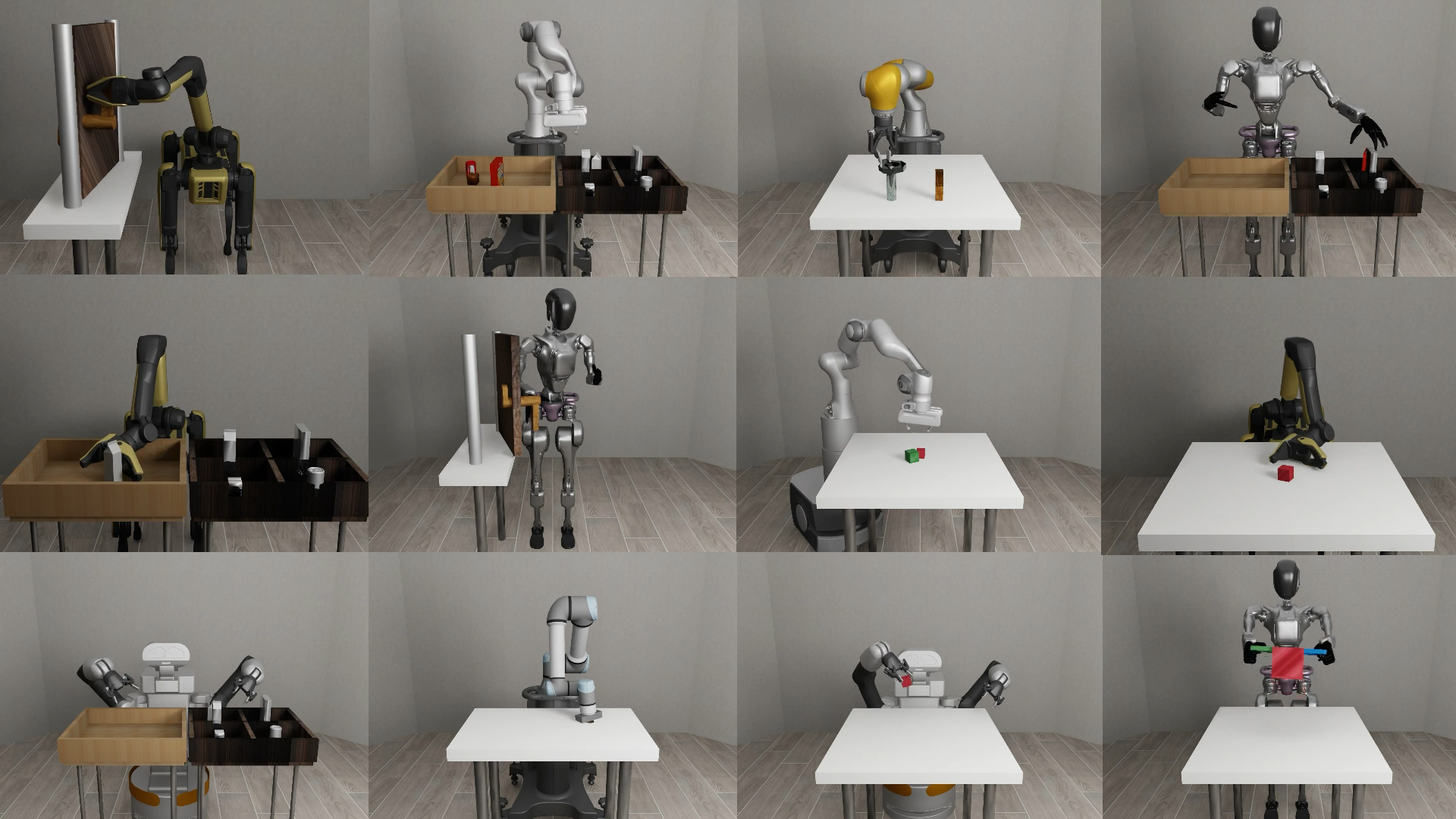
[10/28/2024] v1.5: Added support for diverse robot embodiments (including humanoids), custom robot composition, composite controllers (including whole body controllers), more teleoperation devices, photo-realistic rendering. [release notes] [documentation]
[11/15/2022] v1.4: Backend migration to DeepMind's official MuJoCo Python binding, robot textures, and bug fixes :robot: [release notes] [documentation]
[10/19/2021] v1.3: Ray tracing and physically based rendering tools :sparkles: and access to additional vision modalities 🎥 [video spotlight] [release notes] [documentation]
[02/17/2021] v1.2: Added observable sensor models :eyes: and dynamics randomization :game_die: [release notes]
[12/17/2020] v1.1: Refactored infrastructure and standardized model classes for much easier environment prototyping :wrench: [release notes]
robosuite is a simulation framework powered by the MuJoCo physics engine for robot learning. It also offers a suite of benchmark environments for reproducible research. The current release (v1.5) features support for diverse robot embodiments (including humanoids), custom robot composition, composite controllers (including whole body controllers), more teleoperation devices, photo-realistic rendering. This project is part of the broader Advancing Robot Intelligence through Simulated Environments (ARISE) Initiative, with the aim of lowering the barriers of entry for cutting-edge research at the intersection of AI and Robotics.
Data-driven algorithms, such as reinforcement learning and imitation learning, provide a powerful and generic tool in robotics. These learning paradigms, fueled by new advances in deep learning, have achieved some exciting successes in a variety of robot control problems. However, the challenges of reproducibility and the limited accessibility of robot hardware (especially during a pandemic) have impaired research progress. The overarching goal of robosuite is to provide researchers with:
- a standardized set of benchmarking tasks for rigorous evaluation and algorithm development;
- a modular design that offers great flexibility in designing new robot simulation environments;
- a high-quality implementation of robot controllers and off-the-shelf learning algorithms to lower the barriers to entry.
This framework was originally developed in late 2017 by researchers in Stanford Vision and Learning Lab (SVL) as an internal tool for robot learning research. Now, it is actively maintained and used for robotics research projects in SVL, the UT Robot Perception and Learning Lab (RPL) and NVIDIA Generalist Embodied Agent Research Group (GEAR). We welcome community contributions to this project. For details, please check out our contributing guidelines.
Robosuite offers a modular design of APIs for building new environments, robot embodiments, and robot controllers with procedural generation. We highlight these primary features below:
- standardized tasks: a set of standardized manipulation tasks of large diversity and varying complexity and RL benchmarking results for reproducible research;
- procedural generation: modular APIs for programmatically creating new environments and new tasks as combinations of robot models, arenas, and parameterized 3D objects. Check out our repo robosuite_models for extra robot models tailored to robosuite.
- robot controllers: a selection of controller types to command the robots, such as joint-space velocity control, inverse kinematics control, operational space control, and whole body control;
- teleoperation devices: a selection of teleoperation devices including keyboard, spacemouse and MuJoCo viewer drag-drop;
- multi-modal sensors: heterogeneous types of sensory signals, including low-level physical states, RGB cameras, depth maps, and proprioception;
- human demonstrations: utilities for collecting human demonstrations, replaying demonstration datasets, and leveraging demonstration data for learning. Check out our sister project robomimic;
- photorealistic rendering: integration with advanced graphics tools that provide real-time photorealistic renderings of simulated scenes, including support for NVIDIA Isaac Sim rendering.
Citation
Please cite robosuite if you use this framework in your publications:
@inproceedings{robosuite2020,
  title={robosuite: A Modular Simulation Framework and Benchmark for Robot Learning},
  author={Yuke Zhu and Josiah Wong and Ajay Mandlekar and Roberto Mart\'{i}n-Mart\'{i}n and Abhishek Joshi and Soroush Nasiriany and Yifeng Zhu and Kevin Lin},
  booktitle={arXiv preprint arXiv:2009.12293},
  year={2020}
}
관련 프로젝트 살펴보기
sindresorhus/awesome
😎 온갖 흥미로운 주제에 관한 Awesome 목록 [참고: 기존 풀 리퀘스트를 따라잡을 여유가 생길 때까지 풀 리퀘스트가 일시적으로 비활성화되어 있습니다]
535,567 스타EbookFoundation/free-programming-books
:books: 무료로 이용할 수 있는 프로그래밍 도서
401,463 스타nilbuild/developer-roadmap
개발자의 커리어 성장을 돕는 인터랙티브 로드맵, 가이드 및 기타 교육 콘텐츠.
371,869 스타vinta/awesome-python
“Python으로 X를 하고 싶은데, 어떤 도구를 써야 할까?”에 답하는 결정판 목록.
334,177 스타