
概要
PyTorchによる、さまざまなVAEベースの半教師ありモデルおよび生成モデルの実装
機械学習計測したスター増加
- 24時間
- 0
- 7日間
- 0
- 15日間
- 履歴を収集中
- 1か月
- 履歴を収集中
期間ごとの純増数です。期間は重複しており、日別の値ではありません。未計測の値は空欄です。スター数は注目度の指標であり、品質の保証ではありません。
README.md
オリジナルSemi-supervised PyTorch
A PyTorch-based package containing useful models for modern deep semi-supervised learning and deep generative models. Want to jump right into it? Look into the notebooks.
Latest additions
2018.04.17 - The Gumbel softmax notebook has been added to show how you can use discrete latent variables in VAEs. 2018.02.28 - The β-VAE notebook was added to show how VAEs can learn disentangled representations.
What is semi-supervised learning?
Semi-supervised learning tries to bridge the gap between supervised and unsupervised learning by learning from both labelled and unlabelled data.
Semi-supervised learning can typically be applied to areas where data is easy to get a hold of, but labelling is expensive. Normally, one would either use an unsupervised method, or just the few labelled examples - both of which would be likely to yield bad results.
The current state-of-the-art method in semi-supervised learning achieves an accuracy of over 99% on the MNIST dataset using just 10 labelled examples per class.
Conditional generation
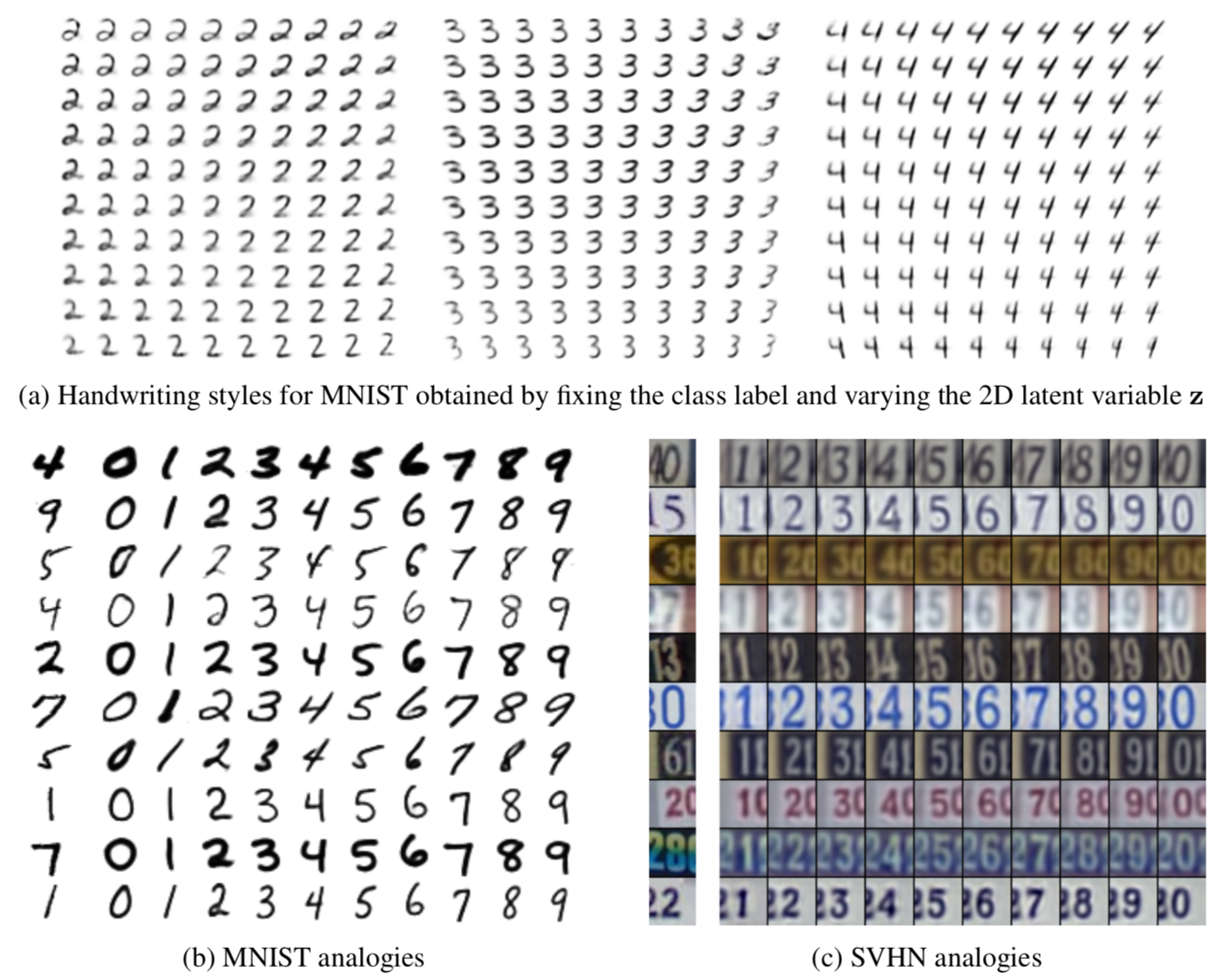
Most semi-supervised models simultaneously train an inference network and a generator network. This means that it is not only possible to query this models for classification, but also to generate new data from trained model. By seperating label information, one can generate a new sample with the given digit as shown in the image below from Kingma 2014.
Implemented models and methods:
- Variational Autoencoder (Kingma 2013)
- Importance Weighted Autoencoders (Burda 2015)
- Variational Inference with Normalizing Flows (Rezende & Mohamed 2015)
- Semi-supervised Learning with Deep Generative Models (Kingma 2014)
- Auxiliary Deep Generative Models (Maaløe 2016)
- Ladder Variational Autoencoders (Sønderby 2016)
- β-VAE (Higgins 2017)
関連プロジェクトを探す
読み込み中…