
weijie-chen/Linear-Algebra-With-Python
weijie-chen/Linear-Algebra-With-Python has 2,577 GitHub stars and 614 forks. GitHot measured -2 in 7 days. Last checked 2026-11-09 18:42 UTC. Last push 2024-09-05.
Lecture Notes for Linear Algebra Featuring Python. This series of lecture notes will walk you through all the must-know concepts that set the foundation of data science or advanced quantitative skillsets. Suitable for statistician/econometrician, quantitative analysts, data scientists and etc. to quickly refresh the linear algebra with the assistance of Python computation and visualization.
計測したスター増加
- 24時間
- 更新が遅れています
- 7日間
- -2
- 15日間
- 更新が遅れています
- 1か月
- 更新が遅れています
期間ごとの純増数です。期間は重複しており、日別の値ではありません。未計測の値は空欄です。スター数は注目度の指標であり、品質の保証ではありません。
README.md
オリジナルUpdated on Aug 2024

Lectures of Linear Algebra
These lecture notes are intended for introductory linear algebra courses, suitable for university students, programmers, data analysts, algorithmic traders and etc.
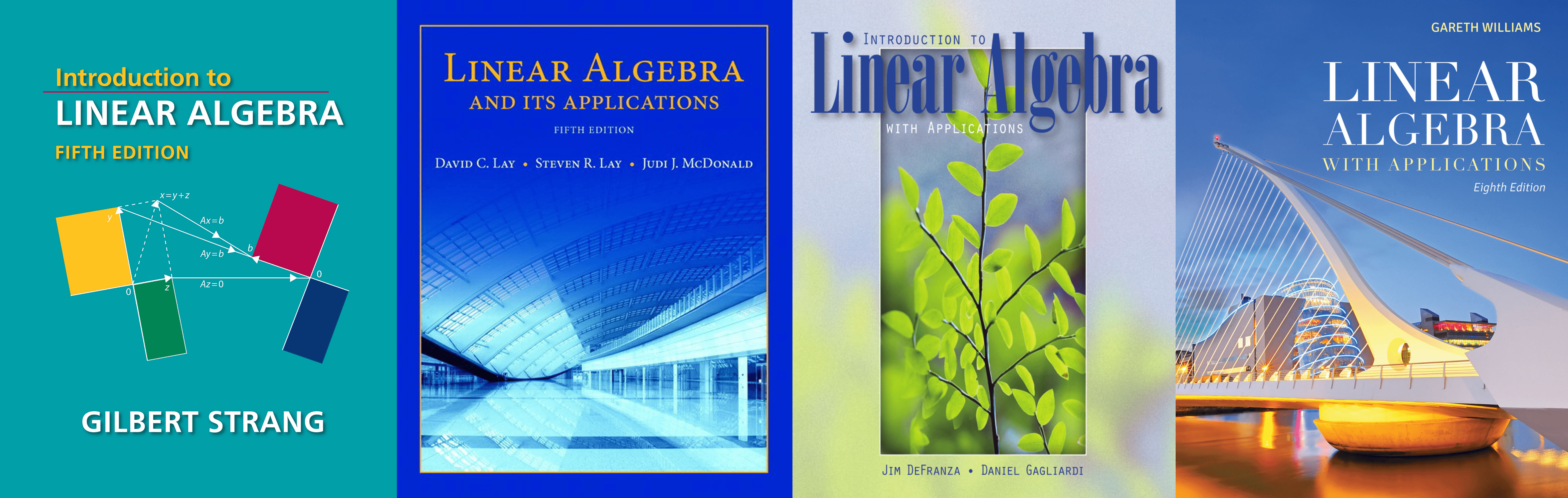
The lectures notes are loosely based on several textbooks:
- Linear Algebra and Its Applications by Gilbert Strang
- Linear Algebra and Its Applications by David Lay
- Introduction to Linear Algebra With Applications by DeFranza & Gagliardi
- Linear Algebra With Applications by Gareth Williams
However, the crux of the course is not about proving theorems, but to demonstrate the practices and visualization of the concepts. Thus we will not engage in precise deduction or notation, rather we aim to clarify the elusive concepts and thanks to Python/MATLAB, the task is much easier now.
Prerequisites
Though the lectures are for beginners, it is beneficial that attendants had certain amount of exposure to linear algebra and calculus.
And also the attendee are expected to have basic knowledge (3 days training would be enough) of
- Python
- NumPy
- Matplotlib
- SymPy
All the codes are written in an intuitive manner rather than efficient or professional coding style, therefore the codes are exceedingly straightforward, I presume barely anyone would have difficulty in understanding the codes.
Environment Setup
I use poetry to management environment, if you happen to use VS code like me, please follow the steps below:
- In Windows powershell and install poetry
(Invoke-WebRequest -Uri https://install.python-poetry.org -UseBasicParsing).Content | python -p - Navigate to
cd $env:APPDATA\Python\Scripts, check if poetry being installed. - Open a notepad
notepad $profileand set alias for poetrySet-Alias poetry "C:\Users\user\AppData\Roaming\Python\Scripts\poetry.exe"in notepad, I prefered this way, because sometimes setting env path not working in windows. - Reload profile by
. $profile. - If you are on your personal computer
Set-ExecutionPolicy RemoteSigned -Scope CurrentUserto unstrict your execution policy and choose Y. - Resume the default restricted policy for security
Set-ExecutionPolicy Restricted -Scope CurrentUser. - Now check
poetry --version, if you see the version printed, good to go. - You choose to use
poetry update, or just manage version at your own convenience.
What to Expect from Notes
These notes will equip you with most needed and basic knowledge for other subjects, such as Data Science, Econometrics, Mathematical Statistics, Financial Engineering, Control Theory and etc., which heavily rely on linear algebra. Please go through the tutorial patiently, you will certainly have a better grasp of the fundamental concepts of linear algebera. Then further step is to study the special matrices and their application with your domain knowledge.
Contents
Please access my webiste for better reading experience: Linear Algebra for Python
Chapter 1 - Linear Equation System
Chapter 2 - Basic Matrix Algebra
Chapter 3 - Determinant
Chapter 4 - LU Factorization
Chapter 5 - Vector Addition, Subtraction and Scalar Multiplication
Chapter 6 - Linear Combination
Chapter 7 - Linear Independence
Chapter 8 - Vector Space and Subspace
Chapter 9 - Basis and Dimension
Chapter 10 -Null Space vs Col Space, Row Space and Rank
Chapter 11 - Linear Transformation
Chapter 12 - Eigenvalues and Eigenvectors
Chapter 13b - Principal Component Analysis
Chapter 13a - Diagonalization
Chapter 14 - Applications to Dynamic System
Chapter 15 - Innear Product and Orthogonality
Chapter 16 - Gram-Schmidt Process and QR Decomposition
Chapter 17 - Symmetric Matrices , Quadratic Form and Cholesky Decomposition
Chapter 18 - The Singular Value Decomposition
Chapter 19 - Multivariate Normal Distribution
Screen Shots Examples


関連プロジェクトを探す
Asabeneh/30-Days-Of-Python
30 Days of Python プログラミングチャレンジは、Python プログラミング言語を 30 日で学ぶためのステップバイステップのガイドです。このチャレンジは 100 日以上かかることもあります。自分のペースで進めてください。こちらの動画も役立つかもしれません: https://www.youtube.com/channel/UC7PNRuno1rzYPb1xLa4yktw
78,486 スターgrafana/grafana
オープンで組み合わせ可能なオブザーバビリティおよびデータ可視化プラットフォームです。Prometheus、Loki、Elasticsearch、InfluxDB、Postgres など、複数のソースからメトリクス、ログ、トレースを可視化できます。
77,790 スターredis/redis
リアルタイムのデータ駆動型アプリケーションを構築する開発者にとって、Redis は最も選ばれ、最速で、機能が最も豊富なキャッシュ、データ構造サーバー、ドキュメントおよびベクトルクエリエンジンです。
77,332 スターapache/superset
Apache Superset は、データ可視化とデータ探索のためのプラットフォームです。
75,455 スター