
ulmentflam/llm.mojo
ulmentflam/llm.mojo has 32 GitHub stars and 6 forks. GitHot measured 0 stars in 24 hours, +1 in 7 days, and +1 in 15 days. Last checked 2026-11-20 21:21 UTC. Last push 2026-11-17.
計測したスター増加
- 24時間
- 0
- 7日間
- +1
- 15日間
- +1
- 1か月
- 履歴を収集中
期間ごとの純増数です。期間は重複しており、日別の値ではありません。未計測の値は空欄です。スター数は注目度の指標であり、品質の保証ではありません。
概要
GPT-2 training in pure Mojo with hand-written CUDA and Metal GPU kernels. llm.c parity in bf16 on NVIDIA, 1.72x faster than PyTorch MPS on Apple Silicon.
機械学習README.md
オリジナルLLM.🔥
This is my port of Andrej Karpathy's llm.c, extending the GPU kernels of @dorjeduck's llm.🔥 in honor of Mojo's v1.0.0 release (this project now tracks 1.2.0 stable with MAX 26.7, off the max channel rather than max-nightly). The headline results:
- On an NVIDIA GB10, it matches or beats llm.c's CUDA path at both training precisions (bf16 parity, fp32 ~7% faster with TF32).
- On an Apple M4 Max, it runs 1.71× faster than PyTorch MPS bf16, though Apple's own MLX is faster still (see Benchmarks).
- It adds working FP8 (e4m3/e5m2) and NVFP4 (e2m1) low-precision training alongside bf16/fp32.
See llm.c for a detailed explanation of the original project.
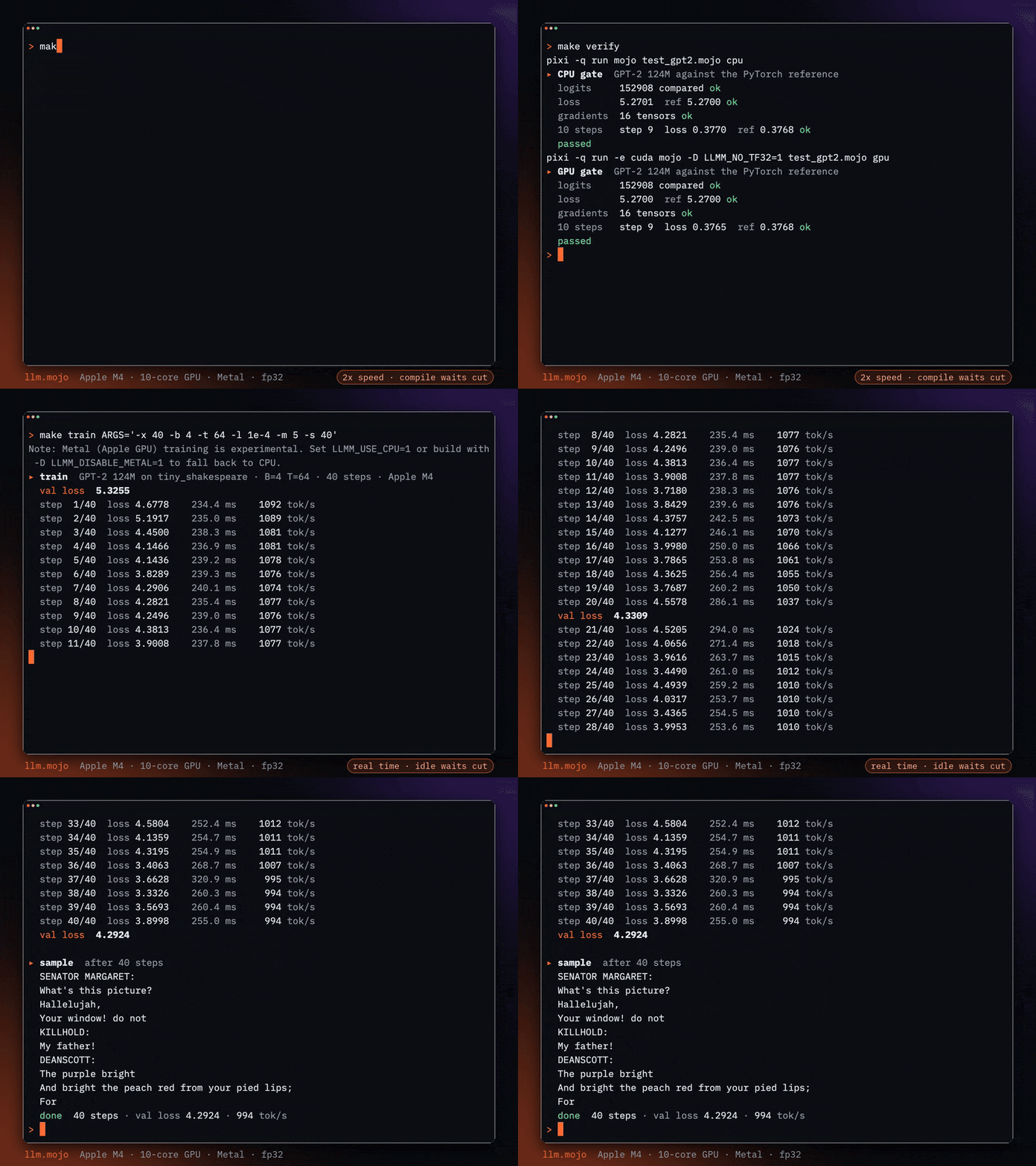
Verification plays at 2x and training in real time, with static waits (Mojo compiling, the model
loading) trimmed, as the badges say; the output is the trainer's and make verify's own pretty
format (see below), and the frame names the machine that recorded it. Regenerate with
scripts/render_bench_gif.sh (tapes in docs/bench/). make verify checks every gradient
tensor and a 10-step loss trajectory against PyTorch, then
make train ARGS='-x 40 -b 4 -t 64 -l 1e-4 -m 5 -s 40' trains on llm.c's 40-step configuration on
the Metal GPU, on the same batches in the same mt19937 shuffle order (val loss 5.3255 → 4.2924). It
clips gradients at norm 1.0 like llm.c's CUDA trainer, which llm.c's CPU trainer does not, so it
is not the same run as train_gpt2.c; the comparison below is, with -gc 0.
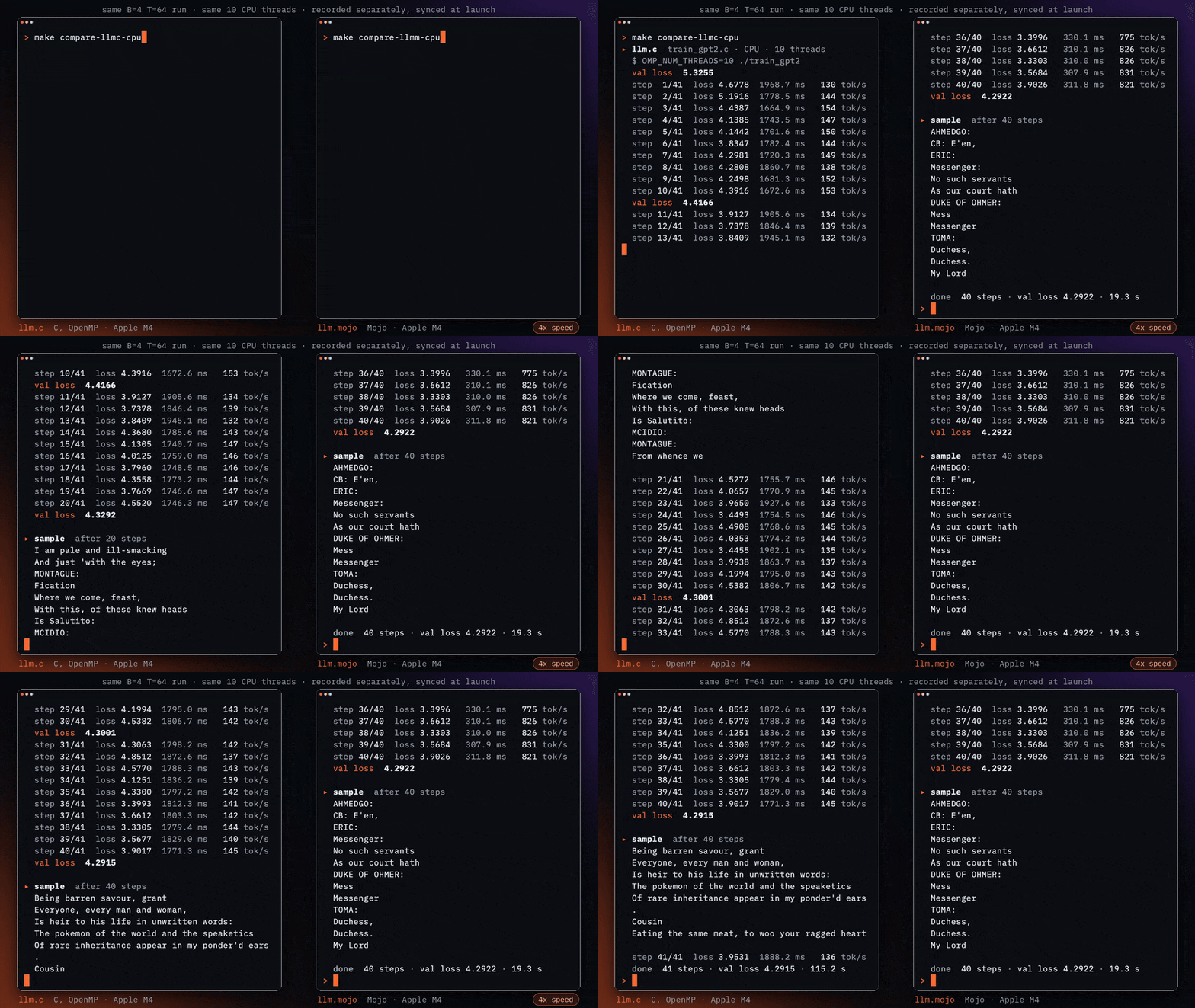
llm.c's train_gpt2.c (its fastest CPU build, OpenMP, 10 threads) next to llm.mojo on CPU (10
cores) on an Apple M4, running the same training: B=4, T=64, lr 1e-4, no gradient clipping
(-gc 0), the same batches. A step takes 1782 ms in llm.c and 318 ms in llm.mojo (5.6×); the run
takes 115.2 s against 19.3 s. The losses agree to within 0.002 at every step and the final val loss
to 0.0007 (4.2915 vs 4.2922), but the samples differ: a logit difference far below that flips a
sampled token, after which the two texts continue from different contexts. Both panes print through
scripts/log_view.py, which computes tok/s the same way for both. Each trainer ran alone on an
idle machine and the panes replay those runs at their recorded pace, synced at launch, because
filming loads the CPU and slows llm.c's OpenMP threads far more than llm.mojo. The GIF plays at 4×;
the MP4 is real time. Regenerate with scripts/render_compare_video.sh;
run either side with make compare-llmc-cpu / make compare-llmm-cpu.
Installation
Step 1: Clone the repository
This project vendors Karpathy's llm.c as a git submodule (used as the CPU/GPU
reference for benchmarking), so clone with --recurse-submodules:
git clone --recurse-submodules https://github.com/ulmentflam/llm.mojo.git
cd llm.mojo
If you already cloned without that flag, run git submodule update --init from
the repo root (the Makefile also does this automatically the first time a
benchmark/profile-llmc-* target needs it).
Step 2: Install Pixi
If you don't have it, install pixi:
curl -fsSL https://pixi.sh/install.sh | sh
Step 3: Install Dependencies and Git Hooks
Quick setup: pixi environment + git pre-commit/pre-push hooks (which run
make lint and make check respectively; see make install-hooks; requires
pre-commit to already be on your PATH, and is
skipped, not fatal, if not found):
make install
If you have CUDA installed (setup is beyond the scope of this file), use the CUDA-enabled equivalent instead:
make install-cuda
make install/make install-cuda do not download the Tiny Shakespeare
dataset or GPT-2 124M starter weights (~1.5 GB). That's a separate step,
needed before make train, make verify, or make benchmark* will work:
make data
Or combine both in one shot with make install-with-data (or
make install-cuda-with-data for the CUDA variant).
Step 4: Train
make train
For additional help, see make help.
The trainer, make verify and make test-mojo report the same events (setup, step, val, sample,
check, test) in one of four formats. Run by an LLM coding harness (Claude Code, Codex, Gemini CLI,
OpenCode, Cursor, or anything that sets AI_AGENT), they print llm lines automatically;
otherwise they print the compact pretty layout the demo above shows.
| Variable | Values |
|---|---|
LLMM_LOG |
llm (key=value, no color or glyphs; agent is an alias), pretty, json (one object per line), plain (llm.c's original output: setup tables, per-step norm, lr, z-scores and MFU) |
LLMM_LOG_LEVEL |
quiet (results and failures), normal (default), verbose (norm, lr, z-scores and MFU per step, a line per gradient tensor and trajectory step, every test case), debug (per-element gradient dumps, raw test output) |
LLMM_LOG_FILE |
also append every event, up to verbose, as JSON lines to this file |
LLMM_LOG_TIME |
1 adds the time since the run began to every event |
NO_COLOR |
keep the pretty layout, drop its colors |
A failing check or test file prints its full detail at every level. scripts/train_log.py reads a
training log back from any of the four formats.
Optimizer: AdamW is the default and its path is unchanged. -opt muon (env LLMM_OPTIMIZER) is
opt-in and switches the attention and MLP weight matrices to Muon (Newton-Schulz-orthogonalized
momentum, Moonlight scaling, so -l and -c are shared with AdamW; -mu sets the momentum,
default 0.95) and keeps embeddings, biases and LayerNorm on AdamW. The GPU path needs cuBLASLt
(NVIDIA); the CPU path is a naive reference (~124 s/step at 30M params), not for training. Muon
works with ZeRO-1, 2 and 3 (matrix-granular ownership, so each rank orthogonalizes whole matrices).
That is verified on the CPU multi-rank harness on one box, which exercises it without a second GPU:
make train-cpu WORLD_SIZE=2 ARGS="... -pn 2 -z N -opt muon". GPU at WORLD_SIZE > 1 is
compile-checked only and a 2-GPU smoke is pending (a runbook is in the design doc). Tuned recipe
(124M, 300 steps, ranking study at one seed): -opt muon -l 4.8e-3 -mu 0.9 -c 0 -gc 0 reached val
5.01 against 6.12 for an untuned AdamW control; the lr (8x AdamW's) is the robust part. For a long
run keep -c 0.1 -gc 1.0 unless you re-test. -qk_clip <tau> (env LLMM_QK_CLIP, 0 = off)
rescales any attention head whose max logit exceeds tau; it is GPU-only, works with Muon at every
ZeRO stage and with either optimizer at ZeRO-0, and still raises for AdamW with ZeRO >= 1. qk_max=
is printed only at verbose level. The pretrained GPT-2 124M already exceeds tau=100 (max logit
~110), so it clips on step 1 of a fine-tune. Checkpoints: a state file cannot be resumed with the
other optimizer, at another world size or rank, or across ZeRO-0 and ZeRO >= 1 for sharded Muon
(each is refused before any state is read); AdamW and single-GPU Muon files are byte-identical to
before. The overhead is a fixed cost per step: ~1% at 131k tokens/step (29% only at the 4k-token
smoke config). -D LLMM_INIT_SEED=N (via MOJO_DEFINES="-D LLMM_INIT_SEED=N") overrides the
from-scratch init seed for multi-seed runs. Implementation, verification and the perf pass:
docs/ai/muon_muonclip_implementation_2026-10-29.md;
sharded design and per-slice verification:
docs/ai/zero_sharded_muon_design_2026-10-30.md;
hyperparameter sweep:
docs/ai/muon_hparam_sweep_124m_2026-10-30.md;
convergence vs AdamW:
docs/ai/muon_vs_adamw_124m_2026-10-29.md.
Untied LM head (opt-in build flag, default unchanged): GPT-2 shares one matrix between the token
embedding and the output projection. -D LLMM_UNTIED_HEAD=1 (MOJO_DEFINES="-D LLMM_UNTIED_HEAD=1")
adds a separate 17th tensor lm_head ([V_p, C], after ln_f), so the embedding becomes lookup-only and
the head trains on its own; -l_head <mult> scales the head's AdamW learning rate. It costs one extra
V_p x C matrix of params, grads, m, v and master: +589.5 MiB per rank at 124M, bf16 or fp32, W=1 (the
per-ZeRO table is in the design doc; ZeRO-1, 2 and 3 all support the trained head, the ZeRO-3 head is
gathered one vocab tile at a time). -untie_at <fraction> trains tied (head := wte) for that fraction
of -x steps, then untied (head copied from wte, m and v zero, a fresh Adam bias correction for the
head); a resumed run must pass the same -untie_at and -x. Untied checkpoints are version 13 (fp32) and 15 (bf16) and load only into an untied build;
the HF export and the MAX graphs refuse them with a clear message. The step time and MFU count the
same head GEMM as the tied model (the setup line's gpt2-124M label and the MFU use the 16-tensor
parameter count; params= shows the stored 163M). Verify with make verify-untied-cpu (and
verify-untied-gpu, verify-untied-dump, make test-mojo TEST_DEFINES="-D LLMM_UNTIED_HEAD=1");
generate from an untied file with make infer-untied CHECKPOINT=<untied .bin> ARGS=<tokens>. Design,
memory model and per-slice verification:
docs/ai/untied_lm_head_design_2026-10-30.md.
Rotary position embeddings (opt-in, MOJO_DEFINES="-D LLMM_ROTARY=1"). The modded-nanogpt
half-truncated rotary on the q and k thirds of qkv replaces the learned wpe add: wpe stays in
the parameter layout (checkpoint tensor list, ZeRO shards and Muon owner-space unchanged) but is
not added, gets no gradient, is zero from a from-scratch init and is left out of the Muon-mode
AdamW ranges. A rotary checkpoint is only meaningful in a rotary build, and a QK-norm
(-D LLMM_QK_NORM=1) checkpoint only in a QK-norm build, so both are recorded in the checkpoint
headers (flags word: bit 0 rotary, bit 1 untied head in state files, bit 2 QK-norm). A model .bin
carrying a bit the build lacks is refused by the trainer's -e, by resume and by infer_gpt2,
naming the bit; resuming refuses a mismatch in either direction (a state file written before bit 2
existed records rotary only, so a QK-norm build refuses to resume it). A .bin without the bit,
e.g. pretrained GPT-2, still initialises a flagged run (-e) and infer_gpt2 runs it with the
build's architecture after printing a note, as the trainer's -e does (the verify gates rely on this);
infer_gpt2 refuses a stock-gpt2 safetensors in a flagged build. Checkpoints written
before the QK-norm bit existed record rotary only (the published headline files were corrected and that
repo's history squashed, though the originals can still be fetched by their old commit IDs); write a corrected copy with scripts/set_checkpoint_arch_flags.py. The MAX graphs refuse any flagged file.
Default-build checkpoints are byte-identical to before.
Reference (GPT2_ROTARY=1 in train_gpt2.py), gates and results:
docs/ai/rotary_embeddings_w8_2026-10-30.md.
Muon vs AdamW on this box (GPT-2 124M from scratch, FineWeb, bf16, B=32 T=1024 at 131k tokens/step, 600 steps = 79M tokens, cosine to zero, same init per seed; val loss at step 600, three init seeds):
| optimizer | recipe | seed 42 | seed 1 | seed 2 | mean | first eval at or below AdamW's step-600 val |
|---|---|---|---|---|---|---|
| AdamW | -l 6e-4 -c 0.1 -gc 1.0 |
5.469 | 5.499 | 5.484 | 5.484 | (600) |
| Muon, AdamW's recipe | -opt muon -l 6e-4 -c 0.1 -gc 1.0 |
5.112 | 5.107 | 5.120 | 5.113 | step 300-400 |
| Muon, tuned | -opt muon -l 4.8e-3 -mu 0.9 -c 0 -gc 0 |
4.364 | 4.358 | 4.361 | 4.361 | step 200 |
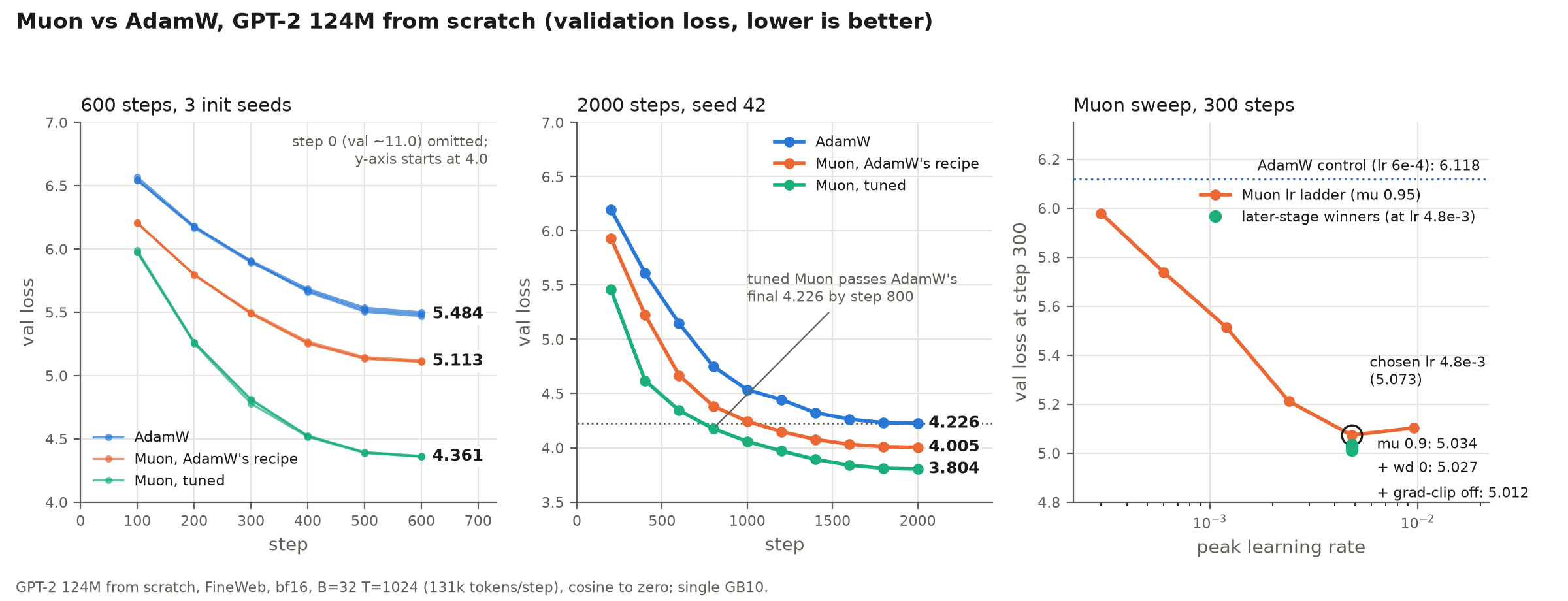
Val loss vs step for the three arms (left: 600 steps x 3 seeds; middle: 2000 steps, tuned Muon passes AdamW's final loss by step 800) and the 300-step Muon lr sweep (right). Reproduce with make figure-muon.
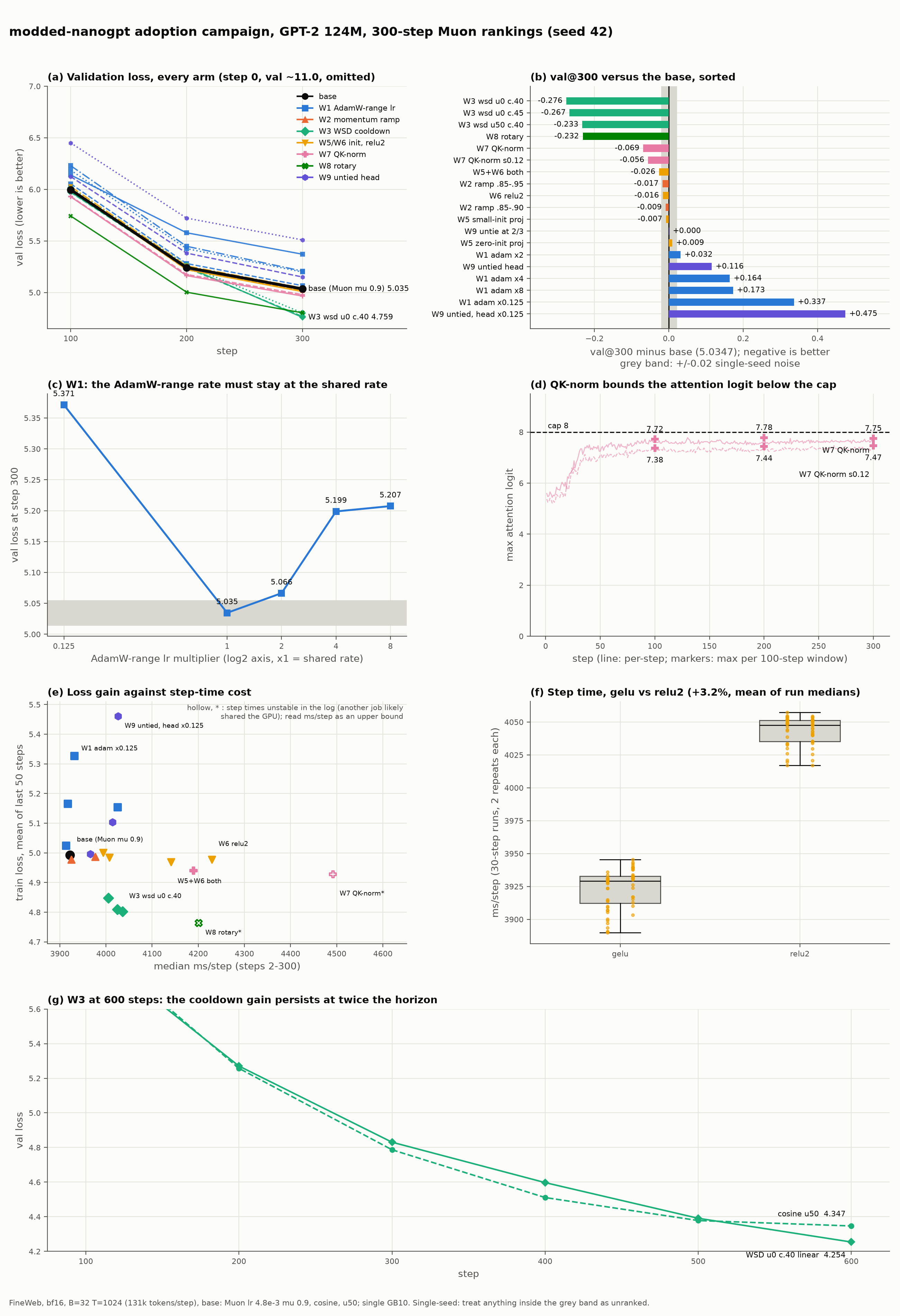
The follow-up campaign ranked nine modded-nanogpt ideas on the tuned-Muon recipe at 300 steps (single seed, so differences under about 0.02 are noise): a zero-warmup linear-cooldown (WSD) schedule is the largest gain, rotary embeddings are second, QK-norm helps and bounds the attention logit, the AdamW-range learning rate has to stay at the shared rate, and the rest sit inside the noise band. Nothing becomes a default without three seeds. Details in docs/ai/modded_nanogpt_adoption_results_2026-10-30.md; reproduce with make figure-adoption.
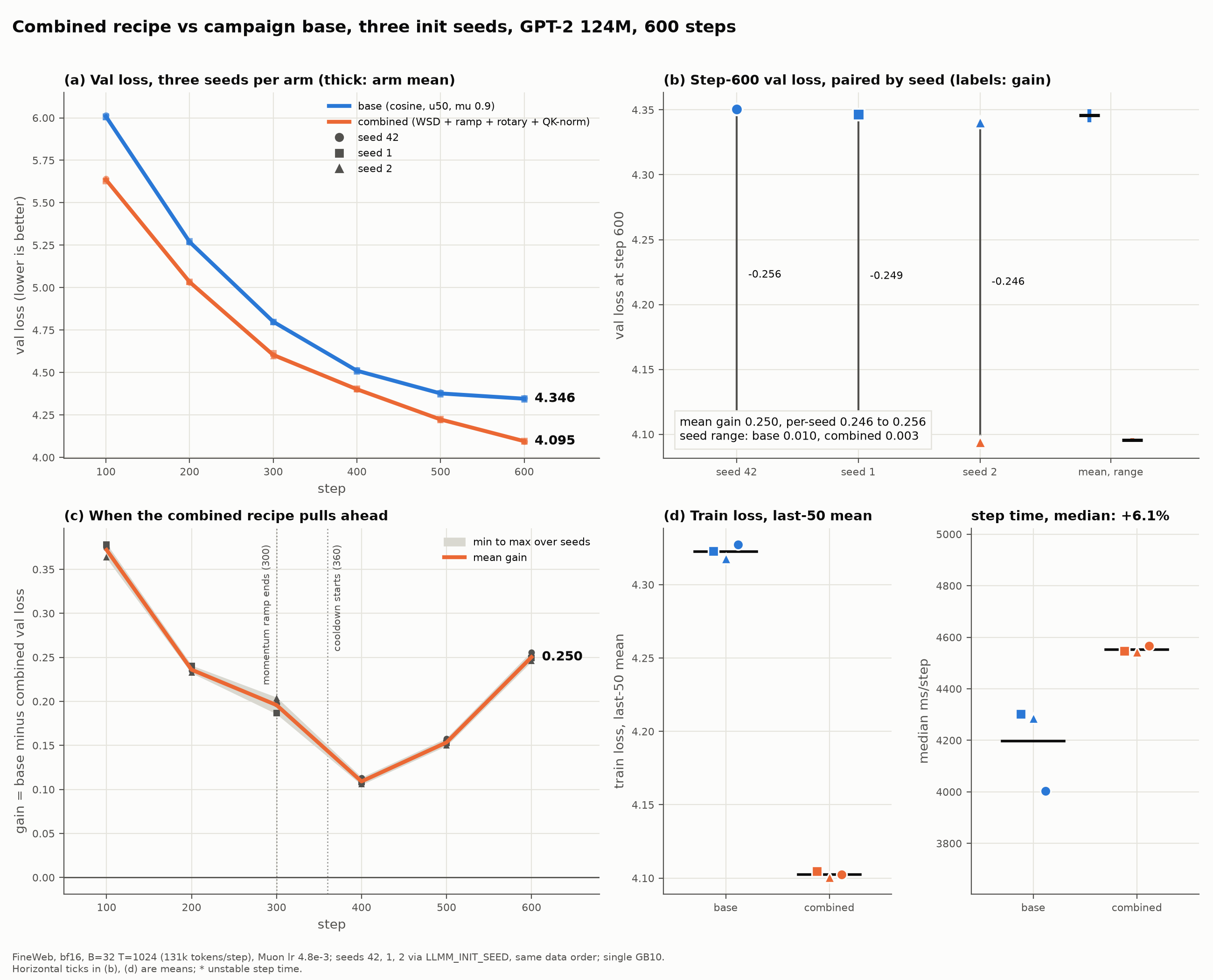
Three-seed confirmation of the recommended recipe (WSD cooldown, momentum ramp, rotary, QK-norm; 600 steps, init seeds 42/1/2, same setup as the table above but with -c 0.1 -gc 1.0): val loss at step 600 is 4.346 for the campaign base and 4.095 for the combined recipe, a gain of 0.250 (per seed 0.246 to 0.256) against seed spreads of 0.010 (base) and 0.003 (combined). The gain is smaller than the sum of the 300-step single-item gains, and the recipe costs about 6% step time measured interleaved with the base before the row passes were fused (fusing saves about 1.7% on an idle GPU; still no fresh idle base in the same session). Reproduce with make figure-adoption-seeds; details and per-seed table in the results doc.
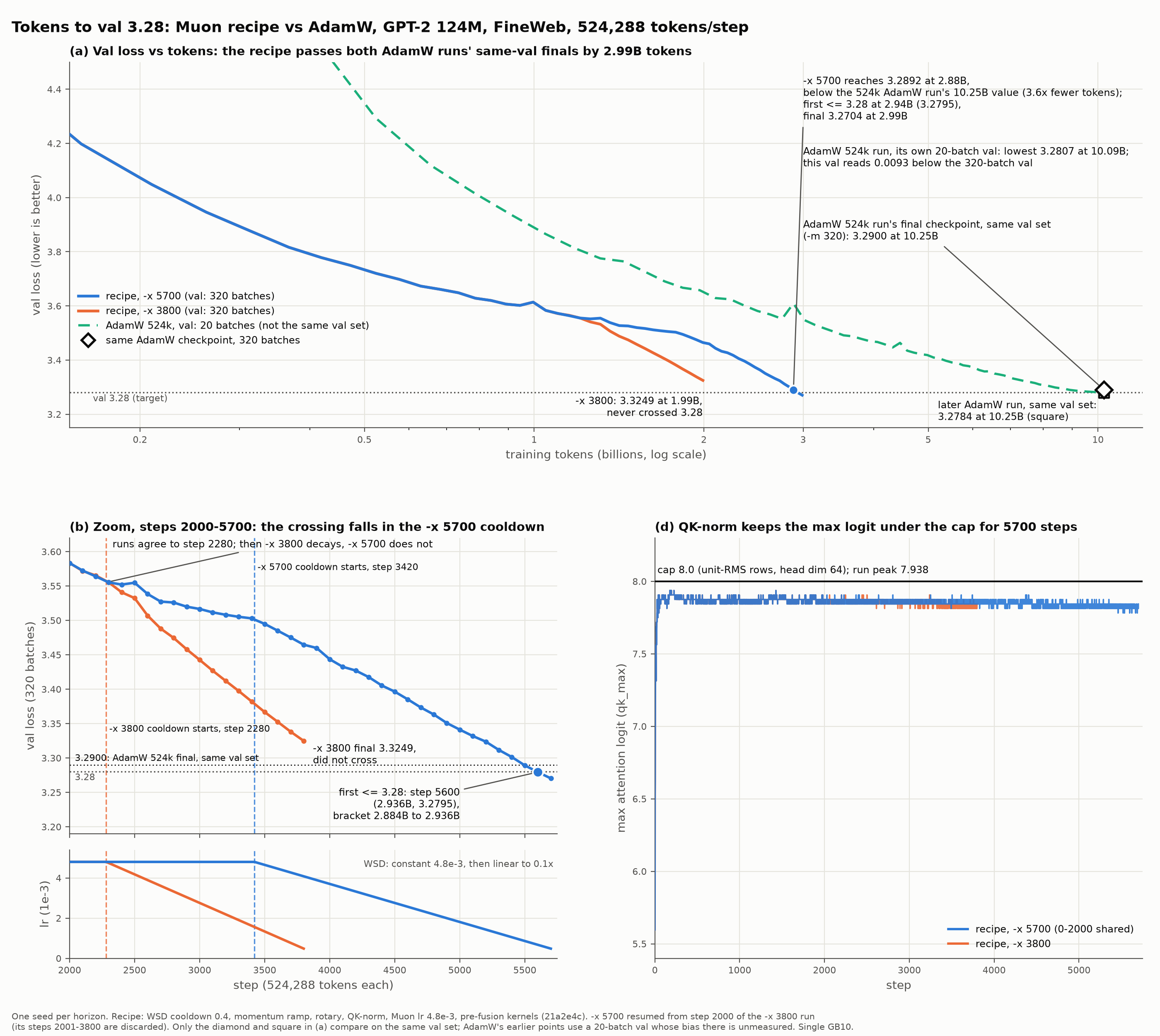
Headline run: the same recipe at the full 524,288 tokens/step (one seed, -x 5700, 2.99B tokens, 17 h on one GB10, pre-fusion kernels) against two in-house AdamW runs of 10.25B tokens. On the same 10.5M-token val set (-m 320) the better one, the current model.safetensors of gpt2-124m-fineweb-mojo (7 GPUs, 458,752 tokens/step), scores 3.2784, and the recipe passes that by 2.99B tokens, about 3.4x fewer, ending at 3.2704. The 524k-token AdamW run the recipe was designed against (model_19552.bin) scores 3.2900 there, and the recipe passes that at 2.88B tokens, about 3.6x fewer. That second run's own 20-batch val bottoms out at 3.2807 and reads 0.0093 below the 320-batch one at its final checkpoint (the bias at earlier checkpoints is unmeasured, so its crossing tokens on that val are not same-val). The recipe's first val <= 3.28 is at 2.94B tokens. That figure belongs to the (recipe, horizon) pair, since it falls in the cooldown: the same recipe at -x 3800 (1.99B tokens) ends at 3.3249 and does not cross. It is one seed, the 5700-step run resumed from step 2000 of the 3800-step run (before either cooldown), and the learning rate was tuned at 131k tokens/step. modded-nanogpt's under 0.7B tokens uses a larger architecture stack and is not like-for-like. Reproduce with make figure-adoption-headline; table, caveats and the per-eval numbers in the results doc. Weights and resume state: ulmentflam/gpt2-124m-fineweb-muon-rotary-qknorm-mojo (the raw .bin plus a model.safetensors with model_type: llm_mojo_gpt2; both need a -D LLMM_ROTARY=1 -D LLMM_QK_NORM=1 build of llm.mojo to compute the right model). AutoConfig, AutoModelForCausalLM and pipeline refuse that safetensors by design; an explicit GPT2LMHeadModel.from_pretrained loads it with a warning and a randomly initialised wpe and computes the wrong model (it is not stock GPT-2). The safetensors comes from python scripts/export_to_hf.py --input model_5700.bin --output <dir> (a rotary-only file needs --flags-confirmed, --attn-scale records a non-default scale) and is checked by scripts/check_hf_export.py --expect-loss; see the doc.
Step time is within a few percent across arms (median 3.88-4.01 s/step over all twelve runs; at
600 steps the per-seed Muon-minus-AdamW gap ranges from -1.3% to +2.7% with no consistent sign, at
2000 steps Muon was 1.4% and 2.9% slower by median, partly contention): the Muon optimizer step is a
fixed ~20-40 ms amortized over ~3.9 s of forward/backward. Seed spread is 0.03 for AdamW and under 0.015 for the Muon arms,
far below the gaps between arms. On a 2000-step schedule (262M tokens, seed 42, same recipe with
-u 150), val at step 2000 is AdamW 4.226, Muon at AdamW's recipe 4.005, tuned Muon 3.804; the
tuned arm passes AdamW's final value between steps 600 and 800. Caveats: early-training horizons,
one seed for the 2000-step runs, init seed varied but data order fixed, the tuned recipe came from a
300-step single-seed sweep (seed 42, so partly in-sample) and the AdamW control was not re-tuned. Logs and per-step tables: the
convergence doc above.
Multi-GPU training: build with WORLD_SIZE=N (one rank per GPU, compile-time)
and choose a ZeRO sharding stage at runtime:
make build WORLD_SIZE=8
scripts/run_train_gpt2.sh -z 2   # ZeRO: 0=DDP, 1=+opt shard, 2=+grad shard, 3=+param shard
Or launch from one of the baseline stage configs in zero/
(DeepSpeed-style: zero1.json/zero2.json/zero3.json), which handles the
build + run pair in one step:
make train-zero ZERO_CONFIG=zero/zero2.json
To pretrain on FineWeb instead of Tiny Shakespeare, tokenize it first
(--streaming avoids the ~60 GB Arrow materialization on small-disk hosts):
pixi run python data/fineweb.py -t classic -v 10B -m gpt-2 --streaming
For a long-running training run you want to survive crashes/reboots
unattended, supervise it with autosentry
(a self-healing process supervisor: checkpoint-resume on restart, OOM
batch-halving, Claude-agent escalation on unrecognized failures) via this
repo's .autosentry/autosentry.yaml, scripts/run_train_gpt2_bf16.sh, and
scripts/ensure_supervisor.sh. See
docs/ai/gpt2_124m_fineweb_training_run.md
for a full worked example.
Benchmarks
Benchmark Results: (NVIDIA DGX Spark)
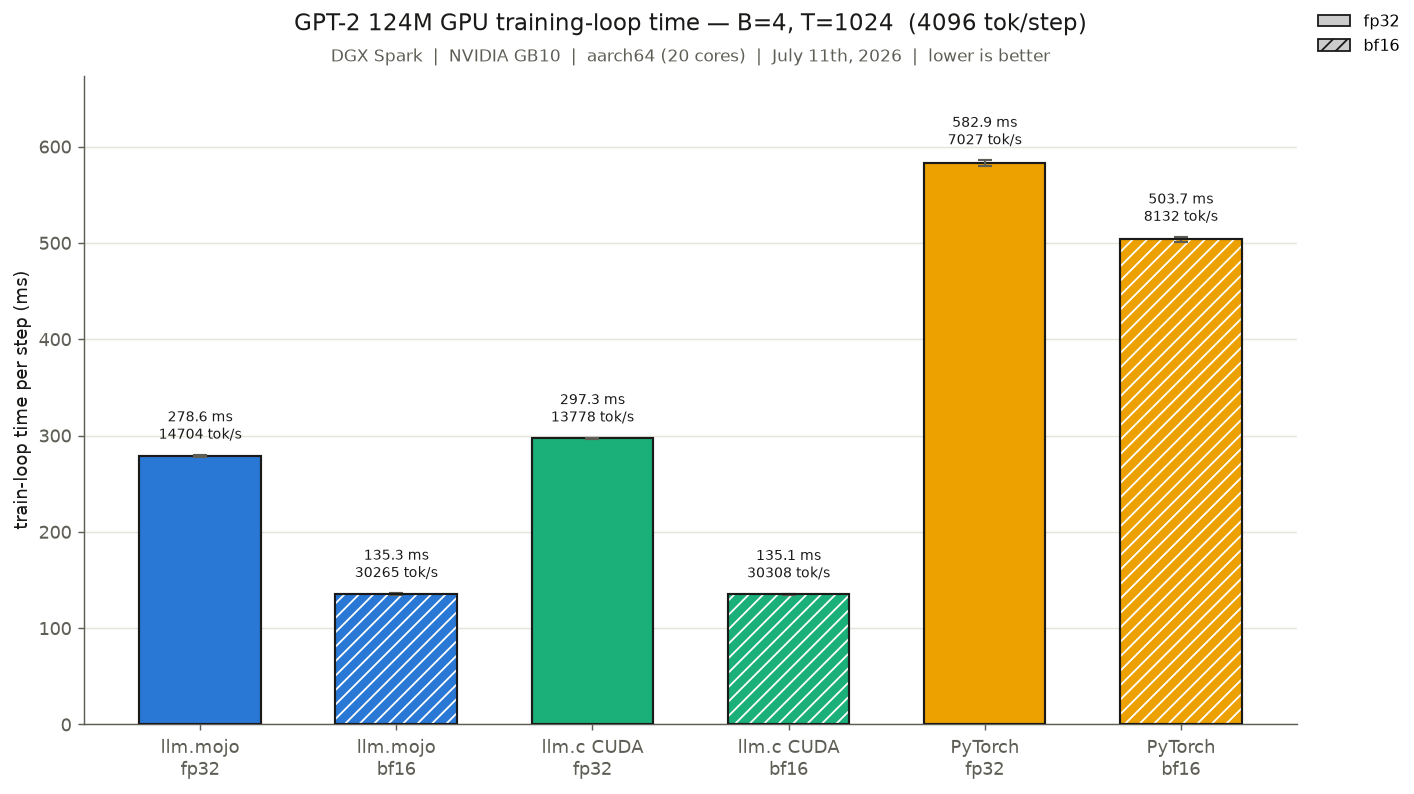
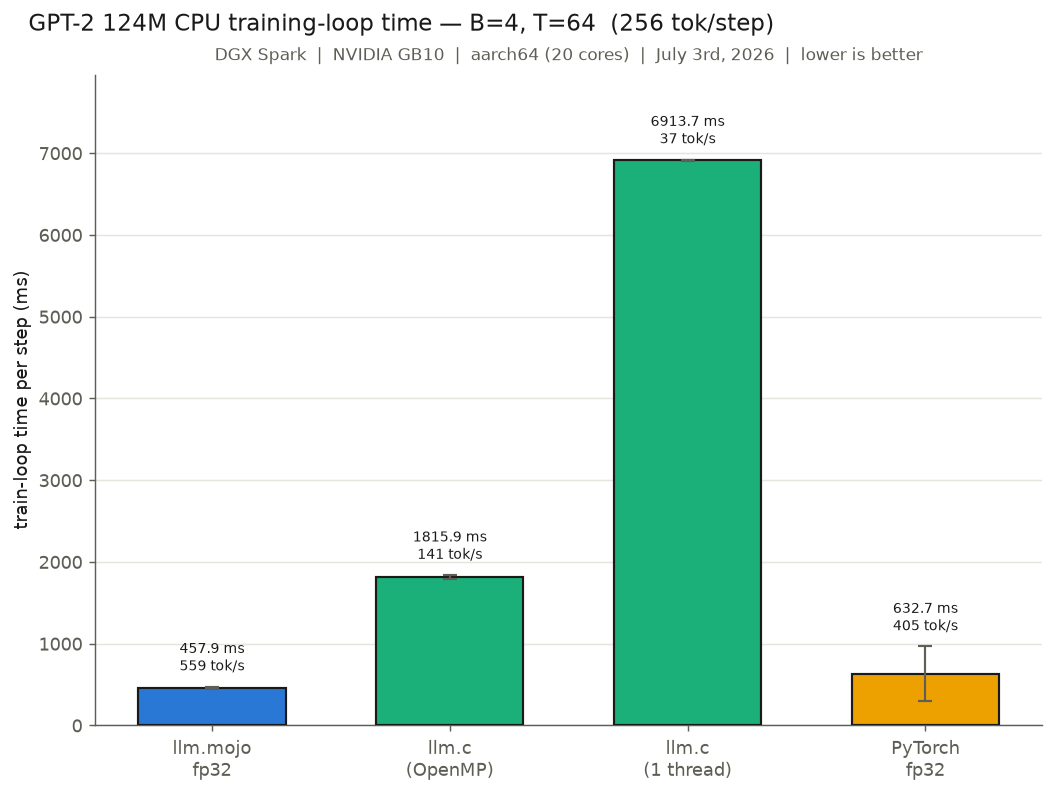
Average training loop times across llm.mojo, llm.c, and PyTorch, all with matched hyperparameters. llm.c runs OpenMP-enabled with 20 threads. CPU comparisons are float32, and GPU comparisons run both float32 and bfloat16. On Apple Silicon, make benchmark-metal runs llm.mojo (Metal GPU) against PyTorch MPS (llm.c has no Metal port, so PyTorch MPS fills in as the baseline). See the Apple Silicon (Metal GPU) section for those results.
Single GPU
Official run on the GB10 (B=4, T=1024, 40 steps with the first 5 dropped as warmup, all six arms interleaved in one session, 2026-07-11 15:31, measured directly on the shipped tree, HEAD c1a48d5, after the Metal test-restoration + MLX-benchmark merge; confirms the 2026-07-10 post-campaign table within noise, all six arms within 1.7% of it):
| configuration | mean ms/step | tok/s | vs llm.c |
|---|---|---|---|
| llm.mojo bf16 | 135.34 | 30265 | parity (0.999× vs llm.c bf16, ≈noise) |
| llm.c CUDA bf16 | 135.14 | 30308 | baseline (bf16) |
| llm.mojo fp32 (TF32) | 278.57 | 14704 | 1.07× faster (vs llm.c fp32) |
| llm.c CUDA fp32 (TF32) | 297.29 | 13778 | baseline (fp32) |
| PyTorch bf16 | 503.71 | 8132 | — |
| PyTorch fp32 | 582.89 | 7027 | — |
TF32 note: llm.mojo's fp32 GPU GEMMs now use TF32 tensor cores by default (
CUBLAS_COMPUTE_32F_FAST_TF32), matching llm.c's fp32 behavior: its fp32 build auto-enables TF32 on any compute-capability-8.0+ GPU, so the fp32 rows above are TF32-vs-TF32. Build with-D LLMM_NO_TF32=1to restore strict IEEE fp32 math (that is also whatmake verify-gpugates on; the default TF32 path has its own gate,make verify-gpu-tf32).
Backward-kernel note: the fp32 result above rests on two backward-pass optimizations layered on top of TF32: a redesigned fused LN-backward (one register-accumulating kernel plus a block-per-channel finalize, replacing 4 launches per invocation; −6.9 ms fp32 / −3.1 ms bf16 kernel-family time) and a fused, 128-bit-vectorized matmul dbias reduction (−1.5 ms fp32 / −1.0 ms bf16). Both are gated by the full verify battery above.
Multi-GPU (ZeRO stages 0-3)
Multi-GPU data-parallel training runs one rank per GPU inside a single process: build with make build WORLD_SIZE=N (compile-time, like llm.c's -DMULTI_GPU) and pick the ZeRO stage at runtime with -z 0|1|2|3. Stage 0 is plain DDP, stage 1 shards optimizer state, stage 2 also shards gradients, and stage 3 also shards parameters. All four stages are equivalence-gated against the single-GPU baseline (tests/test_zero_equivalence.mojo at world sizes 2 and 8, per-parameter match to 1e-5; per-step training losses agree across stages to ~1e-4 at world size 8). The collectives are staged reduce-scatter/all-gather over driver-routed device-to-device copies, so they work on PCIe boxes without CUDA P2P or NVLink. See docs/ai/zero_multigpu_rewrite_2026-07-14.md for the design and docs/ai/zero_world8_verification_2026-07-14.md for the verification campaign.
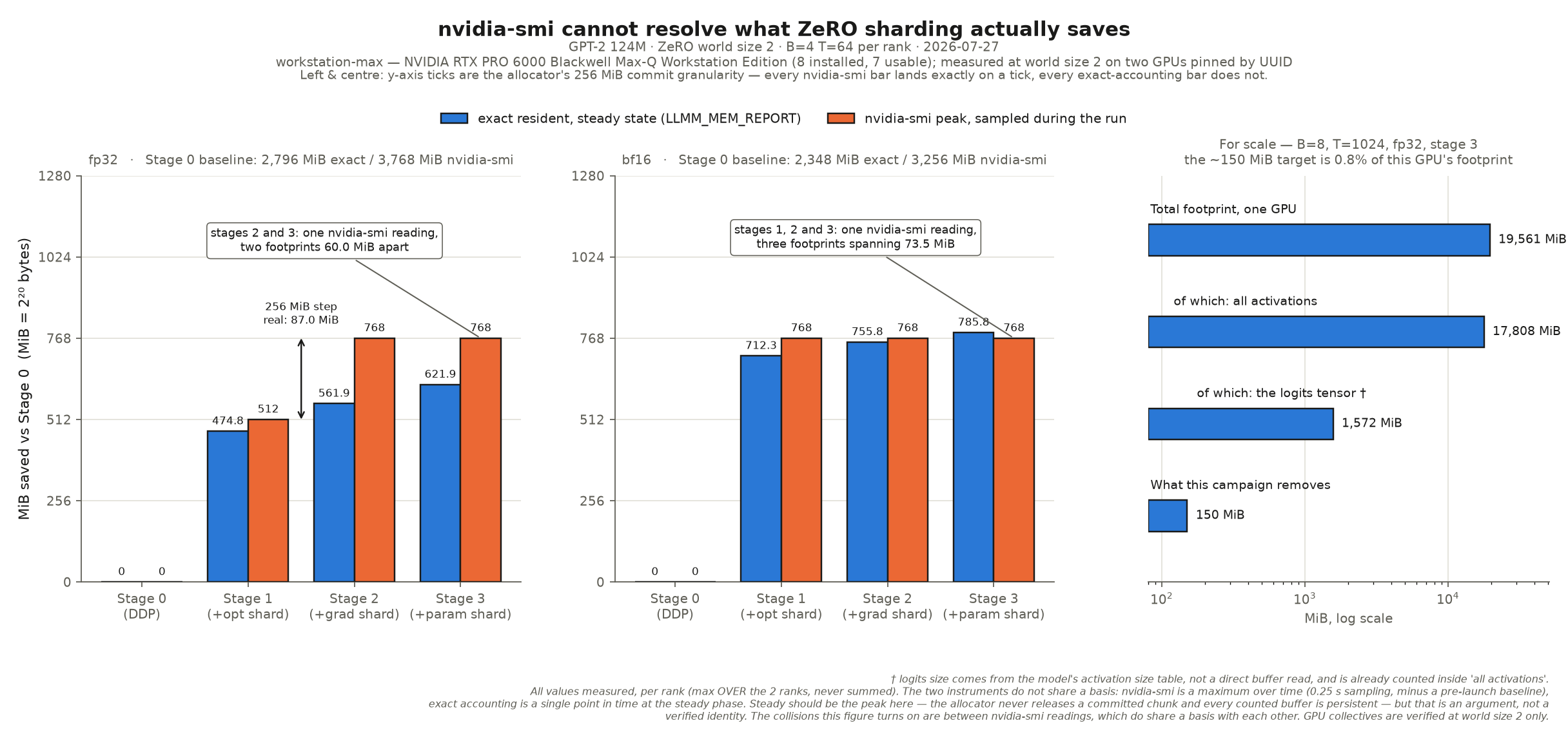
Measured on 4× NVIDIA RTX PRO 6000 Blackwell Max-Q (96 GB, PCIe, no P2P), GPT-2 124M, B=4 T=64 per rank, 12 steps (first 2 dropped as warmup), after the stage-2/3 memory pass (per-layer gradient bucketing and stage-3 parameter streaming):
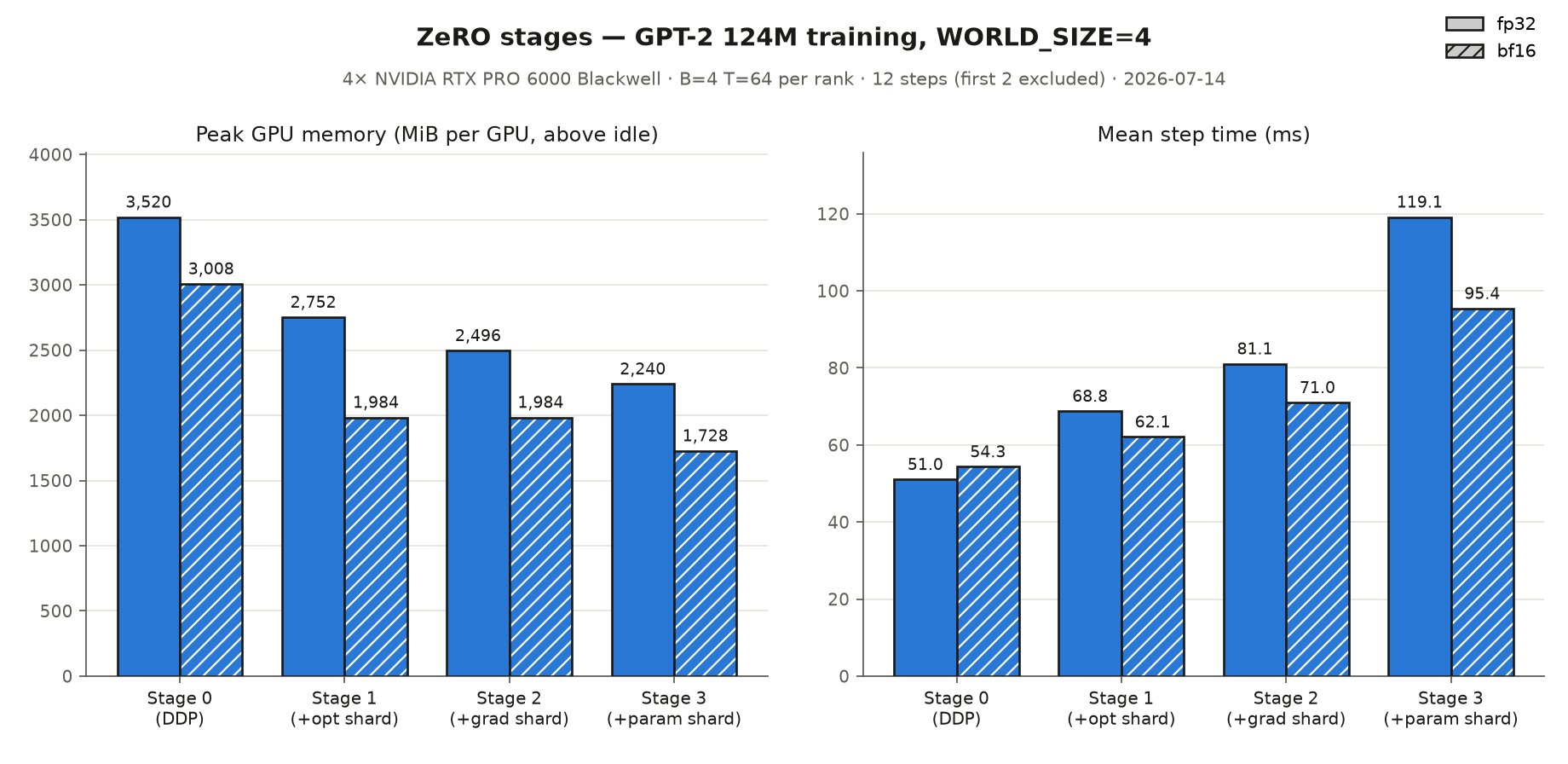
Each stage buys additional per-GPU memory. Stage 1's optimizer-state sharding saves 768 MiB in fp32 (1 GiB in bf16, where the fp32 master weights shard too), stage 2's bucketed backward reduction saves another 256 MiB, and stage 3's parameter streaming another 256 MiB. The savings trade against step time: stages 2 and 3 pay for their per-layer collectives, with stage 3's just-in-time parameter gathers costing the most. At this tiny benchmark shape that overhead is a large fraction of the 50 ms step; at production shapes (B≥32, T=1024, ~250-470 ms steps) it is a few percent. Reproduce with make benchmark-zero (BENCH_ZERO_WORLD=N; writes the JSON into zero/bench/ and renders this chart into figures/).
The tied wte embedding used to floor stages 2/3 at ~150 MiB. One [V_p, C] tensor — 50304 × 768 = 147 MiB in fp32 — is both the token-embedding table and the LM-head weight, so it had two consumers with opposite access patterns: the LM head reads it densely as a GEMM weight, the encoder reads it sparsely by token-id row lookup. Each needed its own fix. The LM head is now vocab-tiled (-D LLMM_LM_HEAD_VOCAB_TILES, default 8), so backward holds and reduce-scatters one tile at a time; the encoder gradient is now row-sparse over a cross-rank union of the tokens actually present. The gradient-bucket pool drops from ~150 MiB to 27 MiB, at which point wte is no longer the binding constraint at all — a transformer layer's 12 tensors are. Cost: +0.60% step time. Correctness is gated by make verify-gpu at the shipped default, where all 16 gradient tensors match PyTorch, dwte included.
Read that in proportion. At production shape the tensors that actually dominate a GPU are att_probs (~18 GiB, growing as T²) and logits (~6.1 GiB) — 123× and 42× the floor this work removed, and untouched by it. Removing 150 MiB is 0.7% of the footprint there, where activations are 88% of everything on the card. The floor was real and blocked stages 2/3 from doing what they exist to do, but the memory problem is not solved. Full accounting, including the measurement instrument this needed (nvidia-smi cannot resolve a 150 MiB change — the allocator commits in 256 MiB chunks) is in docs/ai/zero_wte_deresidency_campaign_2026-07-27.md.
The logits half of that is now addressable too. -D LLMM_LM_HEAD_CHUNKED_CE=1 (default off) replaces the classifier with a two-pass online-softmax cross-entropy that never materializes the full (B·T, V_p) tensor: pass 1 folds each vocab tile into a running per-row max and sum-exp, pass 2 recomputes each tile and turns it into that tile's dlogits in place. At B=32, T=1024 that takes logits from 6288 MiB to 800 MiB (196.5 MiB at 64 tiles) for +6.1% step time — 5.36 GiB per 26.4 ms. It is opt-in precisely because that is a good trade only when memory is what limits your batch size; both configurations are measured so the exchange rate is visible rather than just the saving. The technique is Liger Kernel's (arXiv:2410.10989 §3.2), not ours.
A Megatron-style vocab-parallel LM head was evaluated as the alternative and rejected on measured grounds: it wins only below W/(C+3) ≈ 51,130 global tokens per micro-step, and we train at 229,376 — a 4.5× communication regression. The world size cancels out of that ratio entirely, so no rank count fixes it. See docs/ai/vocab_parallel_lm_head_feasibility_2026-07-27.md.
Low-precision training (FP8 / NVFP4)
FP8 and NVFP4 are working training precisions, not just inference formats. FP8 quantizes the per-block linear GEMMs (QKV/attn-proj/MLP fc/fc-proj, forward and backward) to transient e4m3/e5m2 operands with delayed scaling. The math runs in FP8 tensor cores, but the master weights and optimizer state stay in fp32. NVFP4 block-scales the middle transformer blocks' MLP GEMMs to e2m1 on cuBLASLt. It adds stochastic rounding and a random Hadamard transform (per the published NVFP4 training recipe) to control the extra quantization variance. Both converge alongside bf16 at GPT-2 124M scale. See the loss envelopes below and make verify-fp8-grads / the fp8/fp4 gates in docs/ai/ai_assisted_optimizations_and_benchmarks.md.
Step-time measurement (B=4, T=1024, checkpoint-init tinyshakespeare, 2 rounds with arm order alternated per round, 40 measured steps/arm after a discarded fresh-binary warmup run, 2026-07-11, post-optimization-campaign tree):
| precision | median ms/step | vs bf16 | 50-step loss envelope vs bf16 | build target |
|---|---|---|---|---|
| bf16 | 134.9 | baseline | baseline | make build-bf16 |
| FP8 (e4m3/e5m2) | 146.6 | 1.09× slower | median 0.57% | make build-fp8 |
| NVFP4 (e2m1) | 154.3 | 1.14× slower | median 0.89% | make build-fp4 |
The 2026-07-10/11 optimization campaign (coalesced/fused quantize-transpose kernels, persistent fp8 weight-transpose caching, dual-output quantize, fused tiled RHT-prep for NVFP4) cut FP8 from 150.5 to 146.6 ms and NVFP4 from 184.2 to 154.3 ms at this scale. It pays off harder at width: at the 774M-class d36 config FP8 is now ~12% faster than bf16 (0.878×), and NVFP4 reaches parity (1.002×). An optional calibrated static-scales mode (-D LLMM_FP8_STATIC_SCALES=1, default off) removes the per-step amax/scale-update kernels entirely. It shaves a further ~1.5% at 124M and ~3% at d36 (0.853×), at the cost of per-config offline calibration. See the A1 writeup and the final campaign scoreboard in docs/ai/ai_assisted_optimizations_and_benchmarks.md.
At 124M params these are numerics/research configs, not throughput wins. The quantized GEMMs themselves are measurably faster than bf16's — fp8 and fp4 both cut raw GEMM compute time — but at this scale that saving is swamped by the quantize/amax/scale overhead (plus the Hadamard transform for NVFP4) around small per-block GEMMs. Width, not batch, is what closes the gap: an on-box scaling sweep found FP8 slower than bf16 at every batch size tested (B up to 64) at 124M, while the 774M-class d36 config crosses over decisively, as the numbers above show. Published FP4/FP8 throughput wins likewise start around ~1B+ parameters, where the GEMMs are large enough to amortize that fixed overhead. See docs/ai/lowp_scaling_sweep_2026-07-10.md, plus the quant-opt and transpose-coalescing writeups and the FP8/FP4 gotcha catalogs in docs/ai/ai_assisted_optimizations_and_benchmarks.md.
Single CPU
CPU training is fp32 by policy. Official run (B=4, T=64, 2026-07-03):
| configuration | mean ms/step | tok/s | vs llm.c OpenMP |
|---|---|---|---|
| llm.mojo fp32 | 457.9 | 559 | 4.0× faster |
| llm.c OpenMP (20 threads) | 1815.9 | 141 | baseline |
| llm.c (1 thread) | 6913.7 | 37 | — |
| PyTorch fp32 | 632.7 | 405 | — |
Apple Silicon (Metal GPU)
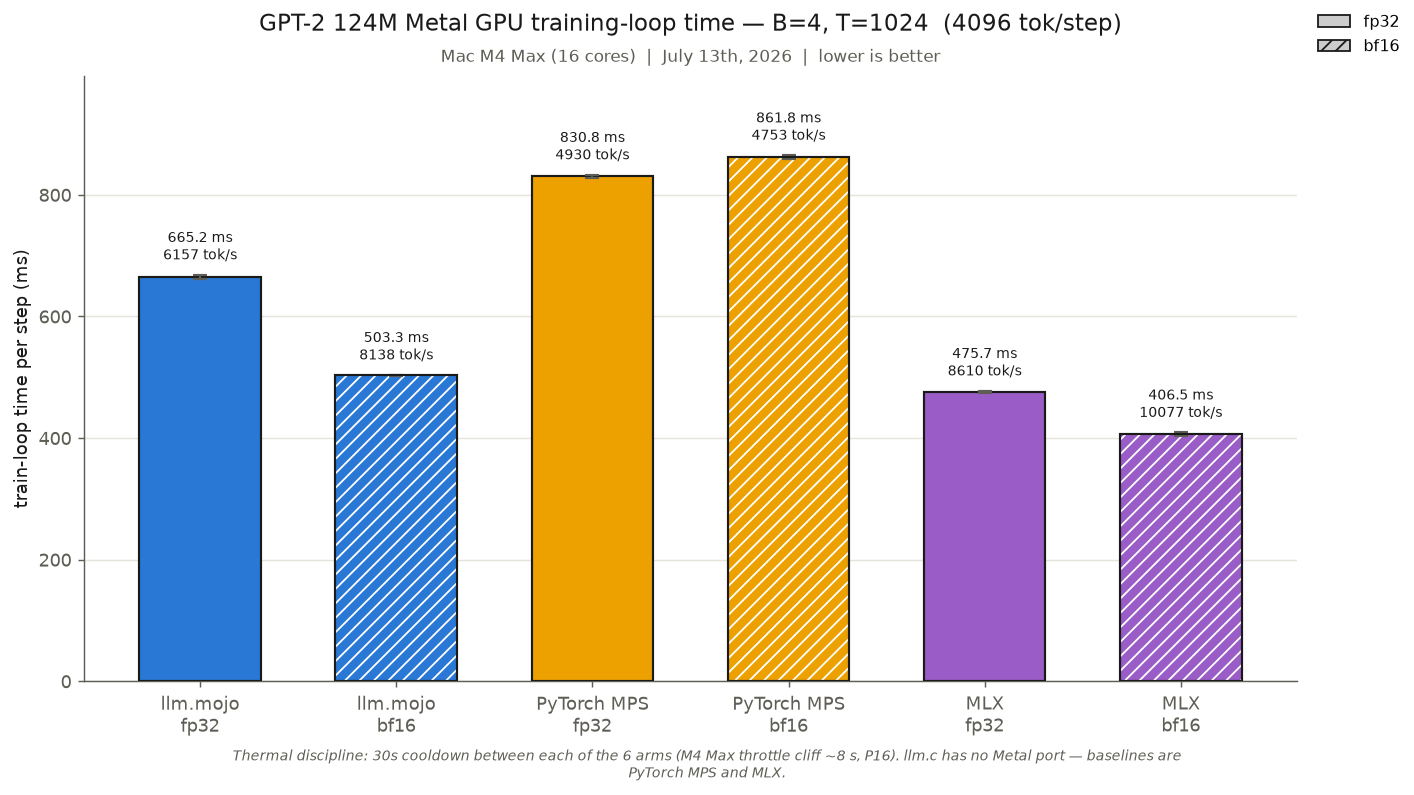
I ported this to the Metal GPU on Apple Silicon as well. The first working port ran at about 3627 ms/step (roughly 4.1× slower than PyTorch MPS); a round of kernel work moved it well ahead of PyTorch's Metal path at both precisions. Official run on an M4 Max (B=4, cold GPU, 30 s inter-arm cooldowns, 2026-07-13), at the full training sequence length T=1024:
| configuration | mean ms/step | tok/s | vs PyTorch MPS | vs MLX |
|---|---|---|---|---|
| llm.mojo bf16 | 503.3 | 8138 | 1.71× faster (MPS bf16) | 1.24× slower |
| llm.mojo fp32 | 665.2 | 6157 | 1.25× faster (MPS fp32) | 1.40× slower |
| PyTorch MPS fp32 | 830.8 | 4930 | baseline | — |
| PyTorch MPS bf16 | 861.8 | 4753 | baseline | — |
| MLX fp32 | 475.7 | 8610 | — | baseline |
| MLX bf16 | 406.5 | 10077 | — | baseline |
At the short benchmark length T=64 (same machine, same session), llm.mojo stays well ahead of PyTorch MPS, and MLX pulls further out front: the M4 Max's large GPU clears the tiny T=64 workload almost instantly under MLX.
| configuration | mean ms/step | tok/s | vs PyTorch MPS | vs MLX |
|---|---|---|---|---|
| llm.mojo fp32 | 165.0 | 1551 | 1.90× faster | 2.3× slower |
| llm.mojo bf16 | 189.7 | 1349 | 1.69× faster | 3.5× slower |
| PyTorch MPS fp32 | 312.7 | 819 | baseline | — |
| PyTorch MPS bf16 | 320.7 | 798 | baseline | — |
| MLX fp32 | 71.5 | 3580 | — | baseline |
| MLX bf16 | 54.8 | 4674 | — | baseline |
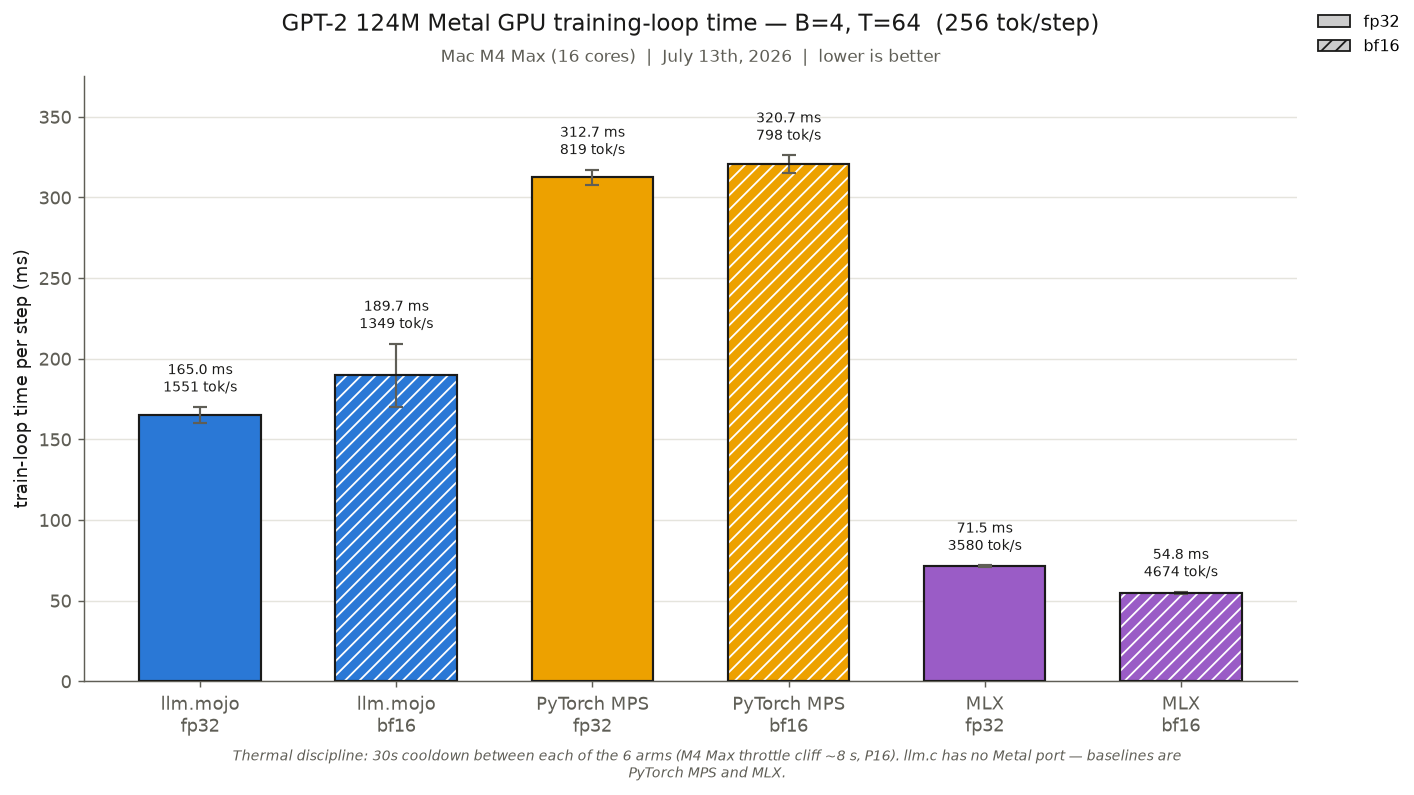
On Apple Silicon, llm.mojo runs faster than PyTorch's Metal (MPS) path at both sequence lengths, while Apple's own MLX is faster than both. The difference is almost entirely the matmul, which is about 70% of a training step: on Metal, MAX's linalg.matmul runs bf16 at only about 1.1× its fp32 speed, while MLX's bf16 uses tensor cores for roughly 2× (see bench_gemm.mojo and docs/ai/metal_beat_mlx_campaign_2026-07-11.md).
Run make benchmark-metal to reproduce (add BENCH_T=64 for the short-sequence table). It runs all six arms in one shot (llm.mojo fp32/bf16, PyTorch MPS fp32/bf16, MLX fp32/bf16) with 30 s cooldowns between them (the M4 throttles after about 8 s of sustained GPU load, so these cooldowns are mandatory). Correctness is gated by make test, which checks 16 gradient tensors plus the 10-step loss trajectory against PyTorch. The full gotcha catalog (address-space bugs, in-order queue semantics, threadgroup limits, the correctness campaign) is in docs/ai/metal_port_gotchas_and_optimizations.md, and the benchmarking setup is in docs/ai/ai_assisted_optimizations_and_benchmarks.md.
Evaluation
make eval scores a checkpoint on HellaSwag (via our own llmm/eval_dataloader.mojo + infer_gpt2.mojo, ported from llm.c's EvalLoader) and prints k/n = accuracy. Our from-scratch GPT-2 124M (10B FineWeb tokens, bf16) scores 2965/10042 = 29.53% (acc_norm), with a Wilson 95% CI of [28.6%, 30.4%]. Karpathy's own llm.c reproduction of the identical setup (124M, d12, 10B FineWeb tokens; discussion #481) reports 29.9%, which falls comfortably inside that interval: statistically indistinguishable from our own measurement, not just "close."
This checkpoint is published on HuggingFace: ulmentflam/gpt2-124m-fineweb-mojo (safetensors + the original raw llm.mojo/llm.c-format checkpoint). infer_gpt2.mojo can load it three ways: a local .bin, a local .safetensors, or straight from the Hub (--hf ulmentflam/gpt2-124m-fineweb-mojo). See llmm/safetensors.mojo / llmm/hf_download.mojo. Full training-run details (hyperparameters, timeline, hardware) are in docs/ai/gpt2_124m_fineweb_training_run.md.
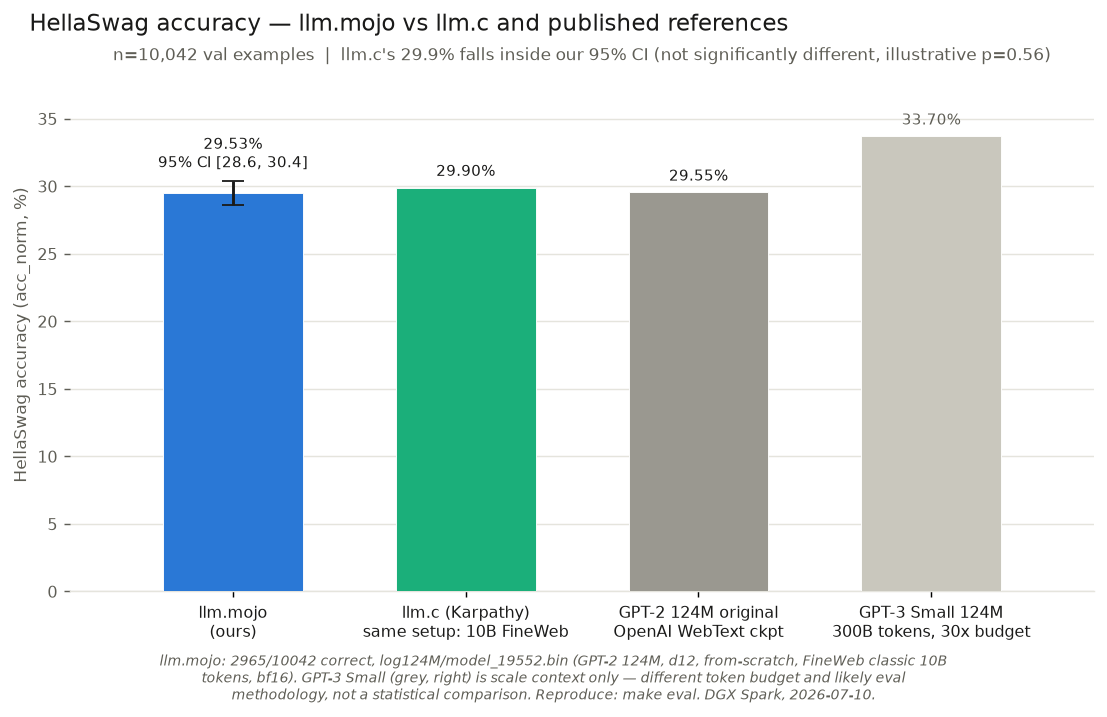
Run make benchmark-eval to reproduce this chart (it runs make eval and computes the Wilson CI); pass --k/--n to scripts/benchmark_eval.py directly to re-render from a cached result instead of re-scoring the full 10,042-example split. I include GPT-2 124M original and GPT-3 Small as scale/methodology context, not statistical comparisons. See the script's docstring for why.
Training-precision comparison: bf16, fp8, and NVFP4 from scratch at 124M and 774M
To take the low-precision modes beyond benchmark numbers, we trained complete models with them: six from-scratch pretraining runs (GPT-2 124M and 774M, each in bf16, fp8, and NVFP4) on the FineWeb classic 10B-token sample, on a single 7-GPU node (7× RTX PRO 6000 Blackwell Max-Q 96GB, ZeRO-1 data parallel). Within each scale the runs share the identical recipe (same data order, schedule, tokens/step, seed, and hardware), so any delta comes from GEMM precision alone:
| Model | Precision | Final val loss | HellaSwag acc_norm | Tokens/s (this box) | Checkpoint |
|---|---|---|---|---|---|
| GPT-2 124M | bf16 | 3.2869 | 29.97% (3010/10042) | ~771k | gpt2-124m-fineweb-mojo |
| GPT-2 124M | fp8 | 3.2983 | 29.87% (3000/10042) | ~551k | gpt2-124m-fineweb-fp8-mojo |
| GPT-2 124M | nvfp4 | 3.3135 | 29.70% (2982/10042) | ~649k | gpt2-124m-fineweb-nvfp4-mojo |
| GPT-2 774M | bf16 | 2.9859 | 37.25% (3741/10042) | ~133k | gpt2-774m-fineweb-mojo |
| GPT-2 774M | fp8 | 2.9877 | 37.67% (3783/10042) | ~116k | gpt2-774m-fineweb-fp8-mojo |
| GPT-2 774M | nvfp4 | 3.0128 | 36.50% (3665/10042) | ~109k | gpt2-774m-fineweb-nvfp4-mojo |
Every row is generated by scripts/update_readme_results.py from docs/ai/v2_arm_results/*.json, which scripts/record_arm_result.py writes by parsing each run's own train.log and make eval output. Nothing in this table is entered by hand.
fp8 training is quality-equivalent to bf16 at both scales, and NVFP4 pays a real but small cost. At 124M bf16 finishes 0.0114 val loss ahead of fp8 (0.35%) and the HellaSwag gap is 10 items out of 10,042, a tie. At 774M the two are indistinguishable in a more interesting way: fp8 leads on HellaSwag by 42 items (37.67% vs 37.25%, z = 0.61, confidence intervals overlapping) while bf16 leads on val loss by 0.0018, and that val-loss ordering is decided by where the run stops. fp8 is ahead in 16 of the final 20 evaluations and the two curves cross in the last few hundred steps, so the final-step winner is the crossing point rather than a stable separation. Two metrics disagreeing in sign, over gaps smaller than the drift within a single run, is what noise looks like; I would not read either arm as better at 774M.
NVFP4 is the one arm that separates. It trails bf16 on val loss in 20 of the final 20 evaluations at both scales (+0.0291 at 124M, +0.0266 at 774M) and on HellaSwag at both, so unlike the fp8 gap the sign is consistent across metrics and scales. It is still a small cost for 4-bit forward GEMMs. Note the two low-precision arms are not equally aggressive: fp8 quantizes every per-block linear GEMM while the NVFP4 recipe quantizes only the middle blocks' MLP forward GEMMs.
Throughput on this box still favors bf16 at these model sizes; the quantize/scale overhead isn't amortized until larger GEMMs (see the scaling-sweep discussion under Benchmarks). All six checkpoints are published in the llm.mojo GPT-2 releases collection, each with safetensors plus the raw llm.mojo checkpoint.
An earlier version of these runs was retracted: a scratch-buffer overrun in the fused dbias kernel left some biases frozen, and not the same ones per arm, which confounded the comparison. All six arms above are the re-trained replacements, and every bias tensor in every arm is fully trained. See docs/ai/v1_precision_table_retraction.md.
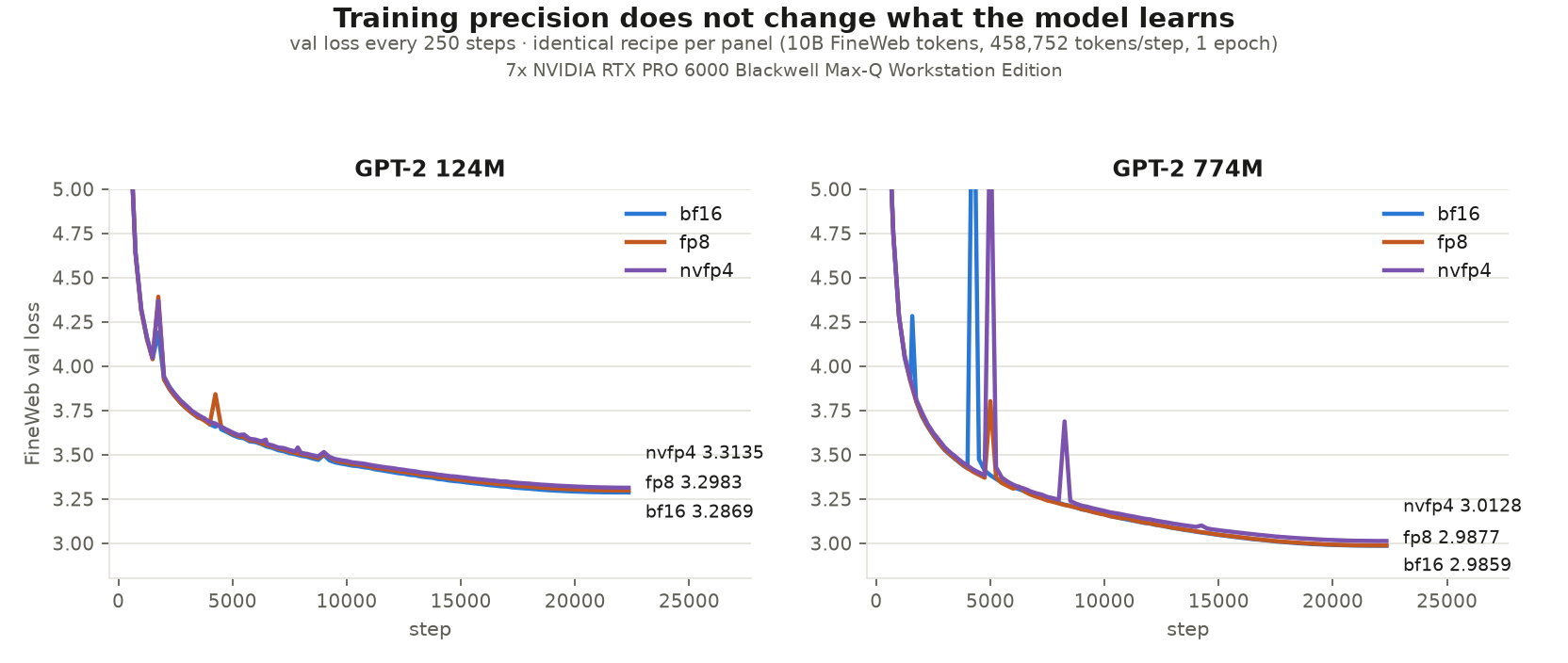
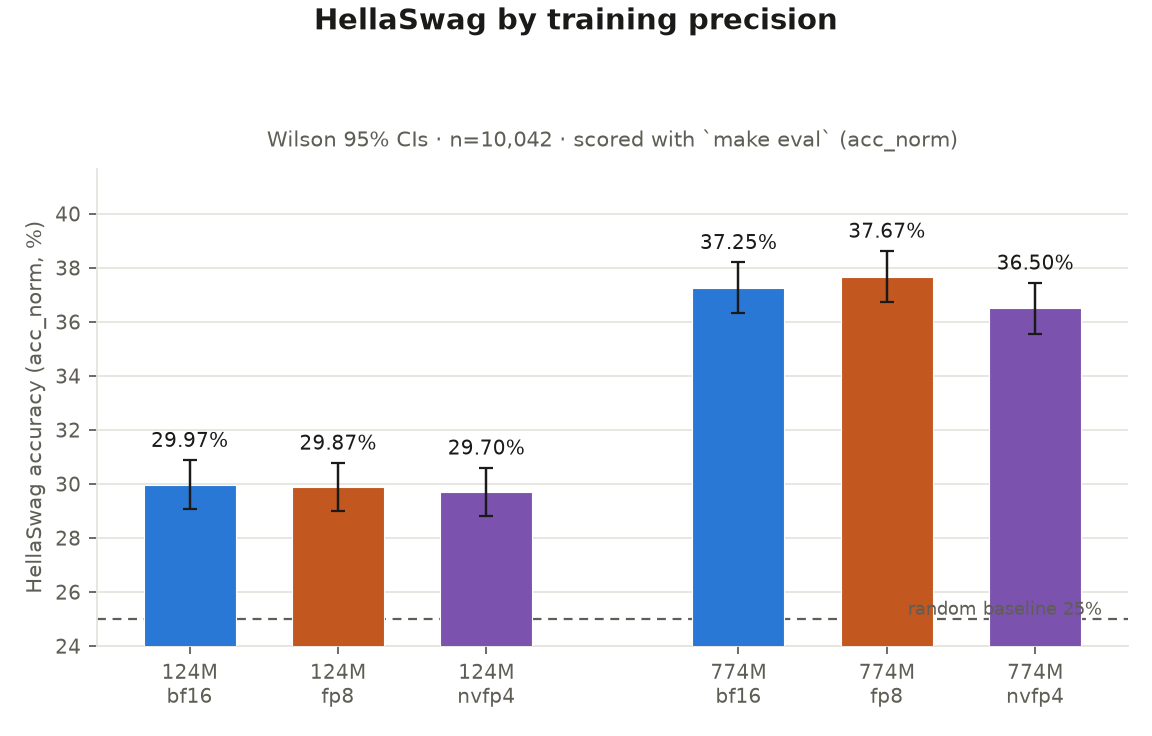
Reproduce with make figure-precision (or make figures for every data-derived figure). It renders from docs/ai/v2_arm_results/*.json, the same records that generate the table above, and writes a .json sidecar next to each .png carrying the source data verbatim.
Test
We ported test_gpt2.c from the original repository to validate our port. A full verification suite is also available via make.
Note:
make testchecks activations as well as gradients, so it needs reference files regenerated by the PyTorch script (pixi run python train_gpt2.py), a one-time step on a fresh clone. The starter-pack debug state downloaded bymake datais llm.c's activation-free format and is not sufficient.make trainworks with the downloaded starter pack directly.
Run Tests
make test
Run Verification
make verify
Development Roadmap
Future development includes:
att_probs, now the largest tensor on the card by a wide margin (~18 GiB at B=32, T=1024, growing as T² — 24× the logits tensor once cross-entropy is chunked). Its own code comment names the trigger condition for switching the store to the per-layer QKᵀ-recompute path already implemented behindkv_cache.att_probs_addr = 0, and this box now meets it — but the +3.5% cost figure behind the current default was measured on Metal at an 8× smaller batch, so it needs re-measuring on CUDA at production shape before flipping- Drop the chunked cross-entropy's remaining 196.5 MiB floor, which exists only because generation reads
acts.logits + row·V_pwhen it wants a single row; removing it also decouples the saving frommax_seq_len - Mamba1/Mamba2/Mamba3 architecture and MoE
Motivation
LLMs in Mojo without needing PyTorch or CPython. Inspired by Karpathy's llm.c, with a focus on proving out the viability of autograd in pure Mojo syntax. The goal is to reproduce GPT-2 and GPT-3 alongside a parallel PyTorch reference in train_gpt*.py.
A personal goal is to write all kernel and main Python code without any LSPs or LLMs, writing every algorithm (forward and backpropagation) from scratch. I received feedback recently that my "coding and math expertise" needs work, and building out this framework is how I intend to strengthen those skills. Just like writing a compiler, writing the fundamentals of generative models from scratch sharpens both engineering and mathematics.
As part of that goal, I use NVIDIA Nsight and Perfetto to analyze performance and compare it against my PyTorch implementation of GPT-2. As the project evolves, I will add benchmarking results and other insights comparing Mojo, PyTorch, and Karpathy's C implementation.
To speed up testing, I used LLMs/AI to help write the test cases and accelerate their runtime. I wrote all of the code in llmm/ and the root directory by hand, but LSPs and LLMs helped write the tests. I also use the formatter and compiler to typecheck, as I always have.
Agentic Optimizations
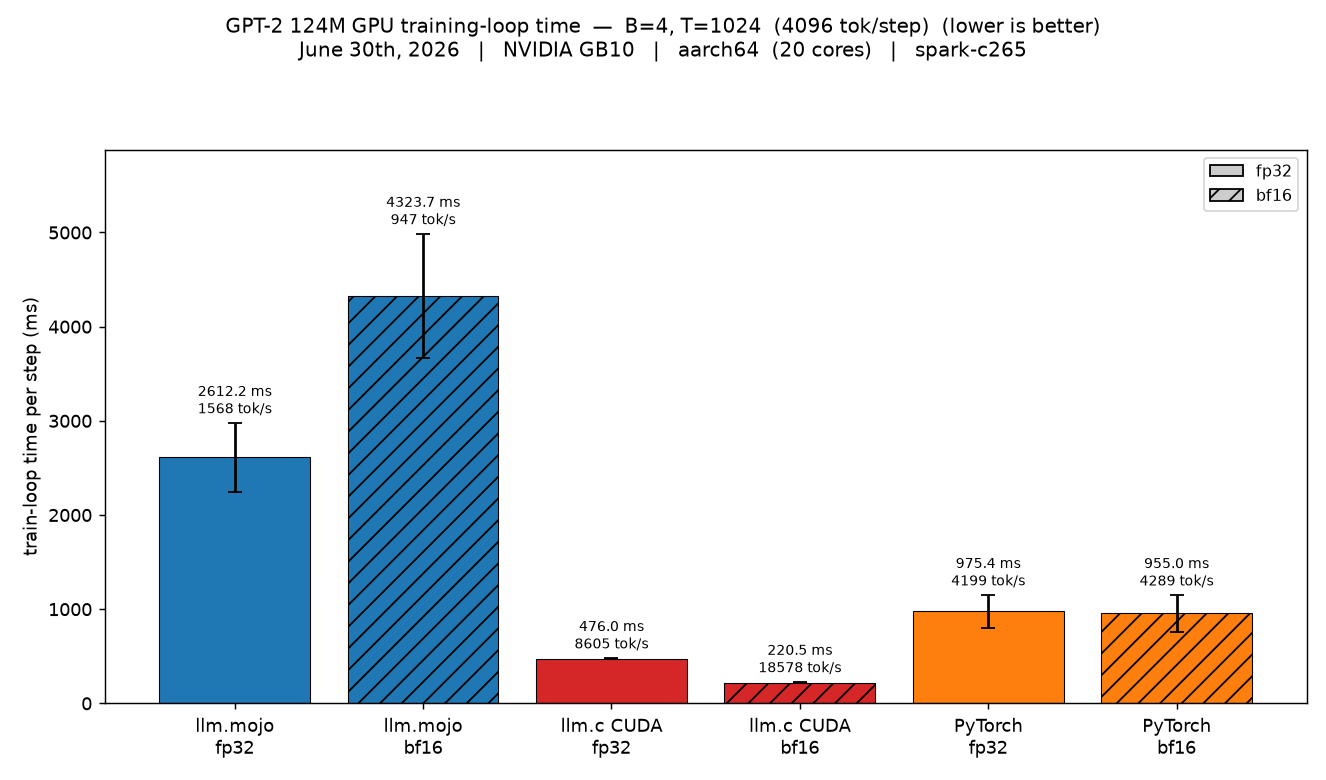
After I reached functional success, my kernels were badly underperforming Karpathy and PyTorch. I profiled the code first and found attention was the bottleneck. After a few attempts at writing a better attention kernel, I decided to bring in AI agents. I started with Google Gemini, and after quickly running out of credits, moved to OpenCode and NVIDIA Nemotron 3 Ultra. When Nemotron 3 struggled for a few days on the optimization, I pivoted to Claude Opus (and more recently Fable), eventually reaching parity in bfloat16 (and later, with TF32 enabled on the fp32 GEMMs plus a round of backward-kernel fusion, pulling ~7% ahead of llm.c in float32 too). The full exploration is documented in docs/ai/ai_assisted_optimizations_and_benchmarks.md. My initial results are documented below:
Thanks
A special thanks to https://github.com/dorjeduck/llm.mojo and @dorjeduck for writing the original implementation of llm.mojo in Mojo 25.5.
Changelog
See CHANGELOG.md for a detailed history of notable changes to this project.
License
This project is licensed under the MIT License.