
timfewi/tentaflake has 32 GitHub stars and 2 forks. GitHot measured 0 stars in 24 hours and 0 in 7 days. Last checked 2026-11-12 22:19 UTC. Last push 2026-11-05.
Declaratively deploy & manage multiple isolated AI agents on a single NixOS machine — each with its own secrets, skills, and personality.
計測したスター増加
- 24時間
- 0
- 7日間
- 0
- 15日間
- 更新が遅れています
- 1か月
- 更新が遅れています
期間ごとの純増数です。期間は重複しており、日別の値ではありません。未計測の値は空欄です。スター数は注目度の指標であり、品質の保証ではありません。
README.md
オリジナルTentaflake
A runtime-agnostic NixOS flake template for isolated AI agents on one host.
Declare agents in tentaflake.toml, choose an adapter, and manage them through
systemd and the Rust tentaflake CLI. No mandatory web UI or control service.
Pre-1.0: interfaces and security policy can break between releases. Pin a revision and read the changelog and migration guide before updating.
Start here
- Install or use the consumer example.
- Follow the secure quickstart.
- Import a stopped agent, then review and explicitly build/activate the host. Import never starts services.
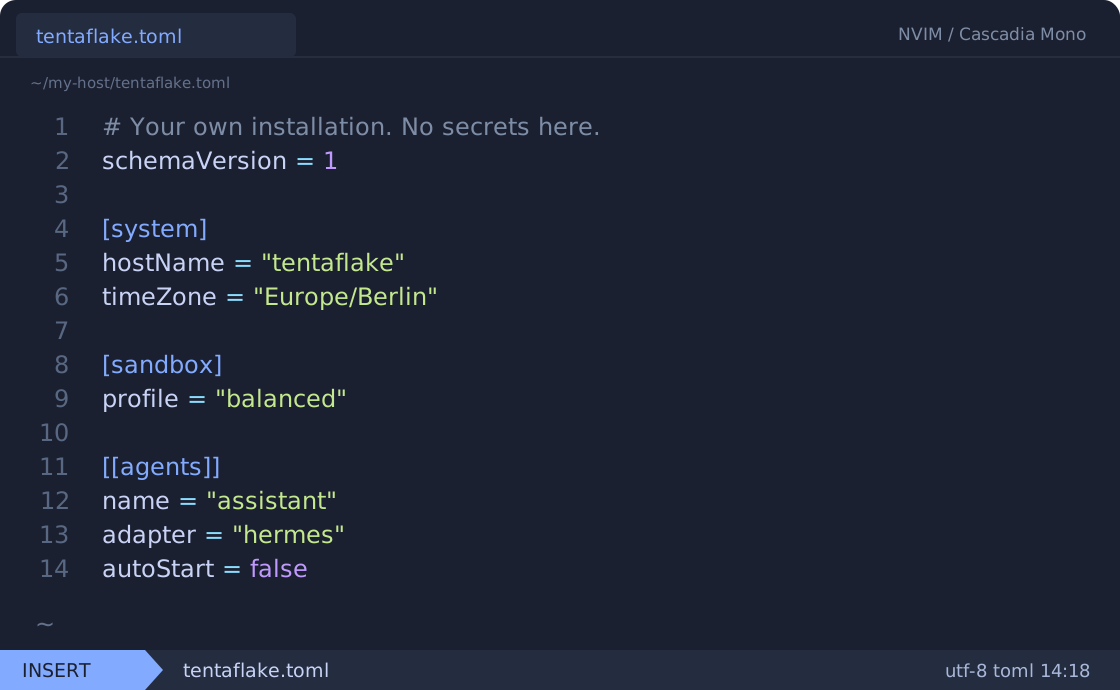
The public tentaflake.toml stays an empty, commented template:
schemaVersion = 1
agents = []
Maintain real desired state in your own consumer flake or deployment
fork, not in the upstream
template. Track that installation's TOML in its owning Git source; untracked,
ignored or missing configuration must fail rather than load the upstream empty
inventory. Even private TOML enters the Nix store: keep secrets in runtime files.
Fresh installations initialize their own empty inventory; no sample starts
automatically. Add reviewed, stopped entries only to that installation's file.
Existing agents.toml and agents.json inventories require a deliberate
migration; they are never silently
ignored in favor of an empty TOML inventory.
All managed container IDs are agent-<name>; names are globally unique across
adapters. Default host state is /var/lib/tentaflake/agents/<name>.
Configuration uses this file as the only instance source;
host broker, worker, quota and Research policy stays in Nix.
The operator shell
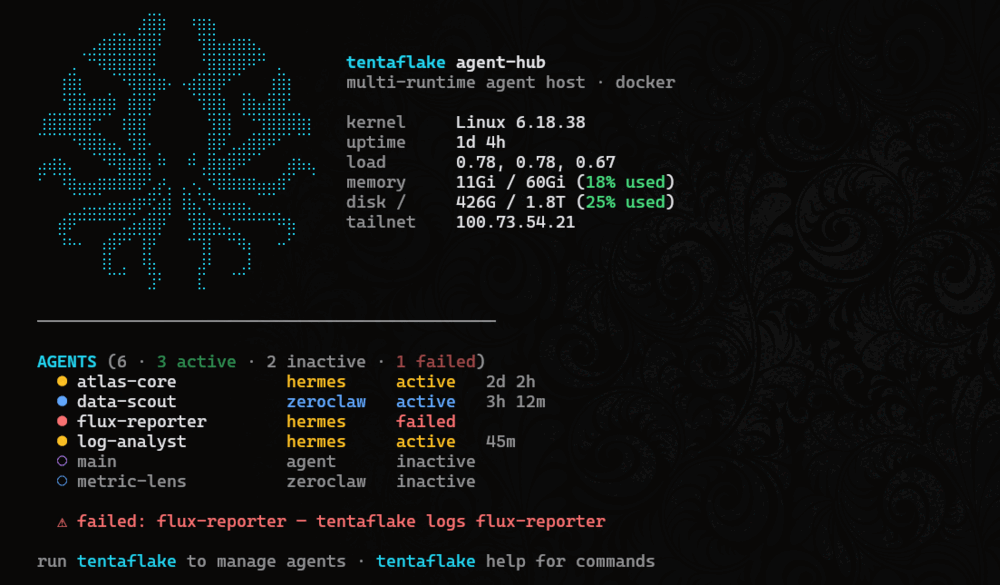
The login shell presents host and agent status. Use tentaflake status,
tentaflake logs agent-assistant and tentaflake doctor --security to inspect
your installation. The image illustrates the layout, not a live host or vendor
acceptance. See the operator shell guide for current commands.
Scope and support
Hermes and ZeroClaw have native adapters; real vendor acceptance remains
pending. OpenClaw is a stopped refusal scaffold, not a runnable
integration. Pi Durable is the same refusal scaffold by default; only explicit host
admission of the reviewed runtime (tentaflake.piDurableRuntime) runs it, and real
provider acceptance is pending. Generic workloads support reviewed digest-pinned OCI images and
in-capsule argv, offline only with no accepted provider/model or Research
integration. Discover fixed presets with tentaflake runtimes --json; the
adapter catalog records
support and evidence separately. Synthetic tests are not vendor acceptance.
Balanced containment uses gVisor, a read-only root, non-root ownership, bounded resources and no general egress. Automatic startup requires the exact agent's LLM broker, offline worker, workspace quota and Research relay. A worker declaration does not automatically intercept native tools. Provider keys stay on the host; private data never belongs in Nix inputs or Git. Read the security profiles and threat model before deployment.
Optional modules provide encrypted backup, image provenance, observability, runtime detection, a private Unix operator API, approval-bound system control and read-only enterprise connectors. They do not establish application readiness, native chat support or live provider acceptance. Their guides describe current source, not necessarily the website's pinned release.
Guides
- CLI, agent management, operations and restore
- Secrets, private management, observability
- Fork checklist, skills, roadmap
- Contributing, build/check boundaries, documentation ownership
Contributors start with just fast; evaluation, builds and live acceptance are
separate gates. Enter nix develop for direct Cargo/lint commands. No check
implicitly authorizes deployment. Report vulnerabilities through GitHub Security
Advisories. Code is MIT licensed; DCO and
trademark terms apply separately.
関連プロジェクトを探す
trimstray/the-book-of-secret-knowledge
インスピレーションを与えるリスト、マニュアル、チートシート、ブログ、ハック、ワンライナー、CLI/Web ツールなどを集めたコレクション。
258,145 スターHack-with-Github/Awesome-Hacking
ハッカー、ペンテスター、セキュリティ研究者向けのさまざまな Awesome リスト集。
125,360 スターswisskyrepo/PayloadsAllTheThings
Web アプリケーションセキュリティおよびペネトレーションテスト/CTF 向けの、実用的なペイロードとバイパスの一覧。
82,649 スターcaddyserver/caddy
高速で拡張しやすい、マルチプラットフォーム対応の HTTP/1-2-3 Web サーバー。自動 HTTPS に対応
79,038 スター