
socketio/socket.io-redis-adapter has 2,766 GitHub stars and 485 forks. GitHot measured 0 stars in 24 hours and 0 in 7 days. Last checked 2026-11-14 16:22 UTC. Last push 2026-06-22.
できること
- Socket management - 4.0.0 - :white_check_mark: YES (since version 6.1.0)
- Inter-server communication - 4.1.0 - :white_check_mark: YES (since version 7.0.0)
- Broadcast with acknowledgements - 4.5.0 - :white_check_mark: YES (since version 7.2.0)
- Connection state recovery - 4.6.0 - :x: NO
計測したスター増加
- 24時間
- 0
- 7日間
- 0
- 15日間
- 履歴を収集中
- 1か月
- 履歴を収集中
期間ごとの純増数です。期間は重複しており、日別の値ではありません。未計測の値は空欄です。スター数は注目度の指標であり、品質の保証ではありません。
概要
Adapter to enable broadcasting of events to multiple separate socket.io server nodes.
開発ツールREADME.md
オリジナルSocket.IO Redis adapter
The @socket.io/redis-adapter package allows broadcasting packets between multiple Socket.IO servers.
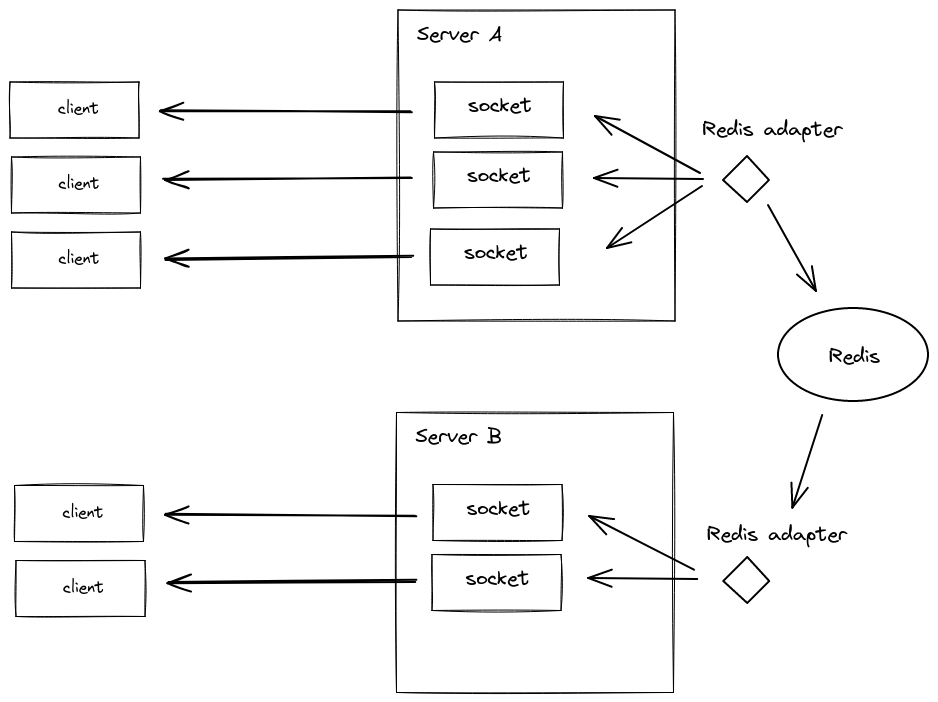
Table of contents
Supported features
| Feature | socket.io version |
Support |
|---|---|---|
| Socket management | 4.0.0 |
:white_check_mark: YES (since version 6.1.0) |
| Inter-server communication | 4.1.0 |
:white_check_mark: YES (since version 7.0.0) |
| Broadcast with acknowledgements | 4.5.0 |
:white_check_mark: YES (since version 7.2.0) |
| Connection state recovery | 4.6.0 |
:x: NO |
Security notice
The Redis adapter assumes that Redis is part of the trusted internal infrastructure.
Messages exchanged through Redis Pub/Sub are not signed, encrypted, or authenticated by the adapter. Anyone able to publish to the adapter channels may be able to inject packets or control messages. Redis should therefore not be exposed to untrusted networks or shared with untrusted clients.
Please use Redis ACLs, authentication, TLS, firewall rules, private networking, and dedicated credentials/channel permissions where appropriate.
Installation
npm install @socket.io/redis-adapter
Compatibility table
| Redis Adapter version | Socket.IO server version |
|---|---|
| 4.x | 1.x |
| 5.x | 2.x |
| 6.0.x | 3.x |
| 6.1.x | 4.x |
| 7.x and above | 4.3.1 and above |
Usage
With the redis package
import { createClient } from "redis";
import { Server } from "socket.io";
import { createAdapter } from "@socket.io/redis-adapter";

const pubClient = createClient({ url: "redis://localhost:6379" });
const subClient = pubClient.duplicate();

await Promise.all([
  pubClient.connect(),
  subClient.connect()
]);

const io = new Server({
  adapter: createAdapter(pubClient, subClient)
});

io.listen(3000);
With the redis package and a Redis cluster
import { createCluster } from "redis";
import { Server } from "socket.io";
import { createAdapter } from "@socket.io/redis-adapter";

const pubClient = createCluster({
  rootNodes: [
    {
      url: "redis://localhost:7000",
    },
    {
      url: "redis://localhost:7001",
    },
    {
      url: "redis://localhost:7002",
    },
  ],
});
const subClient = pubClient.duplicate();

await Promise.all([
  pubClient.connect(),
  subClient.connect()
]);

const io = new Server({
  adapter: createAdapter(pubClient, subClient)
});

io.listen(3000);
With the ioredis package
import { Redis } from "ioredis";
import { Server } from "socket.io";
import { createAdapter } from "@socket.io/redis-adapter";

const pubClient = new Redis();
const subClient = pubClient.duplicate();

const io = new Server({
  adapter: createAdapter(pubClient, subClient)
});

io.listen(3000);
With the ioredis package and a Redis cluster
import { Cluster } from "ioredis";
import { Server } from "socket.io";
import { createAdapter } from "@socket.io/redis-adapter";

const pubClient = new Cluster([
  {
    host: "localhost",
    port: 7000,
  },
  {
    host: "localhost",
    port: 7001,
  },
  {
    host: "localhost",
    port: 7002,
  },
]);
const subClient = pubClient.duplicate();

const io = new Server({
  adapter: createAdapter(pubClient, subClient)
});

io.listen(3000);
With Redis sharded Pub/Sub
Sharded Pub/Sub was introduced in Redis 7.0 in order to help scaling the usage of Pub/Sub in cluster mode.
Reference: https://redis.io/docs/interact/pubsub/#sharded-pubsub
A dedicated adapter can be created with the createShardedAdapter() method:
With redis
Minimum requirements:
- Redis 7.0
[email protected]
import { Server } from "socket.io";
import { createClient } from "redis";
import { createShardedAdapter } from "@socket.io/redis-adapter";

const pubClient = createClient({ host: "localhost", port: 6379 });
const subClient = pubClient.duplicate();

await Promise.all([
  pubClient.connect(),
  subClient.connect()
]);

const io = new Server({
  adapter: createShardedAdapter(pubClient, subClient)
});

io.listen(3000);
With ioredis
Minimum requirements:
- Redis 7.0
[email protected]
Please note that the shardedSubscribers option is required to enable sharded Pub/Sub.
import { Cluster } from "ioredis";
import { Server } from "socket.io";
import { createShardedAdapter } from "@socket.io/redis-adapter";

const pubClient = new Cluster(
  [
    {
      host: "localhost",
      port: 7000,
    },
    {
      host: "localhost",
      port: 7001,
    },
    {
      host: "localhost",
      port: 7002,
    },
  ],
  {
    shardedSubscribers: true,
  }
);
const subClient = pubClient.duplicate();

const io = new Server({
  adapter: createShardedAdapter(pubClient, subClient)
});

io.listen(3000);
Options
Default adapter
| Name | Description | Default value |
|---|---|---|
key |
The prefix for the Redis Pub/Sub channels. | socket.io |
requestsTimeout |
After this timeout the adapter will stop waiting from responses to request. | 5_000 |
publishOnSpecificResponseChannel |
Whether to publish a response to the channel specific to the requesting node. | false |
parser |
The parser to use for encoding and decoding messages sent to Redis. | - |
Sharded adapter
| Name | Description | Default value |
|---|---|---|
channelPrefix |
The prefix for the Redis Pub/Sub channels. | socket.io |
subscriptionMode |
The subscription mode impacts the number of Redis Pub/Sub channels used by the adapter. | dynamic |