
seekerhuang/HarMA
seekerhuang/HarMA has 64 GitHub stars and 3 forks. GitHot measured 0 stars in 24 hours, 0 in 7 days, and 0 in 15 days. Last checked 2026-11-11 19:40 UTC. Last push 2026-10-26.
[ICLRW 2024] Efficient Remote Sensing with Harmonized Transfer Learning and Modality Alignment
計測したスター増加
- 24時間
- 0
- 7日間
- 0
- 15日間
- 0
- 1か月
- 更新が遅れています
期間ごとの純増数です。期間は重複しており、日別の値ではありません。未計測の値は空欄です。スター数は注目度の指標であり、品質の保証ではありません。
README.md
オリジナルHarMA


This repo is the official implementation of "Efficient Remote Sensing with Harmonized Transfer Learning and Modality Alignment"(ICLRW 2024).
Introduction 🌍
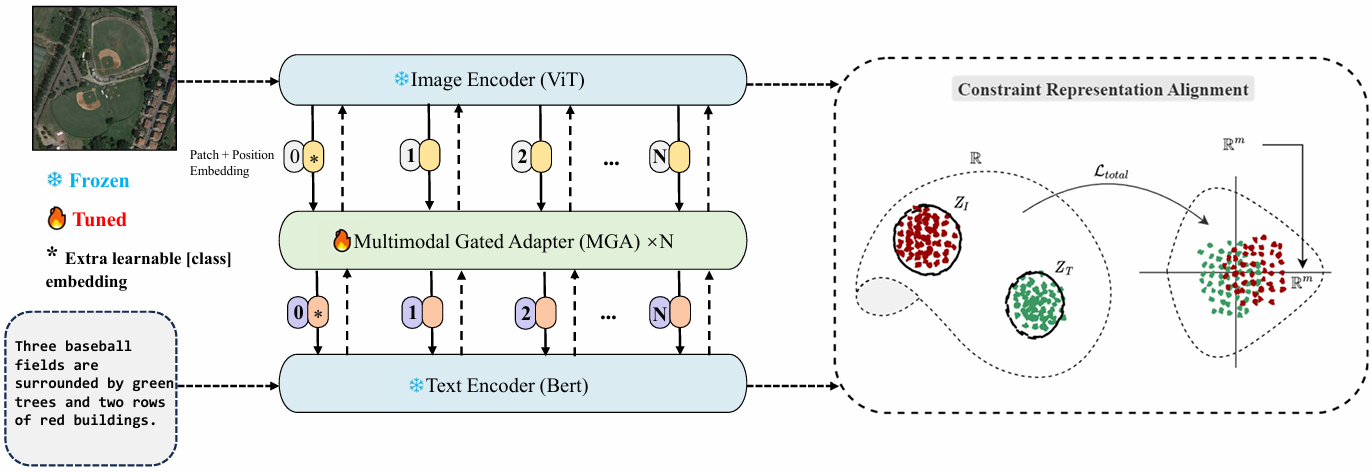
This paper proposes a framework for efficient remote sensing using Harmonized Transfer Learning and Modality Alignment (HarMA), addressing key challenges in the field of remote sensing image-text retrieval. HarMA leverages a unified perspective on multimodal transfer learning to enhance task performance, modality alignment, and single-modality uniform alignment. The core innovation lies in the hierarchical multimodal adapter inspired by the human brain's information processing, which integrates shared mini-adapters to improve fine-grained semantic alignment. By employing parameter-efficient fine-tuning, HarMA significantly reduces training overhead while achieving state-of-the-art performance on popular multimodal retrieval tasks without relying on external data or other tricks. This approach outperforms fully fine-tuned models with minimal parameter adjustments, making it a versatile and resource-efficient solution for remote sensing applications. Experiments validate the effectiveness of HarMA, showcasing its potential to enhance vision and language representations in remote sensing tasks.
Implementation 💻
Environments 🌐
Set up the environment by running:
pip install -r requirements.txt
Datasets 📚
All experiments are based on the RSITMD and RSICD datasets.
Download the images from Baidu Disk or Google Drive and modify the configs/yaml file accordingly:
image_root: './images/datasets_name/'
The annotation files for the datasets are located in the data/finetune directory.
Training 📈
Download the GeoRSCLIP pre-trained model from this link and place it in the models/pretrain/ directory.
If you encounter environmental issues, you can modify the get_dist_launch function in run.py. For example, for a 2-GPU setup:
elif args.dist == 'f2':
        return "CUDA_VISIBLE_DEVICES=0,1 WORLD_SIZE=2 /root/miniconda3/bin/python -W ignore -m torch.distributed.launch --master_port 9999 --nproc_per_node=2 " \
               "--nnodes=1 "
Start training with:
python run.py --task 'itr_rsitmd_vit' --dist "f2" --config 'configs/Retrieval_rsitmd_vit.yaml' --output_dir './checkpoints/HARMA/full_rsitmd_vit'

python run.py --task 'itr_rsicd_vit' --dist "f2" --config 'configs/Retrieval_rsicd_vit.yaml' --output_dir './checkpoints/HARMA/full_rsicd_vit'

python run.py --task 'itr_rsitmd_geo' --dist "f2" --config 'configs/Retrieval_rsitmd_geo.yaml' --output_dir './checkpoints/HARMA/full_rsitmd_geo'

python run.py --task 'itr_rsicd_geo' --dist "f2" --config 'configs/Retrieval_rsicd_geo.yaml' --output_dir './checkpoints/HARMA/full_rsicd_geo'
Testing 🧪
To evaluate the model, change if_evaluation to True in the configs/yaml, then run:
python run.py --task 'itr_rsitmd_vit' --dist "f2" --config 'configs/Retrieval_rsitmd_vit.yaml' --output_dir './checkpoints/HARMA/test' --checkpoint './checkpoints/HARMA/full_rsitmd_vit/checkpoint_best.pth' --evaluate

python run.py --task 'itr_rsicd_vit' --dist "f2" --config 'configs/Retrieval_rsicd_vit.yaml' --output_dir './checkpoints/HARMA/test' --checkpoint './checkpoints/HARMA/full_rsicd_vit/checkpoint_best.pth' --evaluate

python run.py --task 'itr_rsitmd_geo' --dist "f2" --config 'configs/Retrieval_rsitmd_geo.yaml' --output_dir './checkpoints/HARMA/test' --checkpoint './checkpoints/HARMA/full_rsitmd_geo/checkpoint_best.pth' --evaluate

python run.py --task 'itr_rsicd_geo' --dist "f2" --config 'configs/Retrieval_rsicd_geo.yaml' --output_dir './checkpoints/HARMA/test' --checkpoint './checkpoints/HARMA/full_rsicd_geo/checkpoint_best.pth' --evaluate
Note: We provide a Jupyter notebook for direct execution. Please refer to the begin.ipynb file. If you want to test or use the pre-trained models directly, you can download the checkpoints from Checkpoints-v1.0.0.
Citation 📜
If you find this paper or repository useful for your work, please give it a star ⭐ and cite it as follows:
@article{huang2024efficient,
  title={Efficient Remote Sensing with Harmonized Transfer Learning and Modality Alignment},
  author={Huang, Tengjun},
  journal={arXiv preprint arXiv:2404.18253},
  year={2024}
}
Acknowledgement 🙏
This code builds upon the excellent work of PIR by Pan et al.
関連プロジェクトを探す
sindresorhus/awesome
😎 あらゆる興味深いトピックに関する Awesome リスト [注意: 既存のプルリクエストに追いつけるまで、プルリクエストは一時的に無効になっています]
535,914 スターEbookFoundation/free-programming-books
:books: 無料で入手できるプログラミングの書籍
401,494 スターnilbuild/developer-roadmap
開発者のキャリア成長を支える、インタラクティブなロードマップ、ガイド、その他の教育コンテンツ。
371,909 スターvinta/awesome-python
「Python で X をしたい。どのツールを使えばいい?」に答える決定版リスト。
334,311 スター