
rasinmuhammed/misata
rasinmuhammed/misata has 77 GitHub stars and 4 forks. Star changes are not measured yet. Last checked 2026-11-12 10:06 UTC. Last push 2026-11-01.
Declarative synthetic data for Python. State the facts a dataset must hold (monthly revenue, channel shares, balanced ledgers, foreign keys, state machines) and get multi-table data that holds them exactly, with a DuckDB certificate anyone can rerun. From YAML, SQL DDL or a sentence. CLI and MCP server.
できること
- outcome_curves - a measure's total per period, to the cent - ✓
- rate_curves - the share of rows flagged per period, to the nearest row - ✓
- group_shares - each group's share of a measure inside every period - ✓
- balanced_ledger - debits equal credits per entry, and the trial balance is zero - ✓
計測したスター増加
- 24時間
- 更新が遅れています
- 7日間
- 更新が遅れています
- 15日間
- 更新が遅れています
- 1か月
- 更新が遅れています
期間ごとの純増数です。期間は重複しており、日別の値ではありません。未計測の値は空欄です。スター数は注目度の指標であり、品質の保証ではありません。
README.md
オリジナル
Misata
Declare what must be true. Get data that makes it true. Prove it.
Misata is a declarative synthetic data generator for Python. You write down the facts a dataset has to satisfy, from a monthly revenue curve to a balanced ledger to a foreign key that must never dangle, and the engine builds multi-table data that satisfies all of them at once. Then DuckDB checks the files on disk and writes a certificate anyone can re-run.


Docs · Use cases · The language · Limitations · Studio · Changelog
Sixty seconds
pip install "misata[duckdb]"
# misata.yaml
seed: 7
tables:
  customers:
    rows: 2000
    columns:
      customer_id: {type: int, unique: true, min: 1, max: 2000}
      name: {type: text, text_type: name}
      signed_up: {type: date, start: "2024-01-01", end: "2024-12-31"}
  orders:
    rows: 40000
    columns:
      order_id: {type: int, unique: true, min: 1, max: 1000000}
      customer_id: {type: foreign_key}
      channel: {type: categorical, choices: [web, app, store]}
      amount: {type: float, min: 5, max: 900}
      ordered_at: {type: date, start: "2025-01-01", end: "2025-12-31"}
relationships:
  - customers.customer_id -> orders.customer_id
outcome_curves:
  - table: orders
    column: amount
    time_column: ordered_at
    start_date: "2025-01-01"
    curve_points:
      - {month: 1, target_value: 180000}
      - {month: 6, target_value: 240000}
      - {month: 12, target_value: 310000}
group_shares:
  - table: orders
    measure: amount
    group_column: channel
    shares: {web: 0.5, app: 0.3, store: 0.2}
misata generate -c misata.yaml -o data --attest
python data/verify.py
Attestation: data
  result: PASSED
  files pinned: 2
  invariants held: 69 of 69

ok    2 file(s) match their attested sha256
ok    69 of 69 invariant(s) hold
The 69 are derived from the YAML before a row exists: twelve monthly revenue
totals (180,000.00 in January, 240,000.00 in June, 310,000.00 in December,
straight lines between), the channel split inside every one of those months,
the planned row count per month, zero orphaned customer_ids and unique keys.
verify.py needs only the standard library and duckdb, and it shares no
code with the generator.
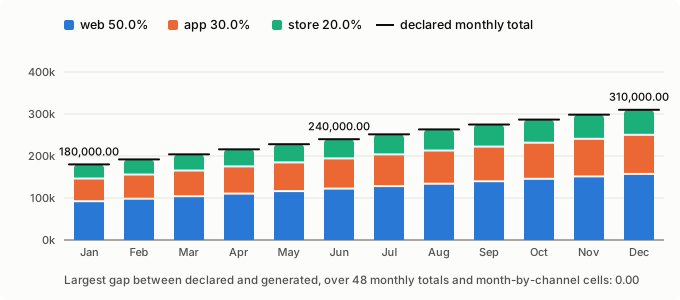
The YAML above, generated and summed by month and channel. Each bar is a month of generated revenue split by channel; the cap is the total the YAML declares. Drawn by readme_charts.py from a fresh run of this README's own YAML.
Change one cent in one row and it says so:
FAIL  orders.csv: sha256 301165f9dc4e does not match the attested 670f89195826
FAIL  orders.amount.month:1.outcome_curve_period: expected 180000.00, observed 180000.01
FAIL  orders.amount.outcome_curve_total: expected 2945000.00, observed 2945000.01
FAIL  orders.amount.web.2025-01.group_share_period: expected 90000.00, observed 90000.01
FAIL  orders.amount.web.group_share_total: expected 1472500.00, observed 1472500.01
FAIL  65 of 69 invariant(s) hold
Why declare instead of generate
Every test fixture has an oracle problem. To check a dbt model, a Spark job, a dashboard tile or a data agent you need input data and an answer you know independently of the code under test. Copying production gives you data without an answer. Hand-written fixtures give you an answer that rots. Random generators give you data whose answer you have to compute with the code you are testing.
Misata turns it around. The specification is the ground truth and the rows are derived from it. "January revenue is 180,000" is true before a single row exists, so your pipeline either returns 180,000.00 or it has a bug.
flowchart LR
    A["Declare<br/>curves, shares, ledgers,<br/>keys, lifecycles"] --> B{"Can they<br/>all hold?"}
    B -- "no" --> R["Refused, with the<br/>arithmetic and a fix"]
    B -- "yes" --> C["Build rows<br/>closed form where it can,<br/>by construction elsewhere"]
    C --> D["Write<br/>CSV, Parquet, JSONL,<br/>DuckDB, Postgres"]
    D --> E["Attest<br/>DuckDB re-runs every<br/>derived invariant"]
    E --> F["Certificate<br/>in-toto Statement<br/>plus verify.py"]
Three properties make this different from a generator with options:
- A declaration is honoured or refused, never quietly replaced. Declarations that cannot all hold stop generation with an error that names each one, shows the arithmetic and suggests the change.
- The certificate is checked by code that did not write the data. A bug in Misata's arithmetic shows up as a failed invariant, not a self-consistent wrong answer.
- The same spec, seed and version give the same bytes on Linux, macOS and Windows, so a fixture can live in git with its fingerprint.
Where this is going
Misata's aim is that nobody writes a Python script to make a dataset, of any kind. You say what has to be true; the engine works out the rows, refuses what cannot hold, and proves what it built.
It is not there yet, and it is getting there brick by brick. Each release adds things you can declare instead of programming, and a brick is laid only when it passes three tests: it can be declared in a few lines of YAML, it is refused before generation when it contradicts another declaration, and it is re-checked on the rows afterwards by code that did not write them.
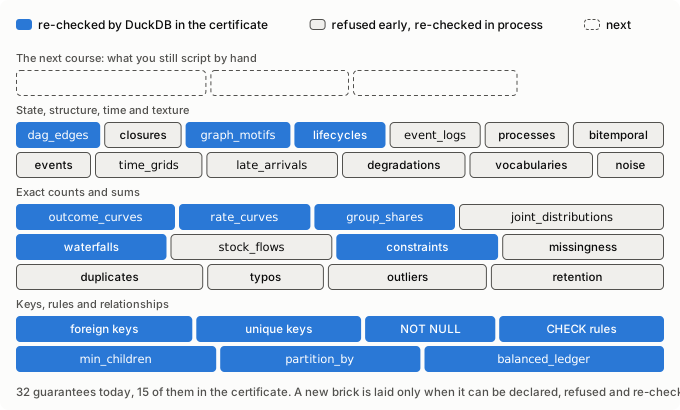
Every brick is something you declare instead of code. Drawn from misata/registry.py, the list a contract test holds the code to, so the wall cannot claim a brick the engine does not have.
One fact, two ways. What a script has to do to make a fact true, and what you write instead:
| The fact | In a generator script | In Misata |
|---|---|---|
| January revenue is 180,000.00 | draw amounts, sum them, rescale, round, chase the last cent | {month: 1, target_value: 180000} |
| web is half of every month's revenue | rescale inside each month and channel, then repair the monthly totals you just broke | shares: {web: 0.5, app: 0.3, store: 0.2} |
| every order has a real customer | sample ids from the parent table and keep both in step | customers.customer_id -> orders.customer_id |
| some churned customers were active first | branch on status, write timestamps in order, null the rest, count by hand | transitions: [[trialing, active], [active, churned]] |
| 1% of transfers form laundering patterns, in a set mix | build each ring and fan by hand, then prove the background has no cycle of its own | rate: 0.01 and shares: {cycle: 0.4, fan_in: 0.25, ...} |
| the trial balance is zero | post both legs of every entry and reconcile at the end | a balanced_ledger constraint on the journal lines |
What still takes code, and where each one stands:
| Still scripted by hand | Where it stands |
|---|---|
| The expected output of logic Misata cannot invert: window functions, custom SQL, business rules | misata solve drives your real dbt, SQL or Python pipeline to a declared number within a stated tolerance; past that, you write the expected value |
| Correlations you can only describe by example | misata.mimic fits them from real rows, and its output is not anonymous |
| Free text with a voice of its own | text is generated from grammars and agrees with its row; prose that reads as written is not declarable yet |
| Version histories (SCD2) and inventory trajectories | generated to balance, not yet declared step by step |
| Documents, images and audio | not started |
LIMITATIONS.md keeps the full list. When a line leaves this table, it is because the brick that replaces it has passed all three tests.
The evidence
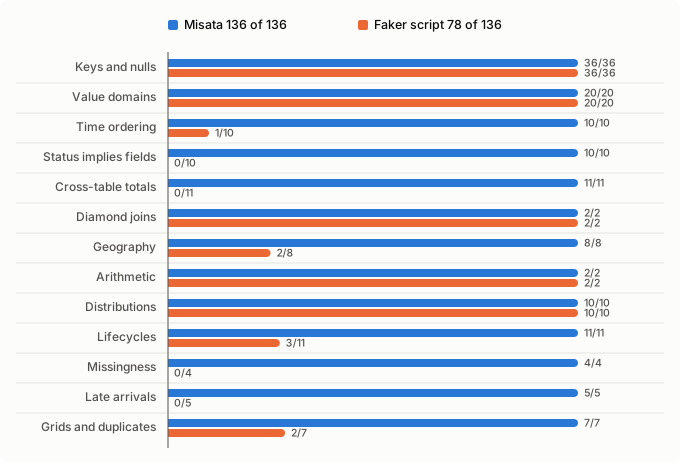
The Gauntlet: 13 tables and 136 SQL assertions run by DuckDB. The Faker script ties wherever a fact is about one column at a time and loses wherever columns, rows or tables have to agree. Source, rerun with python -m benchmarks.gauntlet.
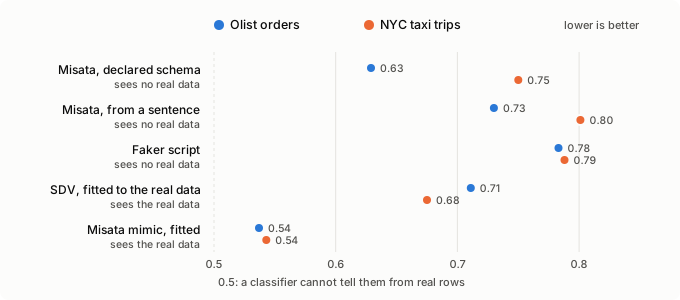
A gradient-boosted classifier tries to tell generated rows from real ones; mean of five seeds. Without seeing a real row, a declared schema beats SDV trained on the real orders. On taxi trips SDV wins: blind fares are a miss. Source, numbers in summary.json.
| Claim | Measured | Reproduce |
|---|---|---|
| Valid by construction | 0 violations of keys, CHECK, UNIQUE, NOT NULL and self-reference trees on five DDL schemas. A per-column Faker script: 15,014 to 50,416 per schema. SDV's multi-table model trained on valid data: 3,055 to 5,557, and it refuses two of the five | python -m benchmarks.validity_bench |
| Conformance | 345 SQL assertions in four suites, all held: the Gauntlet 136, the Warren 110, the Ledger 48, the Borough 51 | python -m benchmarks.gauntlet |
| Reproducible | identical fingerprints on Linux, macOS and Windows | python -m benchmarks.golden |
| Scale | 10,000,000 rows across 14 tables in 36.3 s at 0.78 GB peak on an Apple M1, every foreign key checked afterwards | python benchmarks/bench_r3_volume.py --scale 10 --stream out/ |
What you can declare
Each declaration has a guarantee stated so you could test it, a list of the columns it owns, a cost and a refusal. LANGUAGE.md is the reference. All 25 declaration kinds are checked for feasibility before a row exists and re-checked on the rows afterwards; the ones marked ✓ are also in the DuckDB certificate.
| Declare | What holds | Certificate |
|---|---|---|
outcome_curves |
a measure's total per period, to the cent | ✓ |
rate_curves |
the share of rows flagged per period, to the nearest row | ✓ |
group_shares |
each group's share of a measure inside every period | ✓ |
balanced_ledger |
debits equal credits per entry, and the trial balance is zero | ✓ |
waterfalls |
opening plus movements equals closing, per component | ✓ |
relationships, min_children, partition_by |
no orphans, no childless parent, no key crossing a tenant | ✓ |
unique, inequality, col_range, choices, NOT NULL, DDL CHECK |
no row breaks the rule | ✓ |
lifecycles |
a status implies its whole history: the right timestamps set, in order, and the rest null | ✓ |
dag_edges, graph_motifs |
no cycle outside a planted case; each ring, fan and chain at its exact count | ✓ |
stock_flows |
inventory balances, chains period to period, and opens where declared | ✓ |
lte_parent, sum_lte_parent |
a child, or a parent's children together, stay under the parent's bound, without moving a declared total | ✓ |
time_grids, parent_time, parent_end |
a declared clock; a child after its parent existed, and inside its span | ✓ |
no_overlap, capacity |
an entity in one place at a time; no resource holding more than it can at any instant | ✓ |
roll-ups, scd2, bitemporal, when_then |
parents equal their children, versions tile a timeline | |
outliers, typos, duplicates, missingness, late_arrivals |
dirt at exact counts, with an answer key | |
retention, joint_distributions, event_logs, processes |
cohort curves, joint margins, logs that agree with status |
Underneath any declaration, foreign keys resolve by construction (parents are built before children), text agrees with its row, money is skewed, timestamps have a daily rhythm and a few customers place most of the orders, so the data looks like a business before you declare anything. A sentence picks one of 18 story domains, from SaaS and fintech to healthcare, logistics and streaming, each with its tables, keys and calibrated distributions.
Pick your entry point
| You have | Call | Notes |
|---|---|---|
| A sentence | misata.generate("A SaaS company with 1,000 customers", seed=42) |
fastest start; print the tables or misata explain to see what it built |
| YAML or a dict | misata.generate_from_schema(schema) |
every declaration holds, or it refuses |
| SQL DDL | misata.from_ddl(ddl) or misata generate -c schema.sql |
NOT NULL, UNIQUE, composite keys, CHECK ranges and enums, self-references |
| A live database | misata seed postgresql://... |
introspects, inserts in one transaction, never truncates unless you pass --truncate |
| A dbt project | misata dbt-unit-test --select my_model |
fixtures from manifest.json whose keys agree |
| Prisma or Django | misata prisma-seed, misata.from_django(app_labels=[...]) |
|
| More rows than memory | misata.generate_stream(schema) |
yields (table, batch); partitioned Parquet, one file per partition |
| A pipeline whose output must hit a number | misata solve -c solve.yaml |
drives inputs through your real dbt or Python pipeline to a declared outcome, within a stated tolerance |
| A dataset to share | misata publish data --hf you/name |
re-verifies, then uploads the data with its spec, certificate and verifier |
| Real rows to imitate | misata.mimic(df) |
fitted to real rows; not anonymous |
Pass a seed every time. The same seed is the same data.
Twelve recipes
Each is a folder with the schema, the commands, and the check that proves the
declaration held. tools/stranger.py --clean runs every command on every page
from a freshly built wheel in a clean virtualenv before each release, so the
numbers on the pages are what you will see.
| Recipe | For | Proof |
|---|---|---|
| Seed a dev database | app developers, coding agents | 22 invariants from three CREATE TABLE statements |
| Known-answer tests for dbt | analytics engineers | a dbt test that catches the last-day-of-month bug |
| A warehouse before users | founders, data leads | 291,000 rows of partitioned Parquet, 80 invariants |
| A demo tenant | sales engineers, PMs | churned and healthy accounts, a few whales; realism 0.96 |
| An eval database | AI labs, eval teams | text-to-SQL answers verified on three rotated databases |
| An agent sandbox | agent builders | the sandbox and the grader agree row for row |
| Load testing | platform engineers | hot keys and a daily curve, keys checked before replay |
| Fraud and AML | risk and ML teams | an acyclic background and every ring at its declared count |
| Ledgers that reconcile | finance engineering, audit | two fiscal years, 52 invariants, trial balance zero |
| Take-home exercises | hiring teams, course authors | a different answer key per candidate, each verified |
| PII-free environments | regulated teams | staging data from production DDL, never production rows |
| Example data for docs | DX, API and SDK teams | nested JSONL whose ids resolve across files |
A status that implies its history
Declare the state machine once and every row's timestamps follow from its status. From the demo tenant:
stateDiagram-v2
    direction LR
    [*] --> trialing
    trialing --> active
    trialing --> churned
    active --> past_due
    active --> churned
    past_due --> churned
lifecycles:
  - name: subscription
    table: subscriptions
    state_column: status
    start_column: started_at
    initial: trialing
    states:
      - {name: trialing}
      - {name: active, timestamp: activated_at}
      - {name: past_due, timestamp: past_due_at}
      - {name: churned, timestamp: churned_at, terminal: true}
    transitions:
      - [trialing, active]
      - [trialing, churned]
      - [active, past_due]
      - [active, churned]
      - [past_due, churned]
    weights: {trialing: 0.07, active: 0.6, past_due: 0.07, churned: 0.26}
Of 1,200 subscriptions, exactly 720 are active, 312 churned, 84 past due and 84 still trialing: weights are counts, allocated by largest remainder, not probabilities. Every past-due row has an activation date and a past-due date, in that order and after it started; no active row has a churn date. The certificate checks both, row by row. A state reachable several ways splits its rows across every route: of the 312 churned, 156 left during the trial, 78 after being active and 78 after falling past due.
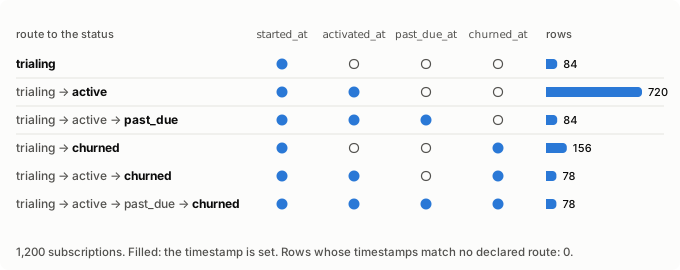
The demo tenant's 1,200 subscriptions, grouped by which timestamps are set. Six routes, and no row outside them. Drawn by readme_charts.py from the recipe's own YAML.
When it says no
$ misata explain bad.yaml
Generation would refuse: 1 conflict(s).
1 declaration cannot be satisfied together:
  1. [orders.channel] group_shares on amount
      declared shares sum to 1.500 (web=0.6, app=0.6, store=0.3); a share of a whole cannot exceed 1.0
      → Suggestion: scale the shares so they sum to 1.0, or drop a group. Misata will not renormalise them for you, because the result would be a specification you did not write
Nothing was generated. Change the declarations each conflict names; its remedy says how.
misata explain prints the planned rows, what each declaration will write,
how many invariants the certificate will carry and every conflict, without
generating anything. Every command takes --json and prints one envelope;
exit code 3 means the declarations cannot all hold and nothing was written.
With a coding agent
The agent designs the schema, Misata does the arithmetic, and DuckDB checks it. An agent cannot certify its own output; this is how it gets an answer it did not write.

claude mcp add misata -- uvx --from "misata[mcp]" misata-mcp   # Claude Code
misata mcp install --client all                                  # Cursor, Windsurf, Claude Desktop
Fifteen tools: generate_from_schema, generate_dataset, explain_schema,
validate_yaml, inspect_schema, preview_story, list_domains,
validate_domain, seed_database, create_sandbox, query_sandbox,
solve_outcome, attest_dataset, audit_dataset and check_realism.
AGENTS.md tells an agent which entry point fits which job and
which claims the evidence supports.
What it is not
Misata imitates nothing unless you ask it to. It does not learn a joint
distribution from your data. If you need a statistical twin of a specific
private table, use a differentially private synthesizer with a stated
epsilon. mimic fits to real rows and is not anonymous.
It is exact for what can be declared (sums, rates, shares, roll-ups,
ledgers, keys, lifecycles) and not for arbitrary SQL. A model built on a
window function or business logic Misata cannot invert still gets coherent,
key-valid inputs, and you write the expected output. misata solve closes
part of that gap by driving inputs through your real pipeline to a declared
outcome within a stated tolerance, and the certificate says which tolerance.
Priors are English-first and US-leaning on money, and rates round to whole rows. LIMITATIONS.md has the full list and wins any argument with the rest of the docs.
| Imperative | Inferential | Declarative | |
|---|---|---|---|
| You give it | code that emits values | real data to fit | facts that must hold |
| It guarantees | nothing after the fact | resemblance, approximately | the facts exactly, or a refusal |
| Foreign keys | your problem | per table fine, across tables fragile | by construction |
| Needs real data | no | yes | no |
| Examples | Faker, Mockaroo, LLM seed scripts | SDV, learned synthesizers | Misata |
Cite
If Misata helps your work, cite the software. GitHub's Cite this repository button reads the same metadata from CITATION.cff.
@software{rasin_misata,
  title  = {Misata: declarative synthetic data},
  author = {Rasin, Muhammed},
  url    = {https://github.com/rasinmuhammed/misata}
}
Contribute
git clone https://github.com/rasinmuhammed/misata && cd misata
uv sync --all-extras && uv run pytest -q
python tools/stranger.py --clean    # every documented command, from the built wheel
A capability earns a place only if it can be declared and verified. The
conformance suites in benchmarks/ are the contract: write the assertion
first, watch it fail, then make it pass. MIT licensed.
関連プロジェクトを探す
Asabeneh/30-Days-Of-Python
30 Days of Python プログラミングチャレンジは、Python プログラミング言語を 30 日で学ぶためのステップバイステップのガイドです。このチャレンジは 100 日以上かかることもあります。自分のペースで進めてください。こちらの動画も役立つかもしれません: https://www.youtube.com/channel/UC7PNRuno1rzYPb1xLa4yktw
78,618 スターgrafana/grafana
オープンで組み合わせ可能なオブザーバビリティおよびデータ可視化プラットフォームです。Prometheus、Loki、Elasticsearch、InfluxDB、Postgres など、複数のソースからメトリクス、ログ、トレースを可視化できます。
77,859 スターredis/redis
リアルタイムのデータ駆動型アプリケーションを構築する開発者にとって、Redis は最も選ばれ、最速で、機能が最も豊富なキャッシュ、データ構造サーバー、ドキュメントおよびベクトルクエリエンジンです。
77,472 スターapache/superset
Apache Superset は、データ可視化とデータ探索のためのプラットフォームです。
75,495 スター