
numisveinsson/SeqSeg
numisveinsson/SeqSeg has 26 GitHub stars and 5 forks. GitHot measured 0 stars in 24 hours and 0 in 7 days. Last checked 2026-11-14 16:50 UTC. Last push 2026-11-03.
計測したスター増加
- 24時間
- 0
- 7日間
- 0
- 15日間
- 履歴を収集中
- 1か月
- 履歴を収集中
期間ごとの純増数です。期間は重複しており、日別の値ではありません。未計測の値は空欄です。スター数は注目度の指標であり、品質の保証ではありません。
概要
SeqSeg (Sequential Vessel Segmentation)
機械学習README.md
オリジナル

SeqSeg: Sequential Vessel Segmentation and Tracking
Automatic tracking and segmentation of blood vessels in CT and MR images using deep learning and geometric tracking.



Why SeqSeg?
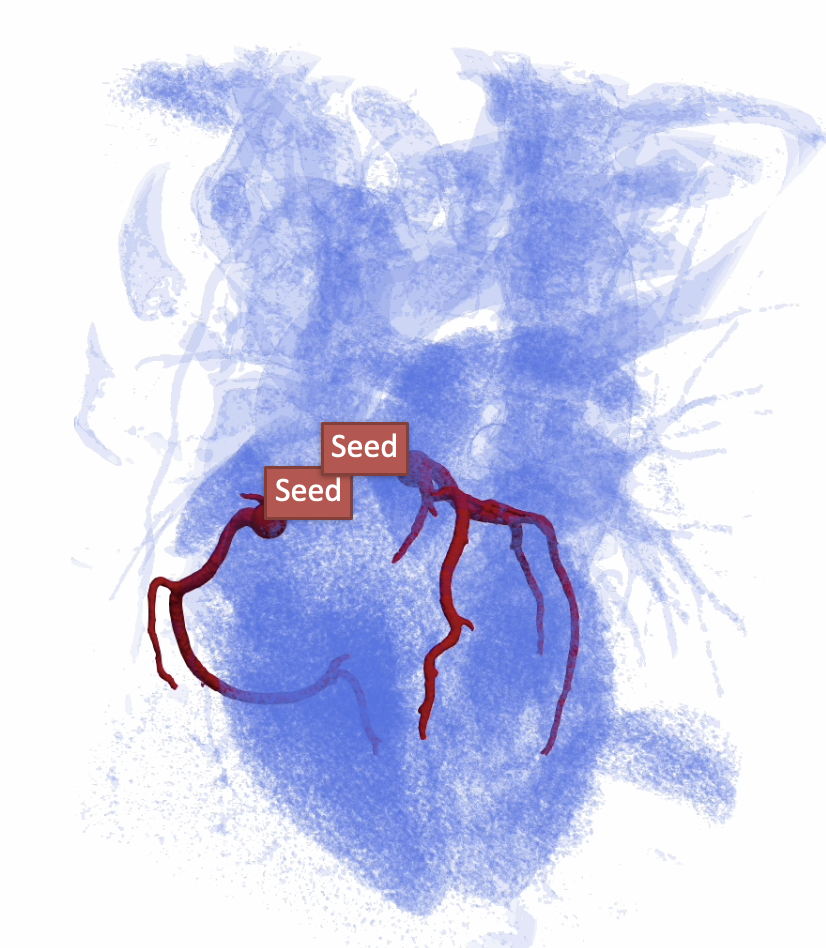
SeqSeg segments vessels sequentially, taking steps along vessel centerlines and detecting bifurcations to grow complete vascular trees from just 1–2 seed points. By combining local deep-learning predictions (nnU-Net) with geometric tracking, it stays robust across vessel scales — from small coronaries to large aortas.
- 🌱 Minimal supervision — only 1–2 seed points to initialize
- 🌿 Robust bifurcation detection — automatically follows every branch
- 🩻 Multi-modal — works with CT and MR 3D medical images
- 📏 Scalable — vessels from ~1mm coronaries to ~30mm aortas
- ✅ Clinically validated — coronary, aortic, cerebral, and pulmonary anatomies (pre-trained weights for aorta CT/MR and coronary CT)
- ⚡ Fast — on CPU, about 2–5 minutes for an aorta, 5–15 for a coronary tree, and 10–30 for a cerebral tree. GPU is faster. Details in Benchmarks.
A finished case includes a simvascular/ project you can open directly in SimVascular, with pathlines and contours for every segmented branch.
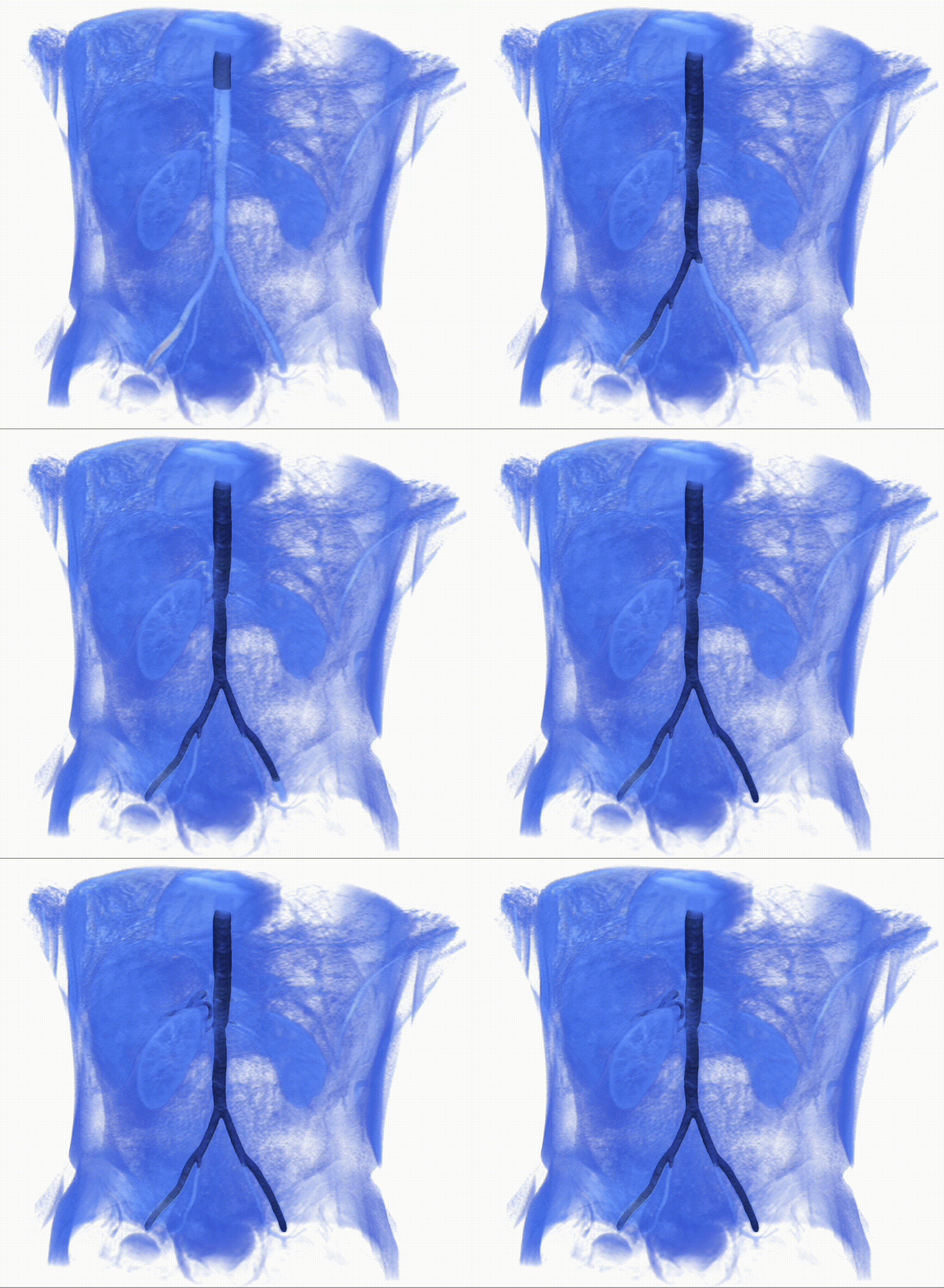
Real-time demonstration: automatic segmentation of an abdominal aorta in a 3D MR scan.
Start here
- First segmentation — the tutorial runs a sample abdominal-aorta MR scan.
- Your own images — Usage describes
images/andseeds.json. The command is in Quick Start. - Train a model — Training.
Quick Start
Python 3.9 or newer. 3.11 is the version used in the tutorial and conda example.
The tutorial is the sample run (abdominal-aorta MR, seed points, and Windows notes). Plan on 15–20 minutes including setup. Tracing is capped, so that part finishes in a few minutes; a real case should use the defaults.
Install SeqSeg and the aorta weights below, then run seqseg run batch on your own data. The folder needs images/ and seeds.json (Usage). This example is an aorta MR case. Change -train_dataset, -config_name, and -img_ext to match your images and weights.
pip install seqseg

# Aorta and femoral weights (MR and CT)
curl -L -o nnUNet_results.zip https://zenodo.org/records/15020477/files/nnUNet_results.zip
unzip nnUNet_results.zip
Aorta and femoral weights (nnUNet_results.zip). Coronary CT weights are a separate archive, nnUNet_results_coronary.zip.
-nnunet_results_path is the folder that contains Dataset005_SEQAORTANDFEMOMR (and the other dataset folders in that zip).
seqseg run batch \
    -data_dir your_data/ \
    -nnunet_results_path nnUNet_results/ \
    -train_dataset Dataset005_SEQAORTANDFEMOMR \
    -config_name global_aorta \
    -img_ext .mha \
    -outdir results/
| Anatomy | -train_dataset |
-config_name |
|---|---|---|
| Aorta / femoral MR | Dataset005_SEQAORTANDFEMOMR |
global_aorta |
| Aorta / femoral CT | Dataset006_SEQAORTANDFEMOCT |
global_aorta |
| Coronary CT | Dataset010_SEQCOROASOCACT |
global_coro |
The tutorial uses -config_name aorta_tutorial for its sample scan. The trainer-folder layout is in Installation. The full command list and flag spelling are in Usage.
Documentation
| Job | Guide | Description |
|---|---|---|
| Run | Installation | Setup, dependencies, and pre-trained model weights |
| Run | Tutorial | End-to-end aorta example with sample data |
| Run | Usage | Data layout, seeds, CLI arguments, and output files |
| Run | Configuration | YAML configs and tracking parameters |
| Train | Training | Train nnU-Net models on a new dataset |
| Understand | Algorithm Overview | Methodology, workflow, and training strategy |
| Understand | Performance & Benchmarks | Accuracy, timing, and qualitative comparisons |
| Integrate | API | Call tracing from Python |
| Integrate | Research & Development | SimVascular, 3D Slicer, and repository layout |
Citation
When using SeqSeg, please cite the following paper:
@Article{SveinssonCepero2024,
author={Sveinsson Cepero, Numi
and Shadden, Shawn C.},
title={SeqSeg: Learning Local Segments for Automatic Vascular Model Construction},
journal={Annals of Biomedical Engineering},
year={2024},
month={Sep},
day={18},
issn={1573-9686},
doi={10.1007/s10439-024-03611-z},
url={https://doi.org/10.1007/s10439-024-03611-z},
}