
izzatum/FWIGAN has 37 GitHub stars and 7 forks. Star changes are not measured yet. Last checked 2026-11-14 12:40 UTC. Last push 2026-10-18.
計測したスター増加
- 24時間
- 履歴を収集中
- 7日間
- 履歴を収集中
- 15日間
- 履歴を収集中
- 1か月
- 履歴を収集中
期間ごとの純増数です。期間は重複しており、日別の値ではありません。未計測の値は空欄です。スター数は注目度の指標であり、品質の保証ではありません。
概要
FWIGAN: Full-Waveform Inversion with Deep Adversarial Learning
機械学習README.md
オリジナルFWIGAN: Full Waveform Inversion in PyTorch
FWIGAN is an open-source Python/PyTorch research toolkit for 2D acoustic full waveform inversion (FWI), seismic imaging and adversarial learning. Conventional FWI and adversarial FWIGAN share DeepWave physics, configuration, evaluation and checkpoint/resume workflows.
Installation
Use Python 3.10 and a C++ compiler. Install PyTorch before building the pinned DeepWave backend:
python3.10 -m venv .venv
source .venv/bin/activate
python -m pip install setuptools==69.5.1 wheel==0.45.1
python -m pip install torch==1.13.1+cpu --index-url https://download.pytorch.org/whl/cpu
python -m pip install numpy==1.23.5 scipy==1.10.1
MAX_JOBS=2 python -m pip install --no-build-isolation deepwave==0.0.9
python -m pip install -e '.[test,plot,notebook]'
These commands install the CPU environment. For GPU setup, see CUDA instructions.
Quick start
Run a small FWIGAN experiment from the repository root:
fwigan invert --config configs/tiny-fwigan.yaml --output-root runs --max-batches 2
The command prints the new run directory. Use that path to continue and inspect the result:
fwigan resume runs/<run-id>/checkpoint.pt --device cpu
fwigan evaluate runs/<run-id>
Use configs/tiny-fwigan-noisy.yaml for noisy FWIGAN or configs/tiny-fwi.yaml for conventional FWI. All three presets use small CPU examples. Full Marmousi presets are in configs/marmousi-*.yaml.
For interactive work, open FWIGAN.ipynb or FWIGAN_Noisy.ipynb and select the environment's Python kernel.
FWIGAN simulation results
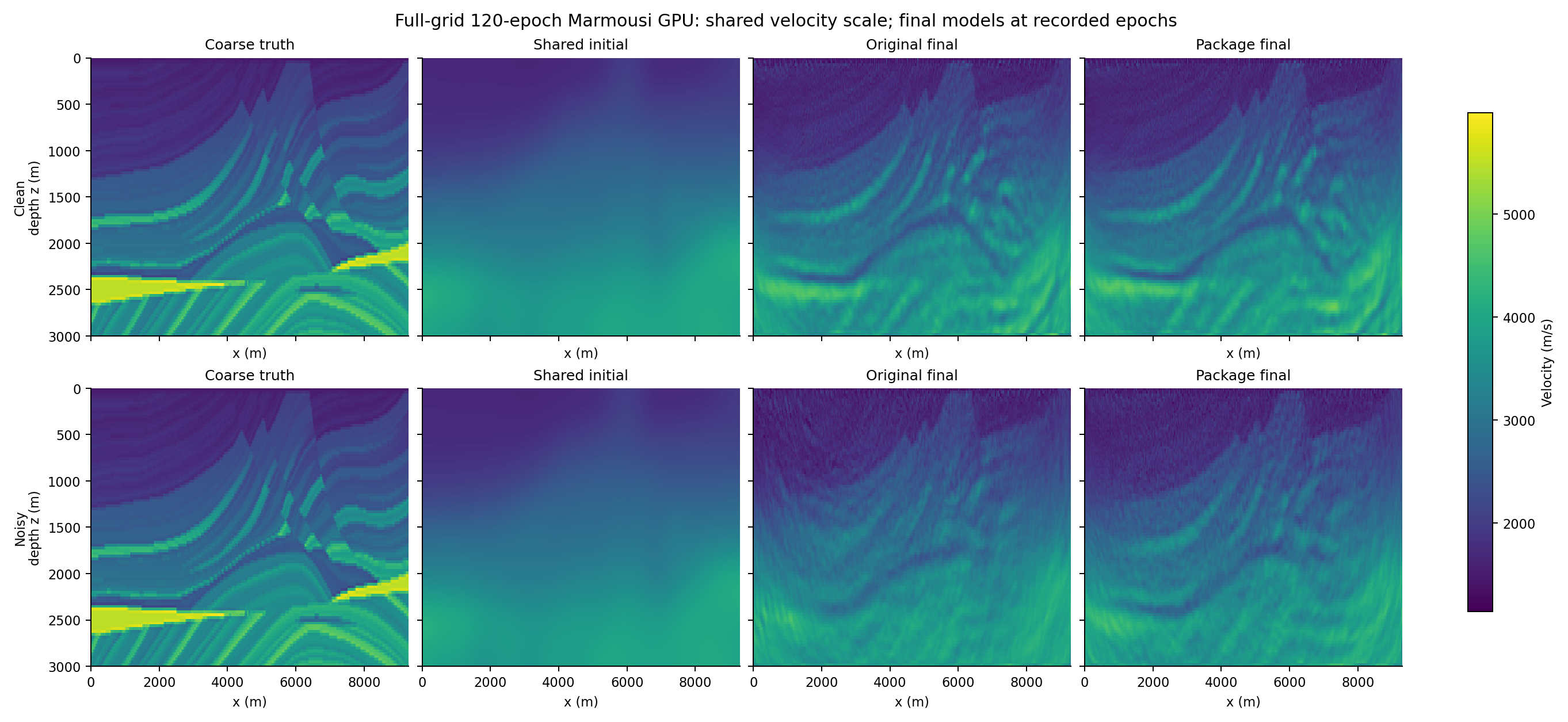
Full-grid Marmousi FWIGAN simulations completed 120 epochs on an NVIDIA A40. The package's velocity RMSE fell from 478.00 m/s to 412.91 m/s for clean data and 462.52 m/s for noisy data. These are single-run results, covering 120 of the original study's 401 epochs. See the comparison report for executed notebooks, metrics and limitations.
Documentation
- Frequently asked questions about FWIGAN and seismic inversion
- Configuration, data contracts and checkpoint workflows
- Performance measurements and GPU setup
- Tests and validation record
Run python -m pytest -q to execute the tests.
Attribution and license
Originally developed by Muhammad Izzatullah, inspired by physics-informed adversarial geophysical imaging and CryoGAN. Released under the MIT license. Cite the software using CITATION.cff.