
inicontent/inibase
inicontent/inibase has 29 GitHub stars and 4 forks. Star changes are not measured yet. Last checked 2026-11-14 12:51 UTC. Last push 2026-11-13.
できること
- Minimalist :white_circle: (but powerful)
- 100% TypeScript :large_blue_diamond:
- Built for fast access :zap: Built-in caching and column projection
- ATOMIC :lock: Per-table writer locks, write-ahead journal + crash recovery, fsync-backed durability, and multi-table transactions (begin/commit/rollback) for atomic cascades (exact scope below)
計測したスター増加
- 24時間
- 履歴を収集中
- 7日間
- 履歴を収集中
- 15日間
- 履歴を収集中
- 1か月
- 履歴を収集中
期間ごとの純増数です。期間は重複しており、日別の値ではありません。未計測の値は空欄です。スター数は注目度の指標であり、品質の保証ではありません。
概要
A file-based & memory-efficient, serverless, ACID compliant, relational database management system
データREADME.md
オリジナルiniBase :pencil:
A file-based & memory-efficient, serverless relational database with crash-atomic ACID: single-table DML + multi-table transactions :fire: — per-table writer locks, write-ahead journal + crash recovery, fsync-backed durability, and a
begin/commit/rollbacktransaction API (exact scope in Durability & crash safety).
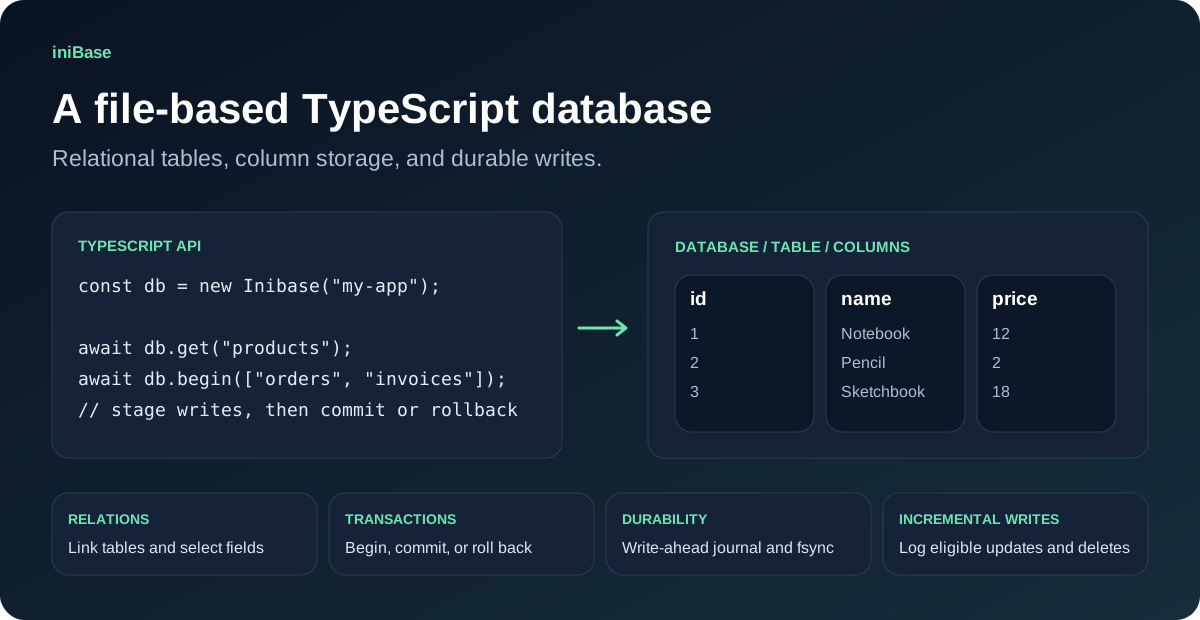


Quick start · How it works · Durability · Benchmarks
Storage and write performance
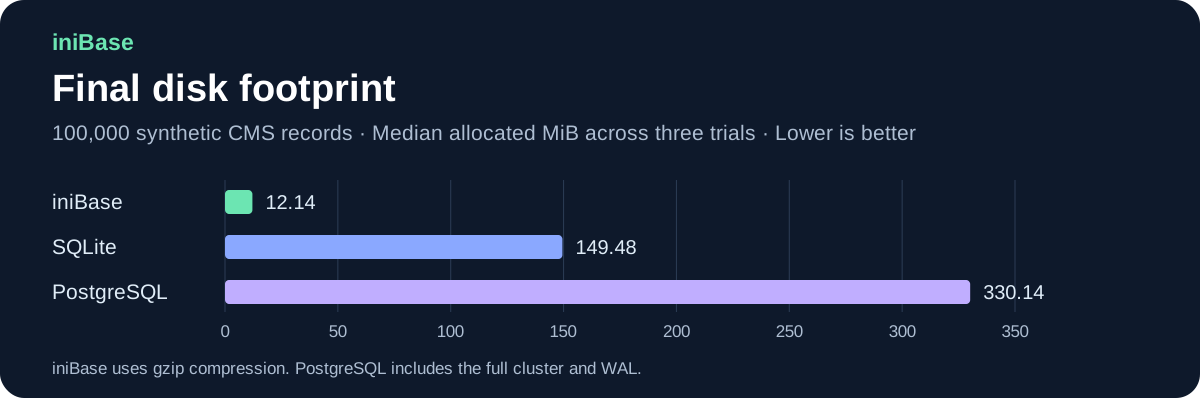
In the 100,000-record CMS workload, iniBase with gzip compression used 12.14 MiB of allocated disk at the end of the run, compared with 149.48 MiB for SQLite and 330.14 MiB for the full PostgreSQL cluster, including its WAL.
Automatic incremental writes brought median single-record update and delete times down to 11.79 ms and 9.96 ms in this workload, compared with 101.72 ms and 1,055.14 ms in the earlier iniBase build that rewrote columns. SQLite and PostgreSQL each took about 4 ms per operation.
Benchmark and methodology · Automatic incremental writes
Features
- Lightweight 🪶
- Minimalist :white_circle: (but powerful)
- 100% TypeScript :large_blue_diamond:
- Built for fast access :zap: Built-in caching and column projection
- ATOMIC :lock: Per-table writer locks, write-ahead journal + crash recovery, fsync-backed durability, and multi-table transactions (
begin/commit/rollback) for atomic cascades (exact scope below) - Built-in form validation (+unique values :new: ) :sunglasses:
- Suitable for large data :page_with_curl: (tested with 4M records)
- Incremental writes :recycle: Eligible updates and deletes automatically append durable log entries
- Support Compression :eight_spoked_asterisk: (using built-in nodejs zlib)
- Support Table Joins :link:
- Memory-conscious design :chart_with_downwards_trend: File-based storage and streaming reads
- Safe :lock: (no sql or javascript injections)
- Easy to use :bread:
- ... and much more :rocket:
Usage
import Inibase from "inibase";
// const db = new Inibase("databaseName", ".", "es");
const db = new Inibase("databaseName");

// Get all items from "user" table
const users = await db.get("user");

// Read page 2 content
const users = await db.get("user", undefined, { page: 2, per_page: 15 });

// Get only required columns to improve speed
const users = await db.get("user", undefined, {
  columns: ["username", "address.street", "hobbies.name"],
});

// Get items from "user" table where "favoriteFoods" does not includes "Pizza" or "Burger"
const users = await db.get("user", { favoriteFoods: "![]Pizza,Burger" });
[!NOTE] Enjoy using Inibase? Consider sponsoring us via PayPal
Your support helps us maintain and improve our services.
Thank you! 🫰
Install
<npm|pnpm|yarn|bun> install inibase
[!WARNING] If you're using Windows, the following Unix commands are required:
zcat,sed,gzip, andecho.To use the missing commands, you need to install additional tools:
- GnuWin32: Provides individual GNU utilities for Windows.
- Cygwin: Offers a full Unix-like environment for Windows.
Alternatively, consider using the Windows Subsystem for Linux (WSL) to run a Linux environment on Windows. Learn more here.
How it works?
Inibase organizes data into databases, tables, and columns, each stored in separate files.
- POST: New data is appended to column files efficiently.
- GET: Data retrieval is optimized by reading files line-by-line.
- PUT: Updates are streamlined: on a plain table only the relevant column file is rewritten, while a table with the update log enabled appends a small frame instead.
- DELETE: Removes lines from column files for swift deletion.
This structure ensures efficient storage, retrieval, and updates, making our system scalable and high-performing for diverse datasets and applications.
Durability & crash safety
[!IMPORTANT] DML (post / put / delete / truncate) is crash-atomic per table. A logical operation spans many column files plus a pagination-metadata file; all of those files are committed as one journaled unit, so a table is never observed half-applied. Multi-table atomicity is available explicitly through the transaction API (
begin/commit/rollback, see below) — cascade deletes and multi-table writes are atomic inside a transaction, and best-effort without one.
How each property is provided
| Property | Mechanism |
|---|---|
| Atomicity | Write-ahead journal: one journal per table (.tmp/journal.jsonl) for single-table DML, plus a database journal (<db>/.tmp/journal.jsonl) that transactions append op entries to. Intent is fsynced before any live file changes; a commit marker is fsynced after publication. On crash: no commit marker → roll back (restore backups), commit present → roll forward (complete swaps, discard backups). Recovery runs automatically under the lock before any mutation/read. |
| Consistency | Schema validation + uniqueness enforcement happen before anything is written; every operation is atomic, so a table is never observed half-applied. |
| Isolation | One writer lock per table serializes every mutation (single-host and multi-host / NFS); a transaction holds the writer lock of every table it touches for its whole lifetime, plus a database lock to serialize transactions. Reads are lock-free with optimistic version-retry: each read snapshots the identity of every column + pagination file, and is re-run if anything changed mid-scan — a reader never sees torn rows. |
| Durability | Durability knob INIBASE_DURABILITY=full (default) fsyncs the temp file, the journal (begin/commit), and the affected directories (incl. shell sed/gzip temp paths and stream pipelines). DDL (create/update table, compression & prepend toggles) is fsynced too. INIBASE_DURABILITY=none skips every fsync while keeping the exact journal protocol — the data is process-crash safe (a crash leaves an in-flight journal that recovery rolls back or forward) but not power-loss safe, because the OS page cache can be lost. |
Commit-point ordering: the pagination metadata rename happens first (the atomic publication point — the row count flips in a single rename that lock-free readers observe), then column files are swapped live → backup + tmp → live.
Transactions (multi-table atomicity)
await db.begin(["orders", "invoices"]); // pre-lock tables in sorted order (deadlock-free)
try {
  await db.post("orders", order);
  await db.post("invoices", invoice);
  await db.commit(); // publish everything crash-atomically
} catch {
  await db.rollback(); // discard everything; no live file was touched
}
- Semantics: mutations issued inside a transaction are staged — their
temps are fsynced and an
opentry appended to the database journal — but no live file changes untilcommit().commit()publishes every staged mutation (per table: pagination rename first, then column swaps) and ends with a single fsyncedcommitmarker, making the whole set atomic with respect to crashes and process kills.rollback()removes the temps and the journal without touching any live file. - Cascade: a
deleteinside a transaction cascades into referencing tables through the same journal, so the whole parent + children removal is atomic; a failure during the cascade aborts the transaction. - Rules & limits (v1):
- No read-your-writes: reads inside a transaction observe the last committed state, not staged writes.
- One mutation per table per transaction. A second post/put/delete on a
table already staged in the same transaction throws
INVALID_PARAMETERS(composing same-table writes would require read-your-writes). - DDL is not allowed inside a transaction (
createTable/updateTablethrowINVALID_PARAMETERS). beginwithout a table list locks tables on first touch, in first-touch order; list the tables up front to get sorted, cycle-free ordering.returnPostedDatainside a transaction returns the formatted staged rows (no joins);returnUpdatedDatainside a transaction throwsINVALID_PARAMETERS.- Transactions are excluded from structural lock-upgrade deadlocks, but two long transactions that touch overlapping tables can only deadlock in the first-touch-order case (pre-listing avoids it).
Scope & caveats
- Best-effort without a transaction. Cross-table cascade deletes outside a
transaction stay best-effort: referencing rows are removed after the
primary delete commits, and a crash in between can leave orphaned references.
Wrap them in
begin/commitfor atomicity. - NFS: lock files use
O_EXCLcreation, which is advisory on some NFS servers — two hosts may briefly both believe they hold a lock. Locks store{pid, host, startedAt}: a same-host owner that is provably dead (kill(pid, 0)fails) is stolen immediately; foreign/unknown owners fall back to the TTL (INIBASE_LOCK_TTL_MS, default60000). - fsync guarantees: durability assumes the OS/filesystem honours
fsync. Some disks and virtualized filesystems silently ignore it; directoryfsyncis unsupported on a few platforms (best-effort there).nonemode deliberately gives up power-loss durability — that is the whole point of the knob. - Cost: at
full, every mutation fsyncs the temp file, journal, and directories — expect noticeably slower hot-path writes than pre-durability builds (the benchmark comparesfullvsnoneside by side). The swap protocol also transiently holds temp + backup + live copies (~2–3× a column's size; worst case is aputwith nowhere— a full-table rewrite). - Cache (
.cache): entries are derived, rebuildable artifacts versioned by the row count; they detect staleness but never participate in the ACID guarantee. Non-fsync'd.
Run pnpm test:durability for the journal-recovery, multi-process writer,
live-reader and stale-lock test suite, pnpm test:transaction for the
transaction/cascade/crash-recovery suite, and pnpm benchmark:durability for
the full vs none throughput comparison.
Incremental update log
Eligible small updates and deletes on append-layout tables with at least 128 rows and simple, non-computed columns automatically append durable log entries. The engine folds those entries into the base columns during compaction. Transactions, schema changes and broader mutations retain their existing supported paths. See automatic incremental writes for eligibility and recovery.
The supported application table options are decodeID, prepend, compression
and cache. The engine also learns eligible equality indexes automatically. See
storage acceleration for the indexing policy.
The append-only update log (on-disk format 2) remains supported for existing databases and historical runtime configurations. The description below documents that compatibility backend; it is not an additional application option to choose.
- Writes.
putappends one length-prefixed,crc32-checked frame ({ id, cols, updatedAt }) toupdates.loginstead of rewriting column files, so the fast path is proportional to the number of updated rows rather than the table size.postanddeletestill rewrite the base columns. - Reads. Every read —
get, criteria,columns, sort, pagination, aggregates, and uniqueness checks — merges the log over the base columns, so results match an un-logged table. With an empty log the merge is a no-op. - Compaction.
await db.compact(tableName)folds the log into the base columns and resets it, returning the newbaseGen— ornullwhen there was nothing to fold. Compaction is crash-safe and semantically neutral: it only materializes already-acknowledged updates. It also runs automatically under backpressure so the overlay and log stay bounded (INIBASE_MAX_OVERLAY_RECORDS, default100000;INIBASE_MAX_LOG_BYTES, default 64 MiB); if the bound is hit and compaction cannot run, the write fails withMAINTENANCE_REQUIREDrather than growing without limit. - Requirements. The table must use the append layout (no
prepend) and a schema of simple top-level fields. Transactions, schema changes, and disabling the log on a format-2 log table throwMAINTENANCE_REQUIRED. - On disk. A
.formatmarker recordsformat,baseGen, and the compatibility contract (minReader);updates.logholds the frames. A table with no.formatis legacy format 1 and behaves exactly as before. - Downgrade safety. A reader older than the log format ignores the marker
and would silently serve stale base columns. The marker's
minReadermakes a conforming engine refuse such a table withUNSUPPORTED_FORMATinstead of mis-reading it.
[!WARNING] Backups. A raw directory copy is only a valid backup when writes are quiesced or the copy is a filesystem snapshot. Copying a logged table during writes can capture base columns paired with a mismatched
updates.log/baseGen. Runningcompactfirst does not remove the need to quiesce writes.
Inibase CLI
npx inibase -p <databaseFolderPath>
# by default it will diplay a list of available commands (or type 'help')
Examples
Tables
Config
interface {
  compression: boolean;
  cache: boolean;
  prepend: boolean;
  decodeID: boolean;
}
Schema
Types
interface Field {
  id: number; // position in the schema; 0 = the row id, -1 = createdAt, -2 = updatedAt
  key: string;
  required?: boolean;
  unique?: boolean | string; // boolean for simple uniqueness, string for grouped uniqueness
  regex?: RegExp; // Regular expression for custom validation
  type:
    | "string"
    | "number"
    | "boolean"
    | "date"
    | "email"
    | "url"
    | "password"
    | "html"
    | "ip"
    | "json"
    | "id";
}

interface TableField {
  id: number;
  key: string;
  required?: boolean;
  unique?: boolean | string; // Supports uniqueness constraints
  type: "table";
  table: string;
}

interface ArrayField {
  id: number;
  key: string;
  required?: boolean;
  unique?: boolean | string; // Supports uniqueness constraints
  type: "array";
  children: string | string[]; // Can be a single type or an array of types
}

interface ObjectOrArrayOfObjectsField {
  id: number;
  key: string;
  required?: boolean;
  unique?: boolean | string; // Supports uniqueness constraints
  regex?: RegExp; // For validation of object-level keys
  type: "object" | "array";
  children: Schema; // Nested schema for objects or arrays
}
Unique
The
uniqueproperty ensures that the values of a specific column or a group of columns are unique within a table. This property can be either a boolean or a string.
- Boolean: Setting
unique: trueensures that the values in the column are unique across all rows.- String: By setting a string value, you can group columns to enforce a combined uniqueness constraint. This is useful when you need to ensure that a combination of values across multiple fields is unique.
Examples
Unique Column
{
  key: "email",
  type: "string",
  required: true,
  unique: true, // Ensures all email values are unique
}
Group of Unique Columns
[
  {
    key: "firstName",
    type: "string",
    required: true,
    unique: "nameGroup", // Part of "nameGroup" uniqueness
  },
  {
    key: "lastName",
    type: "string",
    required: true,
    unique: "nameGroup", // Part of "nameGroup" uniqueness
  },
]
Create Table
import Inibase from "inibase";
const db = new Inibase("/databaseName");

const userTableConfig = {
  compression: true,
  cache: true,
  prepend: false,
  decodeID: false
}

const userTableSchema = [
  {
    key: "username",
    type: "string",
    required: true,
  },
  {
    key: "email",
    type: "string",
    required: true,
  },
  {
    key: "age",
    type: "number",
    required: true,
  },
  {
    key: "isActive",
    type: "boolean",
    // required: false
  },
  {
    key: "hobbies",
    type: "array",
    children: [
      {
        key: "name",
        type: "string",
        // required: false
      },
      {
        key: "level",
        type: "string",
        // required: false
      },
    ],
  },
  {
    key: "favoriteFoods",
    type: "array",
    children: "string",
    // required: false
  },
  {
    key: "address",
    type: "object",
    children: [
      {
        key: "street",
        type: "string",
        // required: false
      },
      {
        key: "city",
        type: "string",
        // required: false
      },
      {
        key: "country",
        type: "string",
        // required: false
      },
    ],
  },
];

await db.createTable("user", userTableSchema, userTableConfig);
decodeIDBy default a row's
idis stored as a number but only ever handed back as an encrypted (aes-256-cbc, hex) string, so ids can't be guessed by incrementing. SetdecodeID: trueand the id is exposed as the plain number everywhere —getrows,get/put/deleteby id, relation lookups, and the id returned bypost:const db = new Inibase("/databaseName"); await db.createTable("item", [{ key: "name", type: "string" }], { decodeID: true, }); const id = await db.post("item", { name: "widget" }); // => 1 (a number) await db.get("item", 1); // works with the raw numberSo
postreturns anumberon adecodeIDtable and an encryptedstringon every other table — in TypeScript its return type isstring | number((string | number)[]for a bulk post). Encrypted ids stay valid inputs on adecodeIDtable too, so existing clients that round-trip an id keep working either way.decodeIDcan be toggled later withupdateTable.Update Table
Change Name
import Inibase from "inibase";
const db = new Inibase("/databaseName");

// this will change table name also in joined tables
await db.updateTable("user", undefined, {name: "userV2"});
Update field
import Inibase from "inibase";
import { setField } from "inibase/utils";

const db = new Inibase("/databaseName");

const userTableSchema = (await db.getTable("user")).schema;
setField("username", userTableSchema, {key: "fullName"});
await db.updateTable("user", newUserTableSchema);
Remove field
import Inibase from "inibase";
import { unsetField } from "inibase/utils";

const db = new Inibase("/databaseName");

const userTableSchema = (await db.getTable("user")).schema;
unsetField("fullName", userTableSchema);
await db.updateTable("user", newUserTableSchema);
Join Tables
import Inibase from "inibase";
const db = new Inibase("/databaseName");

const productTableSchema = [
  {
    key: "title",
    type: "string",
    required: true,
  },
  {
    key: "price",
    type: "number",
  },
  {
    key: "createdBy",
    type: "table",
    table: "user",
    required: true,
  },
];

await db.createTable("product", productTableSchema);

const productTableData = [
  {
    title: "Product 1",
    price: 16,
    createdBy: "1d88385d4b1581f8fb059334dec30f4c",
  },
  {
    title: "Product 2",
    price: 10,
    createdBy: "5011c230aa44481bf7e8dcfe0710474f",
  },
];

const product = await db.post("product", productTableData);
// [
//   {
//     "id": "1d88385d4b1581f8fb059334dec30f4c",
//     "title": "Product 1",
//     "price": 16,
//     "createdBy": {
//       "id": "1d88385d4b1581f8fb059334dec30f4c",
//       "username": "user1",
//       "email": "[email protected]",
//       ...
//     }
//   },
//   {
//     "id": "5011c230aa44481bf7e8dcfe0710474f",
//     "title": "Product 2",
//     "price": 10,
//     "createdBy": {
//       "id": "5011c230aa44481bf7e8dcfe0710474f",
//       "username": "user2",
//       ...
//     }
//   }
// ]
Methods
POST
import Inibase from "inibase";
const db = new Inibase("/databaseName");

const userTableData = [
  {
    username: "user1",
    email: "[email protected]",
    age: 25,
    isActive: true,
    hobbies: [
      { name: "Reading", level: "Intermediate" },
      { name: "Cooking", level: "Beginner" },
    ],
    favoriteFoods: ["Pizza", "Sushi", "Chocolate"],
    address: {
      street: "123 Main St",
      city: "Exampleville",
      country: "Sampleland",
    },
  },
  {
    username: "user2",
    email: "[email protected]",
    age: 30,
    isActive: false,
    hobbies: [
      { name: "Gardening", level: "Advanced" },
      { name: "Photography", level: "Intermediate" },
    ],
    favoriteFoods: ["Burgers", null, "Salad"],
    address: {
      street: "456 Elm Rd",
      city: "Testington",
      country: "Demo Country",
    },
  },
];

const users = await db.post("user", userTableData);
// [
//   {
//     "id": "1d88385d4b1581f8fb059334dec30f4c",
//     "username": "user1",
//     "email": "[email protected]",
//     "age": 25,
//     "isActive": true,
//     "hobbies": {
//       "name": [
//         "Reading",
//         "Cooking"
//       ],
//       "level": [
//         "Intermediate",
//         "Beginner"
//       ]
//     },
//     "favoriteFoods": [
//       "Pizza",
//       "Sushi",
//       "Chocolate"
//     ],
//     "address": {
//       "street": "123 Main St",
//       "city": "Exampleville",
//       "country": "Sampleland"
//     }
//   },
//   {
//     "id": "5011c230aa44481bf7e8dcfe0710474f",
//     "username": "user2",
//     ...
//   },
//   ...
// ]
GET
GET by ID
import Inibase from "inibase";
const db = new Inibase("/databaseName");

const user = await db.get("user", "1d88385d4b1581f8fb059334dec30f4c");
// {
//     "id": "1d88385d4b1581f8fb059334dec30f4c",
//     "username": "user1",
//     "email": "[email protected]",
//     "age": 25,
//     "isActive": true,
//     "hobbies": {
//         "name": [
//             "Reading",
//             "Cooking"
//         ],
//         "level": [
//             "Intermediate",
//             "Beginner"
//         ]
//     },
//     "favoriteFoods": [
//         "Pizza",
//         "Sushi",
//         "Chocolate"
//     ],
//     "address": {
//         "street": "123 Main St",
//         "city": "Exampleville",
//         "country": "Sampleland"
//     }
// }
GET by criteria
import Inibase from "inibase";
const db = new Inibase("/databaseName");

const users = await db.get("user", { favoriteFoods: "[]Pizza" });
// [
//   {
//     "id": "1d88385d4b1581f8fb059334dec30f4c",
//     "username": "user1",
//     "email": "[email protected]",
//     "age": 25,
//     "isActive": true,
//     "hobbies": {
//       "name": [
//         "Reading",
//         "Cooking"
//       ],
//       "level": [
//         "Intermediate",
//         "Beginner"
//       ]
//     },
//     "favoriteFoods": [
//       "Pizza",
//       "Sushi",
//       "Chocolate"
//     ],
//     "address": {
//       "street": "123 Main St",
//       "city": "Exampleville",
//       "country": "Sampleland"
//     }
//   },
//   ...
// ]
GET with columns
import Inibase from "inibase";
const db = new Inibase("/databaseName");

// Get all "user" columns except "username" & "address.street"
const users = await db.get("user", undefined, {
  columns: ["!username", "!address.street"],
});

// Columns accept dotted nested paths (e.g. "address.street" => nested field)
const nested = await db.get("user", undefined, {
  columns: ["address.street", "hobbies.name"],
});

// Get all columns explicitly with the "*" wildcard
const all = await db.get("user", undefined, {
  columns: ["*"],
});
PUT
import Inibase from "inibase";
const db = new Inibase("/databaseName");

// set "isActive" to "false" for all items in table "user"
await db.put("user", { isActive: false });

// set "isActive" to "true" for specific "user" by id
await db.put("user", { isActive: false }, "1d88385d4b1581f8fb059334dec30f4c");

// set "isActive" to "true" in table "user" by criteria (where "isActive" is equal to "true")
await db.put("user", { isActive: false }, { isActive: true });
DELETE
import Inibase from "inibase";
const db = new Inibase("/databaseName");

// delete all items in "user" table
await db.delete("user");

// delete a specific "user" by id
await db.put("user", "1d88385d4b1581f8fb059334dec30f4c");

// delete "user" by criteria (where "isActive" is equal to "false")
await db.put("user", { isActive: false });
SUM
import Inibase from "inibase";
const db = new Inibase("/databaseName");

// get the sum of column "age" in "user" table
await db.sum("user", "age");

// get the sum of column "age" by criteria (where "isActive" is equal to "false") in "user" table
await db.sum("user", ["age", ...], { isActive: false });

// aggregate over the elements of an array-of-objects column: `items.quantity`
// counts every element of every row's `items` (single array path per call;
// `product` here is an *element* predicate, matching elements whose linked
// product is the given row)
await db.sum("orders", "items.quantity", { product: "id-of-widget" }, { nested: true });

// multiple columns share one predicate and return a record
await db.sum(
	"orders",
	["items.quantity", "items.lineTotal"],
	{ product: "id-of-widget" },
	{ nested: true },
); // => { "items.quantity": 5, "items.lineTotal": 1295 }
MAX
import Inibase from "inibase";
const db = new Inibase("/databaseName");

// get the biggest number of column "age" in "user" table
await db.max("user", "age");

// get the biggest number of column "age" by criteria (where "isActive" is equal to "false") in "user" table
await db.max("user", ["age", ...], { isActive: false });
MIN
import Inibase from "inibase";
const db = new Inibase("/databaseName");

// get the smallest number of column "age" in "user" table
await db.min("user", "age");

// get the smallest number of column "age" by criteria (where "isActive" is equal to "false") in "user" table
await db.min("user", ["age", ...], { isActive: false });
SORT
import Inibase from "inibase";
const db = new Inibase("/databaseName");

// order users by the age column
await db.get("user", undefined, { sort: "age" });

// order users by the age and username columns
await db.get("user", undefined, { sort: ["age", "username"] });
await db.get("user", undefined, { sort: {age: -1, username: "asc"} });
Computed Fields
A
computedcolumn is derived from other columns of the same row whenever the row is written (post/put, including backfill onupdateTable). The result is stored in its own column file like any other value, so reads and criteria queries work unchanged.const db = new Inibase("/databaseName"); await db.createTable("product", [ { key: "name", type: "string" }, { key: "price", type: "number" }, ]); // ids are assigned per table in schema order: customer=1, status=2, items=3, // product=4, quantity=5, unitPriceCents=6, totalCents=7, totalCentsLive=8 await db.createTable("orders", [ { key: "customer", type: "string" }, { key: "status", type: "number" }, { key: "items", type: "array", children: [ { key: "product", type: "table", table: "product" }, { key: "quantity", type: "number" }, { key: "unitPriceCents", type: "number" }, ], }, { key: "totalCents", type: "number", computed: "sum(5 * 6)" }, // quantity x unitPriceCents { key: "totalCentsLive", type: "number", computed: "sum(5 * 4.2)" }, // quantity x product.price ]); const posted = await db.post( "orders", { customer: "acme", status: 1, items: [ { product: "id-of-widget", quantity: 2, unitPriceCents: 250 }, { product: "id-of-gadget", quantity: 1, unitPriceCents: 100 }, ], }, undefined, true, ); // posted.totalCents === 600 (2*250 + 1*100) // posted.totalCentsLive === 847 (2*price(widget) + 1*price(gadget))A child of an array-of-objects column can itself be computed. It is evaluated once per element and stored in its own element cell, so it works like any other element child in queries — including
sumwith{ nested: true }:// ids are assigned per table in schema order: status=1, items=2, product=3, // quantity=4, lineTotal=5 await db.createTable("orders", [ { key: "status", type: "number" }, { key: "items", type: "array", children: [ { key: "product", type: "table", table: "product" }, { key: "quantity", type: "number" }, // lineTotal = quantity × product.price ("4 * 3.2": id 4 = quantity, // hop to the linked product's price, id 2 in `product`) { key: "lineTotal", type: "number", computed: "4 * 3.2" }, ], }, ]); const posted = await db.post( "orders", { status: 1, items: [ { product: "id-of-widget", quantity: 2 }, { product: "id-of-gadget", quantity: 1 }, ], }, undefined, true, ); // posted.items[0].lineTotal === 2 * price(widget) // posted.items[1].lineTotal === 1 * price(gadget) // per-product revenue without touching the line items yourself: await db.sum("orders", "items.lineTotal", { product: "id-of-widget" }, { nested: true });A top-level computed may read a computed child through a helper (
{ key: "totalCents", type: "number", computed: "sum(5)" }) — the children are derived first, in dependency order.Element expressions (child computeds).
- Every reference must be a sibling child of the same array root — top-level columns and siblings of a different array are rejected (
COMPUTED_FIELD_INVALID_TARGET), and helpers (sum/avg/...) are not allowed inside element expressions.- Link hops are supported (
4 * 3.2= siblingquantity× linkedproduct.price).- The element field must be
type: "number".- A missing/null operand in an element evaluates to
0for that element (it never aborts the write and never stores null). A genuinely dangling link (a link to a missing row) still raisesCOMPUTED_FIELD_DANGLING_LINK, same as top-level computeds.updateTablebackfills element cells when a child computed is added or its expression changes; the backfill resolves links from the persisted element values and follows the same missing-operand →0rule.Expression language (v1, integer-only).
- Operators:
+-*/%;( )for grouping. Multiplication binds tighter than addition (1 * 2 + 3=(1*2) + 3).- Helpers:
sumcountavgminmaxiterate an array-of-objects found by the ids inside the parentheses (sum(5 * 6)= quantity x unit-price per item).- Paths:
id ("." id)*where.hops through atablelink (4.2= price of the linked product row).- Integers only: there are no decimal literals —
.is the path separator, so3.14is a path (field 3, hopfield 14), never 3.14. Fractional results are written as division:314 / 100→ 3.14.- A bare integer that matches a field id in the table's schema is that field (ids are locative); a bare integer that matches no field is a literal.
Rules & limits (v1).
- Computed fields cannot be
required,uniqueorregex(aCOMPUTED_FIELD_CONFLICTerror).- Computed values are never user-settable (
post/putwith a computed key throwsCOMPUTED_FIELD_SETTABLE).- Values are evaluated at write time and persisted; compiled expressions are stored as
{ expr, ast }in the schema. The AST carries only field ids, so renaming a column (or its linked table's columns) never retargets an expression.updateTablebackfills existing rows when a computed field is added or its expression changes; a backfill that fails (missing dependency, arithmetic error, dangling link) aborts the migration and leaves the schema untouched.- Aggregates:
sumover no values is0,countis the element count, andavg/min/maxover no values throwCOMPUTED_FIELD_ARITHMETIC.- Non-numeric operands, division/modulo by zero, and arithmetic over missing (null) values throw
COMPUTED_FIELD_ARITHMETIC; a link to a missing row throwsCOMPUTED_FIELD_DANGLING_LINK. (Element expressions are the one exception: a missing/null operand there evaluates that element to0— see above.)- Child computeds (see above) extend the v1 rules to element fields of array-of-objects columns; array contents stay reachable from top-level helpers. Only one level of nesting is computed.
- Missing link values make a single bare path evaluate to null (stored empty).
Benchmark
100,000 CMS records
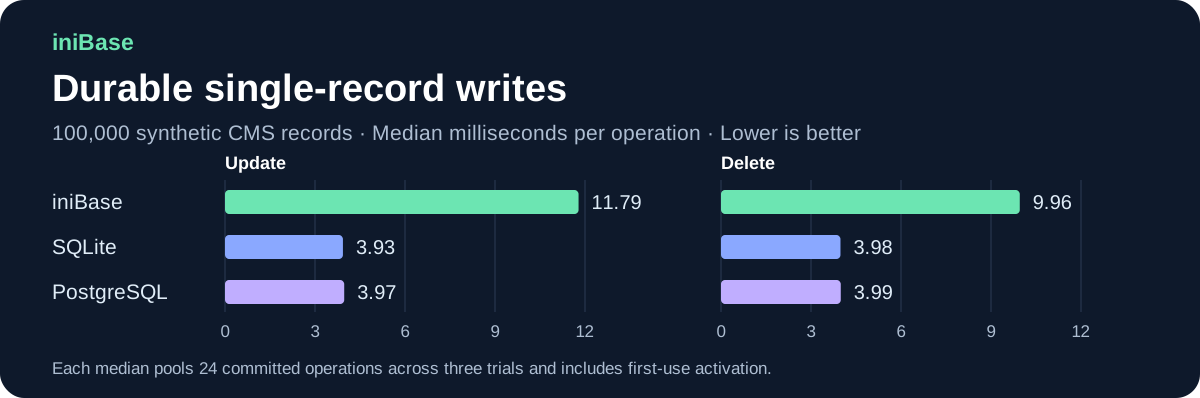
The release qualification ran three isolated trials per configuration on Apple M5, with full durability, equal synthetic records and explicit key indexes. iniBase used gzip compression with query caching disabled. The suite verified 81/81 trials across three engines, three datasets and three record counts.
| Engine | Bulk insert (ms) | Full read (ms) | Projection (ms) | Update p50 (ms) | Delete p50 (ms) | Mixed with maintenance (ms) | Final disk (MiB) |
|---|---|---|---|---|---|---|---|
| iniBase | 4,567.13 | 252.13 | 54.99 | 11.79 | 9.96 | 7,449.30 | 12.14 |
| SQLite | 1,069.86 | 121.73 | 39.67 | 3.93 | 3.98 | 130.29 | 149.48 |
| PostgreSQL | 1,091.92 | 135.56 | 32.61 | 3.97 | 3.99 | 592.46 | 330.14 |
Bulk inserts commit in batches of up to 1,000 and include fixture creation. Reads use the existing OS filesystem cache. Update and delete p50s each pool 24 committed operations across the three trials and include first-use activation. The mixed workload includes updates, verification reads, deletes and three maintenance calls. The final disk figures use allocated bytes, and PostgreSQL includes the entire cluster and WAL.
Qualification report · Raw results and reproduction · Historical cross-database results
Reproduce and profile
The qualification reproduction script rebuilds the archived source and reruns the comparison above.
For local engine development, the following scripts measure different workloads and should not be compared directly with the table above:
pnpm benchmark
pnpm benchmark:durability
pnpm benchmark:updatelog
pnpm benchmark:computed
Roadmap
- Actions:
- GET:
- Pagination
- Criteria
- Columns
- Sort
- POST
- PUT
- DELETE
- SUM
- MAX
- MIN
- GET:
- Schema supported types:
- String
- Number
- Boolean
- Date
- Url
- Table
- Object
- Array
- Password
- IP
- HTML
- Id
- JSON
- TO-DO:
- Use new Map() instead of Object
- Ability to search in JSON fields
- Re-check used exec functions
- Use smart caching (based on N° of queries)
- Commenting the code
- Add Backup feature (generate a tar.gz)
- Add Custom field validation property to schema (using RegEx?)
- Features:
- Encryption
- Data Compression
- Caching System
- Computed fields (v1 id-only expression language)
- Suggest new feature +
License
関連プロジェクトを探す
Asabeneh/30-Days-Of-Python
30 Days of Python プログラミングチャレンジは、Python プログラミング言語を 30 日で学ぶためのステップバイステップのガイドです。このチャレンジは 100 日以上かかることもあります。自分のペースで進めてください。こちらの動画も役立つかもしれません: https://www.youtube.com/channel/UC7PNRuno1rzYPb1xLa4yktw
78,729 スターgrafana/grafana
オープンで組み合わせ可能なオブザーバビリティおよびデータ可視化プラットフォームです。Prometheus、Loki、Elasticsearch、InfluxDB、Postgres など、複数のソースからメトリクス、ログ、トレースを可視化できます。
77,898 スターredis/redis
リアルタイムのデータ駆動型アプリケーションを構築する開発者にとって、Redis は最も選ばれ、最速で、機能が最も豊富なキャッシュ、データ構造サーバー、ドキュメントおよびベクトルクエリエンジンです。
77,491 スターapache/superset
Apache Superset は、データ可視化とデータ探索のためのプラットフォームです。
75,523 スター