
cheng-haha/GPT-Policy
cheng-haha/GPT-Policy has 368 GitHub stars and 9 forks. GitHot measured 0 stars in 24 hours. Last checked 2026-11-22 23:15 UTC. Last push 2026-10-17.
計測したスター増加
- 24時間
- 0
- 7日間
- 履歴を収集中
- 15日間
- 履歴を収集中
- 1か月
- 履歴を収集中
期間ごとの純増数です。期間は重複しており、日別の値ではありません。未計測の値は空欄です。スター数は注目度の指標であり、品質の保証ではありません。
概要
GPT-Policy: In-Context Robot Learning with VLM Agents
学習README.md
オリジナル
GPT-Policy: In-Context Robot Learning with VLM Agents
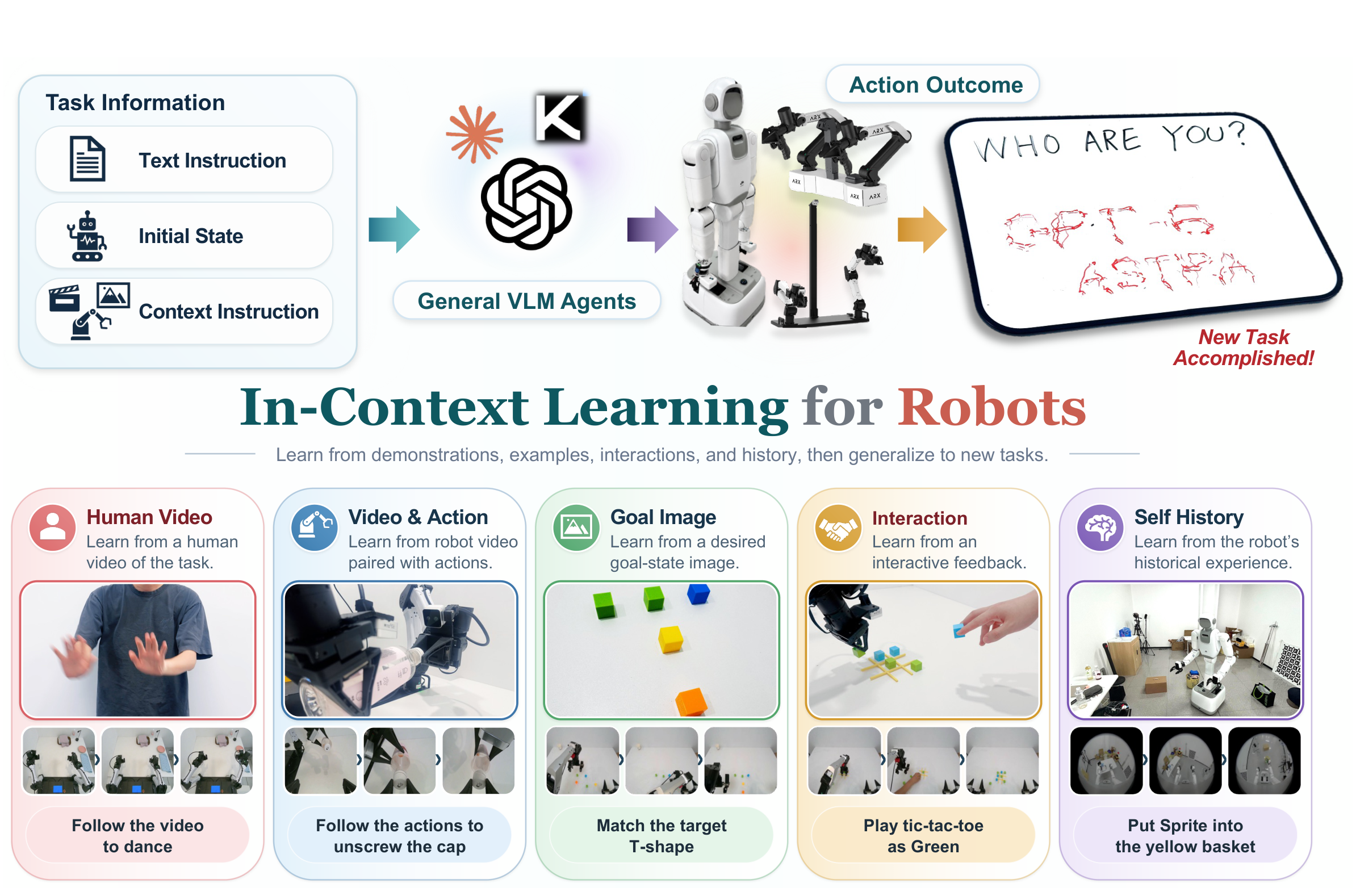
This repository is the public implementation of GPT-Policy, a closed-loop control framework that connects a fixed vision-language model (VLM) to robot tools. At deployment time, the agent can use demonstrations, goal images, interaction history, and execution feedback without gradient updates or task-specific parameter changes.
The implementation provides hardware adapters for ARX X5 and I2RT/YAM, plus an optional RoboDojo simulation backend with a separate Isaac process.





Paper: In-Context Robot Learning with VLM Agents
Authors: Dongzhou Cheng, Taoran Yi, Ye Fang, Xingwu Zhang, Fan Feng, Yixuan Li, Gengxiong Zhuang, Rongze Wang, Shuai Yang, Wei Song, Weizhi Xue, Minyan Wu, Jie Gui, Jiaqi Wang, and Tong Wu.
Abstract
Enabling robots to adapt to unfamiliar environments as readily as humans remains a moonshot goal of embodied AI. No finite collection of demonstrations can cover every task and situation a robot will encounter, making the ability to learn from context at deployment essential for generalization. Such in-context learning (ICL), however, remains largely beyond the reach of existing robotic policies. The broad agentic capabilities of commercial vision-language models (VLMs), such as GPT-6 Astra, raise a compelling question: can these models learn from demonstrations, examples, and interaction feedback, then translate that information into executable and verifiable robot behavior from a new initial state without gradient updates or persistent changes to task-specific parameters? We introduce GPT-Policy, a general-agent framework for in-context robot learning. GPT-Policy integrates a context compiler that preserves task-relevant visual transitions, a VLM that proposes robot-tool actions, and a constrained controller that verifies and executes each action and reports its outcome. We evaluate its reliability and limitations through task success and efficiency metrics, matched comparisons across models, and controlled context ablations. In real-robot trials, human video demonstrations improve task completion even without robot action labels, while aligned action references yield further gains on contact-sensitive tasks. These findings position GPT-Policy as a step toward robot adaptation through in-context learning, providing an empirical foundation for translating the general-purpose capabilities of VLMs into physical behavior and clarifying the challenges that must be overcome for reliable deployment.
News
- 🤖 [2026/10/11] Released demonstration contexts for ten RoboDojo tasks, with a reproduction guide.
- 🚀 [2026/09/16] The paper, project page, and code are now publicly available!
- 🎥 [2026/09/11] The first robot cases and demonstrations are added to the project page!
Demos
Four synchronized views of three GPT-6 Astra robot runs. Click any preview to open its MP4.
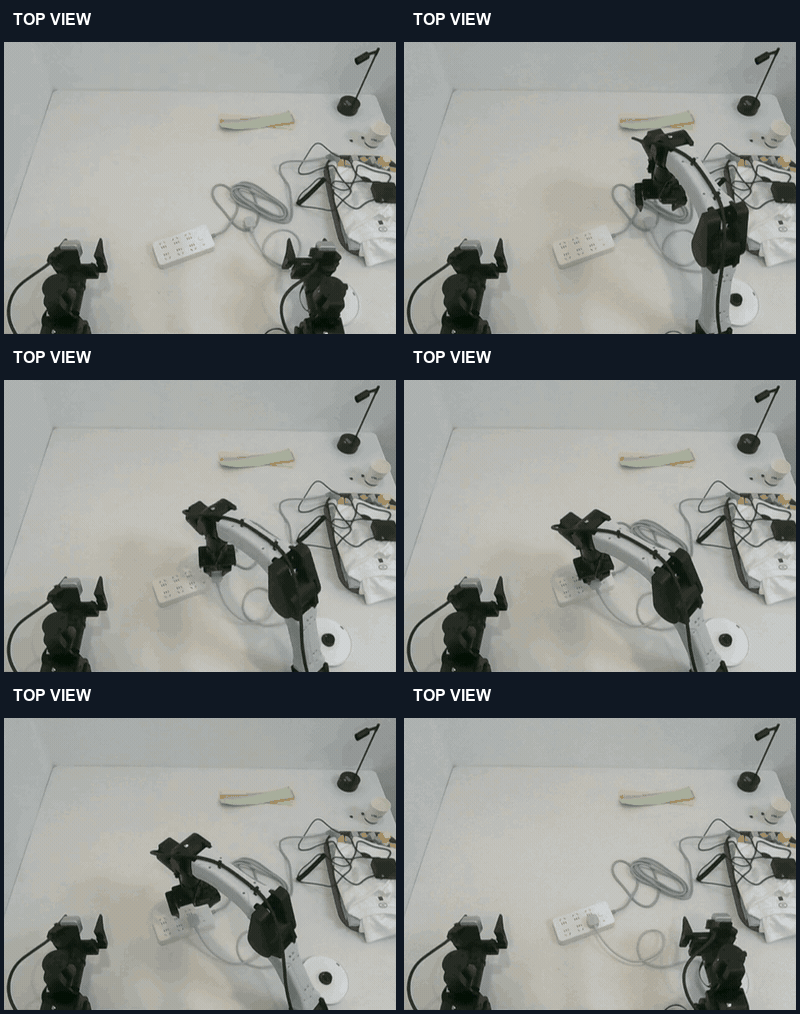
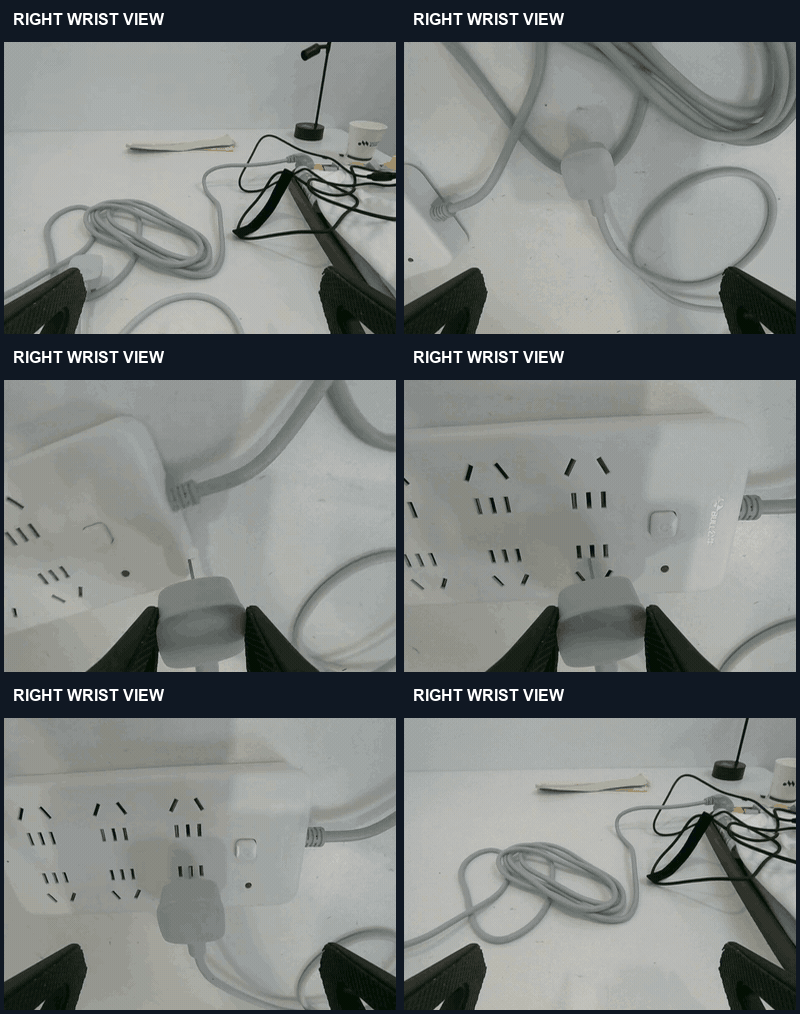
Plug insertion · top view Plug insertion · right wrist view
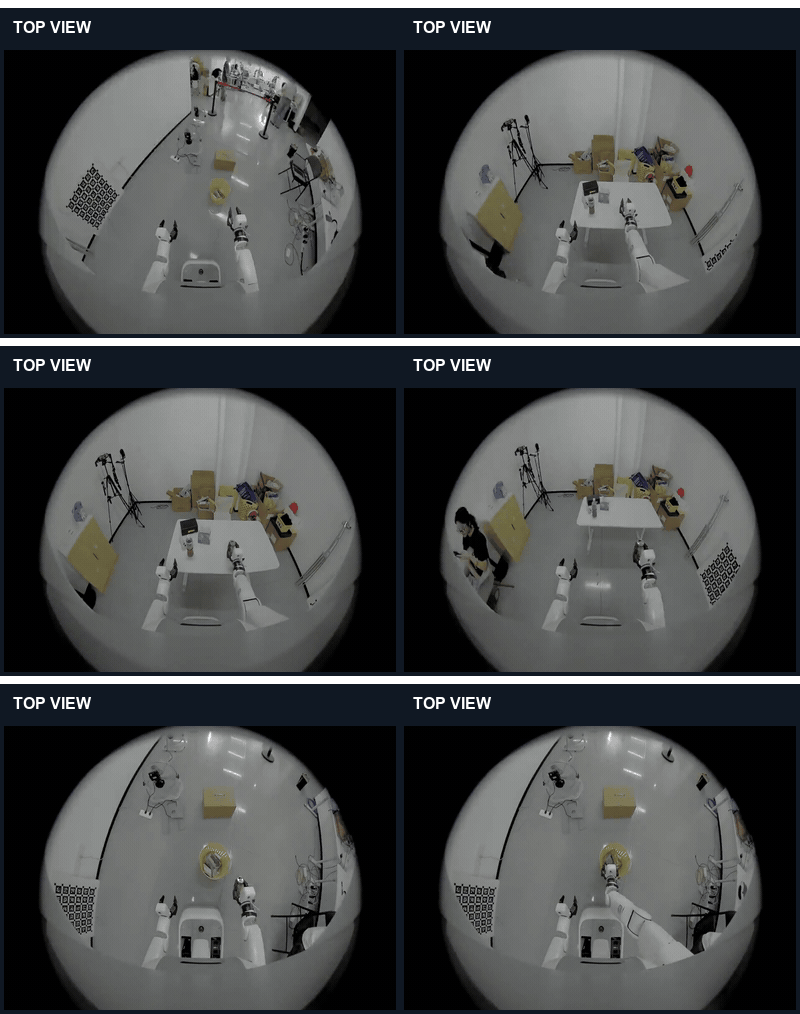
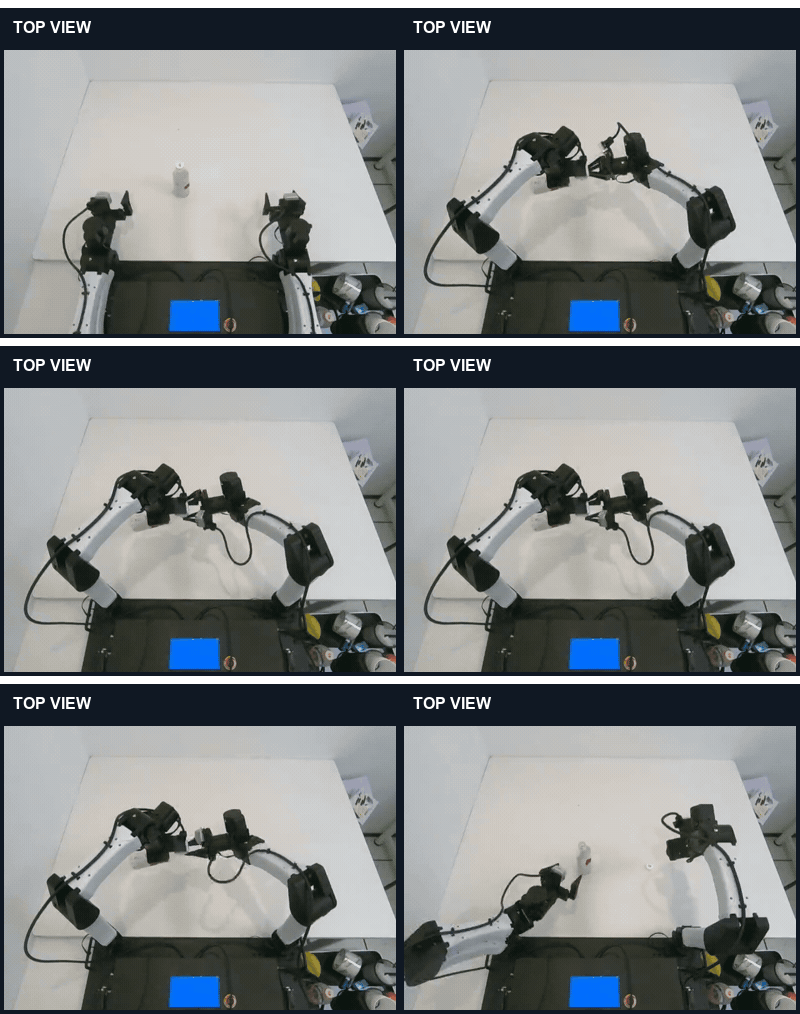
Sprite retrieval · search and place the bottle Bottle opening · unscrew and separate the cap
The full experiment gallery includes the other tasks and context comparisons.
RoboDojo results
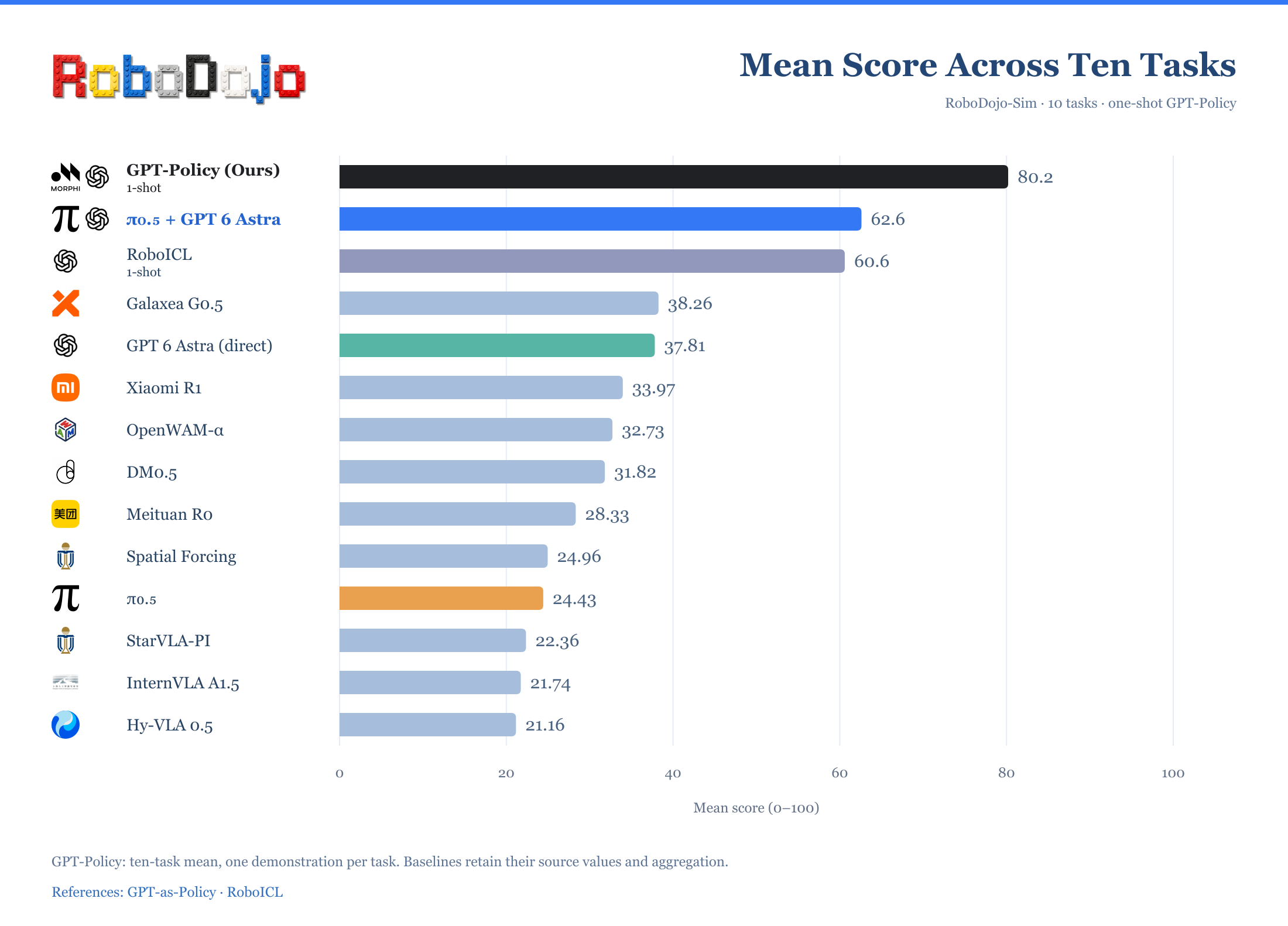
80.20 / 100 mean score · 72% success rate.
Interactive chart · Simulation videos · Reproduce the evaluation
Method overview
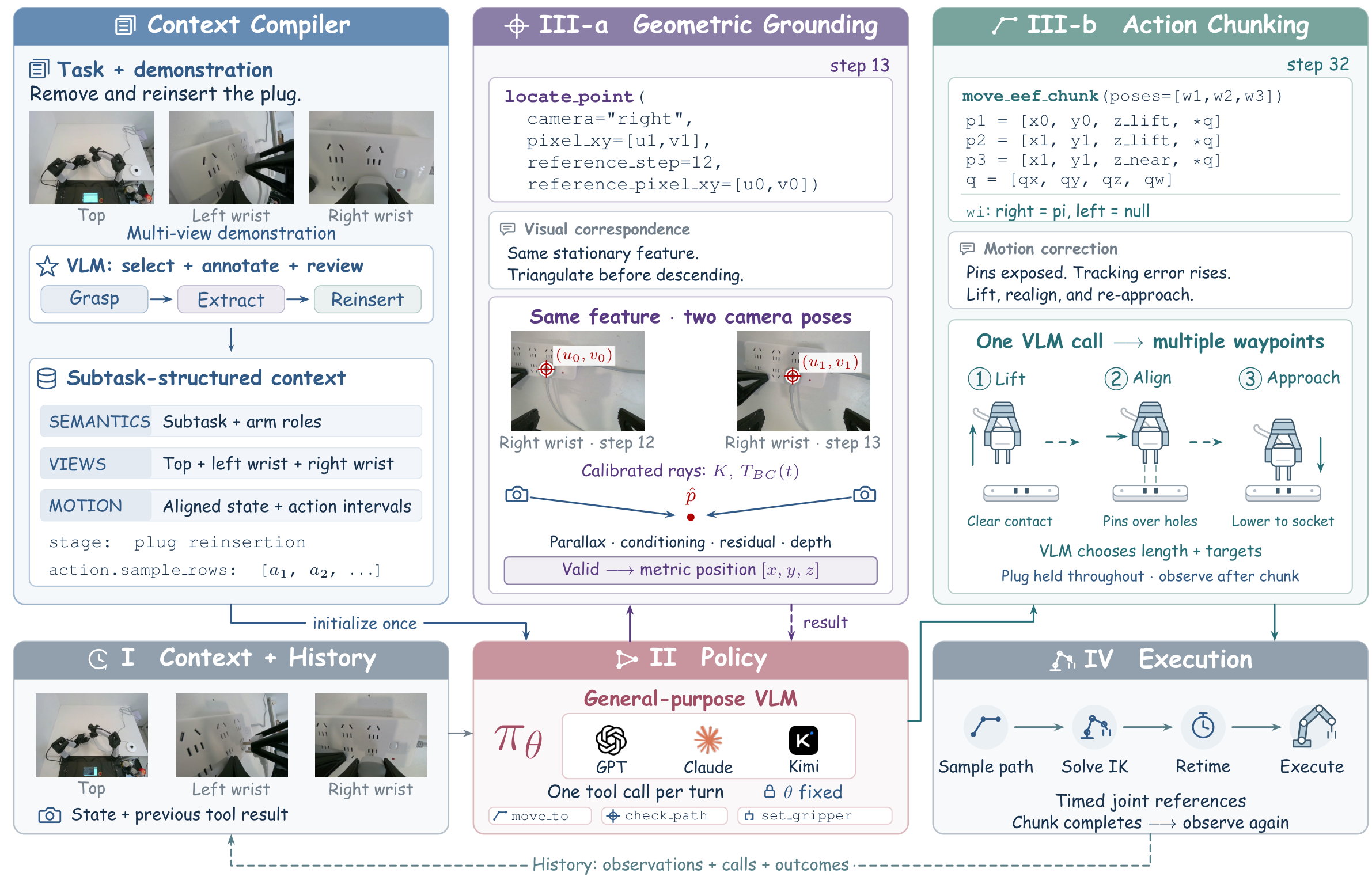
GPT-Policy builds one model input from the task, live camera/state observations, task references, and the previous tool result. The VLM emits one structured request; the selected adapter validates and executes it, then returns fresh observations and feedback for the next decision. Adapters support Cartesian targets and waypoint sequences, sequential IK checks, backend-specific timing, gripper control, and append-only run recording.
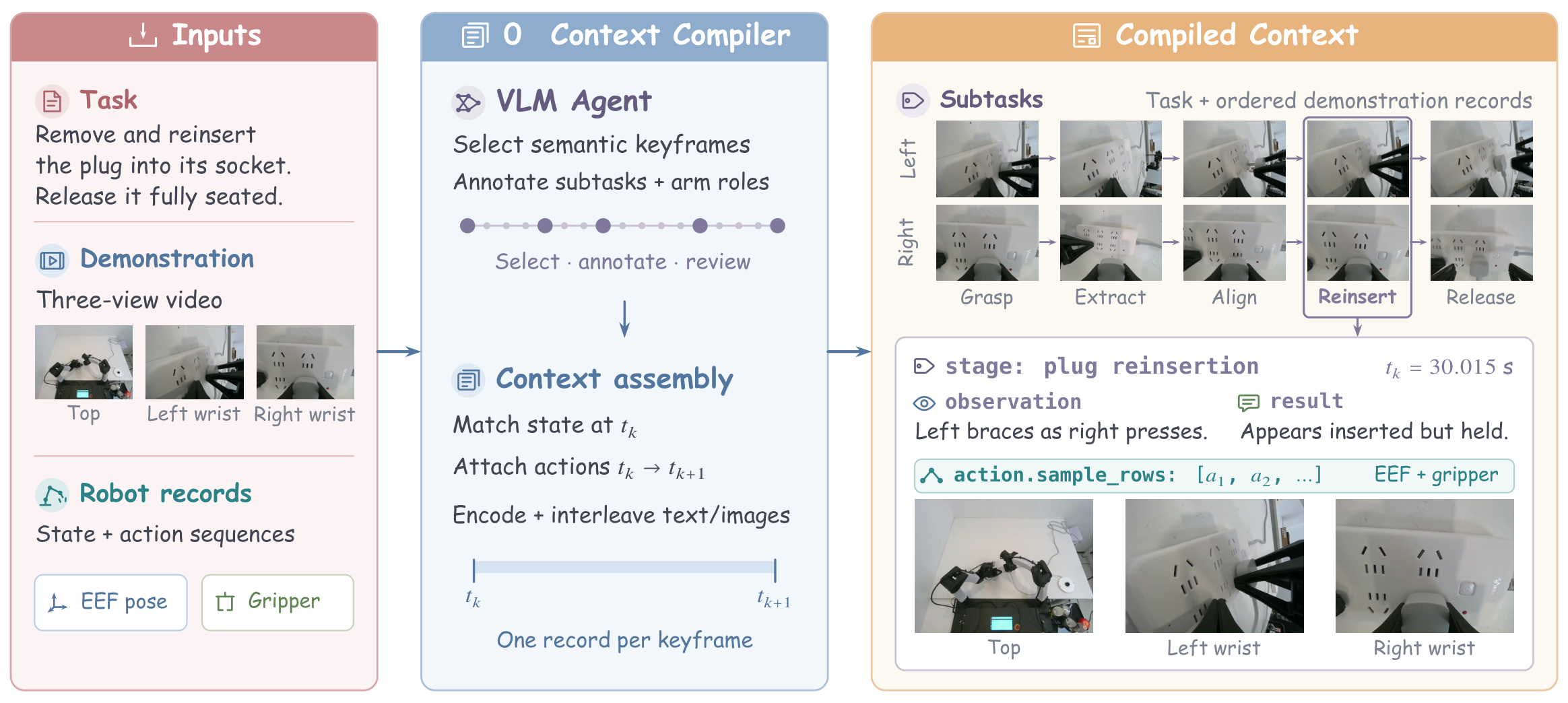
The available context types are:
- Human Video: a visual procedure that can transfer across embodiments.
- Robot Video / Video + Action: robot interactions, arm roles, and aligned motion references.
- Target Image: the desired object arrangement, position, and spacing.
- Self History: earlier observations, actions, results, and discovered subgoals.
- Human-Robot Interaction: live intent, pointing, corrections, and turn-taking.
Installation
Python 3.10 or newer is required.
python -m venv .venv
source .venv/bin/activate
python -m pip install -e .
The base install is hardware-free. Install only the backend you need:
source .venv/bin/activate
python scripts/install_drivers.py yam
python scripts/install_drivers.py realsense
# ARX instead: python scripts/install_drivers.py arx
# YAM alternative: python -m pip install -e '.[yam,realsense]'
Agent CLIs are external dependencies. Install and authenticate the provider you select; credentials are stored outside this repository.
RoboDojo simulation
The optional simulation host reuses the context compiler and one-tool-per-decision agent loop, with native task termination and three-camera recording. Follow the simulation and evaluation guide for environment setup, context download, the eight-GPU 50-episode command and result accounting.
python -m pip install -e '.[simulation]'
gpt-policy sim --config configs/robodojo.local.json --check
gpt-policy sim --config configs/robodojo.local.json --task classify_objects --smoke
The offline check never calls a model or starts Isaac. A short engineering smoke does not establish task success. See the guide for frozen evaluation, GPU queues, result accounting and reproduction limits.
Quick start
The default is YAM (yambox) + Codex (gpt-6-astra). Run from the project directory after installation. For different hardware, configure a machine profile first.
1. Check the configuration
source .venv/bin/activate
gpt-policy --check
The default reports machine: yambox, backend: yam, and hardware_opened: false. Local or explicit profile overrides take precedence.
2. Run with a robot demonstration
Replace the path with your reviewed demo.json. This command starts the robot task:
gpt-policy "Use the robot demonstration as a reference. Unscrew and remove the bottle cap, leaving the bottle standing securely on the table." \
  --demo /path/to/robot-demonstration/demo.json
The default auto mode includes recorded states and actions when available. No extra --demo-mode video+action is needed.
3. Reuse the saved task
Use the filename printed by Request:, for example:
gpt-policy --input-json request_json/unscrew-remove-bottle-cap.json
Task requests live in request_json/; generated context, images and recordings live in var/.
| Need | Documentation |
|---|---|
Choose auto, video, or video+action |
Demonstration modes |
| Preview context and see the loaded mode | Context inspection |
| Configure machines, cameras and recording | Runtime configuration |
Real-world results from the paper
🎯 Target Image / Self History / Human–Robot Interaction: 100% success on each of the six tasks evaluated under these conditions.
👀 Human Video: Success rate increases from 20% to 90% on towel pickup and from 20% to 80% on notebook pickup.
🤖 Robot Video + Action: Success rate increases from 0% to 80% on bottle opening and from 0% to 70% on plug reinsertion.
Repository layout
Start with the documentation index for setup, context and evaluation guides.
src/gpt_policy/       protocol, input preparation, planning, recording, adapters
configs/default.json  default YAM/yambox profile for `gpt-policy "..."`
configs/agents/       provider examples
configs/examples/     local-machine templates
configs/machines/     yambox, arx247 and arx248 deployment profiles
configs/calibration/  measured intrinsics and camera transforms
configs/robots/       portable robot and motion defaults
requirements/         installation entry points for each backend
scripts/              driver installation, evaluation and provider checks
tests/                core offline configuration/runtime regression tests
docs/assets/          figures used in this README
The public tree includes the deployed YAM/ARX machine profiles and their measured calibration. It excludes private task prompts, real credentials, run recordings and evaluation history. The paper's physical demonstration records and complete evaluation environment are not included by implication.
Development
The public repository keeps a focused offline regression suite for configuration, live-window behavior, camera controls and recording layout.
python -m pytest -q
python -m compileall -q src
TODO
- Release the GPT-Policy pipeline for real-world ARX robots, including the complete harness and format adapters for different context types.
- Release the YAM pipeline with hardware integration and flexible context support.
- Implement and validate the optional RoboDojo simulation pipeline; see the simulation and evaluation guide.
- Optimize the agent harness for context construction, feedback, and execution efficiency.
Limitations and safety
This is a research control loop. The integrator must verify calibration, workspace limits, collision behavior, camera placement, provider configuration, and emergency-stop procedures before energizing a robot. IK acceptance and a model completion message do not establish collision-free motion or physical task success. The project license is intentionally pending; redistribution and commercial use are not granted by this preview.
See THIRD_PARTY.md for third-party notices and optional SDK sources.
Community
Scan the QR code to join the GPT-Policy WeChat group (交流群).

Citation
@article{cheng2026context,
  title={In-context robot learning with VLM agents},
  author={Cheng, Dongzhou and Yi, Taoran and Fang, Ye and Zhang, Xingwu and Feng, Fan and Li, Yixuan and Zhuang, Gengxiong and Wang, Rongze and Yang, Shuai and Song, Wei and others},
  journal={arXiv preprint arXiv:2609.19138},
  year={2026}
}
Acknowledgements
GPT-Policy integrates optional ARX, I2RT/YAM, RealSense, and provider CLI interfaces, with reference to RoboCurve's inspect-robots project. Please see THIRD_PARTY.md before redistributing a deployment that includes external SDKs.
関連プロジェクトを探す
読み込み中…