
batzner/indrnn has 513 GitHub stars and 126 forks. GitHot measured 0 stars in 24 hours and 0 in 7 days. Last checked 2026-11-21 14:12 UTC. Last push 2021-08-19.
計測したスター増加
- 24時間
- 0
- 7日間
- 0
- 15日間
- 履歴を収集中
- 1か月
- 履歴を収集中
期間ごとの純増数です。期間は重複しており、日別の値ではありません。未計測の値は空欄です。スター数は注目度の指標であり、品質の保証ではありません。
概要
TensorFlow implementation of Independently Recurrent Neural Networks
機械学習README.md
オリジナルIndependently Recurrent Neural Networks
Simple TensorFlow implementation of Independently Recurrent Neural Network (IndRNN): Building A Longer and Deeper RNN by Shuai Li et al. The author's original implementation in Theano and Lasagne can be found in Sunnydreamrain/IndRNN_Theano_Lasagne.

Summary
In IndRNNs, neurons in recurrent layers are independent from each other. The basic RNN calculates the hidden state h with h = act(W * input + U * state + b). IndRNNs use an element-wise vector multiplication u * state meaning each neuron has a single recurrent weight connected to its last hidden state.
The IndRNN
- can be used efficiently with ReLU activation functions making it easier to stack multiple recurrent layers without saturating gradients
- allows for better interpretability, as neurons in the same layer are independent from each other
- prevents vanishing and exploding gradients by regulating each neuron's recurrent weight
Usage
Copy ind_rnn_cell.py into your project.
from ind_rnn_cell import IndRNNCell

# Regulate each neuron's recurrent weight as recommended in the paper
recurrent_max = pow(2, 1 / TIME_STEPS)

cell = MultiRNNCell([IndRNNCell(128, recurrent_max_abs=recurrent_max),
                     IndRNNCell(128, recurrent_max_abs=recurrent_max)])
output, state = tf.nn.dynamic_rnn(cell, input_data, dtype=tf.float32)
...
Experiments in the paper
Addition Problem
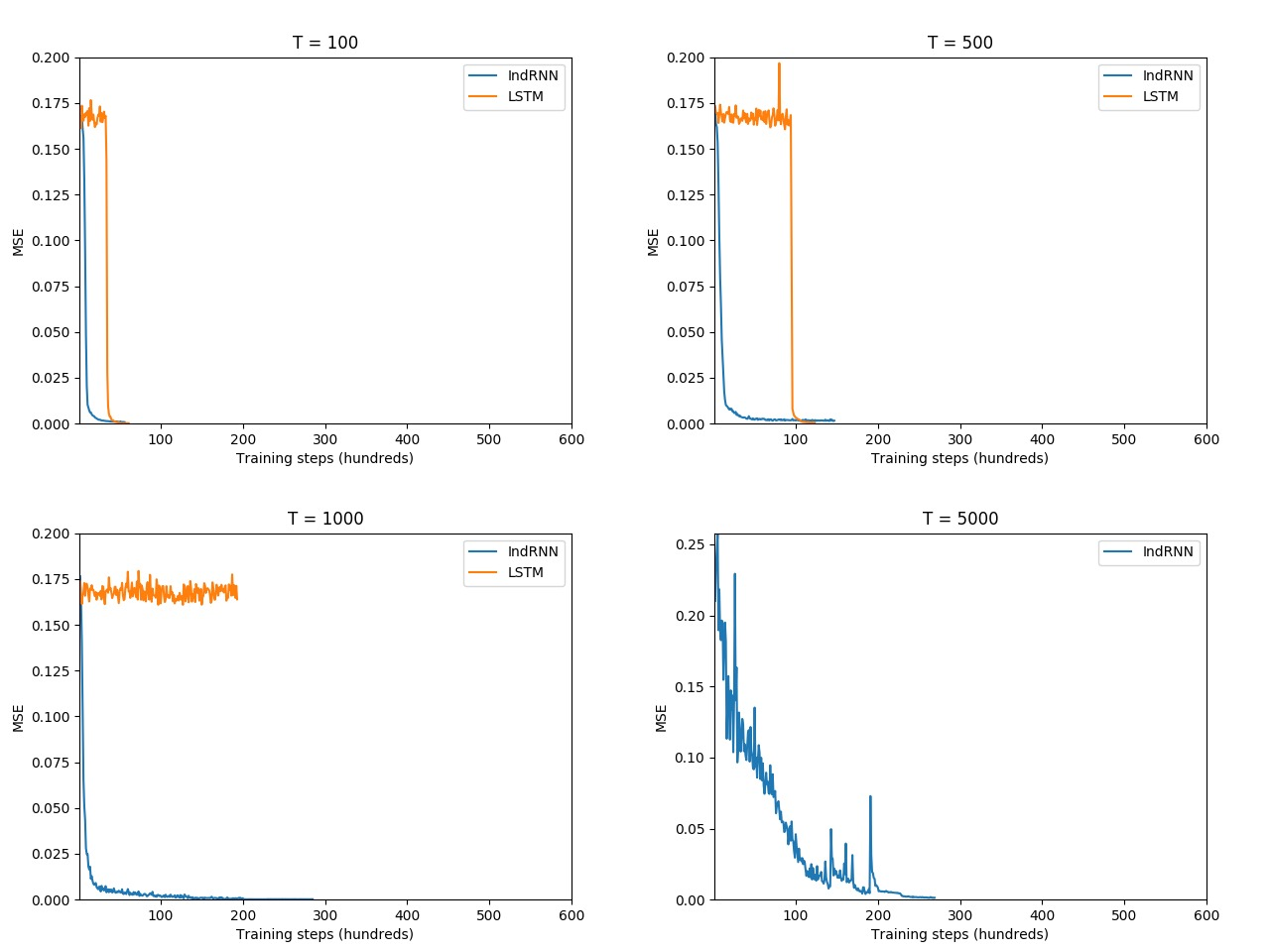
See examples/addition_rnn.py for a script reproducing the "Adding Problem" from the paper. Below are the results reproduced with the addition_rnn.py code.
Sequential MNIST
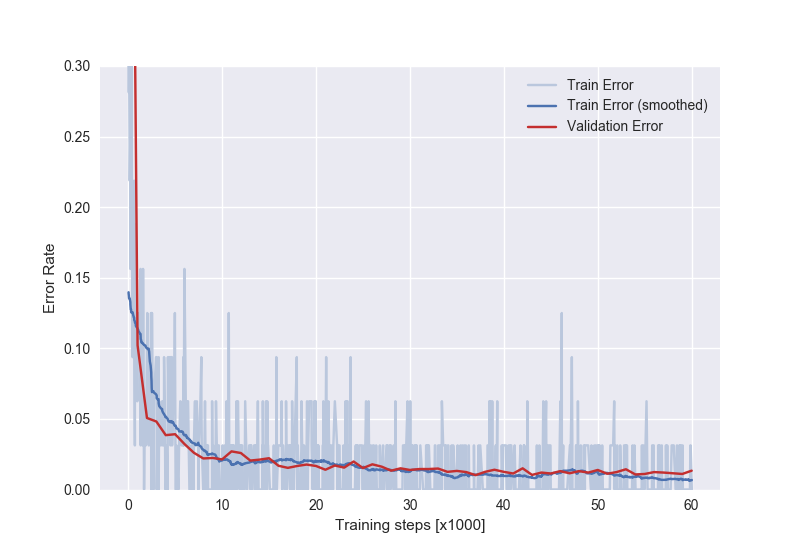
See examples/sequential_mnist.py for a script reproducing the Sequential MNIST experiment. I let it run for two days and stopped it after 60,000 training steps with a
- Training error rate of 0.7%
- Validation error rate of 1.1%
- Test error rate of 1.1%
Requirements
- Python 3.4+
- TensorFlow 1.5+