
Ladbaby/PyOmniTS has 109 GitHub stars and 15 forks. Star changes are not measured yet. Last checked 2026-11-14 11:32 UTC. Last push 2026-11-13.
できること
- Extensibility: Adapt your model/dataset once, train almost any combination of "model" $\times$ "dataset" $\times$ "loss function".
- Compatibility: Accept models with any number/type of arguments in forward; Accept datasets with any number/type of return values in __getitem__; Accept tailored loss calculation for specific models.
- Maintainability: No need to worry about breaking the training codes of existing models/datasets/loss functions when adding new ones.
- Reproducibility: Minimal library dependencies for core components. Try the best to get rid of fancy third-party libraries (e.g., PyTorch Lightning, EasyTorch).
計測したスター増加
- 24時間
- 履歴を収集中
- 7日間
- 履歴を収集中
- 15日間
- 履歴を収集中
- 1か月
- 履歴を収集中
期間ごとの純増数です。期間は重複しており、日別の値ではありません。未計測の値は空欄です。スター数は注目度の指標であり、品質の保証ではありません。
概要
🔬 A Researcher&Agent-Friendly Framework for Time Series Analysis. Train Any Model on Any Dataset!
機械学習README.md
オリジナル

A Researcher&Agent-Friendly Framework for Time Series Analysis.
Train Any Model on Any Dataset.
📊 Time series analysis leaderboard is now available on our 🤗 Hugging Face space. Discover the performance of different models!

This is also the official repository for the following paper:
Learning Recursive Multi-Scale Representations for Irregular Multivariate Time Series Forecasting (ICLR 2026) [poster] [OpenReview] [arXiv]
@inproceedings{li_LearningRecursiveMultiScale_2026,
    author = {Li, Boyuan and Liu, Zhen and Luo, Yicheng  and Ma, Qianli},
    booktitle = {International Conference on Learning Representations},
    title = {Learning Recursive Multi-Scale Representations for Irregular Multivariate Time Series Forecasting},
    year = {2026}
}
HyperIMTS: Hypergraph Neural Network for Irregular Multivariate Time Series Forecasting (ICML 2025) [poster] [OpenReview] [arXiv]
@inproceedings{li_HyperIMTSHypergraphNeural_2025,
    author = {Li, Boyuan and Luo, Yicheng and Liu, Zhen and Zheng, Junhao and Lv, Jianming and Ma, Qianli},
    booktitle = {Forty-Second International Conference on Machine Learning},
    title = {HyperIMTS: Hypergraph Neural Network for Irregular Multivariate Time Series Forecasting},
    year = {2025}
}
1. ✨ Hightlighted Features
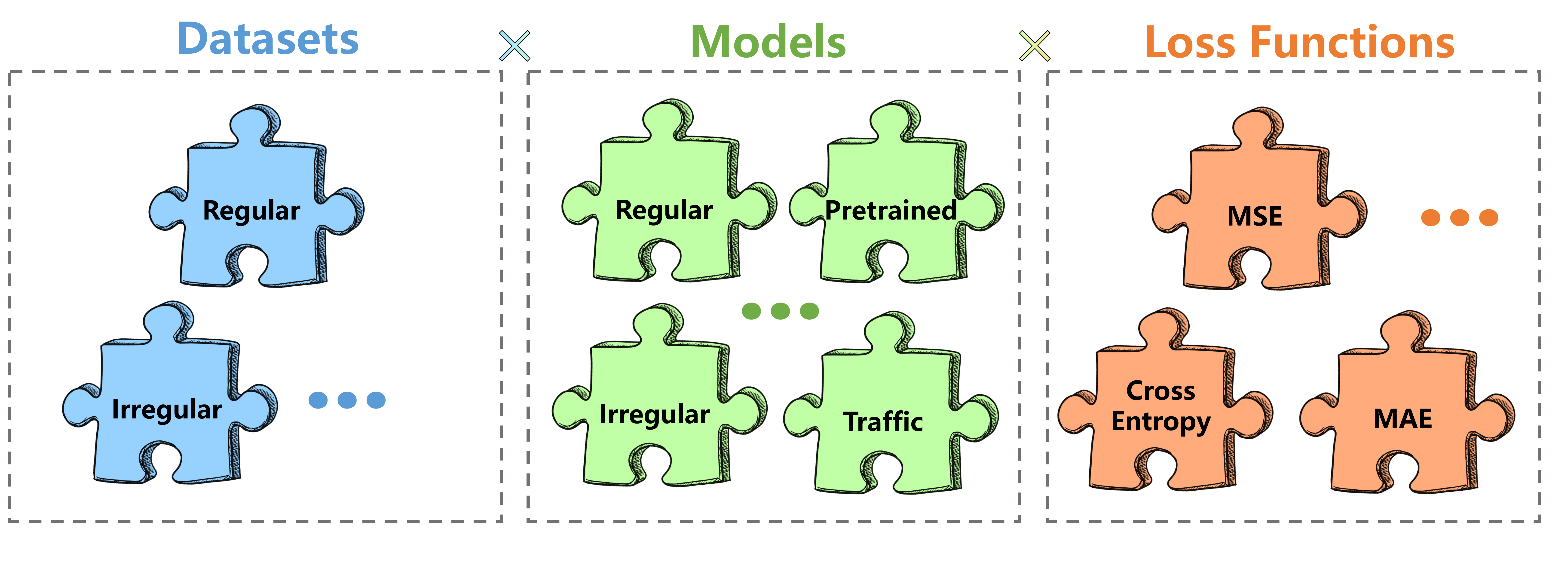
- Extensibility: Adapt your model/dataset once, train almost any combination of "model" $\times$ "dataset" $\times$ "loss function".
- Compatibility: Accept models with any number/type of arguments in
forward; Accept datasets with any number/type of return values in__getitem__; Accept tailored loss calculation for specific models. - Maintainability: No need to worry about breaking the training codes of existing models/datasets/loss functions when adding new ones.
- Reproducibility: Minimal library dependencies for core components. Try the best to get rid of fancy third-party libraries (e.g., PyTorch Lightning, EasyTorch).
- Efficiency: Multi-GPU parallel training; Python built-in logger; structured experimental result saving (json)...
- Transferability: Even if you don't like our framework, you can still easily find and copy the models/datasets you want. No overwhelming encapsulation.
2. 🧭 Documentation
Checkout the new documentation website.
Using 🦞agent? Check out our official PyOmniTS skill on clawhub. Your agent will understand the essentials of our framework, and even automate the code replication process by adapting other papers' codes into PyOmniTS!
3. 🤖 Models
54 models, covering regular, irregular, pretrained, and traffic models, have been included in PyOmniTS, and more are coming.
Model classes can be found in models/, and their dependencies can be found in layers/
- ✅: supported
- ❌: not supported
- '-': not implemented
- MTS: regularly sampled multivariate time series
- IMTS: able to handle irregularly sampled multivariate time series
| Model | Venue | Type | Forecasting | Classification | Imputation | Available Versions |
|---|---|---|---|---|---|---|
| Ada-MSHyper | NeurIPS 2024 | MTS | ✅ | ✅ | ✅ | v1.0.0+ |
| APN | AAAI 2026 | IMTS | ✅ | - | - | v1.3.2+ |
| ASTGI | ICLR 2026 | IMTS | ✅ | - | - | v2.0.1+ |
| Autoformer | NeurIPS 2021 | MTS | ✅ | ✅ | ✅ | v1.0.0+ |
| Scaleformer | ICLR 2023 | MTS | ✅ | - | ✅ | v2.0.0+ |
| BigST | VLDB 2024 | MTS | ✅ | ✅ | ✅ | v1.0.0+ |
| Crossformer | ICLR 2023 | MTS | ✅ | ✅ | ✅ | v1.0.0+ |
| CRU | ICML 2022 | IMTS | ✅ | ❌ | ✅ | v1.0.0+ |
| DLinear | AAAI 2023 | MTS | ✅ | ✅ | ✅ | v1.0.0+ |
| ETSformer | arXiv 2022 | MTS | ✅ | ✅ | ✅ | v1.0.0+ |
| FEDformer | ICML 2022 | MTS | ✅ | ✅ | ✅ | v1.0.0+ |
| FiLM | NeurIPS 2022 | MTS | ✅ | ✅ | ✅ | v1.0.0+ |
| FourierGNN | NeurIPS 2023 | MTS | ✅ | ✅ | ✅ | v1.0.0+ |
| FreTS | NeurIPS 2023 | MTS | ✅ | ✅ | ✅ | v1.0.0+ |
| GNeuralFlow | NeurIPS 2024 | IMTS | ✅ | ❌ | ✅ | v1.0.0+ |
| GraFITi | AAAI 2024 | IMTS | ✅ | ✅ | ✅ | v1.0.0+ |
| GRU-D | Scientific Reports 2018 | IMTS | ✅ | ✅ | ✅ | v1.0.0+ |
| GRUwE | TMLR 2026 | IMTS | ✅ | - | - | v2.0.2+ |
| HD-TTS | ICML 2024 | IMTS | ✅ | - | ✅ | v2.0.0+ |
| Hi-Patch | ICML 2025 | IMTS | ✅ | ✅ | ✅ | v1.0.0+ |
| higp | ICML 2024 | MTS | ✅ | ✅ | ✅ | v1.0.0+ |
| HyperIMTS (Ours) | ICML 2025 | IMTS | ✅ | - | ✅ | v1.0.0+ |
| Informer | AAAI 2021 | MTS | ✅ | ✅ | ✅ | v1.0.0+ |
| iTransformer | ICLR 2024 | MTS | ✅ | ✅ | ✅ | v1.0.0+ |
| Koopa | NeurIPS 2023 | MTS | ✅ | ❌ | ✅ | v1.0.0+ |
| Latent_ODE | NeurIPS 2019 | IMTS | ✅ | ❌ | ✅ | v1.0.0+ |
| Leddam | ICML 2024 | MTS | ✅ | ✅ | ✅ | v1.0.0+ |
| LightTS | arXiv 2022 | MTS | ✅ | ✅ | ✅ | v1.0.0+ |
| Mamba | Language Modeling 2024 | MTS | ✅ | ✅ | ✅ | v1.0.0+ |
| MICN | ICLR 2023 | MTS | ✅ | ✅ | ✅ | v1.0.0+ |
| MOIRAI | ICML 2024 | Any | ✅ | - | ✅ | v1.0.0+ |
| mTAN | ICLR 2021 | IMTS | ✅ | ✅ | ✅ | v1.0.0+ |
| NeuralFlows | NeurIPS 2021 | IMTS | ✅ | ❌ | ✅ | v1.0.0+ |
| NHITS | AAAI 2023 | MTS | ✅ | - | ✅ | v2.0.0+ |
| Nonstationary Transformer | NeurIPS 2022 | MTS | ✅ | ✅ | ✅ | v1.0.0+ |
| PatchTST | ICLR 2023 | MTS | ✅ | ✅ | ✅ | v1.0.0+ |
| Pathformer | ICLR 2024 | MTS | ✅ | - | ✅ | v2.0.0+ |
| PrimeNet | AAAI 2023 | IMTS | ✅ | ✅ | ✅ | v1.0.0+ |
| Pyraformer | ICLR 2022 | MTS | ✅ | ✅ | ✅ | v2.0.0+ |
| Raindrop | ICLR 2022 | IMTS | ✅ | ✅ | ✅ | v1.0.0+ |
| Reformer | ICLR 2020 | MTS | ✅ | ✅ | ✅ | v1.0.0+ |
| ReIMTS (Ours) | ICLR 2026 | IMTS | ✅ | ✅ | - | v2.0.0+ |
| SeFT | ICML 2020 | IMTS | ✅ | ✅ | ✅ | v1.0.0+ |
| SegRNN | arXiv 2023 | MTS | ✅ | ✅ | ✅ | v1.0.0+ |
| Temporal Fusion Transformer | arXiv 2019 | MTS | ✅ | - | - | v1.0.0+ |
| TFMixer | ICML 2026 | IMTS | ✅ | - | - | v2.0.1+ |
| TiDE | TMLR 2023 | MTS | ✅ | ✅ | ✅ | v1.0.0+ |
| TimeCHEAT | AAAI 2025 | MTS | ✅ | ✅ | ✅ | v1.0.0+ |
| TimeMixer | ICLR 2024 | MTS | ✅ | ✅ | ✅ | v1.0.0+ |
| TimesNet | ICLR 2023 | MTS | ✅ | ✅ | ✅ | v1.0.0+ |
| tPatchGNN | ICML 2024 | IMTS | ✅ | ✅ | ✅ | v1.0.0+ |
| Transformer | NeurIPS 2017 | MTS | ✅ | ✅ | ✅ | v1.0.0+ |
| TSMixer | TMLR 2023 | MTS | ✅ | ✅ | ✅ | v1.0.0+ |
| Warpformer | KDD 2023 | IMTS | ✅ | ✅ | ✅ | v1.0.0+ |
4. 💾 Datasets
Dataest classes are put in data/data_provider/datasets, and dependencies can be found in data/dependencies:
11 datasets, covering regular and irregular ones, have been included in PyOmniTS, and more are coming.
- ✅: supported
- ❌: not supported
- '-': not implemented
- MTS: regularly sampled multivariate time series
- IMTS: irregularly sampled multivariate time series
| Dataset | Type | Field | Forecasting |
|---|---|---|---|
| ECL | MTS | electricity | ✅ |
| ETTh1 | MTS | electricity | ✅ |
| ETTm1 | MTS | electricity | ✅ |
| Human Activity | IMTS | biomechanics | ✅ |
| ILI | MTS | healthcare | ✅ |
| MIMIC III | IMTS | healthcare | ✅ |
| MIMIC IV | IMTS | healthcare | ✅ |
| PhysioNet'12 | IMTS | healthcare | ✅ |
| Traffic | MTS | traffic | ✅ |
| USHCN | IMTS | weather | ✅ |
| Weather | MTS | weather | ✅ |
Datasets for classification and imputation have not released yet.
5. 📉 Loss Functions
The following loss functions are included under loss_fns/:
| Loss Function | Task | Note |
|---|---|---|
| CrossEntropyLoss | Classification | - |
| MAE | Forecasting/Imputation | - |
| ModelProvidedLoss | - | Some models prefer to calculate loss within forward(), such as GNeuralFlows. |
| MSE_Dual | Forecasting/Imputation | |
| MSE | Forecasting/Imputation | - |
6. 🚧 Roadmap
PyOmniTS is continously evolving:
- More tutorials.
- Classification support in core components.
- Imputation support in core components.
- Optional python package management via uv.
Yet Another Code Framework?
We encountered the following problems when using existing ones:
Argument & return value chaos for models'
forward():Different models usually take varying number and shape of arguments, especially ones from different domains. Changes to training logic are needed to support these differences.
Return value chaos for datasets'
__getitem__():datasets can return a number of tensors in different shapes, which have to be aligned with arguments of models'
forward()one by one. Changes to training logic are also needed to support these differences.Argument & return value chaos for loss functions'
forward():loss functions take different types of tensors as input, require aligning with return values from models'
forward().Overwhelming dependencies:
some existing pipelines use fancy high-level packages in building the pipeline, which can lower the flexibility of code modification.
Contributors
 Ladbaby 💻 🐛 |
 Ankit Joshi 💻 |
Acknowledgement
- Time Series Library: Models and datasets for regularly sampled time series are mostly adapted from it.
- BasicTS: Documentation design reference.
- Google Gemini: Icon creation.
関連プロジェクトを探す
tensorflow/tensorflow
すべての人のためのオープンソース機械学習フレームワーク
201,594 スターhuggingface/transformers
🤗 Transformers:テキスト、ビジョン、音声、マルチモーダルの最先端機械学習モデル向けモデル定義フレームワークで、推論と学習の両方に対応します。
168,962 スターAUTOMATIC1111/stable-diffusion-webui
Stable Diffusion の Web UI
165,311 スターComfy-Org/ComfyUI
グラフとノードによるインターフェースを備えた、最も強力でモジュール性の高い拡散モデル向け GUI、API、バックエンド。世界最速のローカル推論エンジン。
146,759 スター