
Determined22/zh-NER-TF
Determined22/zh-NER-TF has 2,331 GitHub stars and 923 forks. GitHot measured 0 in 7 days. Last checked 2026-11-15 13:51 UTC. Last push 2022-04-18.
計測したスター増加
- 24時間
- 更新が遅れています
- 7日間
- 0
- 15日間
- 更新が遅れています
- 1か月
- 更新が遅れています
期間ごとの純増数です。期間は重複しており、日別の値ではありません。未計測の値は空欄です。スター数は注目度の指標であり、品質の保証ではありません。
概要
A very simple BiLSTM-CRF model for Chinese Named Entity Recognition 中文命名实体识别 (TensorFlow)
機械学習README.md
オリジナルA simple BiLSTM-CRF model for Chinese Named Entity Recognition
This repository includes the code for buliding a very simple character-based BiLSTM-CRF sequence labeling model for Chinese Named Entity Recognition task. Its goal is to recognize three types of Named Entity: PERSON, LOCATION and ORGANIZATION.
This code works on Python 3 & TensorFlow 1.2 and the following repository https://github.com/guillaumegenthial/sequence_tagging gives me much help.
Model
This model is similar to the models provided by paper [1] and [2]. Its structure looks just like the following illustration:
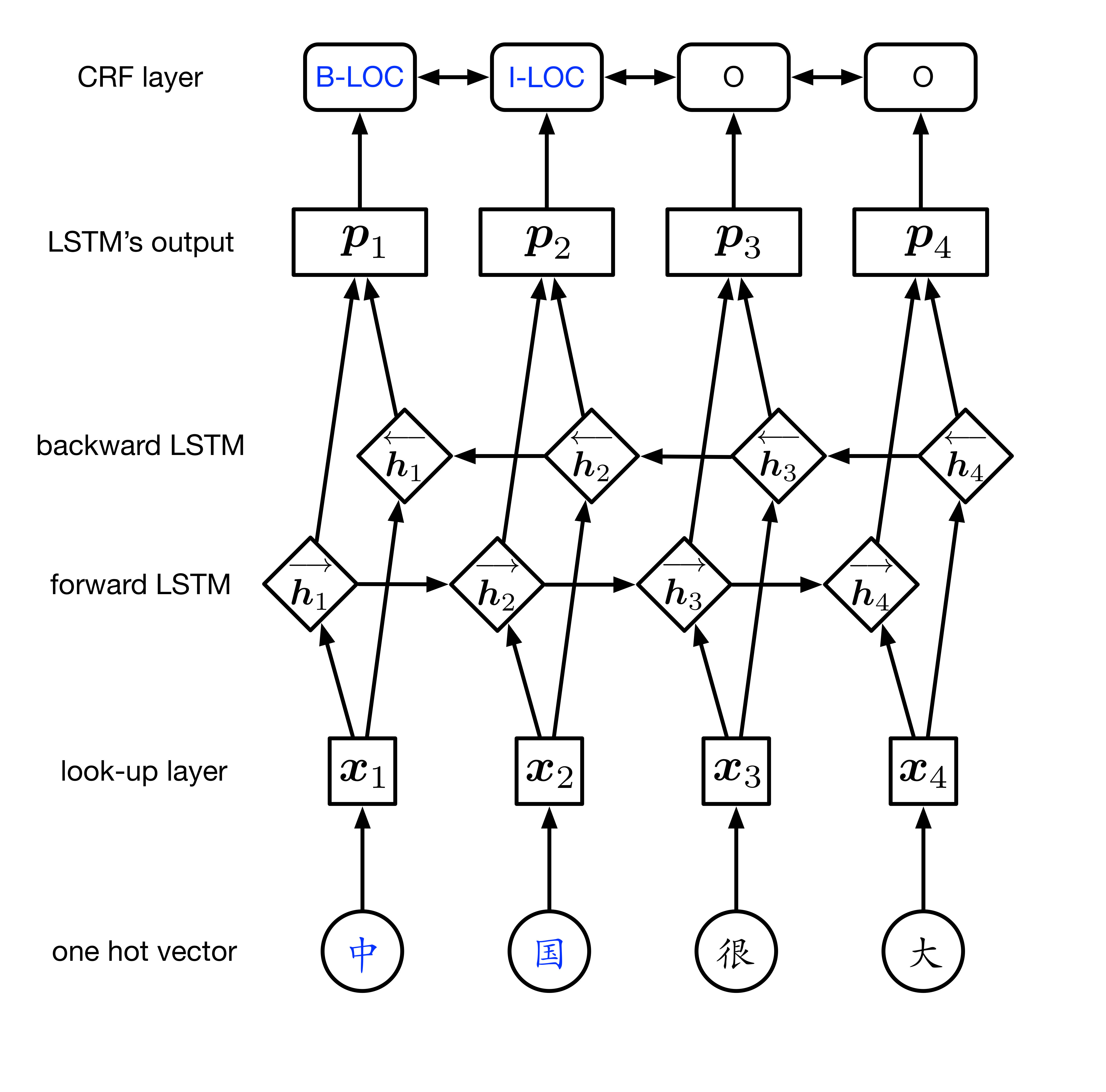
For one Chinese sentence, each character in this sentence has / will have a tag which belongs to the set {O, B-PER, I-PER, B-LOC, I-LOC, B-ORG, I-ORG}.
The first layer, look-up layer, aims at transforming each character representation from one-hot vector into character embedding. In this code I initialize the embedding matrix randomly. We could add some linguistic knowledge later. For example, do tokenization and use pre-trained word-level embedding, then augment character embedding with the corresponding token's word embedding. In addition, we can get the character embedding by combining low-level features (please see paper[2]'s section 4.1 and paper[3]'s section 3.3 for more details).
The second layer, BiLSTM layer, can efficiently use both past and future input information and extract features automatically.
The third layer, CRF layer, labels the tag for each character in one sentence. If we use a Softmax layer for labeling, we might get ungrammatic tag sequences beacuse the Softmax layer labels each position independently. We know that 'I-LOC' cannot follow 'B-PER' but Softmax doesn't know. Compared to Softmax, a CRF layer can use sentence-level tag information and model the transition behavior of each two different tags.
Dataset
| #sentence | #PER | #LOC | #ORG | |
|---|---|---|---|---|
| train | 46364 | 17615 | 36517 | 20571 |
| test | 4365 | 1973 | 2877 | 1331 |
It looks like a portion of MSRA corpus. I downloaded the dataset from the link in ./data_path/original/link.txt
data files
The directory ./data_path contains:
- the preprocessed data files,
train_dataandtest_data - a vocabulary file
word2id.pklthat maps each character to a unique id
For generating vocabulary file, please refer to the code in data.py.
data format
Each data file should be in the following format:
中	B-LOC
国	I-LOC
很	O
大	O

句	O
子	O
结	O
束	O
是	O
空	O
行	O
If you want to use your own dataset, please:
- transform your corpus to the above format
- generate a new vocabulary file
How to Run
train
python main.py --mode=train
test
python main.py --mode=test --demo_model=1521112368
Please set the parameter --demo_model to the model that you want to test. 1521112368 is the model trained by me.
An official evaluation tool for computing metrics: here (click 'Instructions')
My test performance:
| P | R | F | F (PER) | F (LOC) | F (ORG) |
|---|---|---|---|---|---|
| 0.8945 | 0.8752 | 0.8847 | 0.8688 | 0.9118 | 0.8515 |
demo
python main.py --mode=demo --demo_model=1521112368
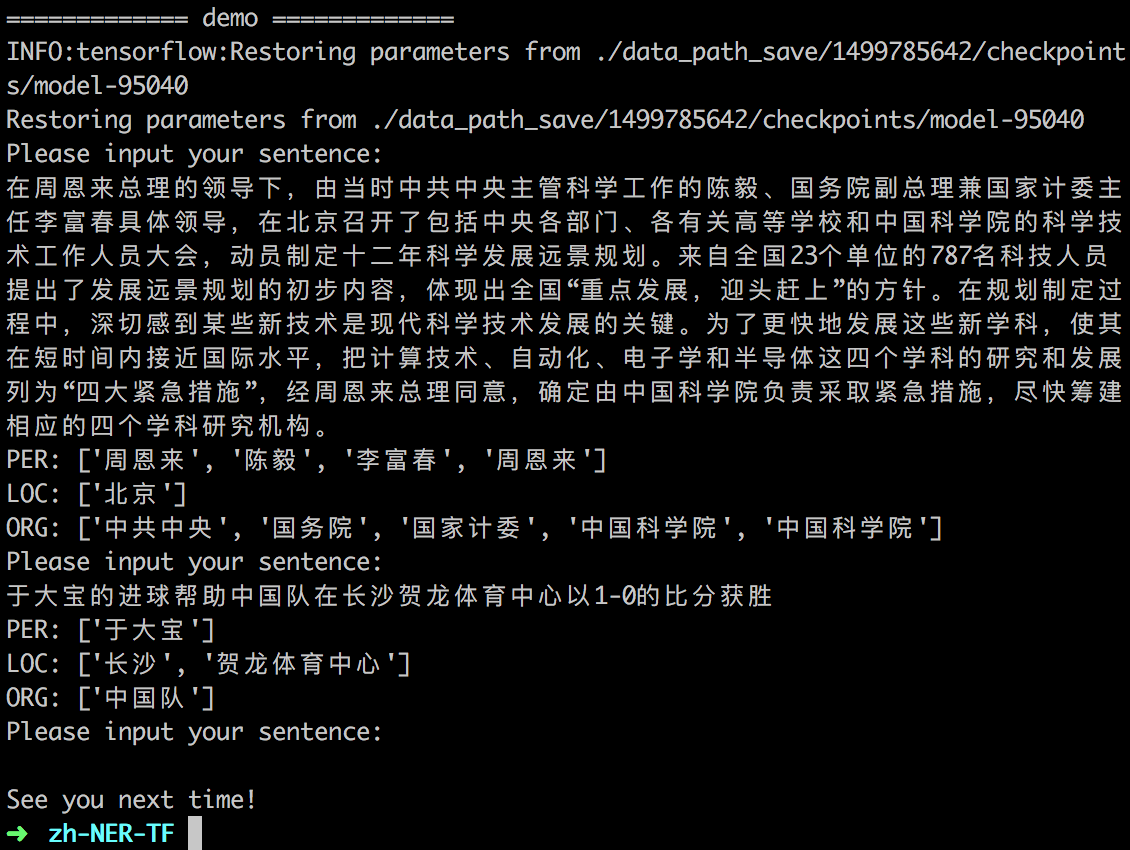
You can input one Chinese sentence and the model will return the recognition result:
Reference
[1] Bidirectional LSTM-CRF Models for Sequence Tagging
[2] Neural Architectures for Named Entity Recognition
[3] Character-Based LSTM-CRF with Radical-Level Features for Chinese Named Entity Recognition