
ChazY11/medradar has 307 GitHub stars and 19 forks. GitHot measured +7 stars in 24 hours. Last checked 2026-11-19 09:05 UTC. Last push 2026-11-17.
計測したスター増加
- 24時間
- +7
- 7日間
- 履歴を収集中
- 15日間
- 履歴を収集中
- 1か月
- 履歴を収集中
期間ごとの純増数です。期間は重複しており、日別の値ではありません。未計測の値は空欄です。スター数は注目度の指標であり、品質の保証ではありません。
概要
エビデンスを重視し、医療技術の開発における初期兆候を観察・研究するためのプラットフォームです。
データREADME.md
オリジナル





Website · Platform · Research · Get started · Documentation · 中文
Can public evidence see medical-technology change coming?
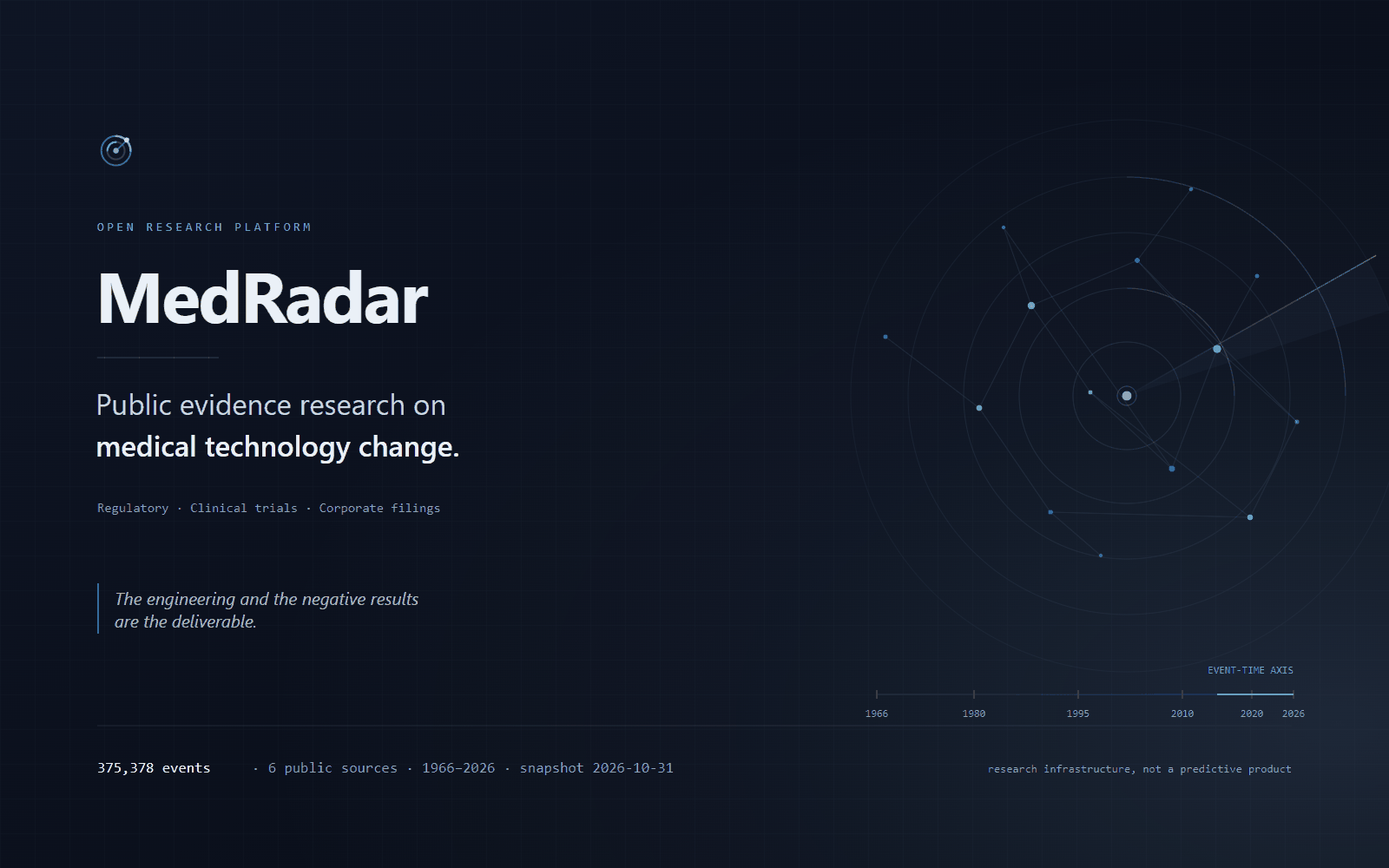
MedRadar collects free regulatory, clinical-trial and corporate-filing evidence about medical-device and drug makers into one auditable event store, then tests — with frozen experiments, named baselines and published negative results — whether that evidence carries signal before the market notices.
Research infrastructure, not a validated predictive product. No method in this repository has demonstrated out-of-sample predictive ability, and the shipped snapshot cannot support genuine point-in-time claims. The engineering and the negative results are the deliverable. → Limitations · Method contract
375,378 events · 6 free public sources · event dates 1966–2026 · snapshot 2026-10-31 · 1,160 offline tests · package v0.5.0 · MIT
Platform in one picture
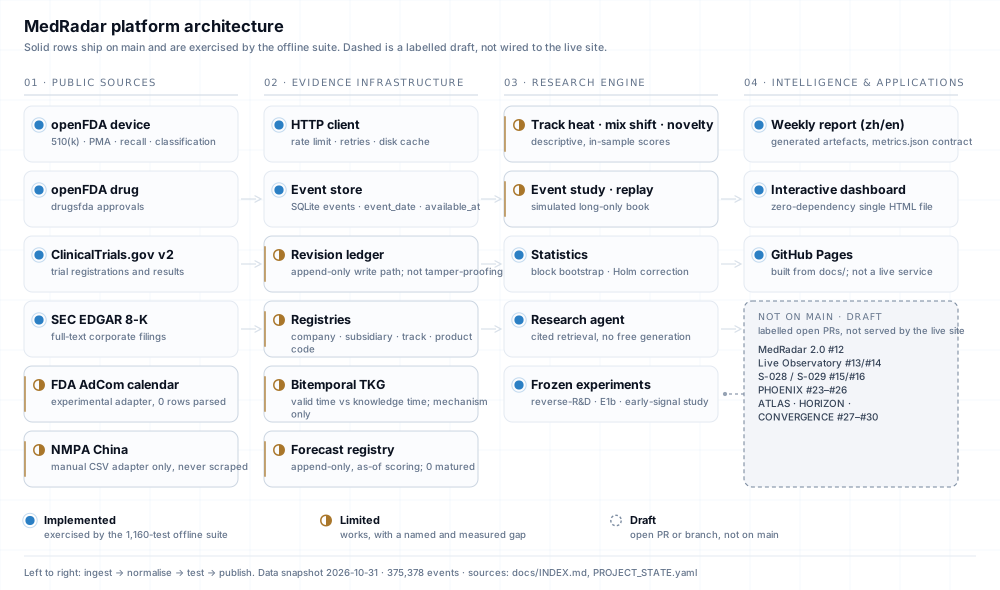
Source: tools/homepage/build_architecture.py — generated from the repository tree, not drawn as a mock-up. Light and dark variants ship together; the research engine and applications rows are paired with the repository path that implements them.
How to read the diagram. Everything solid exists on main and is exercised by the offline suite.
Rows marked limited work but carry a named, measured gap. The dashed lane on the right is labelled
draft: open PRs and branches that are not on main and not wired to the live site.
- Implemented — on
main, exercised by the 1,160-test offline suite. - Limited — works, with a named and measured gap (for example entity resolution at 35.2 % / 52.4 %).
- Draft — an open PR or branch; not shipped, not served, not claimed.
Platform detail, source inventory and coverage: the Platform page ↗
· repository navigation: docs/INDEX.md.
What is implemented, and how far it is validated
Vocabulary: working = on main and exercised by the offline suite; partial = works with a
measured, named gap; mechanism only = the machinery is correct but its inputs cannot support the
claim it would enable.
| Capability | What it does | Validation status | Entry |
|---|---|---|---|
| Multi-source ingest | openFDA device 510(k)/PMA/recall/classification, openFDA drug approvals, ClinicalTrials.gov v2, SEC EDGAR 8-K → one event schema; counts reproduce from live sources | working | medradar/collect_device.py · collect_drug.py · clinical.py |
| Bitemporal event store | event_date / available_at / timestamp_quality on every row, plus an append-only revision ledger behind events — explicitly not tamper-proofing |
working | medradar/db.py · medradar/evidence_core/ |
| Entity resolution | Company/subsidiary and technology-track keys plus product codes; 35.2 % of events carry a company key and 52.4 % a technology track. Unmatched events are counted and reported, never guessed | partial | config/ · docs/DATA.md |
| Descriptive analytics | Track heat (shrinkage-adjusted rate), mix shift (Jensen–Shannon), novelty (first occurrence) — descriptive, in-sample scores, not validated signals | descriptive only | medradar/analyze.py |
| Event study, replay, simulated book | Direction-aligned abnormal returns, block bootstrap, Holm correction, an in-sample long-only simulated book — no out-of-sample claim | working, simulation | medradar/eventstudy.py · replay.py |
| Reports and zero-dependency dashboard | A Chinese report, an English one-pager, a CSV and a self-contained HTML dashboard generated from one metrics.json — generated artefacts, not a live service |
working | medradar/report.py · docs/dashboard.html |
Also on main, at a lower level of validation: the bitemporal knowledge store
(medradar/tkg/, mechanism only) and the append-only forecast registry
(medradar/forecast_registry.py, mechanism only — 25 registered
forecasts, 0 matured, calibration state insufficient_matured_forecasts).
Not on main, not claimed: MedRadar 2.0 (#12), Live Observatory (#13/#14), S-028 / S-029
(#15/#16), PHOENIX (#23–#26), DATA-EXPANSION / ATLAS / HORIZON / CONVERGENCE (#27–#30). Every one is
a labelled draft; none is served by the live site. See Roadmap.
Research, including what it failed to find
The positive result, at its real size
Direction-aligned abnormal returns over the simulated event study (block bootstrap, Holm-corrected over the full category × horizon family). Only the 60-day horizon survives:
| Horizon | n | Mean abnormal return | t | 95 % CI |
|---|---|---|---|---|
| +1 d | 122 | +0.15 % | 0.57 | [−0.33 %, +0.65 %] |
| +5 d | 109 | −0.37 % | −0.92 | [−1.17 %, +0.42 %] |
| +20 d | 89 | +1.14 % | 1.17 | [−0.65 %, +3.13 %] |
| +60 d | 61 | +5.65 % | 2.45 | [+1.35 %, +10.32 %] |
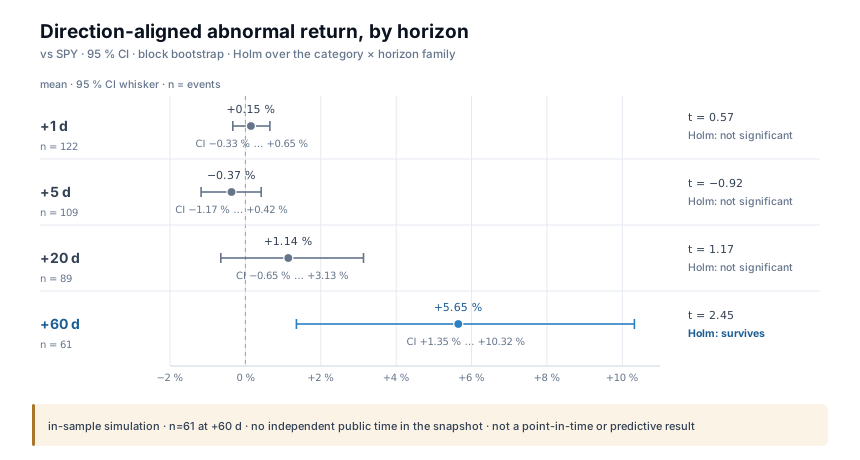
Source: docs/metrics.json → trading.event_study, generated 2026-10-30 · window 2025-11-21 → 2026-10-30 · figure: tools/site/make_figures.py (parses the committed data; the test fails if the art drifts).
Time-data caveat carried with every return number. The snapshot has no independent public time —
all 375,378 rows have published_at = available_at = event_date — so this result rests on a
same-day-public-time assumption and is not a point-in-time result. It is an in-sample simulation
with 38 simulated trades over ~11 months, long-only, and not investment advice.
The negative results, which matter more
- Market-to-R&D (12-month horizon). No added source produces a detectable ranking gain: marginal
PR-AUC financial −0.0013, market −0.0015, publication −0.0001, all-sources −0.0068. The model barely
beats a per-pair base rate — AP 0.7935 vs 0.7913, Δ +0.0022, 95 % CI [−0.032, +0.037]. More data
improves calibration (ECE 0.0811 → 0.0628), not ordering. Frozen artefacts:
experiments/reverse_rd_v1/·experiments/reverse_rd_v2/. - Early-signal study (five firms). Phase 0 returned CONDITIONAL-GO, but the lead-time gate —
was the change detectable earlier? — returned NO-GO.
→
research/studies/early_signal_5firms/PHASE0_REPORT.md - S-028 / S-029 relation studies. Both NO-GO: the evidence-based relation network did not beat its null on held-out data. They live on draft branches (PR #15/#16) and are not presented as a released capability.
Can the missing public timestamp be recovered? (E1b)
| Source | Retrospective public time | Verdict |
|---|---|---|
| SEC EDGAR | yes — acceptanceDateTime, immutable archive, amendments as new accessions |
STRONG |
| ClinicalTrials.gov | partial — first-post date only, date granularity, ACTUAL records only |
MEDIUM |
| openFDA 510(k)/PMA | no — no public-posting field exists; decision_date is the event date |
prospective observation only |
Full report: docs/refoundation/phase2/E1B_SOURCE_RECOVERY.md
(28 requests, 5 records per source — a shape test, not a population estimate).
More: Research page ↗ · docs/RESEARCH.md
· docs/CASES.md · docs/CALIBRATION.md.
Generated artefacts, not a live service
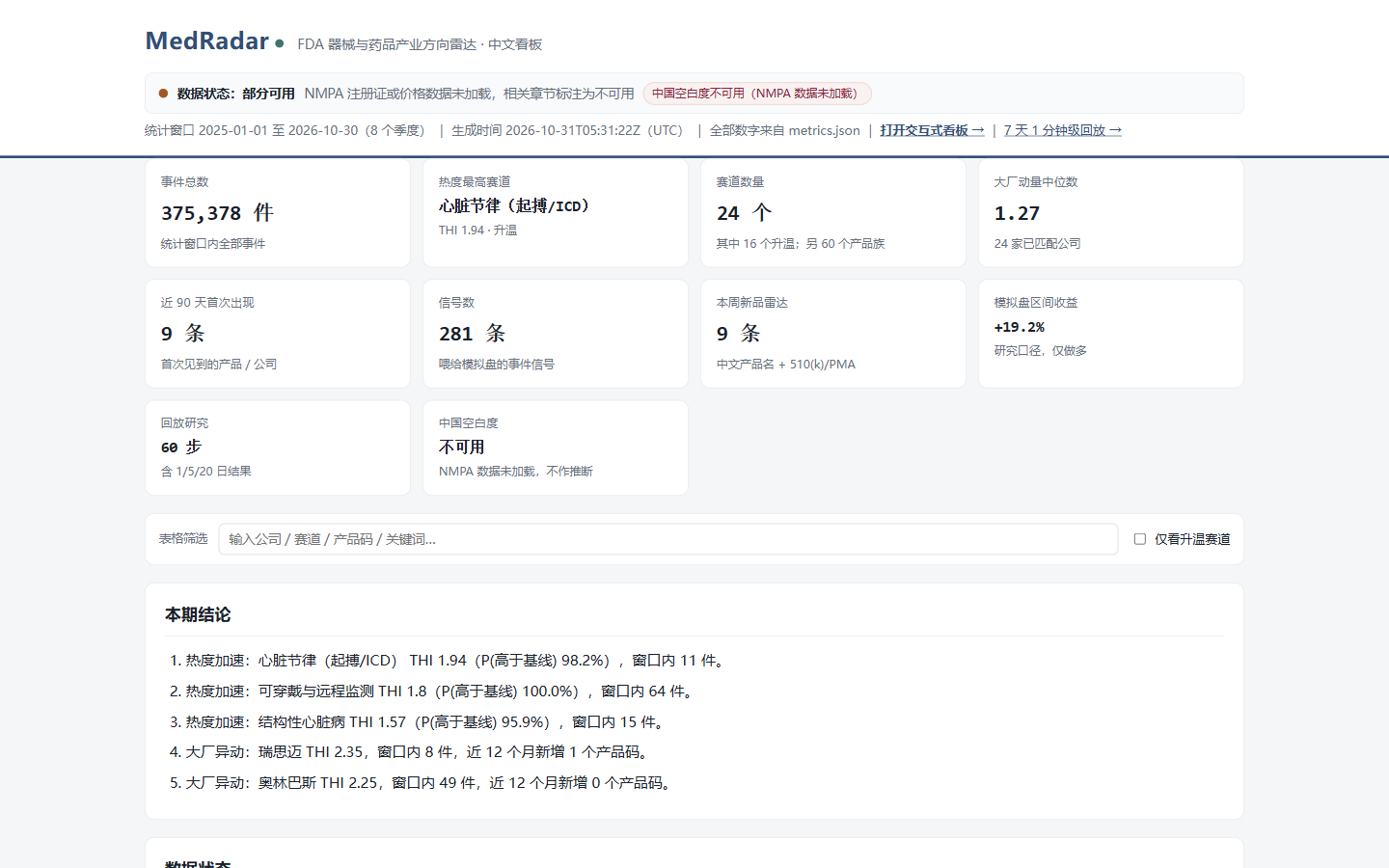
Every image below is a screenshot of a page the repository generates from the committed snapshot.
None is a mock-up; none shows a feature that does not exist on main.
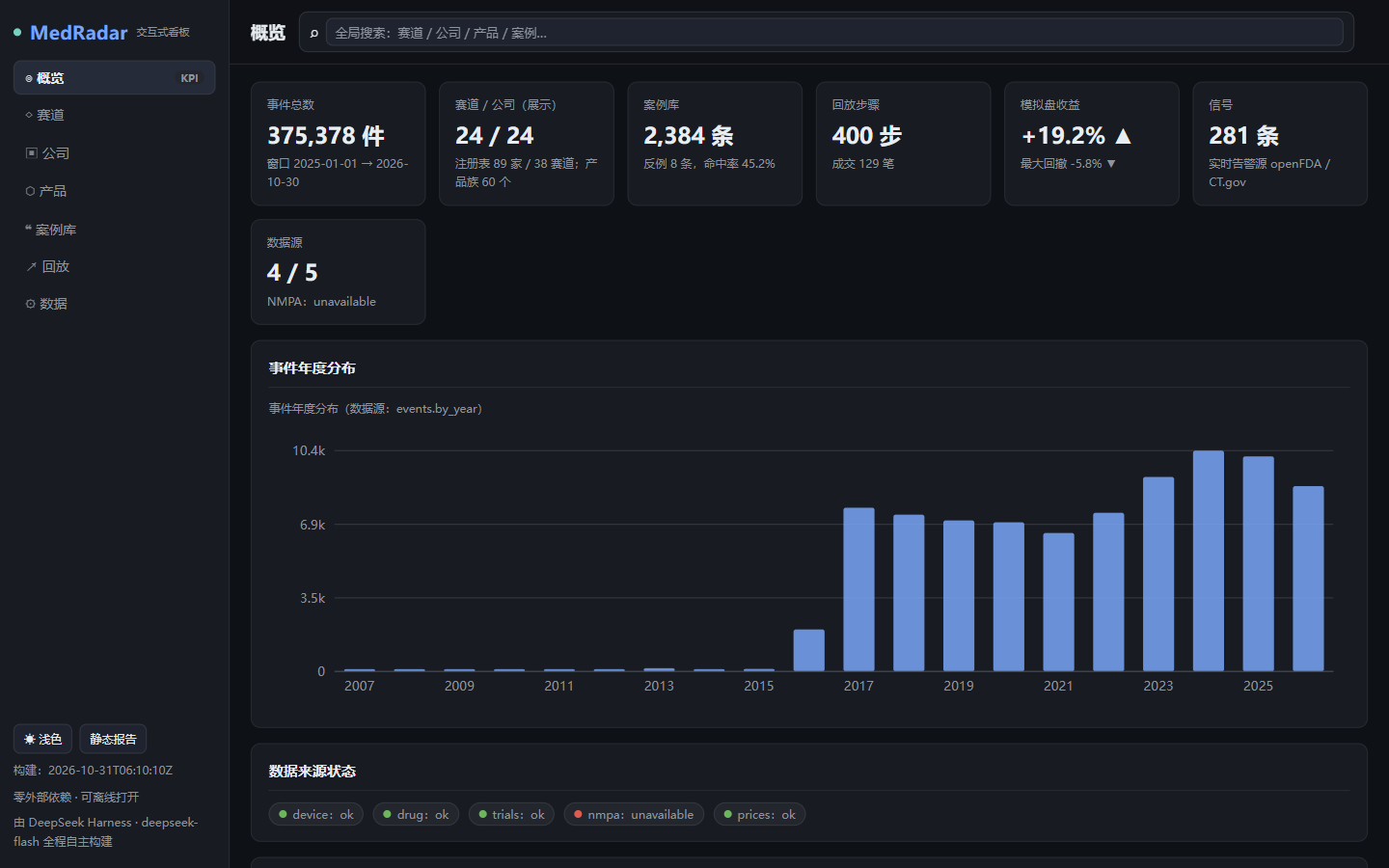
Page: docs/dashboard.html (interactive dashboard, zero-dependency single file) · snapshot: 2026-10-31 (docs/metrics.json) · package: v0.5.0 · offline artefact: yes — all data inlined, opens without a server · on main: yes · capture: Chromium, 1440×900, real generated page, no edits to data or UI.
Page: docs/report.html (generated Chinese report, nineteen chapters) · snapshot: 2026-10-31 · package: v0.5.0 · offline artefact: yes — self-contained HTML · on main: yes · note: the report is Chinese-first today; the site and this README are English.
Explore every artefact — dashboard, report, replay, figures and the data audit — on the Explore page ↗.
Get started
git clone https://github.com/ChazY11/medradar.git && cd medradar
pip install -e .                      # standard library only; no API key

python -m pytest -q -o addopts=""     # 1,160 offline tests at the verified baseline, no network
medradar demo                         # offline, committed snapshot, < 60 s → out/demo/index.html
A live radar run needs network (still no API key), about three minutes:
medradar run --months 24 --with-trade --with-dashboard
# → out/index.html · out/report_zh.md · docs/dashboard.html · docs/report.html · out/summary.csv
The 1.3 GiB SQLite snapshot is intentionally not committed, so a clean clone reproduces the procedure, not the exact numbers. The frozen studies rebuild from the recorded commands:
python -m medradar.intelligence.pipeline collect --source fda --months 120   # needs `.[bulk]`
python experiments/reverse_rd_v2/run_v2.py --db data/medradar.sqlite --holdouts 3
- First run:
medradar/onboarding.py·medradar --help - Data contract:
docs/SCHEMA.md· data inventory:docs/DATA.md - Method contract:
docs/METHODS.md· assumption register:docs/ASSUMPTIONS.md - Reproduction guide: Documentation page ↗ ·
docs/INDEX.md
Limitations
- Event-time only. Every row in the committed snapshot has
published_at = available_at = event_date(375,378 / 375,378) andtimestamp_quality = 'date'. Independent public time = 0 rows. Return studies rest on a same-day-public-time assumption. - Genuine point-in-time claims are not supported until source publication timestamps are re-acquired — recoverable for EDGAR, date-only for ClinicalTrials.gov, and for openFDA obtainable only by observing it from now on.
- Entity resolution is partial. 35.2 % of events carry a company key and 52.4 % a technology track. Unmapped events stay unmapped and are counted; they are never guessed.
- The revision ledger is not tamper-proofing. It records the application write path; a database owner can still mutate the head table or replace the file.
- 510(k)/PMA rows carry no public timestamp, so they enter industry counts but never return studies — a real loss of sample, deliberately not papered over.
- The AdCom collector parses zero rows (FDA renders the calendar client-side) and is marked
experimental; it returns
empty/source_changed, never a silentok. - The simulated book is in-sample, long-only, 38 trades over ~11 months. Shorts are alerted, never traded; fees, squeeze-outs and delisting are unmodelled.
- No causal claims. Difference-in-differences and synthetic control are roadmap items, not results.
- NMPA is deliberately not scraped (WAF). Without a user-supplied CSV every China value is
null, never zero.
The full argument and per-number provenance: docs/METHODS.md ·
docs/CALIBRATION.md · docs/ASSUMPTIONS.md.
Roadmap
Shipped: v0.3.0 research foundation (bitemporal TKG + immutable forecast registry), v0.4.0 harder
target + purged multi-window evaluation, v0.5.0 continuous forecast cycle and the cited research
agent. Full record: ROADMAP.md.
Next, and explicitly not done:
- Re-acquire independent public timestamps — EDGAR first; it can carry a true public instant today. Without this, no point-in-time claim is possible.
- Mature enough forecast windows to make any calibration claim at all.
- Feed graph features into the models, not only into the retrieval agent.
- Patent features once a USPTO Open Data Portal key exists; versioned historical track taxonomy.
- NMPA CSV importer, AdCom parsing, and the draft lanes tracked in PRs #12–#30.
Project status
Project status — generated from PROJECT_STATE.yaml at 2026-11-13T04:50:58+08:00 by python tools/governance/gen_views.py; edit the state file, never this block.
| Item | Value |
|---|---|
| Observed main head | b2a14c0 — 2026-11-03 (may lag main; stale-by-design is a warning) |
| Verified baseline | b2a14c0 (1,157 passed, 1,160 collected) |
| Release | 0.5.0 (unreleased) |
| Tests | 1,157 passed, 3 skipped, 0 failed (1,160 collected, offline) |
| Capabilities | 7 working · 6 draft · 1 retired |
| Research studies | 1 (0 with a public claim) |
| Data snapshot | 2026-10-31 — 375,378 events (local build; data/ is gitignored) |
| Open PRs | 28 open (27 draft), 10 merged |
| Branch protection | not applied |
See docs/governance/GOVERNANCE.md for the gates and docs/RESEARCH_INDEX.md for the generated research index.
Contributing, citation and licence
The highest-value contributions are the curated knowledge files, not code: company and subsidiary
aliases, track dictionaries, product-code mappings. The core package stays standard-library-only, and
every new metric updates docs/METHODS.md and docs/SCHEMA.md
first. Start at CONTRIBUTING.md and
docs/GOOD_FIRST_ISSUES.md.
If you cite this repository, cite it as research infrastructure and cite a specific tagged artefact (a report, a study directory, a frozen experiment), not as a predictive claim.
MIT — see LICENSE. Source data belongs to its publishers: openFDA is public domain; ClinicalTrials.gov and SEC EDGAR have their own terms. Nothing here is investment advice. This is a research and education project.
Data snapshot 2026-10-31 · package v0.5.0 · MIT · 中文版 · documentation index