
carpedm20/deep-rl-tensorflow
Tentang
TensorFlow implementation of Deep Reinforcement Learning papers
Pembelajaran mesinPertumbuhan bintang terukur
- dalam 24 jam
- 0
- dalam 7 hari
- 0
- dalam 15 hari
- -2
- dalam 1 bulan
- Mengumpulkan riwayat
Perubahan bersih pada periode yang tumpang tindih, bukan total harian. Pengukuran yang belum tersedia dibiarkan kosong. Bintang menunjukkan perhatian, bukan kualitas.
README.md
AsliDeep Reinforcement Learning in TensorFlow
TensorFlow implementation of Deep Reinforcement Learning papers. This implementation contains:
[1] Playing Atari with Deep Reinforcement Learning
[2] Human-Level Control through Deep Reinforcement Learning
[3] Deep Reinforcement Learning with Double Q-learning
[4] Dueling Network Architectures for Deep Reinforcement Learning
[5] Prioritized Experience Replay (in progress)
[6] Deep Exploration via Bootstrapped DQN (in progress)
[7] Asynchronous Methods for Deep Reinforcement Learning (in progress)
[8] Continuous Deep q-Learning with Model-based Acceleration (in progress)
Requirements
- Python 2.7
- gym
- tqdm
- OpenCV2 or Scipy
- TensorFlow 0.12.0
Usage
First, install prerequisites with:
$ pip install -U 'gym[all]' tqdm scipy
Don't forget to also install the latest
TensorFlow. Also note that you need to install
the dependences of doom-py which is
required by gym[all]
Train with DQN model described in [1] without gpu:
$ python main.py --network_header_type=nips --env_name=Breakout-v0 --use_gpu=False
Train with DQN model described in [2]:
$ python main.py --network_header_type=nature --env_name=Breakout-v0
Train with Double DQN model described in [3]:
$ python main.py --double_q=True --env_name=Breakout-v0
Train with Deuling network with Double Q-learning described in [4]:
$ python main.py --double_q=True --network_output_type=dueling --env_name=Breakout-v0
Train with MLP model described in [4] with corridor environment (useful for debugging):
$ python main.py --network_header_type=mlp --network_output_type=normal --observation_dims='[16]' --env_name=CorridorSmall-v5 --t_learn_start=0.1 --learning_rate_decay_step=0.1 --history_length=1 --n_action_repeat=1 --t_ep_end=10 --display=True --learning_rate=0.025 --learning_rate_minimum=0.0025
$ python main.py --network_header_type=mlp --network_output_type=normal --double_q=True --observation_dims='[16]' --env_name=CorridorSmall-v5 --t_learn_start=0.1 --learning_rate_decay_step=0.1 --history_length=1 --n_action_repeat=1 --t_ep_end=10 --display=True --learning_rate=0.025 --learning_rate_minimum=0.0025
$ python main.py --network_header_type=mlp --network_output_type=dueling --observation_dims='[16]' --env_name=CorridorSmall-v5 --t_learn_start=0.1 --learning_rate_decay_step=0.1 --history_length=1 --n_action_repeat=1 --t_ep_end=10 --display=True --learning_rate=0.025 --learning_rate_minimum=0.0025
$ python main.py --network_header_type=mlp --network_output_type=dueling --double_q=True --observation_dims='[16]' --env_name=CorridorSmall-v5 --t_learn_start=0.1 --learning_rate_decay_step=0.1 --history_length=1 --n_action_repeat=1 --t_ep_end=10 --display=True --learning_rate=0.025 --learning_rate_minimum=0.0025
Results
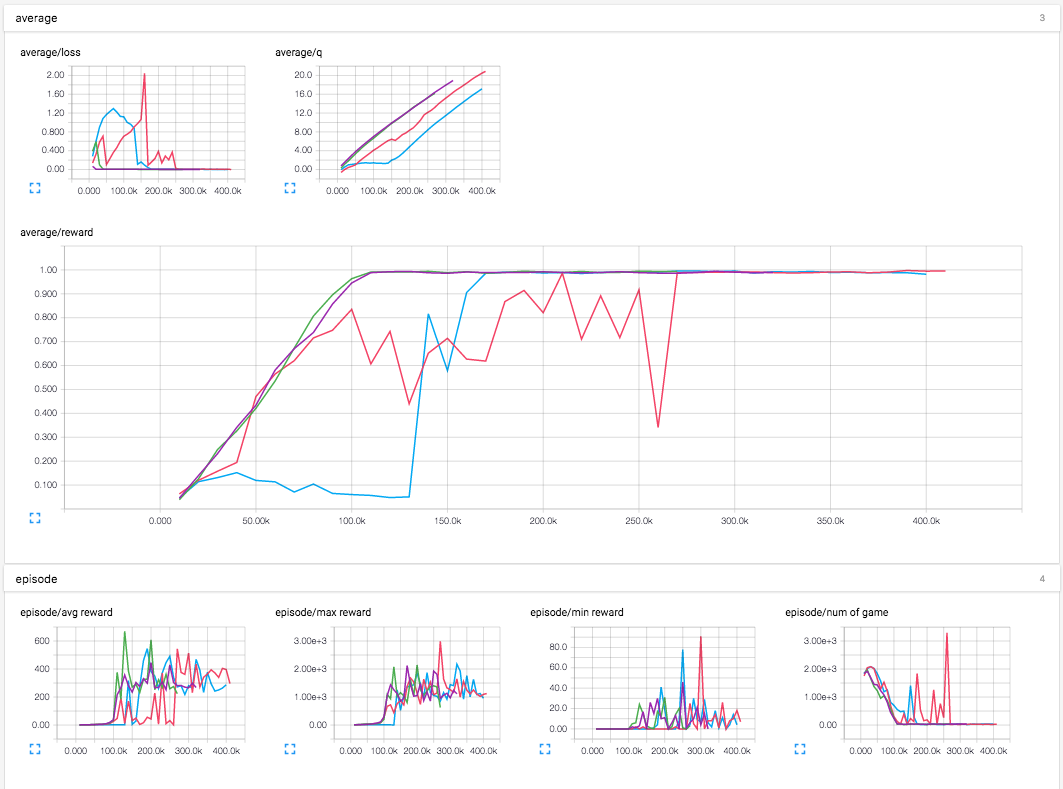
Result of Corridor-v5 in [4] for DQN (purple), DDQN (red), Dueling DQN (green), Dueling DDQN (blue).
Result of `Breakout-v0' for DQN without frame-skip (white-blue), DQN with frame-skip (light purple), Dueling DDQN (dark blue).
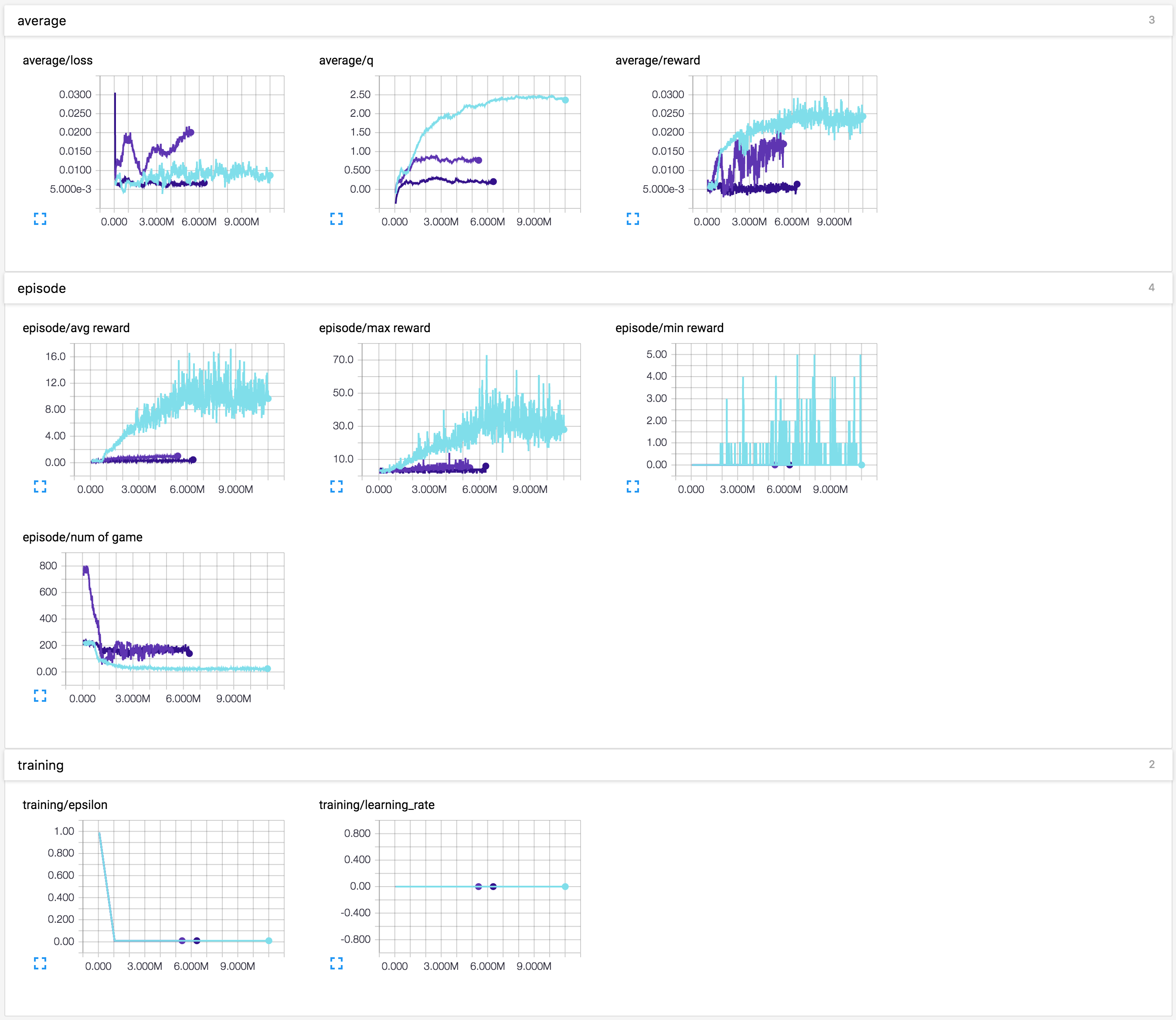
The hyperparameters and gradient clipping are not implemented as it is as [4].
References
Author
Taehoon Kim / @carpedm20
Jelajahi proyek terkait
Memuat…