
alesha-pro/llm.asm
Tentang
Inferensi Qwen3-0.6B (12 KB), OS bare-metal yang dapat di-boot (22 KB), serta trainer Mini-GPT yang dibuat dari nol dengan TUI Braille langsung (32 KB), semuanya dalam assembly NASM x86-64 100% murni. Tanpa C, tanpa libc, tanpa dependensi.
Kecerdasan buatanPertumbuhan bintang terukur
- dalam 24 jam
- +728
- dalam 7 hari
- Mengumpulkan riwayat
- dalam 15 hari
- Mengumpulkan riwayat
- dalam 1 bulan
- Mengumpulkan riwayat
Perubahan bersih pada periode yang tumpang tindih, bukan total harian. Pengukuran yang belum tersedia dibiarkan kosong. Bintang menunjukkan perhatian, bukan kualitas.
README.md
Aslillm.asm
Three complete LLM projects written in 100% pure x86-64 NASM assembly. Zero C, zero C++, zero Rust, zero libc, zero libm, zero runtime dependencies.
Assembled directly with nasm and linked with ld. Every math kernel (expf, sincosf, RMSNorm, RoPE, SiLU, Softmax), AVX2+FMA+F16C GEMM/GEMV engine, BPE tokenizer, clone()/futex() thread pool, bare-metal SMP kernel, analytical backward pass, AdamW optimizer, and live Unicode Braille TUI is hand-written x86-64 assembly (17,252 lines total across all three projects).
The Projects
| Project | Binary | Size | Deps | Key Numbers |
|---|---|---|---|---|
| 01-qwen3-inference/ | build/asm-llm |
14,712 B (14,008 B FAST_Q8=0) |
0 | Pure x86-64 NASM static Linux ELF running Qwen/Qwen3-0.6B (Q8_0, built-in BPE tokenizer, GQA + QK-Norm + RoPE + SwiGLU, single-shot & --chat multi-turn KV-cache REPL). FAST_Q8=1 (default): 126.8 tok/s decode at 40T (20.7 tok/s at 1T), +18% to +36% faster than llama.cpp CPU (Q8_0) across 1..40T, 0.99965 cosine & 64/64 exact greedy tokens vs PyTorch FP32. |
| 02-baremetal-os/ | build/asm-llm-os.elf |
24,252 B (23,612 B FAST_Q8=0) |
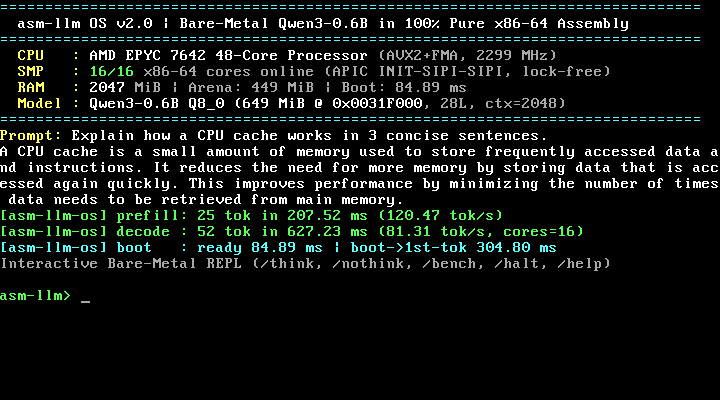
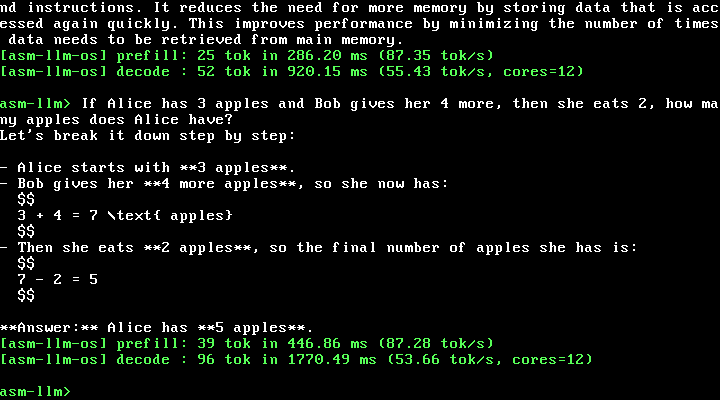
0 | Pure x86-64 NASM bootable bare-metal Qwen3-0.6B OS with no Linux or Windows. Multiboot 1 -> Long Mode -> AVX2/FMA/F16C -> ACPI/APIC SMP -> VGA + PS/2 + COM1 multi-turn KV-cache chat (/clear, /think, /bench). 74–94 ms boot, 134.9 tok/s KVM EPYC (23.7 tok/s 1 vCPU, 136.6 tok/s peak), 55.4 tok/s live on Proxmox Xeon E5-2670 v3 with 0 GB disk. |
| 03-minigpt-train/ | build/asm-gpt-train |
32,944 B | 0 | Pure x86-64 NASM FP32 Mini-GPT trainer and sampler. Register-blocked 6x16 AVX2+FMA SGEMM, full analytical backward pass (1.0000000000 cosine across all 21 gradient tensors vs PyTorch CPU), decoupled AdamW, 27,662 train tok/s, live 80x24 Braille TUI, val_loss 4.19 -> 1.51 on TinyShakespeare in 4 min. |
| 04-ring1-kernel-surgeon/ | 04-ring1-kernel-surgeon/build/surgeon.elf |
75,424 B | 0 (freestanding NASM + zero-libc C) | Bare-metal Type-1 AMD SVM hypervisor (Ring -1) running beneath unmodified Linux 5.15 (Ring 0) with an embedded MiniCPM5-2B Q4_K_M engine across 24 LAPIC SMP cores, NPT memory isolation, live efifb HUD, static x86-64 patch validator, and single-level KVM verifier RL. 97.54% pass@1 (119/122 unseen test scenarios, 0% dangerous continues) vs 16.39% base. |
Head-to-Head CPU Decode Benchmark: llm.asm vs llama.cpp (Qwen3-0.6B Q8_0)
Measured on the same machine (AMD EPYC 7642, 47C online, 256 MiB L3, DDR4, CPU-only -ngl 0), same model (Qwen3-0.6B Q8_0: 613.66 MiB .asmbin v2 FP16-scale vs 604.15 MiB GGUF Q8_0), 34 prompt tokens / 64 generated tokens, 3-run average:
| Threads | llm.asm (FAST_Q8=0, FP32 act) |
llama.cpp (Q8_0, -ngl 0) |
llm.asm (FAST_Q8=1, 14.7 KB) |
vs llama.cpp |
Bare-Metal OS KVM (FAST_Q8=1) |
|---|---|---|---|---|---|
| 1 | 7.18 tok/s | 16.63 tok/s | 20.70 tok/s | 1.24x (+24.5%) | 23.67 tok/s |
| 4 | 28.12 tok/s | 51.08 tok/s | 69.24 tok/s | 1.36x (+35.6%) | 78.89 tok/s |
| 8 | 53.09 tok/s | 80.79 tok/s | 103.64 tok/s | 1.28x (+28.3%) | 118.08 tok/s |
| 16 | 77.50 tok/s | 103.03 tok/s | 121.86 tok/s | 1.18x (+18.3%) | 134.94 tok/s |
| 24 | 91.88 tok/s | 104.11 tok/s | 123.72 tok/s | 1.19x (+18.8%) | 132.90 tok/s |
| 32 | 96.63 tok/s | 103.82 tok/s | 122.51 tok/s | 1.18x (+18.0%) | 133.75 tok/s |
| 40 | 98.50 tok/s | 105.08 tok/s | 125.86 tok/s (peak 126.81) | 1.20x (+19.8%) | — |
(Note: llama.cpp uses batched GEMM for prompt prefill pp34, whereas llm.asm runs token-by-token GEMV. For autoregressive decode tg64, llm.asm (FAST_Q8=1) combines INT8xINT8 AVX2 vpmaddubsw/vpmaddwd, .asmbin v2 FP16 block scales (F16C vcvtph2ps), monotonic next-row prefetch, contiguous head-major KV-cache, and parallel GQA attention — beating llama.cpp by +18%..+36% across 1..40 threads while producing bit-exact deterministic outputs across all thread counts. The bare-metal OS gains another ~10% from 2 MiB huge-page identity mapping.)
Live Output & Visual Proof
Phase 2: Booting Qwen3-0.6B Directly on Bare Metal (QEMU KVM, 16 vCPUs)
Phase 2: Running Live on a Proxmox VE VM (0 GB Disk, Intel Xeon E5-2670 v3, 12 Cores)
Phase 3: Pure-Assembly Live 80x24 UTF-8 Braille TUI (build/asm-gpt-train)
╭──────────────────────────────────────────────────────────────────────────────╮
│ asm-gpt-train │ 100% Pure x86-64 Assembly (Zero libc, AVX2+FMA)              │
│ L=6 D=192 H=6 FF=512 V=65 │ params=2681664 │ B=16 T=128 │ threads=20         │
├──────────────────────────────────────────────────────────────────────────────┤
│ Loss Curve (0..400)    ⣿⣿⣿ train   ◆ val    best_val=1.8399                  │
│ 4.34 ┤◆   ·   ·   ·   ·   ·   ·   ·   ·   ·   ·   ·   ·   ·   ·   ·   ·   ·  │
│      │⡇                                                                      │
│ 3.61 ┤⢱   ·   ·   ·   ·   ·   ·   ·   ·   ·   ·   ·   ·   ·   ·   ·   ·   ·  │
│      │ ⢱                                                                     │
│ 2.87 ┤· ⠣⣀·   ·   ·   ·   ·   ·   ·   ·   ·   ·   ·   ·   ·   ·   ·   ·   ·  │
│      │    ⠑⠢⠤⣀◆                                                              │
│ 2.14 ┤·   ·   ·⠉⠉⠑⠒⠒⠢⠤⠤◆⠤⣀⣀⣀⡀⣀⣀◆  ·   · ◆ ·   ·   ·   ·   ·   ·   ·   ·   ·  │
│      │                      ⠈  ⠉⠉⠉⠊⠉⠊⠒⠊⠒⠊⠒⠔⠒⠢⠤⠤⠔⠢◆⠤⠤⠤⢄⣀⣀⢄◆⣀⣀⣀⣀⡀⣀⣀⢀◆⡀ ⡀⢀   ⣀◆ │
│ 1.40 ┤·   ·   ·   ·   ·   ·   ·   ·   ·   ·   ·   ·   ·   ·   ⠈  ⠁⠁⠈⠉⠈⠁⠉⠉⠉·⠈ │
│      └step 0 ───────────────────────── 200 ────────────────────────── 400    │
├──────────────────────────────────────────────────────────────────────────────┤
│ Step 400/400 [████████████████████████████] 100% │ elapsed 35.2s             │
│ loss=1.6604  val=1.8399  best=1.8399  gnorm=0.53  lr=0.000200  25470 tok/s   │
├─ Live Sample (step 400) ─────────────────────────────────────────────────────┤
│ ROMEO:                                                                       │
│ Nay, to lond, in if as my kears, some with death.                            │
│                                                                              │
│ DUKE VINCENTIO:                                                              │
╰──────────────────────────────────────────────────────────────────────────────╯
Quick Start
Clone the repo and build everything with make all:
git clone https://github.com/alesha-pro/llm.asm.git
cd llm.asm
make all
1. Run Qwen3-0.6B Inference in 14 KB (01-qwen3-inference/)
# Export compact .asmbin v2 (FP16 block scales, 613.66 MiB; or --scale-dtype fp32 for legacy v1)
python3 scripts/export_weights.py --model-dir models/qwen3-0.6b-bf16 --out models/qwen3-0.6b-q8_0.asmbin --scale-dtype fp16
# Build with FAST_Q8=1 (default: INT8xINT8 AVX2 + parallel GQA) or FAST_Q8=0 (exact FP32 activations)
make inference FAST_Q8=1
./build/asm-llm -m models/qwen3-0.6b-q8_0.asmbin -p "Explain how a CPU cache works in 3 concise sentences." -n 128 -t 16
# Or start an interactive multi-turn chat preserving the KV-cache across turns:
./build/asm-llm -m models/qwen3-0.6b-q8_0.asmbin --chat -t 16
Full step-by-step setup, model download, CLI flags, and benchmarks: 01-qwen3-inference/README.md.
2. Boot Bare-Metal Qwen3-0.6B OS in 24 KB (02-baremetal-os/)
make os FAST_Q8=1
make os-run MODEL=models/qwen3-0.6b-q8_0.asmbin SMP=16
# Or build a bootable BIOS+UEFI ISO for QEMU / Proxmox VE:
make os-iso MODEL=models/qwen3-0.6b-q8_0.asmbin
Full QEMU KVM, bootable ISO, and 0 GB disk Proxmox VE deployment guide: 02-baremetal-os/README.md.
3. Train Mini-GPT from Scratch in 32 KB (03-minigpt-train/)
Zero Python required to train or run inference:
mkdir -p data checkpoints && curl -fsSL https://raw.githubusercontent.com/karpathy/char-rnn/master/data/tinyshakespeare/input.txt -o data/tinyshakespeare.txt
make train
./build/asm-gpt-train --data data/tinyshakespeare.txt --steps 400 --seq 128 -t 16 --save checkpoints/shakespeare.ckpt
Full training, live Braille TUI, checkpoint chat loop, and PyTorch gradient check guide: 03-minigpt-train/README.md.
4. Live-Patch Linux Ring 0 Crashes from Ring -1 (04-ring1-kernel-surgeon/)
cd 04-ring1-kernel-surgeon
make hv                                # Build 75 KB freestanding Ring -1 AMD SVM hypervisor (surgeon.elf)
python3 verifier/kvm_verifier.py --selftest
Full architecture, QEMU nested-SVM + VNC demo, SFT/GRPO training, and KVM verifier guide: 04-ring1-kernel-surgeon/README.md.
Repository Layout
llm.asm/
├── LICENSE                        # MIT License
├── Makefile                       # Single build file: inference, os, os-iso, train, all, check
├── README.md                      # You are here
├── assets/
│   ├── baremetal-vga.png          # QEMU KVM 80x25 VGA text-mode capture (EPYC 7642, 16 cores)
│   └── proxmox-vm250-vga.png      # Real Proxmox VE 0 GB disk VM capture (Xeon E5-2670 v3, 12 cores)
├── shared/                        # Pure x86-64 NASM core reused across phases (3,857 lines)
│   ├── constants.inc              # Linux syscalls, .asmbin v1/v2 header, runtime context offsets
│   ├── syscalls.asm               # Raw Linux syscalls + string/number formatting helpers
│   ├── math.asm                   # AVX2/SSE2 expf, sincosf, FP64 RoPE, RMSNorm, Softmax, SiLU, argmax, top-p
│   ├── matmul.asm                 # FAST_Q8=1 INT8xINT8 AVX2+F16C & FAST_Q8=0 Q8_0xFP32 matmul, dequant, dot, saxpy
│   ├── threads.asm                # Zero-libc Linux clone() + hybrid spin/futex thread pool (matmul + GQA attn)
│   ├── tokenizer.asm              # Fibonacci-hashed BPE encoder, UTF-8 decoder, Qwen3 chat template
│   └── transformer.asm            # Full 28-layer Qwen3 forward pass (v1/v2 auto-detect, contiguous KV, parallel GQA)
├── 01-qwen3-inference/            # Phase 1: 14 KB static Linux ELF inference engine + --chat (1,251 lines)
│   ├── README.md
│   ├── main.asm
│   └── test_math.asm
├── 02-baremetal-os/               # Phase 2: 24 KB bare-metal bootable LLM OS (4,167 lines)
│   ├── README.md
│   ├── boot.asm                   # Multiboot 1 -> 4-level paging -> Long Mode -> AVX2/FMA -> IDT
│   ├── drivers.asm                # COM1 115200, 80x25 Color VGA, PS/2 keyboard, PIT+RDTSC, ACPI poweroff
│   ├── kernel.asm                 # Kernel entrypoint, CPUID banner, cmdline parser, multi-turn chat REPL
│   ├── linker.ld                  # Bare-metal linker script at 0x00100000
│   ├── os_constants.inc           # Hardware, Multiboot 1, Local APIC, and SMP constants
│   ├── runtime.asm                # Multiboot mmap bump allocator + bare-metal formatting runtime
│   └── smp.asm                    # ACPI MADT + 16->32->64 AP trampoline + INIT-SIPI-SIPI spin-barrier
├── 03-minigpt-train/              # Phase 3: 32 KB Mini-GPT trainer + inference engine (7,977 lines)
│   ├── README.md
│   ├── train_constants.inc        # Training context offsets, SGEMM flags, .gptckpt format
│   ├── sgemm.asm                  # Thread pool + register-blocked 6x16 AVX2+FMA FP32 SGEMM (NN/TN/NT)
│   ├── kernels.asm                # Forward/backward RMSNorm, RoPE, Causal MHA, SwiGLU, CE, AdamW, PRNG
│   ├── model.asm                  # Arena layout, deterministic init, full fwd/bwd pass, sampler
│   ├── tui.asm                    # ioctl(TCGETS) TTY detect + flicker-free 80x24 ANSI/Braille TUI
│   └── main.asm                   # CLI, auto char-vocab, 90/10 split, .gptckpt I/O, train/sample loop
├── 04-ring1-kernel-surgeon/       # Phase 4: Ring -1 AMD SVM hypervisor + MiniCPM5-2B live kernel patcher
│   ├── README.md
│   ├── ARCHITECTURE.md            # Physical memory map, NPT isolation, SVM intercepts
│   ├── Makefile                   # Builds surgeon.elf, surgeon_crash.ko, initramfs, UEFI ISO
│   ├── hv/                        # Bare-metal Ring -1 hypervisor (NASM + freestanding zero-libc C)
│   ├── guest/                     # Ring 0 fault-injection test module (crash_mod) & KVM verifier module (bench_mod)
│   ├── dataset/                   # 48-pilot & 600-scenario corpus + DeepSeek distillation script
│   ├── verifier/                  # 3-tier single-level QEMU/KVM + Capstone safety verifier
│   ├── training/                  # MiniCPM5-2B LoRA SFT, KVM-verified GRPO, eval, TensorBoard logger
│   ├── dashboard/                 # Live FastAPI training & verifier telemetry dashboard
│   └── scripts/                   # Initramfs/ISO builders, QEMU/VNC demos, GGUF/.r1m packers
└── scripts/
    ├── export_weights.py          # Offline HuggingFace Qwen3-0.6B -> .asmbin (Q8_0) converter
    ├── mkiso.sh                   # Bootable BIOS+UEFI hybrid GRUB Multiboot 1 ISO builder
    ├── test_math.py               # Automated SIMD & math kernel unit test driver
    ├── verify_ref.py              # Independent NumPy Q8_0 + PyTorch FP32 parity harness
    ├── verify_os.py               # Phase 2 parity, SMP determinism, KVM benchmark & VGA capture suite
    └── verify_train_ref.py        # Phase 3 per-tensor PyTorch CPU grad-check & AdamW trajectory suite
System Requirements
- CPU: x86-64 with AVX2 + FMA + F16C (Intel Haswell / AMD Excavator or newer).
- Build tools:
nasmand GNUbinutils(ld,objcopy).sudo apt install nasm binutils - Phase 1 & 3 runtime: Any Linux x86-64 kernel. Zero shared libraries (
readelf -dreports no dynamic section). - Phase 2 runtime (optional):
qemu-system-x86_64with KVM, or any x86-64 hypervisor/bare-metal machine (Proxmox VE, VirtualBox, real hardware). Building bootable ISOs usesgrub-mkrescue(grub-pc-bin,grub-efi-amd64-bin,mtools,xorriso). - Offline tooling (optional):
python3+numpyonly for one-timeQwen3-0.6B.asmbinexport and reference verification (torch+transformersonly if running PyTorch parity checks).
Architecture & Verification Summary
Every phase is built on the same engineering rules: no runtime libraries, deterministic parallel partitioning, and numerical verification against independent Python/PyTorch references.
- Shared assembly core (
shared/): Phase 2 compiles the exact samemath.asm,matmul.asm,tokenizer.asm, andtransformer.asmwith-DBARE_METAL(swapping Linuxmmap/clone/writefor physical Multiboot modules, APIC spin-barriers, and VGA+COM1 drivers). Phase 3 reusessyscalls.asmandmath.asm. - Phase 1 verification: All math/SIMD kernels pass unit tests within
1e-7..1e-6(init_rope_freqsFP64< 5e-14) for bothFAST_Q8=1andFAST_Q8=0across v1 FP32 and v2 FP16 scale formats.FAST_Q8=1matches PyTorch FP32Qwen3-0.6Bwithcosine = 0.9996517and 64/64 exact greedy tokens (FAST_Q8=0matches the Python Q8_0 reference withcosine = 1.000000000). Bit-exact deterministic from1Tto40T. - Phase 2 verification: 100% token-exact and byte-for-byte identical to Phase 1 across 5 test prompts (English, Russian UTF-8, arithmetic,
--thinkmode), multi-turn KV-cache recall +/clear, and across1..32KVM vCPUs (134.9 tok/sat 16 vCPUs). Verified on both QEMU KVM (AMD EPYC 7642) and a real Proxmox VE VM (Intel Xeon E5-2670 v3, 0 GB disk, BIOS GRUB ISO). - Phase 3 verification: Verified against PyTorch FP32 CPU on all 21 parameter tensors (
worst max_abs_diff = 3.35e-8,min cosine_sim = 1.0000000000), 10-step AdamW + cosine LR + grad-clip trajectory (max_loss_diff = 4.77e-7), and bit-exact determinism across1T,8T, and16T. - Phase 4 verification (
04-ring1-kernel-surgeon/): MiniCPM5-2B GRPO achieves97.54%pass@1 (119/122) on unseen held-out fault scenarios (16.39%base) with0%dangerous continues under the 3-tier QEMU/KVM verifier, and runs end-to-end inside Ring-1(75 KBsurgeon.elf, 24 LAPIC SMP cores, 2 GiB read-only NVDIMM unmapped in AMD NPT) to live-patch#PF/#DE/#UD, delegateextable, and freezelock_heldfaults.
See each project's README for full tables, memory layouts, and reproduction steps:
- 01-qwen3-inference/README.md
- 02-baremetal-os/README.md
- 03-minigpt-train/README.md
- 04-ring1-kernel-surgeon/README.md
License
MIT License. See LICENSE.
Jelajahi proyek terkait
Memuat…