
EL4CTEO/fast-anything
Tentang
Don't rewrite it in Rust. Rewrite the 5% that's slow: profile Python, Node or Ruby apps, port the hot functions with your coding agent, prove they behave the same.
Alat pengembanganPertumbuhan bintang terukur
- dalam 24 jam
- +232
- dalam 7 hari
- Mengumpulkan riwayat
- dalam 15 hari
- Mengumpulkan riwayat
- dalam 1 bulan
- Mengumpulkan riwayat
Perubahan bersih pada periode yang tumpang tindih, bukan total harian. Pengukuran yang belum tersedia dibiarkan kosong. Bintang menunjukkan perhatian, bukan kualitas.
README.md
Asli
Don't rewrite it in Rust. Rewrite the 5% that's slow.






Rewriting a whole app in Rust costs months, minute-long compiles and gigabytes of target/. Most of the runtime sits in a few functions anyway.
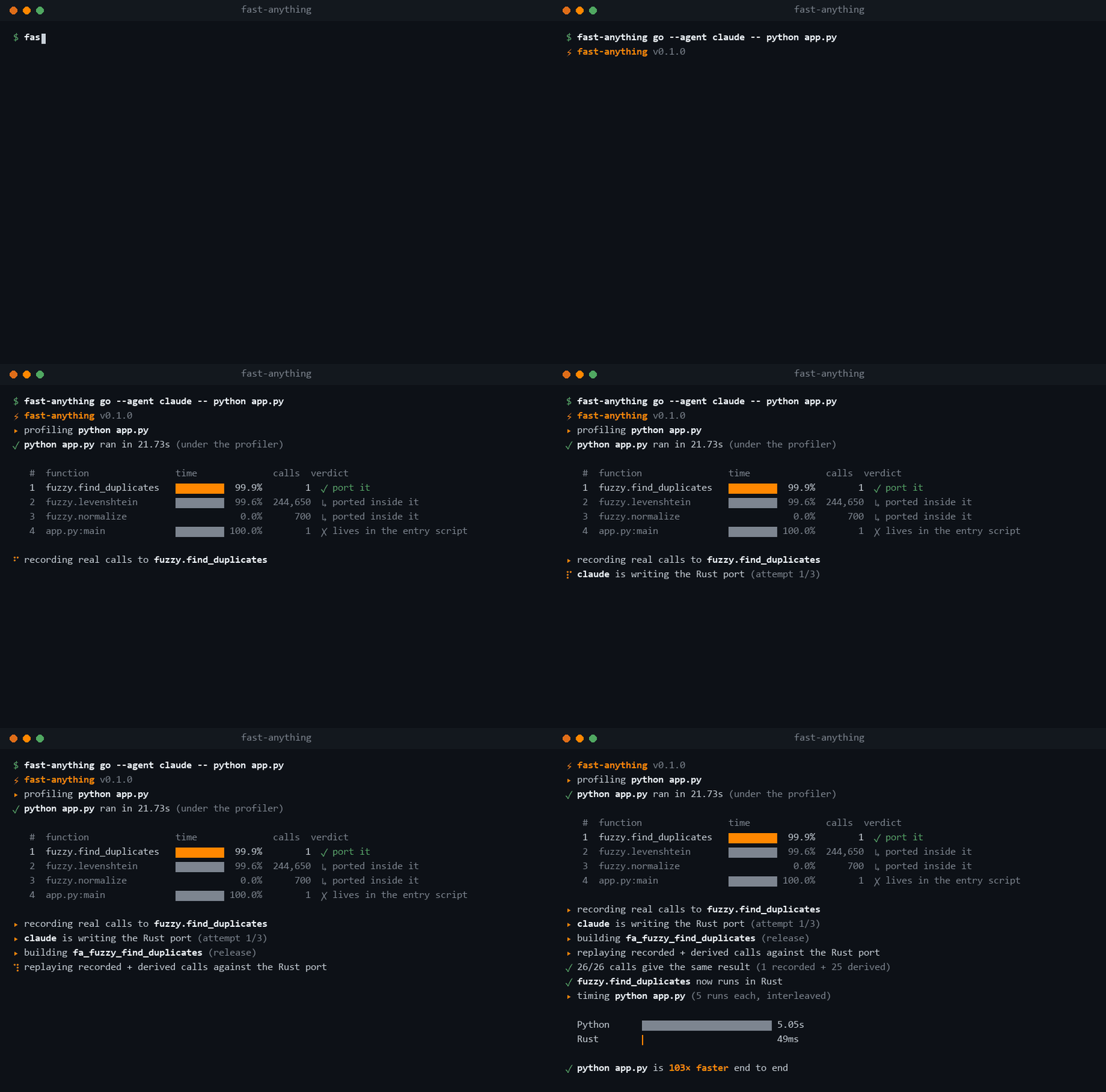
fast-anything finds those functions, has your coding agent port only them to Rust, proves the port gives the same results on real recorded calls, and swaps it in. One command, fully reversible.
Install
npm i -g @el4cteo/fast-anything # or: cargo install fast-anything
Ports are compiled with your Rust toolchain (rustup).
Use
fast-anything go --agent claude -- python app.py # or: -- node app.ts / bun app.ts / deno run -A app.ts / ruby app.rb / java App.java / mvn exec:java / gradle run / go run . / php app.php / clang -O2 main.c / Rscript app.R
Or step by step:
| command | what it does |
|---|---|
scan -- <cmd> |
profiles the app, ranks functions by time × how portable they are |
port [id] |
records up to 500 real calls, creates a one-function Rust crate + TASK.md |
verify |
release-builds the port and replays every recorded call |
enable / disable |
swaps the Rust in or out (one marked block, removed byte for byte) |
bench |
times the whole app in rotated rounds of original, original again (an A/A control for noise) and Rust; wall and CPU time |
report |
markdown + SVG card for your PR |
doctor |
checks Rust, your runtimes and your agents |
--agent takes claude, codex, or any command that reads a prompt on stdin. Without it, hand TASK.md to whatever you use.
Proof, not vibes
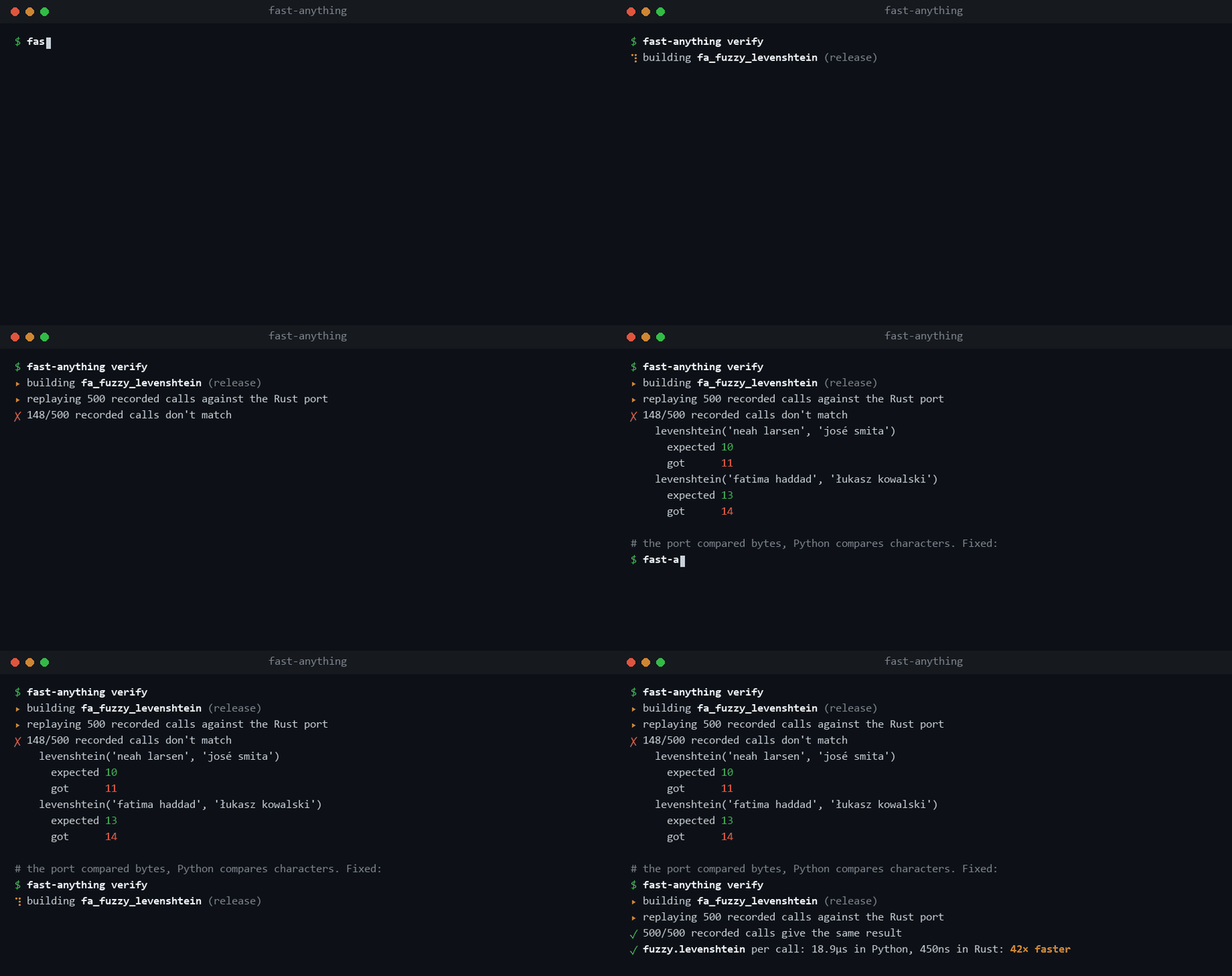
That port looked right but compared bytes instead of characters. 148 of 500 real calls caught it. On top of the recorded calls, fast-anything derives extra cases and lets the original answer them: edge cases (NaN, ±infinity, -0.0, zero and ±1, non-ASCII text, empty and up to 16× bigger inputs) and shrunk inputs (tiny and random slices). Nothing is enabled until every case matches: same values (floats within 1e-9 of their size or of the largest value in the same list, -0.0 not 0.0), errors where the original errors. A port that is right but slower per call than the original (calling into Rust costs more than the work saved) isn't enabled either. FAST_ANYTHING_DISABLE=1 runs the original any time.
Every 5th recorded call (from 5 calls up) is held out of the crate folder the agent works in: verify replays it too but reports a mismatch there without the values, so a port that special-cases the calls it was shown still fails.
Results
Real runs on an i5-10500, Windows 11 (C and C++: a 4-core GitHub Actions Linux runner). Reproduce them from examples/.
| app | before | after |
|---|---|---|
| Python fuzzy dedupe (700 names) | 4.91s | 42ms, 116× |
| TypeScript fuzzy dedupe (2,000 names) | 3.11s | 155ms, 20× |
| PHP fuzzy dedupe (600 names) | 2.94s | 53ms, 55× |
| Go fuzzy dedupe (3,000 names) | 3.02s | 144ms, 21× |
| Ruby fuzzy dedupe (400 names) | 3.13s | 228ms, 14× |
| C# fuzzy dedupe (4,000 names) | 4.03s | 312ms, 13× |
| Java fuzzy dedupe (4,000 names) | 3.50s | 1.18s, 3× (11× on the function; the rest is JVM startup) |
| C mandelbrot (8 zoom levels) | 431ms | 127ms, 3.4× |
| C++ fuzzy dedupe (6,000 names) | 3.02s | 1.09s, 2.7× |
fast-anything ports the outermost loop it can, not the tiny function called inside it, so the app crosses into Rust once instead of millions of times. Porting only the inner levenshtein gave 35× and 1.9×.
Why not rewrite it all?
- Compile time: each port is a one-function crate. Seconds, not minutes.
- Cache: every port shares one
.fast/target. Delete it whenever you like (fast-anything clean). - Risk: your code stays as it is. Rust is opt-in per function, checked against real behavior.
Agents
Plugin: the repo is an agent plugin marketplace (.agents/plugins/marketplace.json) that bundles the skill and the MCP server. Install the CLI first, then:
- Codex:
codex plugin marketplace add EL4CTEO/fast-anything, then installfast-anythingfrom/plugins - Claude Code:
/plugin marketplace add EL4CTEO/fast-anything, then/plugin install fast-anything@fast-anythingand/fast-anything:fast python app.py
Or wire it up by hand:
- MCP server (Claude Code, Codex, Cursor…), built into the binary:
claude mcp add fast-anything -- fast-anything mcp. 8 tools:fast_scan,fast_port,fast_verify,fast_enable,fast_disable,fast_bench,fast_report,fast_status. - Skill:
skills/fast-anythingteaches any agent the loop.
Languages
| language | binding | status |
|---|---|---|
| Python 3.10+ | PyO3; servers and GUIs: scan --duration 30 (stops them like Ctrl+C) |
✅ |
JavaScript / TypeScript (Node 22+, Bun, Deno 2+: bun app.ts, deno run -A app.ts) |
napi-rs; servers: scan --duration 30 (ends them with process.exit) |
✅ |
| Ruby 3.3+ | C ABI + JSON, through Ruby's built-in Fiddle; servers: scan --duration 30 (stops them like Ctrl+C) |
✅ |
Java 22+ (java App.java, Maven, Gradle) |
the same C bridge, through the FFM API; servers: scan --duration 30 |
✅ |
Kotlin/JVM (Gradle, src/main/kotlin, JDK 22+) |
the Java bridge; top-level functions, object and companion members, extension functions |
✅ |
Go 1.22+ (go run .) |
the same C bridge, through the Windows loader or dlopen (cgo); servers: scan --duration 30 |
✅ |
PHP 8.1+ (php app.php) |
the same C bridge, through PHP's FFI extension (extension=ffi); servers: scan --duration 30 (with pcntl) |
✅ |
C and C++ (gcc, clang or Intel oneAPI icx/icpx: clang -O2 main.c lib.c) |
the same C bridge (C passes its arguments as they are, no JSON), through LoadLibrary or dlopen; servers: scan --duration 30 |
✅ |
C# / .NET 8+ (dotnet run -c Release) |
the same C bridge, through NativeLibrary; profiled with EventPipe, nothing to install; GUIs and servers: scan --duration 30 |
✅ |
R 4.0+ (Rscript app.R) |
the same C bridge, through base R's .C(); profiled with Rprof, no packages or R headers needed; servers: scan --duration 30 |
✅ |
It ports top-level, deterministic functions that take plain data (numbers, strings, lists, dicts, typed arrays…), including ones in your entry script when its main code sits under if __name__ == "__main__": (or if __FILE__ == $0, or if (import.meta.main) / if (require.main === module)). In Python that means module-level functions, @staticmethods and @classmethods that don't use cls (dataclasses, NamedTuples and numeric NumPy arrays count as plain data), in Java, C# and PHP static methods (and PHP functions), in Go plain functions, in C and C++ free functions and static methods. scan says why anything else can't move yet.
With Intel oneAPI on Windows, run fast-anything from a shell where setvars.bat ran (it sets up the linker). SYCL kernels run on the device and aren't ported; with -fsycl, only host functions are profiled and ported.
Ruby, Java, Go, PHP, C, C++, C# and R need no headers, bindings or extra tools: the port is a plain Rust library with one C entry point taking and returning JSON, and fast-anything replays the recorded calls against it directly. Any language that can call C can use that bridge. A C port also has a typed entry point that takes the function's own arguments and returns its result, NaN and infinity included; the C app calls that one, and verify replays and times it.
License
MIT
Jelajahi proyek terkait
Memuat…