
zillow/quantile-forest
zillow/quantile-forest has 256 GitHub stars and 35 forks. GitHot measured 0 stars in 24 hours. Last checked 2026-11-11 14:49 UTC. Last push 2026-11-07.
Comment ces chiffres sont mesurés
Quantile Regression Forests compatible with scikit-learn.
Progression mesurée des étoiles
- in 24h
- 0
- in 7 days
- Historique en cours
- in 15 days
- Historique en cours
- in 1 month
- Historique en cours
Variations nettes sur des périodes qui se chevauchent, pas des totaux quotidiens. Les mesures absentes restent vides. Les étoiles indiquent l’intérêt, pas la qualité.
README.md
Originalquantile-forest 




quantile-forest offers a Python implementation of quantile regression forests compatible with scikit-learn.
Quantile regression forests (QRF) are a non-parametric, tree-based ensemble method for estimating conditional quantiles, with application to high-dimensional data and uncertainty estimation [1]. The estimators in this package are performant, Cython-optimized QRF implementations that extend the forest estimators available in scikit-learn to estimate conditional quantiles. The estimators can estimate arbitrary quantiles at prediction time without retraining and provide methods for out-of-bag estimation, calculating quantile ranks, and computing proximity counts. They support sample weights, multiple targets, monotonic constraints, and missing values. They are compatible with and can serve as drop-in replacements for the scikit-learn forest regressors.
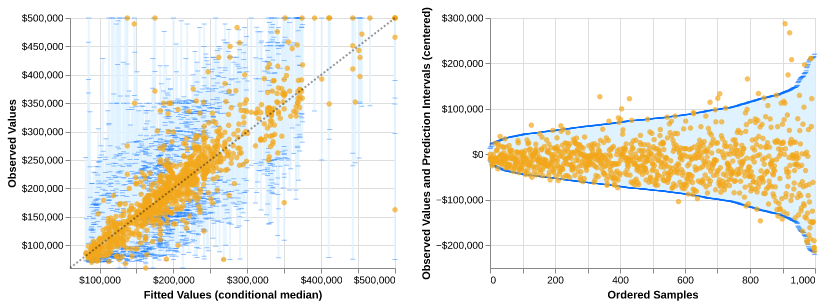
Example of fitted model predictions and prediction intervals on California housing data (code)
Quick Start
To install quantile-forest from PyPI using pip:
pip install quantile-forest
To install quantile-forest from conda-forge using conda:
conda install quantile-forest -c conda-forge
Usage
A quantile forest is fit like a scikit-learn regressor, and predicts any quantiles of the target without being fit again. For example, to predict the median and a 95% prediction interval:
from sklearn import datasets
from sklearn.model_selection import train_test_split
from quantile_forest import RandomForestQuantileRegressor

X, y = datasets.load_diabetes(return_X_y=True)
X_train, X_test, y_train, y_test = train_test_split(X, y, test_size=0.25)
qrf = RandomForestQuantileRegressor().fit(X_train, y_train)
y_pred = qrf.predict(X_test, quantiles=[0.025, 0.5, 0.975])  # one column per quantile
Documentation
An installation guide, API documentation, and examples can be found in the documentation. The release notes list the changes in each version.
References
[1] N. Meinshausen, "Quantile Regression Forests", Journal of Machine Learning Research, 7(Jun), 983-999, 2006. https://www.jmlr.org/papers/volume7/meinshausen06a/meinshausen06a.pdf
Citation
If you use this package in academic work, please consider citing https://joss.theoj.org/papers/10.21105/joss.05976:
@article{Johnson2024,
    doi = {10.21105/joss.05976},
    url = {https://doi.org/10.21105/joss.05976},
    year = {2024},
    publisher = {The Open Journal},
    volume = {9},
    number = {93},
    pages = {5976},
    author = {Reid A. Johnson},
    title = {quantile-forest: A Python Package for Quantile Regression Forests},
    journal = {Journal of Open Source Software}
}
Explorer des projets similaires
tensorflow/tensorflow
Un framework open source d'apprentissage automatique pour tous
201,505 étoileshuggingface/transformers
🤗 Transformers : le framework de définition de modèles pour les modèles d'apprentissage automatique de pointe en texte, vision, audio et multimodal, pour l'inférence et l'entraînement.
168,815 étoilesAUTOMATIC1111/stable-diffusion-webui
Interface web de Stable Diffusion
165,289 étoilesComfy-Org/ComfyUI
La GUI, l'API et le backend les plus puissants et modulaires pour les modèles de diffusion, avec une interface de graphes et de nœuds. Le moteur d'inférence local le plus rapide au monde.
146,271 étoiles