
xiaoyu258/GeoProj
xiaoyu258/GeoProj has 221 GitHub stars and 61 forks. GitHot measured 0 stars in 24 hours and 0 in 7 days. Last checked 2026-11-23 12:02 UTC. Last push 2022-09-28.
Progression mesurée des étoiles
- in 24h
- 0
- in 7 days
- 0
- in 15 days
- Historique en cours
- in 1 month
- Historique en cours
Variations nettes sur des périodes qui se chevauchent, pas des totaux quotidiens. Les mesures absentes restent vides. Les étoiles indiquent l’intérêt, pas la qualité.
À propos
Blind Geometric Distortion Correction on Images Through Deep Learning
Apprentissage automatiqueREADME.md
OriginalGeoProj
Paper
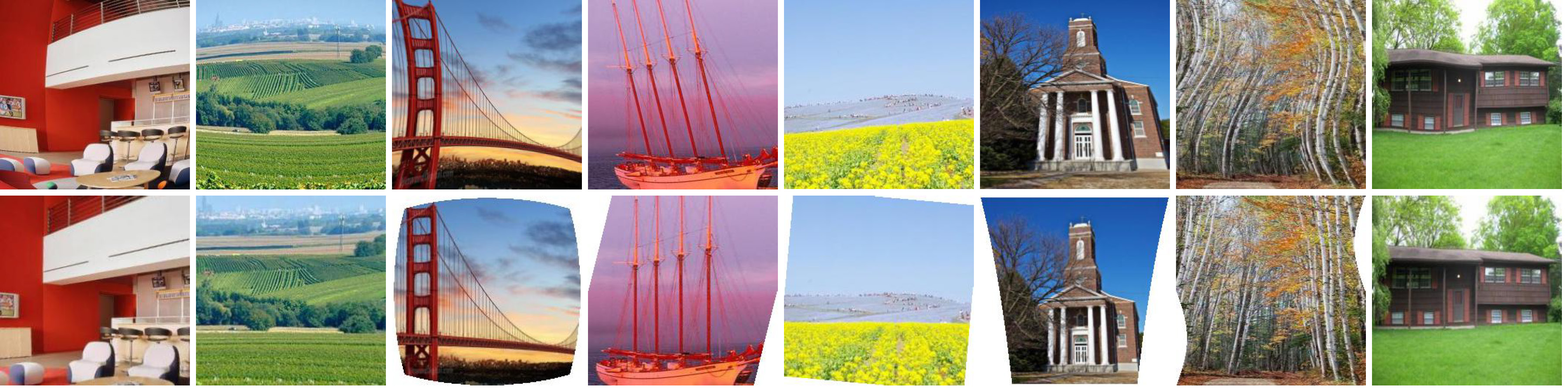
The source code of Blind Geometric Distortion Correction on Images Through Deep Learning by Li et al, CVPR 2019.
Prerequisites
- Linux or Windows
- Python 3
- CPU or NVIDIA GPU + CUDA CuDNN
Getting Started
Dataset Generation
In order to train the model using the provided code, the data needs to be generated in a certain manner.
You can use any distortion-free images to generate the dataset. In this paper, we use Places365-Standard dataset at the resolution of 512*512 as the original non-distorted images to generate the 256*256 dataset.
Run the following command for dataset generation:
python data/dataset_generate.py [--sourcedir [PATH]] [--datasetdir [PATH]]
                                [--trainnum [NUMBER]] [--testnum [NUMBER]]

--sourcedir           Path to original non-distorted images
--datasetdir          Path to the generated dataset
--trainnum            Number of generated training samples
--testnum             Number of generated testing samples
Training
Run the following command for help message about optional arguments like learning rate, dataset directory, etc.
python trainNetS.py --h # if you want to train GeoNetS
python trainNetM.py --h # if you want to train GeoNetM
Use a Pre-trained Model
You can download the pretrained model here.
You can also use eval.py and modify the model path, image path and saved result path to your own directory to generate your own results.
Resampling
Import resample.resampling.rectification function to resample the distorted image by the forward flow.
The distorted image should be a Numpy array with the shape of H*W*3 for a color image or H*W for a greyscale image, the forward flow should be an array with the shape of 2*H*W.
The function will return the resulting image and a mask to indicate whether each pixel will converge within the maximum iteration.
Citation
@inproceedings{li2019blind,
  title={Blind Geometric Distortion Correction on Images Through Deep Learning},
  author={Li, Xiaoyu and Zhang, Bo and Sander, Pedro V and Liao, Jing},
  booktitle={Proceedings of the IEEE Conference on Computer Vision and Pattern Recognition},
  pages={4855--4864},
  year={2019}
}
Explorer des projets similaires
Chargement…