Projets Voir sur GitHub
vivekkalyanarangan30/llm_from_scratch
vivekkalyanarangan30/llm_from_scratch has 1,124 GitHub stars and 300 forks. GitHot measured 0 stars in 24 hours and +2 in 7 days. Last checked 2026-11-13 04:54 UTC. Last push 2025-10-23.
Progression mesurée des étoiles
- in 24h
- 0
- in 7 days
- +2
- in 15 days
- Historique en cours
- in 1 month
- Historique en cours
Variations nettes sur des périodes qui se chevauchent, pas des totaux quotidiens. Les mesures absentes restent vides. Les étoiles indiquent l’intérêt, pas la qualité.
README.md
OriginalLLM from Scratch — Hands-On Curriculum (PyTorch)
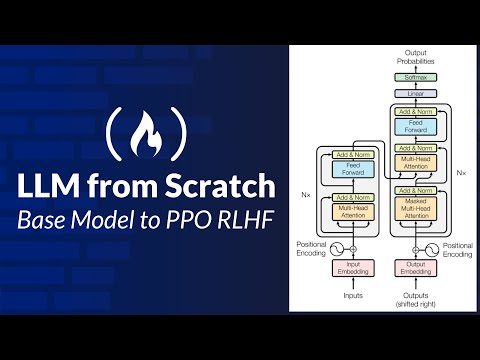
Part 0 — Foundations & Mindset
- 0.1 Understanding the high-level LLM training pipeline (pretraining → finetuning → alignment)
- 0.2 Hardware & software environment setup (PyTorch, CUDA/Mac, mixed precision, profiling tools)
conda create -n llm_from_scratch python=3.11
conda activate llm_from_scratch
pip install -r requirements.txt
Part 1 — Core Transformer Architecture
- 1.1 Positional embeddings (absolute learned vs. sinusoidal)
- 1.2 Self-attention from first principles (manual computation with a tiny example)
- 1.3 Building a single attention head in PyTorch
- 1.4 Multi-head attention (splitting, concatenation, projections)
- 1.5 Feed-forward networks (MLP layers) — GELU, dimensionality expansion
- 1.5 Residual connections & LayerNorm
- 1.6 Stacking into a full Transformer block
Part 2 — Training a Tiny LLM
- 2.1 Byte-level tokenization
- 2.2 Dataset batching & shifting for next-token prediction
- 2.3 Cross-entropy loss & label shifting
- 2.4 Training loop from scratch (no Trainer API)
- 2.5 Sampling: temperature, top-k, top-p
- 2.6 Evaluating loss on val set
Part 3 — Modernizing the Architecture
- 3.1 RMSNorm (replace LayerNorm, compare gradients & convergence)
- 3.2 RoPE (Rotary Positional Embeddings) — theory & code
- 3.3 SwiGLU activations in MLP
- 3.4 KV cache for faster inference
- 3.5 Sliding-window attention & attention sink
- 3.6 Rolling buffer KV cache for streaming
Part 4 — Scaling Up
- 4.1 Switching from byte-level to BPE tokenization
- 4.2 Gradient accumulation & mixed precision
- 4.3 Learning rate schedules & warmup
- 4.4 Checkpointing & resuming
- 4.5 Logging & visualization (TensorBoard / wandb)
Part 5 — Mixture-of-Experts (MoE)
- 5.1 MoE theory: expert routing, gating networks, and load balancing
- 5.2 Implementing MoE layers in PyTorch
- 5.3 Combining MoE with dense layers for hybrid architectures
Part 6 — Supervised Fine-Tuning (SFT)
- 6.1 Instruction dataset formatting (prompt + response)
- 6.2 Causal LM loss with masked labels
- 6.3 Curriculum learning for instruction data
- 6.4 Evaluating outputs against gold responses
Part 7 — Reward Modeling
- 7.1 Preference datasets (pairwise rankings)
- 7.2 Reward model architecture (transformer encoder)
- 7.3 Loss functions: Bradley–Terry, margin ranking loss
- 7.4 Sanity checks for reward shaping
Part 8 — RLHF with PPO
- 8.1 Policy network: our base LM (from SFT) with a value head for reward prediction.
- 8.2 Reward signal: provided by the reward model trained in Part 7.
- 8.3 PPO objective: balance between maximizing reward and staying close to the SFT policy (KL penalty).
- 8.4 Training loop: sample prompts → generate completions → score with reward model → optimize policy via PPO.
- 8.5 Logging & stability tricks: reward normalization, KL-controlled rollout length, gradient clipping.
Part 9 — RLHF with GRPO
- 9.1 Group-relative baseline: instead of a value head, multiple completions are sampled per prompt and their rewards are normalized against the group mean.
- 9.2 Advantage calculation: each completion’s advantage = (reward – group mean reward), broadcast to all tokens in that trajectory.
- 9.3 Objective: PPO-style clipped policy loss, but policy-only (no value loss).
- 9.4 KL regularization: explicit KL(π‖π_ref) penalty term added directly to the loss (not folded into the advantage).
- 9.5 Training loop differences: sample
kcompletions per prompt → compute rewards → subtract per-prompt mean → apply GRPO loss with KL penalty.
Explorer des projets similaires
codecrafters-io/build-your-own-x
Maîtrisez la programmation en recréant de zéro vos technologies préférées.
562,190 étoilespublic-apis/public-apis
Une liste collective d'API gratuites
498,586 étoilesmorluto/rea
Rétro-ingénierie de n'importe quoi avec des agents, du comportement des applications jusqu'aux binaires natifs.
455,812 étoilesopenclaw/openclaw
L'IA qui fait vraiment les choses. Tout système d'exploitation, toute plateforme. À la manière du homard. 🦞
394,414 étoiles