
titu1994/DenseNet
titu1994/DenseNet has 708 GitHub stars and 289 forks. GitHot measured 0 stars in 24 hours. Last checked 2026-11-15 12:12 UTC. Last push 2020-06-10.
Progression mesurée des étoiles
- in 24h
- 0
- in 7 days
- Historique en cours
- in 15 days
- Historique en cours
- in 1 month
- Historique en cours
Variations nettes sur des périodes qui se chevauchent, pas des totaux quotidiens. Les mesures absentes restent vides. Les étoiles indiquent l’intérêt, pas la qualité.
À propos
DenseNet implementation in Keras
Apprentissage automatiqueREADME.md
OriginalDense Net in Keras
DenseNet implementation of the paper Densely Connected Convolutional Networks in Keras
Now supports the more efficient DenseNet-BC (DenseNet-Bottleneck-Compressed) networks. Using the DenseNet-BC-190-40 model, it obtaines state of the art performance on CIFAR-10 and CIFAR-100
Architecture
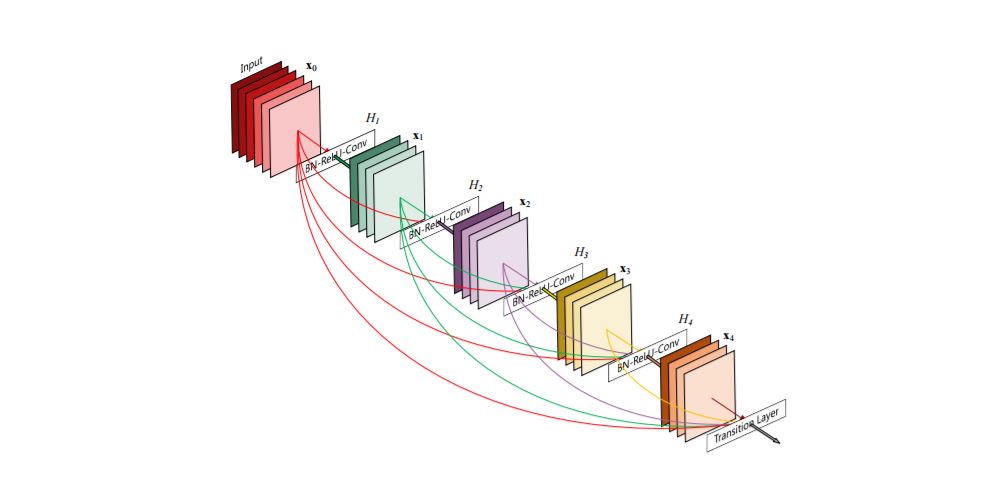
DenseNet is an extention to Wide Residual Networks. According to the paper:
The lth layer has l inputs, consisting of the feature maps of all preceding convolutional blocks.
Its own feature maps are passed on to all L − l subsequent layers. This introduces L(L+1) / 2 connections
in an L-layer network, instead of just L, as in traditional feed-forward architectures.
Because of its dense connectivity pattern, we refer to our approach as Dense Convolutional Network (DenseNet).
It features several improvements such as :
- Dense connectivity : Connecting any layer to any other layer.
- Growth Rate parameter Which dictates how fast the number of features increase as the network becomes deeper.
- Consecutive functions : BatchNorm - Relu - Conv which is from the Wide ResNet paper and improvement from the ResNet paper.
The Bottleneck - Compressed DenseNets offer further performance benefits, such as reduced number of parameters, with similar or better performance.
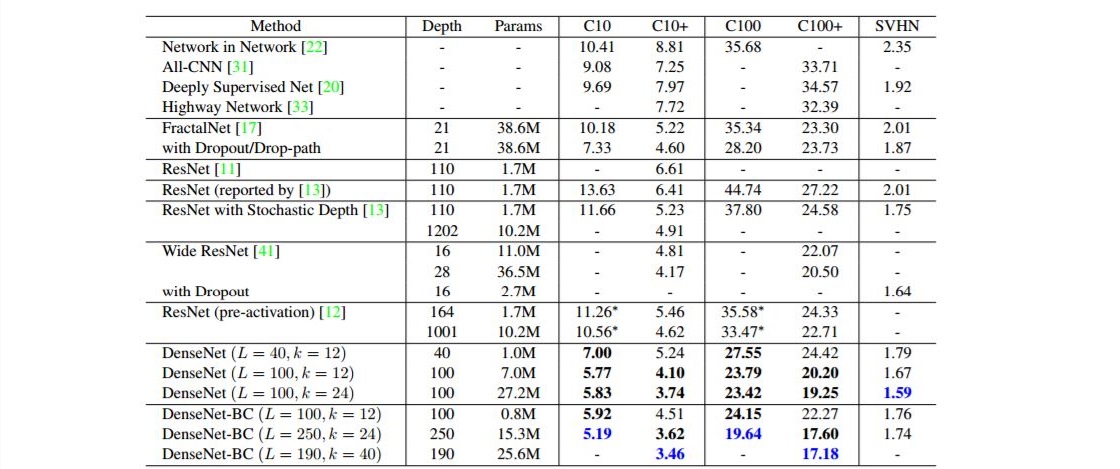
Take into consideration the DenseNet-100-12 model, with nearly 7 million parameters against with the DenseNet-BC-100-12, with just 0.8 million parameters. The BC model achieves 4.51 % error in comparison to the original models' 4.10 % error
The best original model, DenseNet-100-24 (27.2 million parameters) achieves 3.74 % error, whereas the DenseNet-BC-190-40 (25.6 million parameters) achieves 3.46 % error which is a new state of the art performance on CIFAR-10.
Dense Nets have an architecture which can be shown in the following image from the paper:
Performance
The accuracy of DenseNet has been provided in the paper, beating all previous benchmarks in CIFAR 10, CIFAR 100 and SVHN
Usage
Import the densenet.py script and use the DenseNet(...) method to create a custom DenseNet model with a variety of parameters.
Examples :
import densenet

# 'th' dim-ordering or 'tf' dim-ordering
image_dim = (3, 32, 32) or image_dim = (32, 32, 3)

model = densenet.DenseNet(classes=10, input_shape=image_dim, depth=40, growth_rate=12,
			  bottleneck=True, reduction=0.5)
Or, Import a pre-built DenseNet model for ImageNet, with some of these models having pre-trained weights (121, 161 and 169).
Example :
import densenet

# 'th' dim-ordering or 'tf' dim-ordering
image_dim = (3, 224, 224) or image_dim = (224, 224, 3)

model = densenet.DenseNetImageNet121(input_shape=image_dim)
Weights for the DenseNetImageNet121, DenseNetImageNet161 and DenseNetImageNet169 models are provided (in the release tab) and will be automatically downloaded when first called. They have been trained on ImageNet. The weights were ported from the repository https://github.com/flyyufelix/DenseNet-Keras.
Requirements
- Keras
- Theano (weights not tested) / Tensorflow (tested) / CNTK (weights not tested)
- h5Py