
rstudio/renv has 1,165 GitHub stars and 169 forks. GitHot measured -1 stars in 24 hours and -1 in 7 days. Last checked 2026-11-12 05:38 UTC. Last push 2026-10-27.
Comment ces chiffres sont mesurés
renv: Project environments for R.
Progression mesurée des étoiles
- in 24h
- -1
- in 7 days
- -1
- in 15 days
- Mise à jour retardée
- in 1 month
- Mise à jour retardée
Variations nettes sur des périodes qui se chevauchent, pas des totaux quotidiens. Les mesures absentes restent vides. Les étoiles indiquent l’intérêt, pas la qualité.
README.md
Originalrenv 


Overview
The renv package[^1] helps you create reproducible environments for your R projects. Use renv to make your R projects more isolated, portable and reproducible.
- Isolated: Installing a new or updated package for one project won’t break your other projects, and vice versa. That’s because renv gives each project its own private library.
- Portable: Easily transport your projects from one computer to another, even across different platforms. renv makes it easy to install the packages your project depends on.
- Reproducible: renv records the exact package versions you depend on, and ensures those exact versions are the ones that get installed wherever you go.
Installation
Install the latest version of renv from CRAN with:
install.packages("renv")
Alternatively, install the development version from r-universe with:
install.packages("renv", repos = "https://rstudio.r-universe.dev")
Workflow
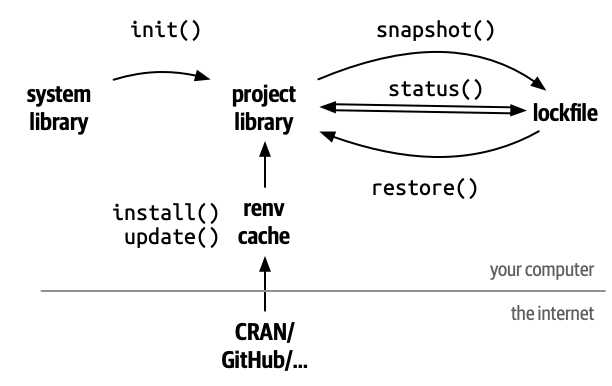
Use renv::init() to initialize renv in a new or existing project. This
will set up a project library, containing all the packages you’re
currently using. The packages (and all the metadata needed to reinstall
them) are recorded into a lockfile, renv.lock, and a .Rprofile
ensures that the library is used every time you open that project.
As you continue to work on your project, you will install and upgrade
packages, either using install.packages() and update.packages() or
renv::install() and renv::update(). After you’ve confirmed your code
works as expected, use renv::snapshot() to record the packages and
their sources in the lockfile.
Later, if you need to share your code with someone else or run your code
on new machine, your collaborator (or you) can call renv::restore() to
reinstall the specific package versions recorded in the lockfile.
Learning more
If this is your first time using renv, we strongly recommend starting with the Introduction to renv vignette: this will help you understand the most important verbs and nouns of renv.
If you have a question about renv, please first check the FAQ to see whether your question has already been addressed. If it hasn’t, please feel free to ask on the Posit Forum.
If you believe you’ve found a bug in renv, please file a bug (and, if possible, a reproducible example) at https://github.com/rstudio/renv/issues.
[^1]: Pronounced “R” “env”
Explorer des projets similaires
codecrafters-io/build-your-own-x
Maîtrisez la programmation en recréant de zéro vos technologies préférées.
562,137 étoilespublic-apis/public-apis
Une liste collective d'API gratuites
498,520 étoilesmorluto/rea
Rétro-ingénierie de n'importe quoi avec des agents, du comportement des applications jusqu'aux binaires natifs.
455,132 étoilesopenclaw/openclaw
L'IA qui fait vraiment les choses. Tout système d'exploitation, toute plateforme. À la manière du homard. 🦞
394,409 étoiles