
prisma/orm has 47,659 GitHub stars and 2,604 forks. GitHot measured -1 stars in 24 hours, -8 in 7 days, and -23 in 15 days. Last checked 2026-11-05 10:33 UTC. Last push 2026-11-03.
Comment ces chiffres sont mesurés
Prisma ORM : écrivez votre application en TypeScript avec des requêtes lisibles par l'humain au lieu de SQL. Hébergez votre base de données sur Prisma Postgres et votre application sur Prisma Compute.
Progression mesurée des étoiles
- in 24h
- -1
- in 7 days
- -8
- in 15 days
- -23
- in 1 month
- Historique en cours
Variations nettes sur des périodes qui se chevauchent, pas des totaux quotidiens. Les mesures absentes restent vides. Les étoiles indiquent l’intérêt, pas la qualité.
README.md
Original
Docs | Discord | X | Blog Post | Architecture



Using Prisma 7? It is maintained for eighteen months after
8.0.0final; supported versions says what that covers. Its source lives on thev7branch of this repository and its docs at prisma.io/docs/orm/v7.
Prisma 8 is a release candidate.
8.0.0final is expected in the next four to eight weeks. Until then a release candidate may include breaking changes, and every release ships with an upgrade recipe that theprisma-8skill applies for you. The candidate is a complete implementation we stand behind: we treat bugs in it as urgent, and the risk you take on is a feature that is not built yet rather than churn. The feature scoreboard names every gap. New projects should start here. Existing Prisma 7 applications can migrate incrementally, and Prisma 7 stays maintained on thev7branch for eighteen months after8.0.0final. Star the repo, follow @prisma on X, or read along on the Prisma blog.
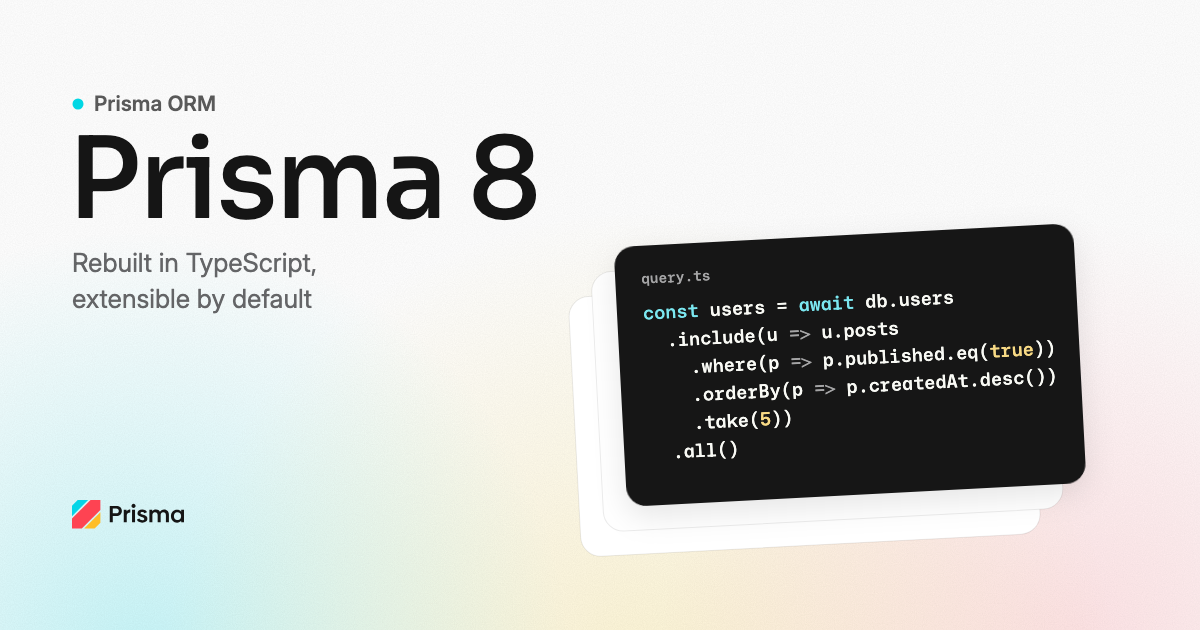
Prisma 8 is a TypeScript rewrite of Prisma ORM, designed to be extensible, composable, and AI-agent friendly by default. Read the announcement or start with the docs.
Prerequisites
- Node.js 24 or newer
- A package manager (
npm,pnpm, oryarn)
Getting started
1. Scaffold a new project
The interactive scaffolder picks an app template (Next.js, Hono, Nuxt, Astro, NestJS, SvelteKit, TanStack Start, or Elysia) and wires Prisma 8 in with your chosen database (PostgreSQL or MongoDB):
npm create prisma
You finish with a runnable app, a starter contract, and the agent skills already installed. See the create-prisma reference for every template and flag, or follow the PostgreSQL and MongoDB quickstarts.
2. Or, add Prisma 8 to an existing project
Run this from your repo root:
npx prisma orm init
orm init writes prisma.config.ts, scaffolds a starter contract and db.ts under src/prisma/, installs the runtime, and emits the contract. It does not touch your framework or build setup. Then install the agent skills:
npx prisma skills sync
See the orm init and skills CLI references, or the guides for adding Prisma 8 to an existing PostgreSQL or MongoDB app.
3. Use your AI agent for everything Prisma 8
Both installers leave a top-level prisma-8.md primer at your project root for any agent to read first, and install one SKILL.md per workflow into the directories agent runtimes read:
.claude/skills/<skill-name>/SKILL.md— Claude Code.cursor/skills/<skill-name>/SKILL.md— Cursor.agents/skills/<skill-name>/SKILL.md— universal location for Copilot Agent and other runtimes.devin/skills/<skill-name>/SKILL.md— Devin
Skills ship inside the Prisma packages your project installs, so they always describe the version in use. Your editor's AI assistant auto-loads the right skill when your prompt matches.
Just describe what you want. For example:
"Add a
postsmodel with a relation tousers, then write a query that loads each user's three most recent posts."
The agent loads the prisma-8 skill, opens its contract and queries references, then drives the change end-to-end.
For the full catalogue and what each skill covers, see skills/README.md.
Found a bug, missing a feature, or have a question for the team?
Ask your agent. The prisma-8 skill's feedback flow drafts a structured GitHub issue or hands you a Prisma Discord link for live Q&A. You can review and confirm before anything is submitted.
For extension authors
Prisma 8 has a minimal core. Everything around it, including Postgres support itself, is built on the same public SPI that's available to any author. If you've wanted to integrate your tool, your database, or your library with Prisma, this is the way in.
Extensions already shipping:
@prisma/orm-extension-pgvector: vector columns and similarity search.@prisma/orm-extension-postgis: geometry columns and geo queries.@prisma/orm-extension-paradedb: BM25 full-text search indexes (experimental).@prisma/orm-extension-supabase: Supabase auth and storage tables, role-bound clients (experimental).@prisma/orm-extension-arktype-json: JSON columns validated by an arktype schema.@prisma/orm-postgres-contrib: packs for the trusted PostgreSQL contrib modules, starting withcitextcase-insensitive text.@cipherstash/prisma-next: searchable encryption and data-level access control.
See Using extensions for how to install and register one. Want to ship your own? The call for extension authors walks through the SPI, the layers your extension can hook into, and how the team features new extensions.
Supported databases
- PostgreSQL — the primary target, first-class support
- MongoDB — first-class support
- SQLite — planned next, a proof of concept today
MySQL follows after SQLite. See the feature scoreboard for what each database supports today.
Contributing
See CONTRIBUTING.md for setup, commands, DCO signoff, and PR expectations. For substantive changes, please open an issue first so we can give direction-fit feedback before you invest implementation time. The vision says where Prisma 8 is going, and the steering list names requests we have already answered, with what to use instead.
Security issues: follow the Private Vulnerability Reporting flow in SECURITY.md. Please do not file them as public issues.
Community
Built something with Prisma 8? Tag @prisma on X. The best community builds get a shout-out and a link here.
- Discord: Talk to us in Discord
- X: @prisma
- Blog: prisma.io/blog
License
Apache 2.0. See LICENSE.
Explorer des projets similaires
Asabeneh/30-Days-Of-Python
Le défi de programmation 30 Days of Python est un guide pas à pas pour apprendre le langage de programmation Python en 30 jours. Ce défi peut prendre plus de 100 jours. Avancez à votre rythme. Ces vidéos peuvent aussi vous aider : https://www.youtube.com/channel/UC7PNRuno1rzYPb1xLa4yktw
78,163 étoilesgrafana/grafana
Plateforme ouverte et composable d’observabilité et de visualisation de données. Visualise les métriques, les journaux et les traces issus de plusieurs sources, comme Prometheus, Loki, Elasticsearch, InfluxDB, Postgres et bien d’autres.
77,699 étoilesredis/redis
Pour les développeurs qui créent des applications en temps réel pilotées par les données, Redis est le cache, le serveur de structures de données et le moteur de requêtes documentaires et vectorielles préféré, le plus rapide et le plus riche en fonctionnalités.
77,199 étoilesapache/superset
Apache Superset est une plateforme de visualisation et d'exploration de données.
75,413 étoiles