
ozkary/machine-learning-engineering
ozkary/machine-learning-engineering has 26 GitHub stars and 5 forks. GitHot measured 0 stars in 24 hours. Last checked 2026-11-14 23:37 UTC. Last push 2026-11-12.
Progression mesurée des étoiles
- in 24h
- 0
- in 7 days
- Historique en cours
- in 15 days
- Historique en cours
- in 1 month
- Historique en cours
Variations nettes sur des périodes qui se chevauchent, pas des totaux quotidiens. Les mesures absentes restent vides. Les étoiles indiquent l’intérêt, pas la qualité.
À propos
Welcome to the Machine Learning Engineering Repository, a comprehensive collection of resources, code, and insights to guide you through the exciting world of machine learning. This repository is designed to provide valuable information, best practices, and hands-on examples for individuals keen on mastering the art and science of machine learning
Apprentissage automatiqueREADME.md
OriginalMachine Learning Engineering: From Basics to Production MLOps


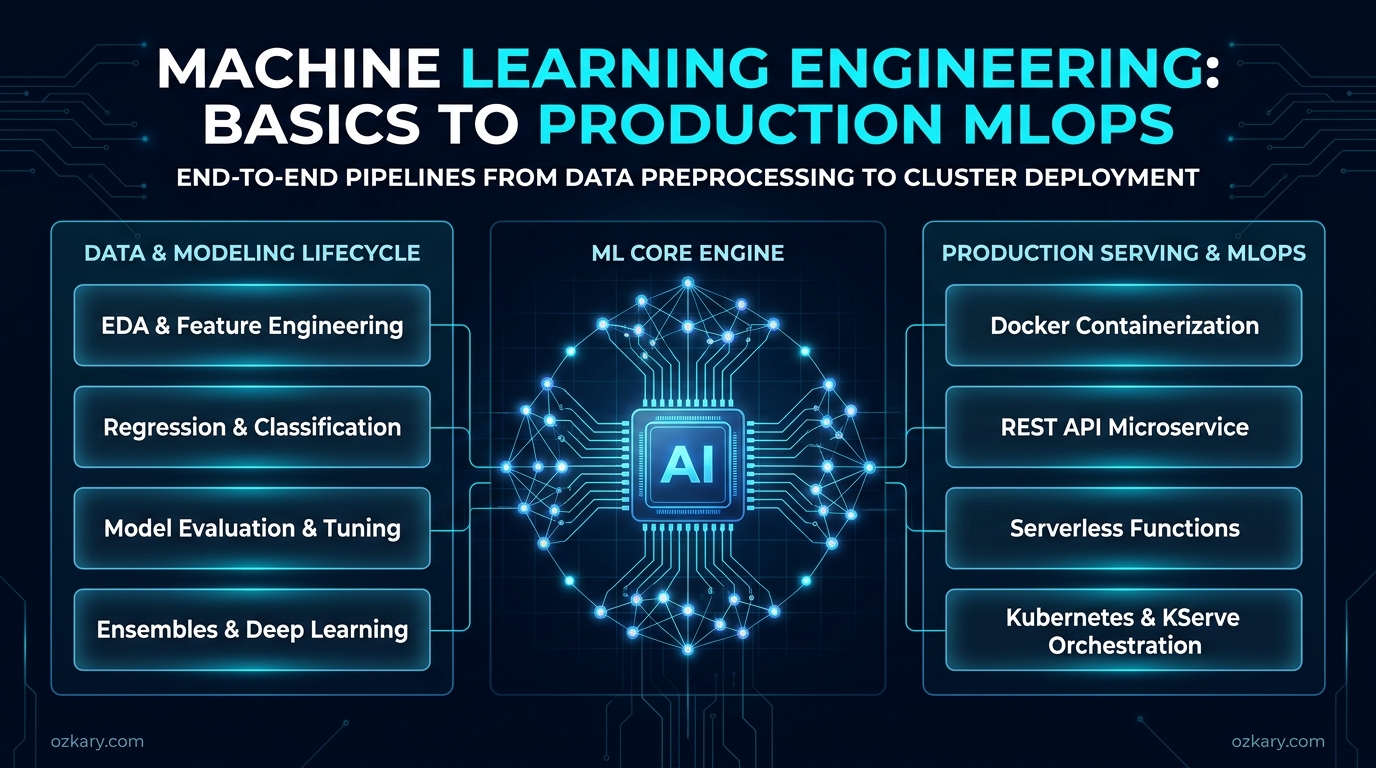
Welcome to the Machine Learning Engineering repository—a structured, comprehensive collection of resources, source code, interactive notebooks, and production deployment patterns designed to teach machine learning from first principles to scalable real-world architectures.
Whether you are beginning your data science journey or mastering production engineering (MLOps), this repository guides you through algorithmic foundations, deep learning, containerization, serverless functions, and Kubernetes orchestration.
⭐ Support this project: If you find these guides, notebooks, and production code helpful, please give this repository a Star on GitHub!
👋 Welcome DataTalks.Club & ML Zoomcamp learners!
Feel free to fork or bookmark this repository as a hands-on companion reference for your homework, midterm projects, and cloud deployments.
Table of Contents
- Overview
- Video Lectures & Walkthroughs
- Featured on Kaggle
- Learning Roadmap
- Curriculum & Module Index
- Featured Capstone Projects
- Model Selection Guide
- Getting Started
- Related Articles & Deep Dives
- Community & Updates
- Contributing
- License
Overview
Machine learning transforms data into predictive intelligence and automated decision systems. This repository functions both as an academic syllabus and a practical engineering playbook:
- Mathematical Foundations & EDA: Understand linear models, cost functions, loss minimization, and data preprocessing.
- Supervised Learning: Master classification and regression with classical algorithms and ensemble tree methods (XGBoost, Random Forests).
- Validation & Metrics: Rigorously evaluate models with precision-recall curves, ROC-AUC, confusion matrices, and cross-validation.
- Deep Learning & Computer Vision: Build convolutional neural networks (CNNs) and apply transfer learning with TensorFlow/Keras and PyTorch.
- Cloud-Native MLOps: Containerize models with Docker, serve REST inference APIs with Flask/Gunicorn, deploy serverless functions, and scale with Kubernetes and KServe.
Video Lectures & Walkthroughs
Accelerate your learning with video lectures and technical walkthroughs corresponding to the curriculum:
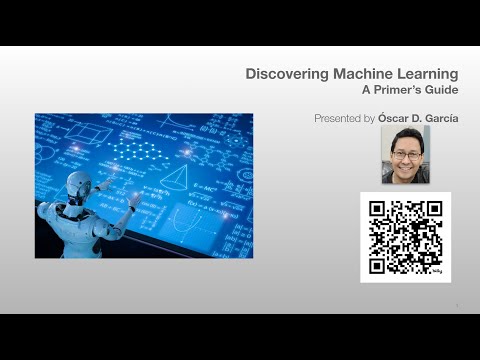
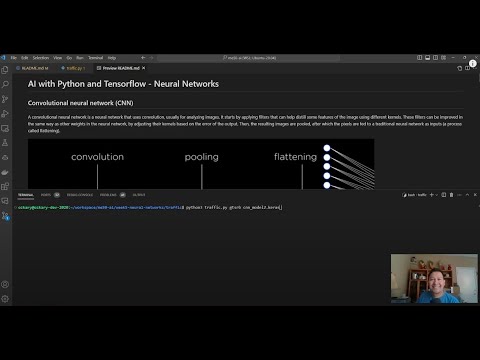
| 📺 Discovering Machine Learning: A Primer Guide | 🎓 Neural Network Model Analysis (Harvard CS50 AI) | 📺 AI Agents for Health Risk Assessment (Kaggle) |
|---|---|---|
 |
 |
 |
| Watch Live Stream | Watch Deep Dive | Watch Walkthrough |
| Topics: ML definitions, supervised vs. unsupervised paradigms, problem formulation, exploratory data analysis (EDA), data cleaning, feature engineering, and lifecycle. | 🎓 Created for Harvard CS50 AI: In-depth breakdown of CNN layer architectures, activation functions, convolutional kernels, pooling, and image classification convergence. | Topics: Clinical interview AI agent on Google Cloud Run, MCP tools integration, real-time risk score inference, and personalized health recommendations. |
Featured on Kaggle
🏆 Kaggle VibeCoding Agents Capstone Project:
The work developed in this repository's Heart Disease Risk Assessment project has been featured on Kaggle!
- 📄 Read the Writeup: AI Agents for Health Risk Assessment on Kaggle
- 📺 Watch the Video Demo: AI Agents for Health Risk Assessment Walkthrough
Learn how to take a trained tabular machine learning classifier and integrate it into an agentic workflow using the Model Context Protocol (MCP), Gemini (Vertex AI), and Google Cloud Run for conversational healthcare risk assessment.
Learning Roadmap
Follow this progression path to transition from core fundamentals to scalable cloud architectures:
flowchart TD
    subgraph Phase1["Phase 1: Foundations & Classical ML"]
        M01["01: Introduction to ML"] --> M02["02: Regression & EDA"]
        M02 --> M03["03: Classification & LogReg"]
        M03 --> M04["04: Evaluation & Validation"]
    end

    subgraph Phase2["Phase 2: Tree Ensembles & API Deployment"]
        M04 --> M06["06: Decision Trees & XGBoost"]
        M06 --> M05["05: Model Deployment (Flask + Docker)"]
        M05 --> M07["07: Midterm Project Implementation"]
    end

    subgraph Phase3["Phase 3: Deep Learning & Complex Modalities"]
        M07 --> M08["08: Deep Learning & Computer Vision (CNNs)"]
        M08 --> P01["Drug-Drug Interaction (SSP + MLP)"]
        M08 --> P02["Voice Cloning with PyTorch"]
    end

    subgraph Phase4["Phase 4: Cloud-Native & Scalable MLOps"]
        M08 --> M09["09: Serverless Model Hosting (TF-Lite / Lambda)"]
        M09 --> M10["10: Kubernetes Orchestration & Autoscaling"]
        M10 --> M11["11: Production Model Serving with KServe"]
    end
Curriculum & Module Index
Each numbered module contains in-depth documentation, runnable Jupyter notebooks, and production code:
| Module | Title & Documentation | Core Topics Covered | Practical Code & Notebooks |
|---|---|---|---|
| 01 | 01-Introduction | What is ML, Core concepts, Supervised learning principles, $Data + Outcome \to Model$, Generalization | homework.ipynb, comparison.ipynb |
| 02 | 02-Regression | Linear regression, normal equation, exploratory data analysis (EDA), feature engineering, validation split, RMSE | homework.ipynb |
| 03 | 03-Classification | Binary/multi-class classification, Logistic Regression, Sigmoid function, mutual information, one-hot encoding | homework.ipynb |
| 04 | 04-Evaluation | Confusion matrix, Accuracy, Precision, Recall, F1 score, ROC and PR curves, AUC, K-Fold cross-validation | homework.ipynb |
| 05 | 05-Deployment | Serializing models (Pickle/Joblib), building web services with Flask/Gunicorn, Pipenv dependencies, Docker containers | app.py, Dockerfile, homework.ipynb |
| 06 | 06-Trees & Ensembles | Decision Trees, stopping criteria, Random Forests, Gradient Boosting (XGBoost), hyperparameter tuning | homework.ipynb |
| 07 | 07-Midterm Project | End-to-end capstone methodology: Problem statement, data preparation, model selection, tuning, and API serving | README.md |
| 08 | 08-Deep Learning | Artificial neural networks, Convolutional Neural Networks (CNNs), TensorFlow/Keras, image augmentation, transfer learning (includes lecture for Harvard CS50 AI) | homework.ipynb |
| 09 | 09-Serverless Hosting | Serverless inference on AWS Lambda / Azure Functions, converting models to TensorFlow-Lite, Docker runtime optimization | main.py, Dockerfile, homework.ipynb |
| 10 | 10-Kubernetes | Container orchestration with K8s, Deployments, Services, Horizontal Pod Autoscaler (HPA), Kind/Minikube local clusters | deployment.yaml, hpa.yaml, q4_predict.py |
| 11 | 11-KServe | Cloud-native model serving with KServe, automated GPU/CPU scaling, multi-framework support (TF, PyTorch, ONNX), vLLM | quick_install.sh, iris_example.yaml |
Featured Capstone Projects
Explore end-to-end case studies implementing machine learning architectures for real-world problems:
1. Heart Disease Risk Assessment (Featured on Kaggle & ozkary.com)
- Domain: Healthcare & Preventative Medicine
- Dataset: US Centers for Disease Control and Prevention (CDC) EHR data
- Architecture: Implements a Model Factory pattern comparing Logistic Regression and Random Forest classifiers, complete with data preprocessing pipelines and containerized REST endpoints.
- Publications & Capstone Extension:
- Key Assets: README.md, data_train.py, app.py, Dockerfile
2. Drug-to-Drug Interaction (DDI) Classifier
- Domain: Pharmacogenomics & Computational Chemistry
- Dataset: DrugBank repository of over 190,000 known drug interaction pairs
- Architecture: Formulates DDI prediction by extracting SMILES molecular representations, generating Structural Similarity Profile (SSP) vectors, and training Multi-Layer Perceptrons (MLP) for multi-label interaction prediction.
- Key Assets: README.md, data_train_mlp.ipynb, app.py, Dockerfile
3. Deep Learning Voice Cloning with PyTorch
- Domain: Speech Processing & Generative Audio
- Architecture: Audio spectrogram feature extraction, acoustic modeling, neural vocoder pipelines, and PyTorch deep learning implementations.
- Key Assets: README.md
4. Additional Exploratory Studies
- Vehicle MSRP Price Prediction: Multivariate regression and feature collinearity analysis for car market valuations (regression.ipynb).
- End-to-End Census & Demographic Modeling: Socioeconomic classification workflows (end_to_end_machine_learning_project.ipynb).
Model Selection Guide
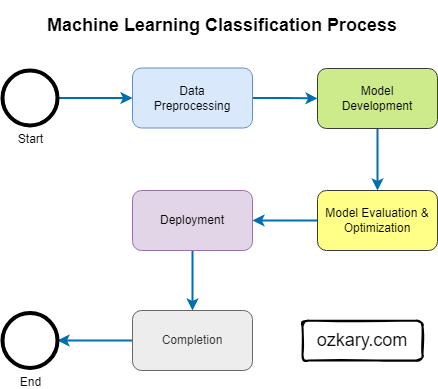
Selecting the right machine learning algorithm depends on the nature of the target variable, data volume, interpretability requirements, and latency constraints:
| Model Type | Primary Task | Best Suited For | Advantages & Tradeoffs |
|---|---|---|---|
| Linear Regression | Continuous Prediction | Baseline price forecasting, trend lines | Fast, highly interpretable; vulnerable to non-linearities and outliers. |
| Ridge / Lasso Regression | Continuous Prediction | Datasets with multicollinear or high-dimensional features | Regularization prevents overfitting; balances feature weights. |
| Logistic Regression | Binary / Multi-class | Disease diagnosis, customer churn probability | Provides calibrated probabilities; linear decision boundary. |
| Decision Trees | Classification & Regression | Rules-based workflows, demographic segmentation | Natural handling of non-linearities and categorical data; prone to overfitting. |
| Random Forests | Classification & Regression | Defect detection, credit risk, complex tabular data | Ensemble bagging reduces variance; robust against noise. |
| Gradient Boosting (XGBoost) | Classification & Regression | Kaggle benchmarks, ranking, fraud detection | State-of-the-art tabular accuracy; requires hyperparameter tuning. |
| Support Vector Machines (SVM) | Classification & Regression | Quality control, text classification | Effective in high-dimensional spaces with custom kernels. |
| K-Nearest Neighbors (KNN) | Classification & Regression | Equipment maintenance scheduling, recommendation systems | Instance-based / lazy learning; inference slows with large datasets. |
| Convolutional Neural Networks (CNN) | Computer Vision | Image recognition, defect inspection, medical scans | Captures spatial hierarchies; requires GPU acceleration and large datasets. |
| Multi-Layer Perceptrons (MLP) | Complex Multi-modal | Chemical interaction (DDI), non-linear feature maps | Flexible neural modeling; requires careful regularization. |
Getting Started
Prerequisites
- Python: 3.9 or higher
- Package / Environment Manager:
pipenvorvenv/conda - Docker: For testing containerized models locally
Quickstart Setup
Clone the repository:
git clone https://github.com/ozkary/ml-engineering.git
cd ml-engineering
Create a virtual environment and install dependencies:
# Using Python venv
python3 -m venv .venv
source .venv/bin/activate
pip install jupyter scikit-learn pandas numpy matplotlib seaborn
Or use
pipenvinside any module folder (e.g.,cd 05-deployment && pipenv install).Launch Jupyter Lab / Notebooks:
jupyter labDetailed Environment & Setup Guide: For step-by-step instructions on setting up Docker, Pipenv, Kubernetes clusters (Kind/Minikube), and testing APIs, read the complete Getting Started Guide.
Related Articles & Deep Dives
Deepen your understanding with technical writeups and architecture articles published on ozkary.com:
- 📖 AI Study: A Learning-Based Approach for Predicting Heart Disease
Comprehensive evaluation using CDC EHR data, contrasting Logistic Regression, Decision Trees, Random Forests, and XGBoost, with deployment patterns. - 📖 Discovering Machine Learning: A Primer Guide
Companion reading for Module 01 exploring the machine learning lifecycle, supervised vs. unsupervised paradigms, and feature engineering. - 📖 AI Python TensorFlow Neural Network Analysis
In-depth architectural breakdown of Convolutional Neural Networks (CNNs), convolutional kernels, pooling layers, and feature map visualizations.
Community & Updates
Stay up-to-date with tutorials, guides, and open-source releases:
- ⭐ Star the Repo: If you find this curriculum helpful, give it a star on GitHub to help other engineers and students discover it!
- 📬 Newsletter: Sign up for the ML Engineering & AI Newsletter
- 🐦 Twitter / X: Follow @ozkary
- 🤖 Companion AI Agents Repo: ozkary/ai-engineering
- 📊 Companion Data Engineering Repo: ozkary/data-engineering-mta-turnstile
Contributing
Contributions, issues, and feature suggestions are welcome! Whether it is fixing a typo, proposing a new algorithm notebook, or optimizing a Docker configuration, please review our Contribution Guidelines before submitting a pull request.
License
This repository is distributed under the terms of the Apache License 2.0. Feel free to use the code, notebooks, and reference materials in your projects and studies.