
muesli/beehive
muesli/beehive has 6,489 GitHub stars and 325 forks. GitHot measured 0 stars in 24 hours. Last checked 2026-11-07 00:08 UTC. Last push 2023-02-25.
Comment ces chiffres sont mesurés
Un système flexible d’événements, d’agents et d’automatisation avec beaucoup d’abeilles 🐝
Progression mesurée des étoiles
- in 24h
- 0
- in 7 days
- Mise à jour retardée
- in 15 days
- Mise à jour retardée
- in 1 month
- Mise à jour retardée
Variations nettes sur des périodes qui se chevauchent, pas des totaux quotidiens. Les mesures absentes restent vides. Les étoiles indiquent l’intérêt, pas la qualité.
README.md
OriginalBeehive


Beehive is an event and agent system, which allows you to create your own agents that perform automated tasks triggered by events and filters. It is modular, flexible and really easy to extend for anyone. It has modules (we call them Hives), so it can interface with, talk to, or retrieve information from Twitter, Tumblr, Email, IRC, Jabber, RSS, Jenkins, Hue - to name just a few. Check out the full list of available Hives in our Wiki.
Connecting those modules with each other lets you create immensly useful agents.
Here are just a few examples of things Beehive could do for you:
- Re-post tweets on your Tumblr blog
- Forward incoming chat messages to your email account
- Turn on the heating system if the temperature drops below a certain value
- Run your own IRC bot that lets you trigger builds on a Jenkins CI
- Control your Hue lighting system
- Notify you when a stock's price drops below a certain value

Installation
Packages & Binaries
- Arch Linux: beehive (AUR)
- Linux Static 64bit
- Linux Static armv6
- macOS 64bit
- Windows 64bit
You can find even more official releases here.
Deployment Tools
- Docker:
docker run --name beehive -d -p 8181:8181 fribbledom/beehive - Ansible
From source
Beehive requires Go 1.13 or higher. Make sure you have a working Go environment. See the install instructions.
The recommended way is to fetch the sources and run make.
git clone --recursive https://github.com/muesli/beehive.git
cd beehive
make
You can build and install the beehive binary like other Go binaries out there (go get)
but you'll need to make sure Beehive can find the assets (images, javascript, css, etc).
See the Troubleshooting/Notes section for additional details.
Run beehive --help to see a full list of options.
Configuration
Think of Hives as little plugins, extending Beehive's abilities with events you can react on and actions you can execute.
Just as examples, there's a Twitter plugin that can
- react to someone you follow posting a tweet (an event)
- post a new tweet for you (an action)
- ...
or an RSS plugin that lets you
- monitor RSS feeds and react on new feed items (another event)
or an email plugin that gives you the ability to
- send emails (another action)
Each Hive lets you spawn one or multiple Bees in it, all working independently from another. That allows you to create separate plugin instances, e.g. one email-Bee for your private mail account, and another one for your work email.
Creating Bees
Sounds complicated? It's not! Just for fun, let's setup Beehive to send us an
email whenever an RSS feed gets updated. Start beehive and open http://localhost:8181/
in your browser. Note that Beehive will create a config file beehive.conf
in its current working directory, unless you specify a different file with the
-config option.
Note: If you built Beehive with go build instead of make you will have to
start beehive from within its source directory in order for it to find all the
resources for the admin interface. Also see the Troubleshooting & Notes section
of this README.
The admin interface will present you with a list of available Hives. We will need to create two Bees here, one for the RSS feed and one for your email account.

Setting up a Chain
Now we will have to create a new Chain, which will wire up the two Bees we just created. First we pick the Bee & Event we want to react on, then we pick the Bee we want to execute an Action with. The RSS-Bee's event gives us a whole set of parameters we can work with: the feed item's title, its links and description among others. You can manipulate and combine these parameters with a full templating language at your disposal. For example we can set the email's content to something like:
Title: {{.title}} - Link: {{index .links 0}}
Whenever this action gets executed, Beehive will replace {{.title}} with
the RSS event's title parameter, which is the title of the feed item it
retrieved. In the same manner {{index .links 0}} becomes the first URL of
this event's links array.
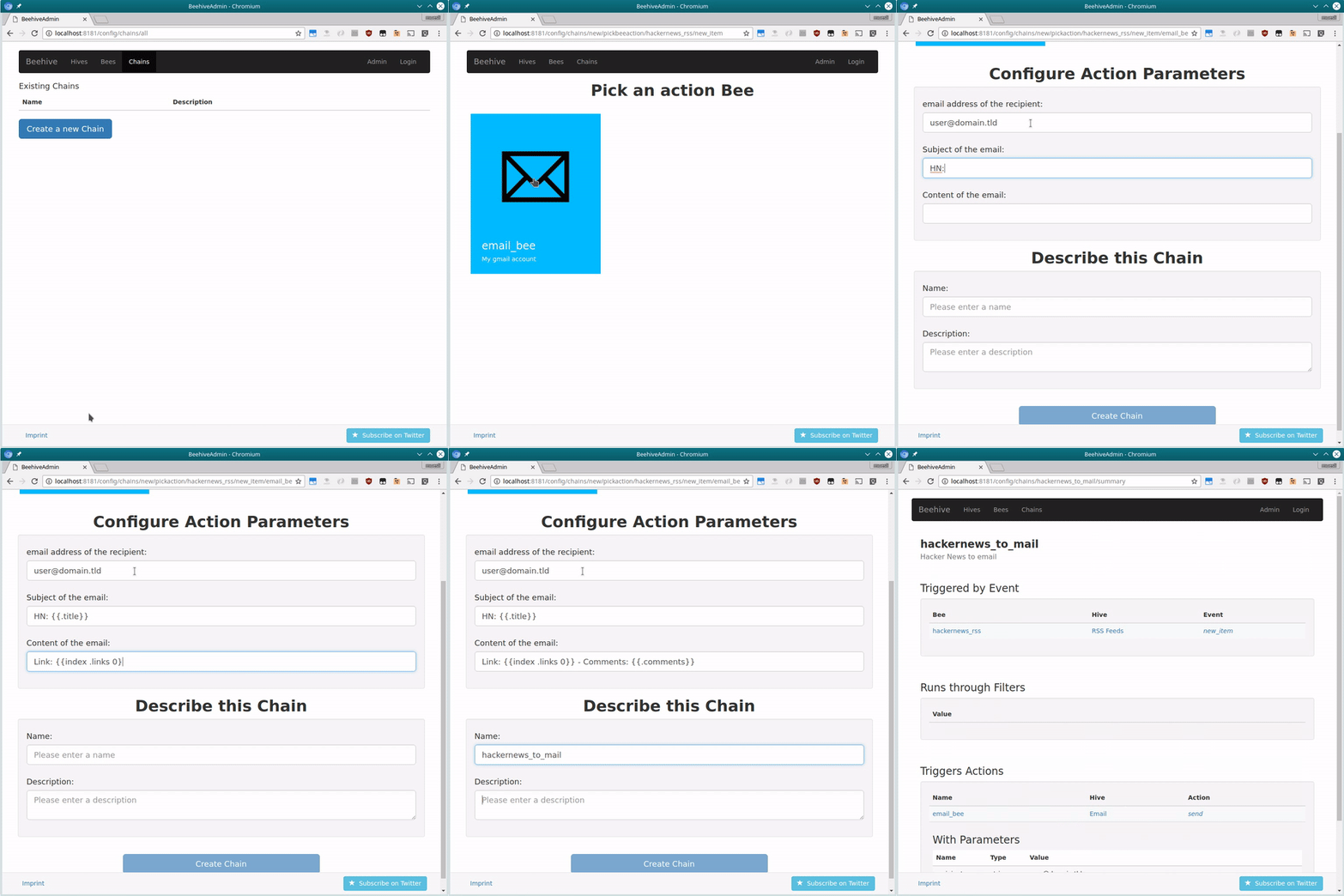
That's it. Whenever the RSS-feed gets updated, Beehive will now send you an email! It's really easy to make various Bees work together seamlessly and do clever things for you. Try it yourself!
You can find more information on how to configure Beehive and examples in our Wiki.
Troubleshooting & Notes
The web interface and other resources are embedded in the binary by default.
When using make noembed, Beehive tries to find those files
in its current working directory, so it's currently recommended to start Beehive
from within its git repository, if you plan to use the web interface.
Should you still not be able to reach the web interface, check if the config
directory in the git repository is empty. If that's the case, make sure the
git submodules get initialized by running git submodule update --init.
The web interface does not require authentication yet. Beehive by default accepts all connections from the loopback device only.
If you want to bind Beehive to a different interface/address, run Beehive with
the -bind and -canonicalurl parameters. For example:
beehive -bind "192.168.0.1:8181" -canonicalurl "http://192.168.0.1:8181"
or
docker run --name beehive -d -e CANONICAL_URL="http://192.168.0.1:8181" -p 8181:8181 fribbledom/beehive
Development
Need help? Want to hack on your own Hives? Join us on IRC (irc://freenode.net/#beehive) or Gitter. Follow the bees on Twitter!
Explorer des projets similaires
n8n-io/n8n
Plateforme Fair-code d’automatisation des flux de travail, avec des capacités d’IA natives. Elle associe la conception visuelle au code personnalisé, peut être hébergée sur vos propres serveurs ou utilisée dans le cloud, et propose plus de 400 intégrations.
209,748 étoileslanggenius/dify
Créer des workflows agentiques et des pipelines RAG, avec une prise en charge riche des modèles et outils d’IA, dans un seul espace de travail collaboratif. Déployer dans le cloud, sur un VPC ou en auto-hébergement, afin que les équipes passent du prototype à la production sans reconstruire la pile.
160,568 étoilesmicrosoft/PowerToys
Microsoft PowerToys est un ensemble d’utilitaires qui améliorent la productivité et la personnalisation sous Windows
140,669 étoilesstablyai/orca
Orca est l'endroit pour travailler avec une flotte d'agents (p. ex. Grok Bot, Claude Code). Exécutez n'importe quel agent de programmation avec votre propre abonnement. Disponible sur ordinateur, sur mobile et en environnement d'exécution distant.
118,213 étoiles