Projets Voir sur GitHub
lucidrains/bit-diffusion
À propos
Implementation of Bit Diffusion, Hinton's group's attempt at discrete denoising diffusion, in Pytorch
Apprentissage automatiqueProgression mesurée des étoiles
- in 24h
- 0
- in 7 days
- 0
- in 15 days
- Historique en cours
- in 1 month
- Historique en cours
Variations nettes sur des périodes qui se chevauchent, pas des totaux quotidiens. Les mesures absentes restent vides. Les étoiles indiquent l’intérêt, pas la qualité.
README.md
Original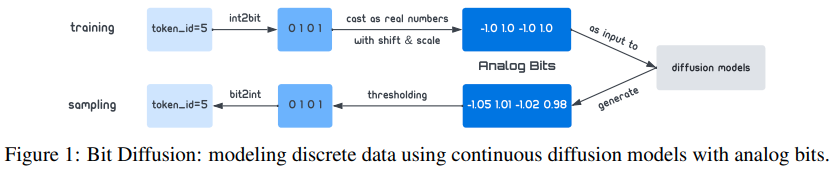
Bit Diffusion - Pytorch
Implementation of Bit Diffusion, Hinton's group's attempt at discrete denoising diffusion, in Pytorch
It seems like they missed the mark for text, but the research direction still seems promising. I think a clean repository will do the research community a lot of benefits for those branching off from here.
Install
$ pip install bit-diffusion
Usage
from bit_diffusion import Unet, Trainer, BitDiffusion

model = Unet(
    dim = 32,
    channels = 3,
    dim_mults = (1, 2, 4, 8),
).cuda()

bit_diffusion = BitDiffusion(
    model,
    image_size = 128,
    timesteps = 100,
    time_difference = 0.1,       # they found in the paper that at lower number of timesteps, a time difference during sampling of greater than 0 helps FID. as timesteps increases, this time difference can be set to 0 as it does not help
    use_ddim = True              # use ddim
).cuda()

trainer = Trainer(
    bit_diffusion,
    '/path/to/your/data',             # path to your folder of images
    results_folder = './results',     # where to save results
    num_samples = 16,                 # number of samples
    train_batch_size = 4,             # training batch size
    gradient_accumulate_every = 4,    # gradient accumulation
    train_lr = 1e-4,                  # learning rate
    save_and_sample_every = 1000,     # how often to save and sample
    train_num_steps = 700000,         # total training steps
    ema_decay = 0.995,                # exponential moving average decay
)

trainer.train()
Results will be saved periodically to the ./results folder
If you would like to experiment with the Unet and BitDiffusion class outside the Trainer
import torch
from bit_diffusion import Unet, BitDiffusion

model = Unet(
    dim = 64,
    dim_mults = (1, 2, 4, 8)
)

bit_diffusion = BitDiffusion(
    model,
    image_size = 128,
    timesteps = 1000
)

training_images = torch.randn(8, 3, 128, 128) # images are normalized from 0 to 1
loss = bit_diffusion(training_images)
loss.backward()
# after a lot of training

sampled_images = bit_diffusion.sample(batch_size = 4)
sampled_images.shape # (4, 3, 128, 128)
Citations
@article{Chen2022AnalogBG,
    title   = {Analog Bits: Generating Discrete Data using Diffusion Models with Self-Conditioning},
    author  = {Ting Chen and Ruixiang Zhang and Geoffrey E. Hinton},
    journal = {ArXiv},
    year    = {2022},
    volume  = {abs/2208.04202}
}
Explorer des projets similaires
Chargement…