
liyown/marknative
À propos
Moteur de rendu Markdown qui génère des sorties PNG et SVG paginées, sans navigateur, Chromium ni DOM.
Création et médiasProgression mesurée des étoiles
- in 24h
- 0
- in 7 days
- +1
- in 15 days
- Historique en cours
- in 1 month
- Historique en cours
Variations nettes sur des périodes qui se chevauchent, pas des totaux quotidiens. Les mesures absentes restent vides. Les étoiles indiquent l’intérêt, pas la qualité.
README.md
Original

A native Markdown rendering engine that produces paginated PNG/SVG documents — no browser, no Chromium, no DOM.
Supports CommonMark, GFM (tables, task lists, strikethrough), syntax-highlighted code blocks (Shiki), and LaTeX math formulas (MathJax) — all rendered server-side.
📖 Documentation — Guide · Showcase · API Reference
Most Markdown rendering pipelines go through a browser:
Markdown → HTML → DOM/CSS → browser layout → screenshot
marknative takes a different path. It parses Markdown directly into a typed document model, runs its own block and inline layout engine, paginates the result into fixed-size pages, and paints each page using a native 2D canvas API.
The result is deterministic, server-renderable, and completely headless.
Gallery
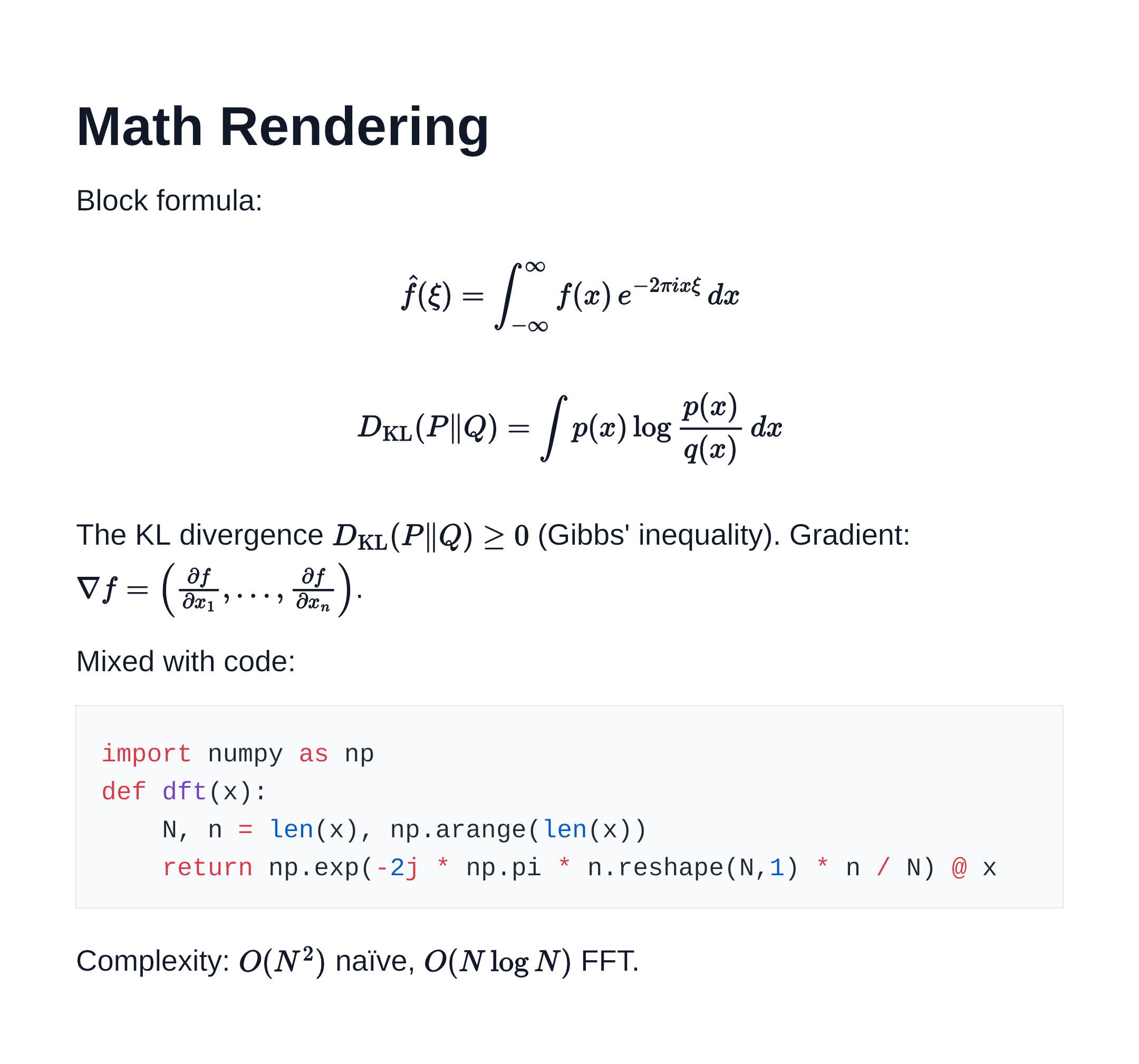
Math formulas (MathJax block + inline) mixed with syntax-highlighted code:
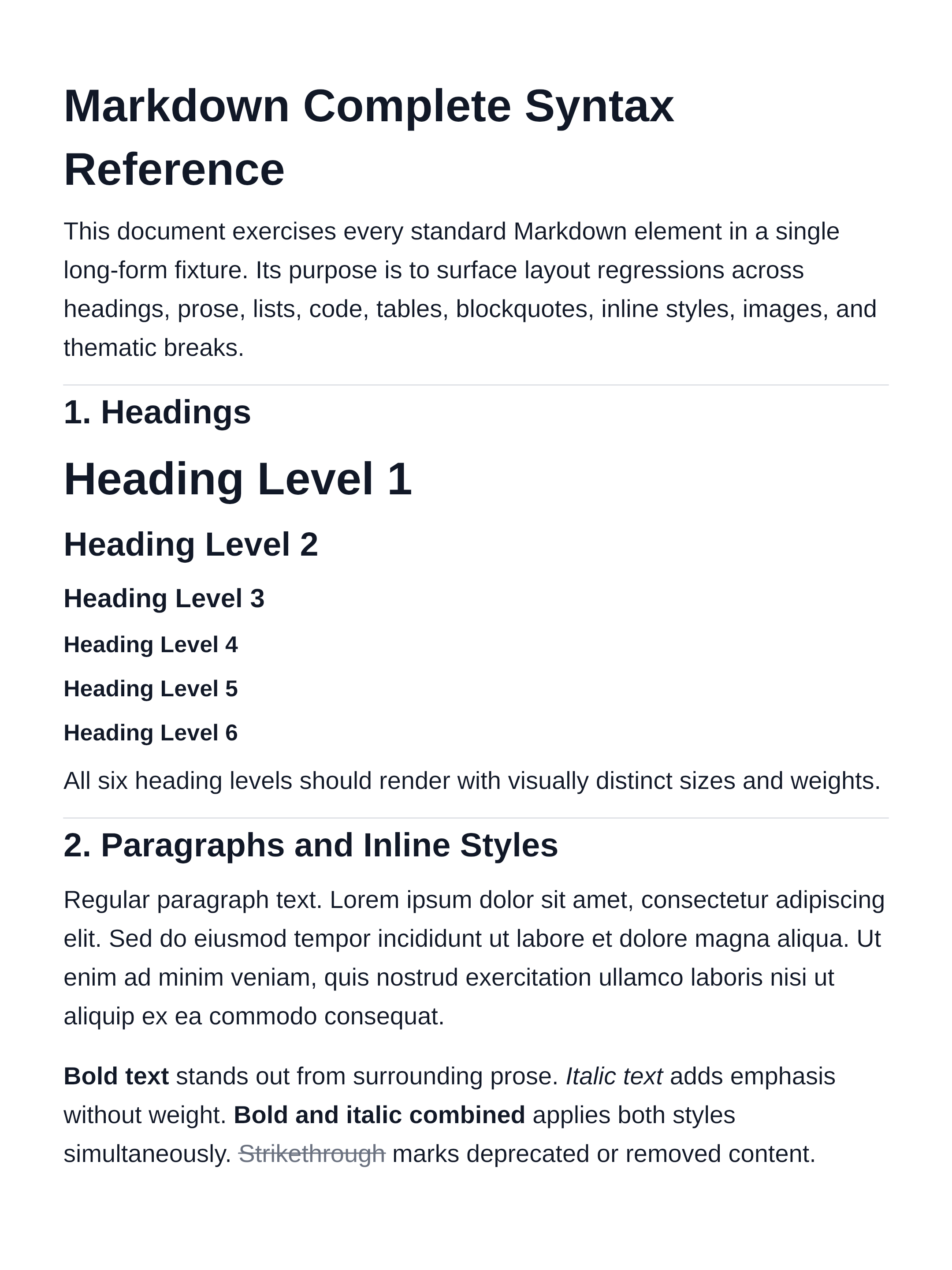
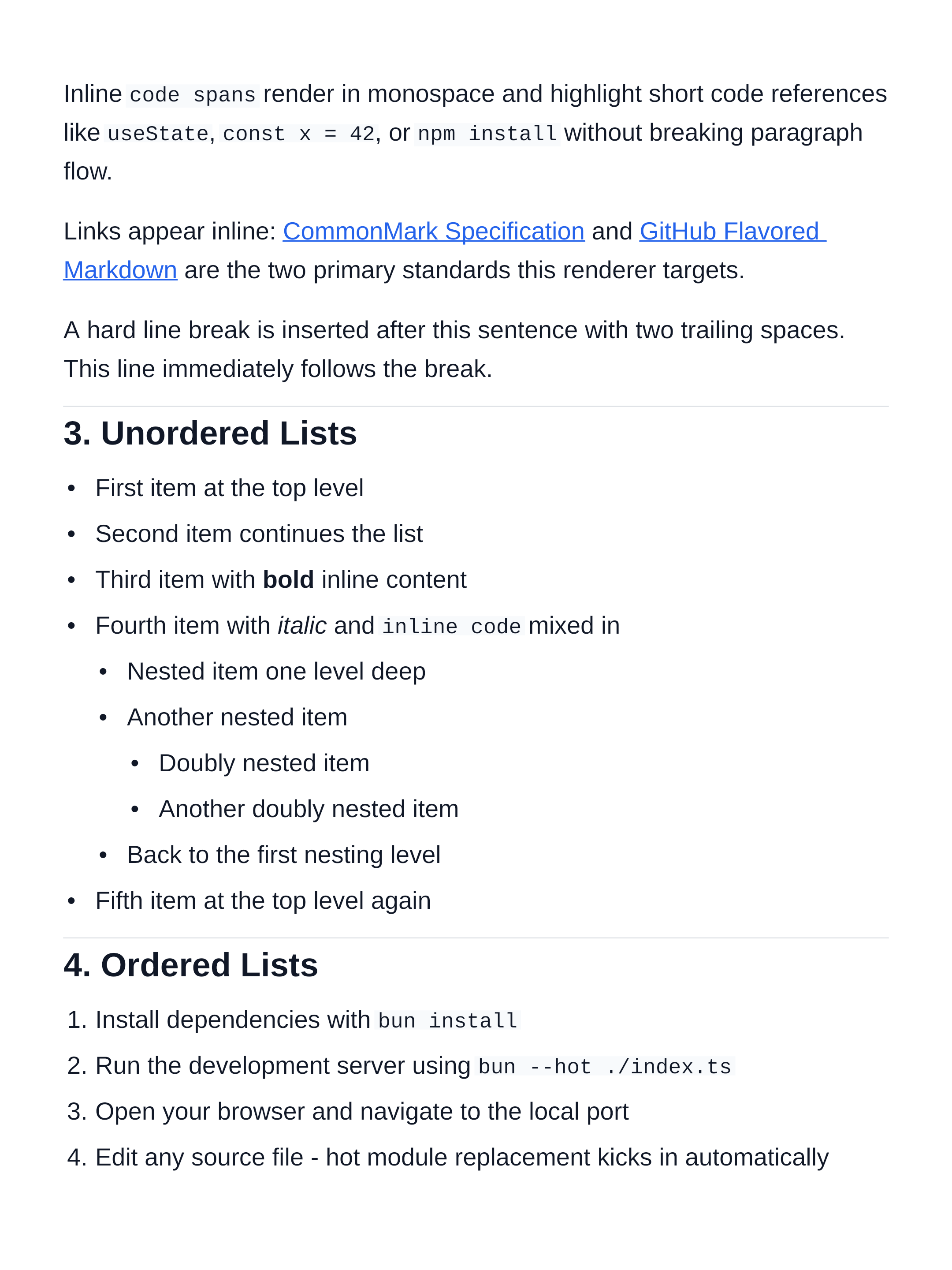
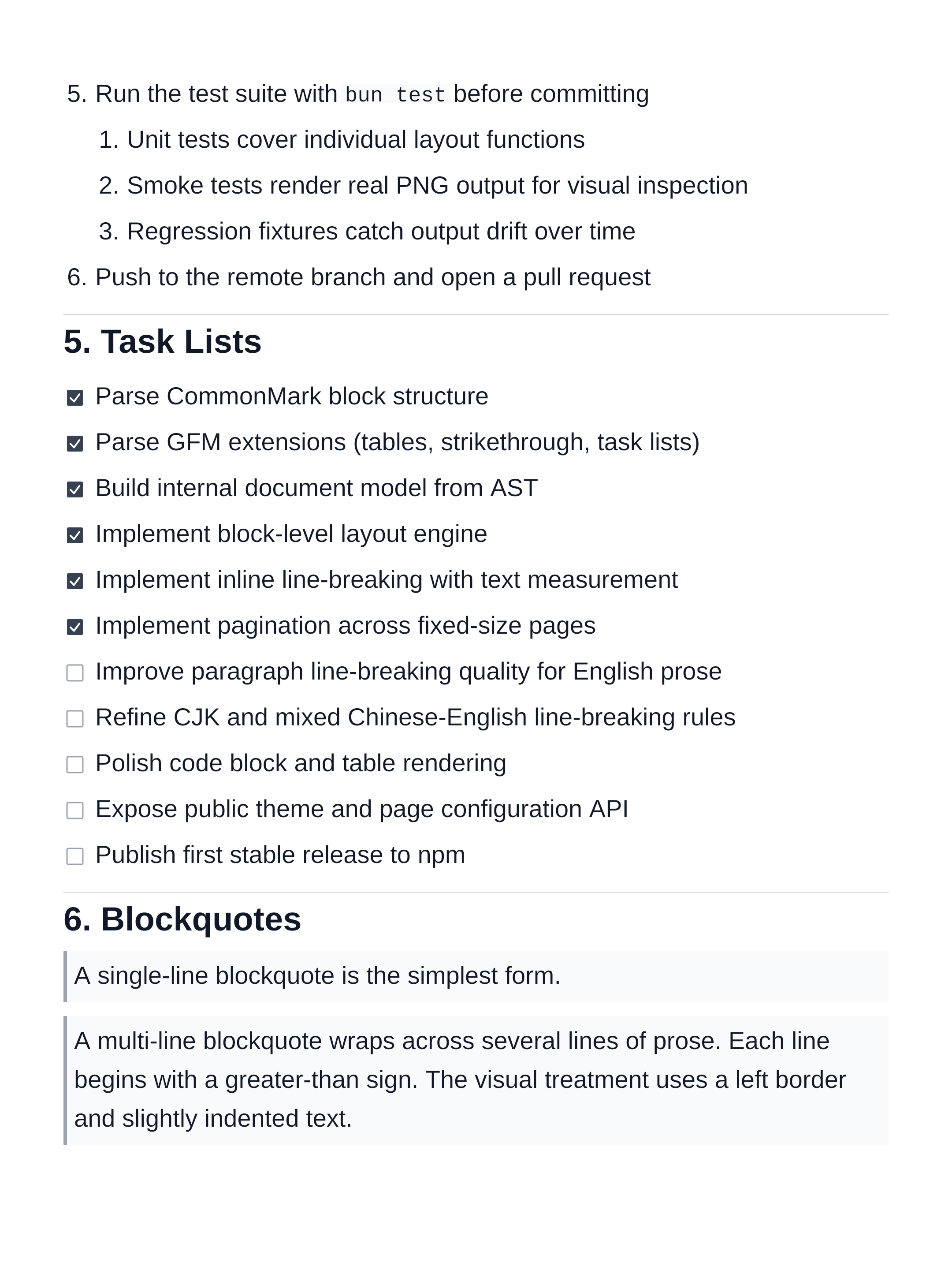
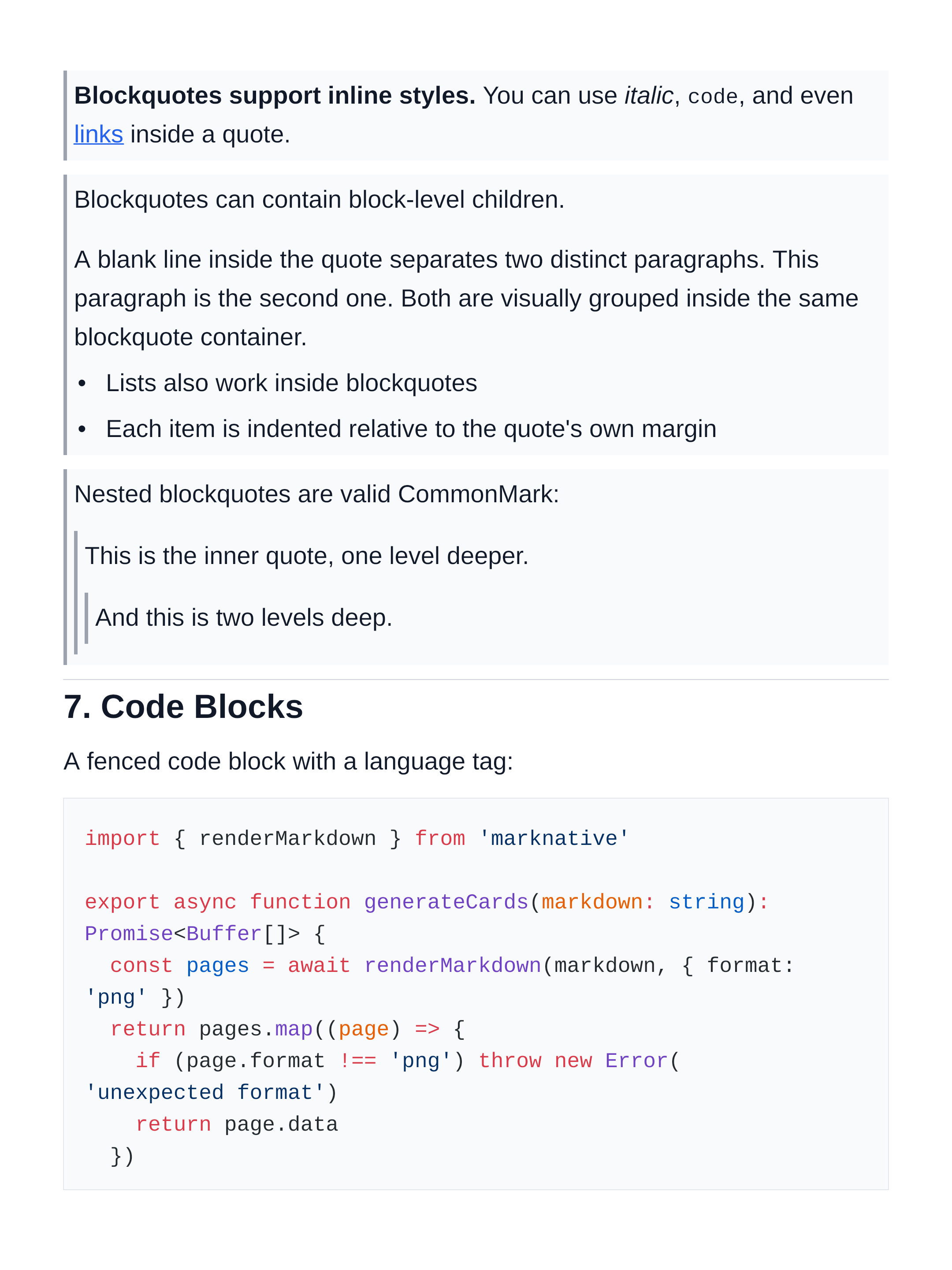
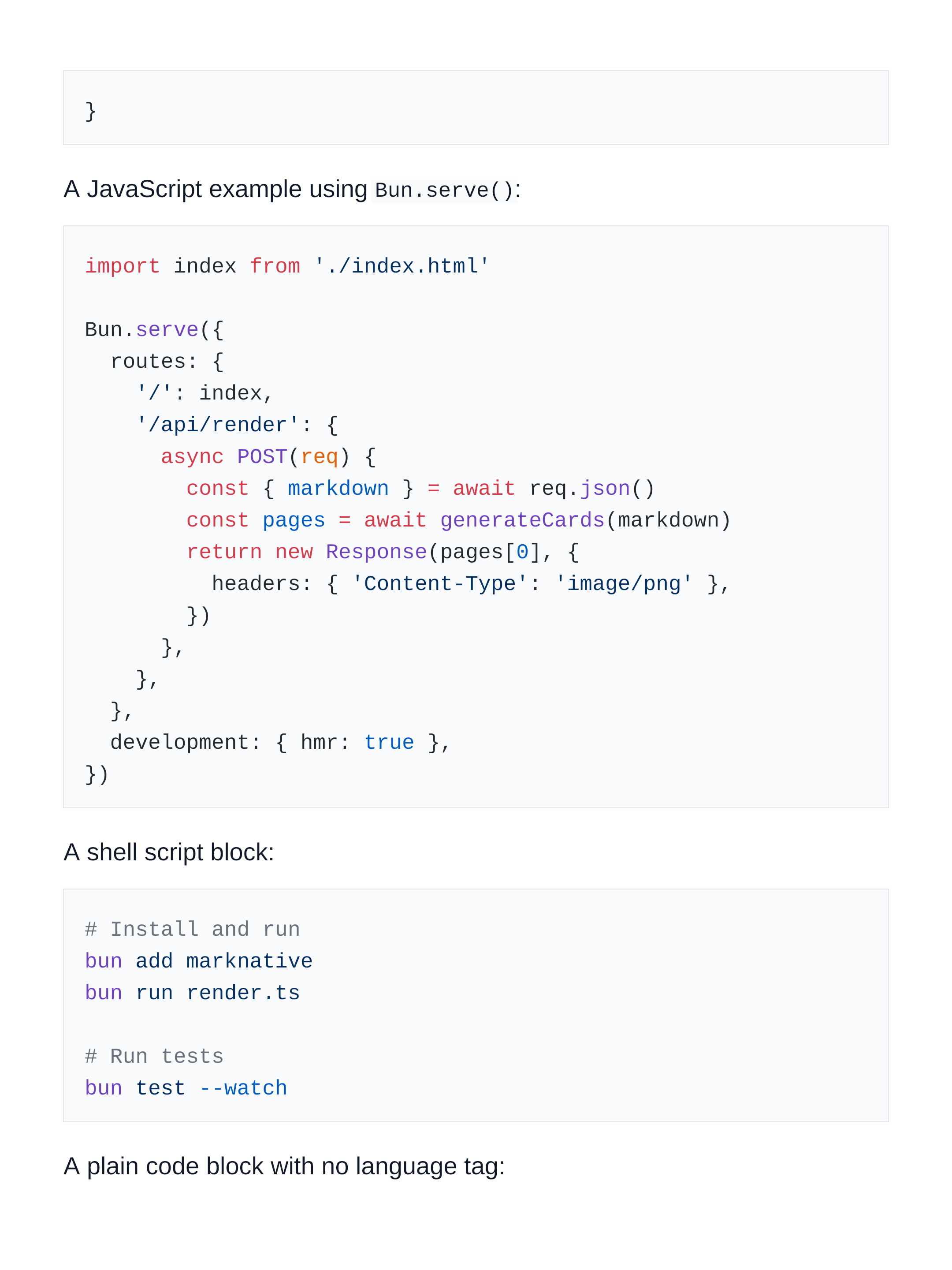
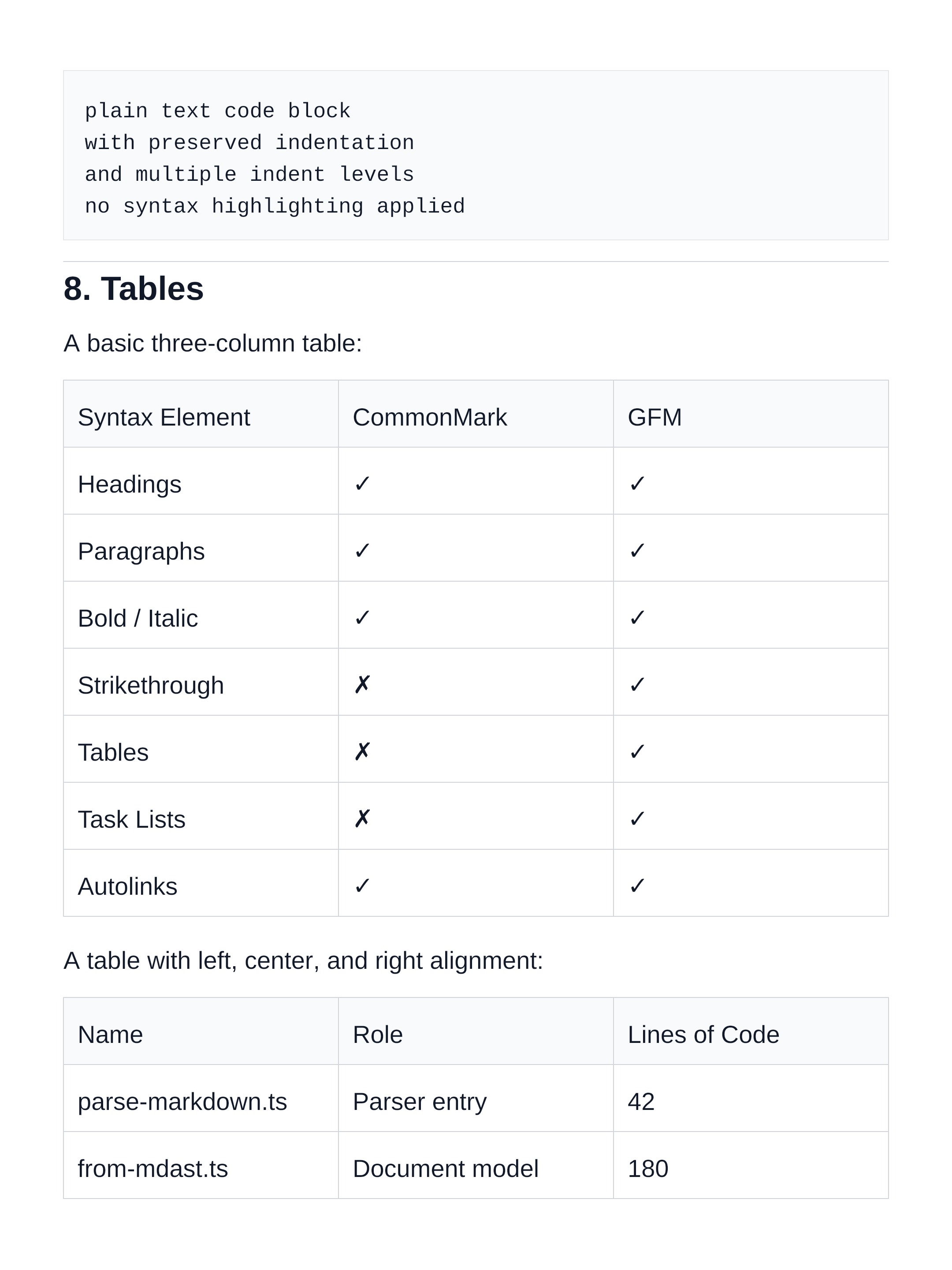
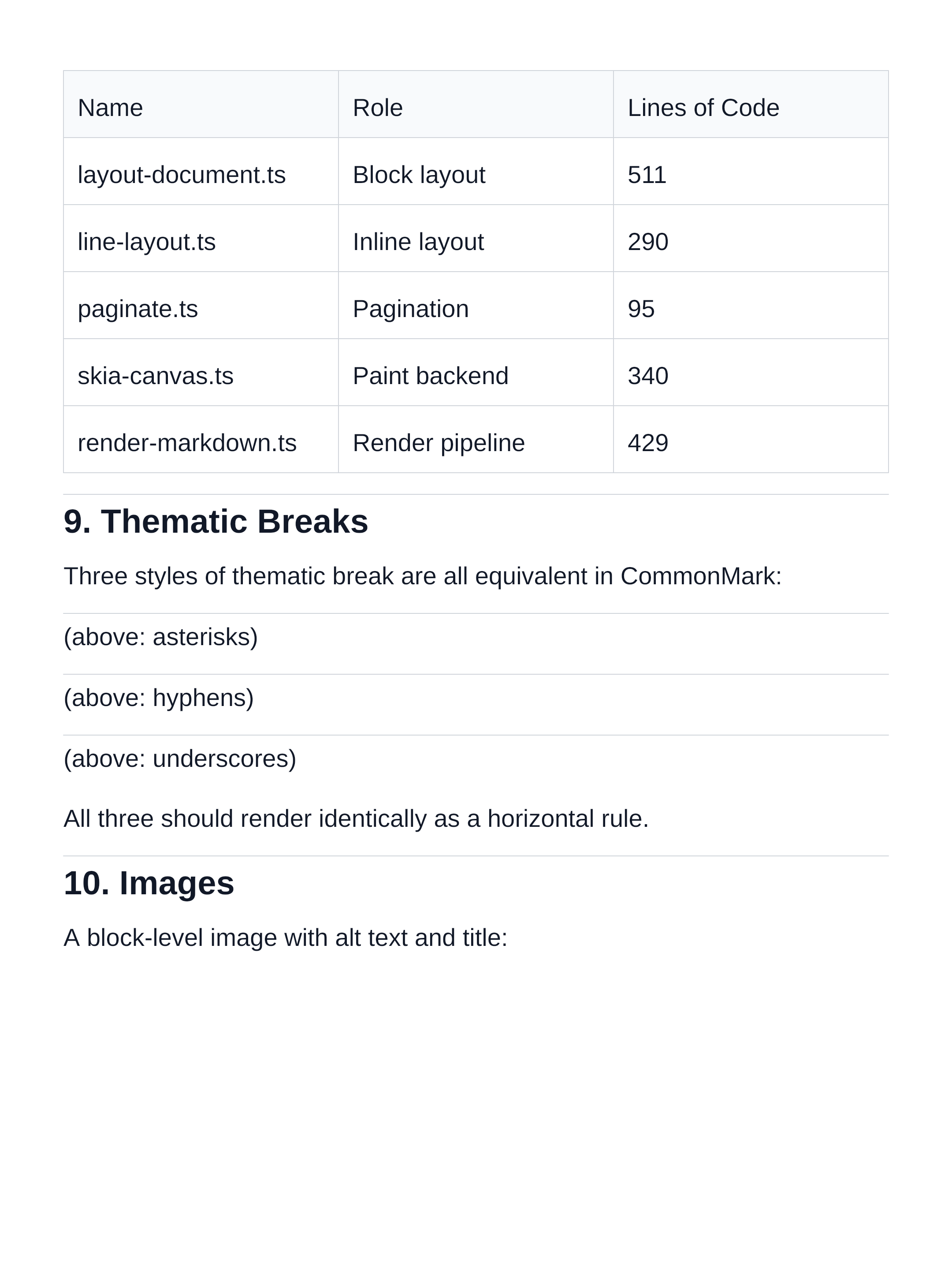
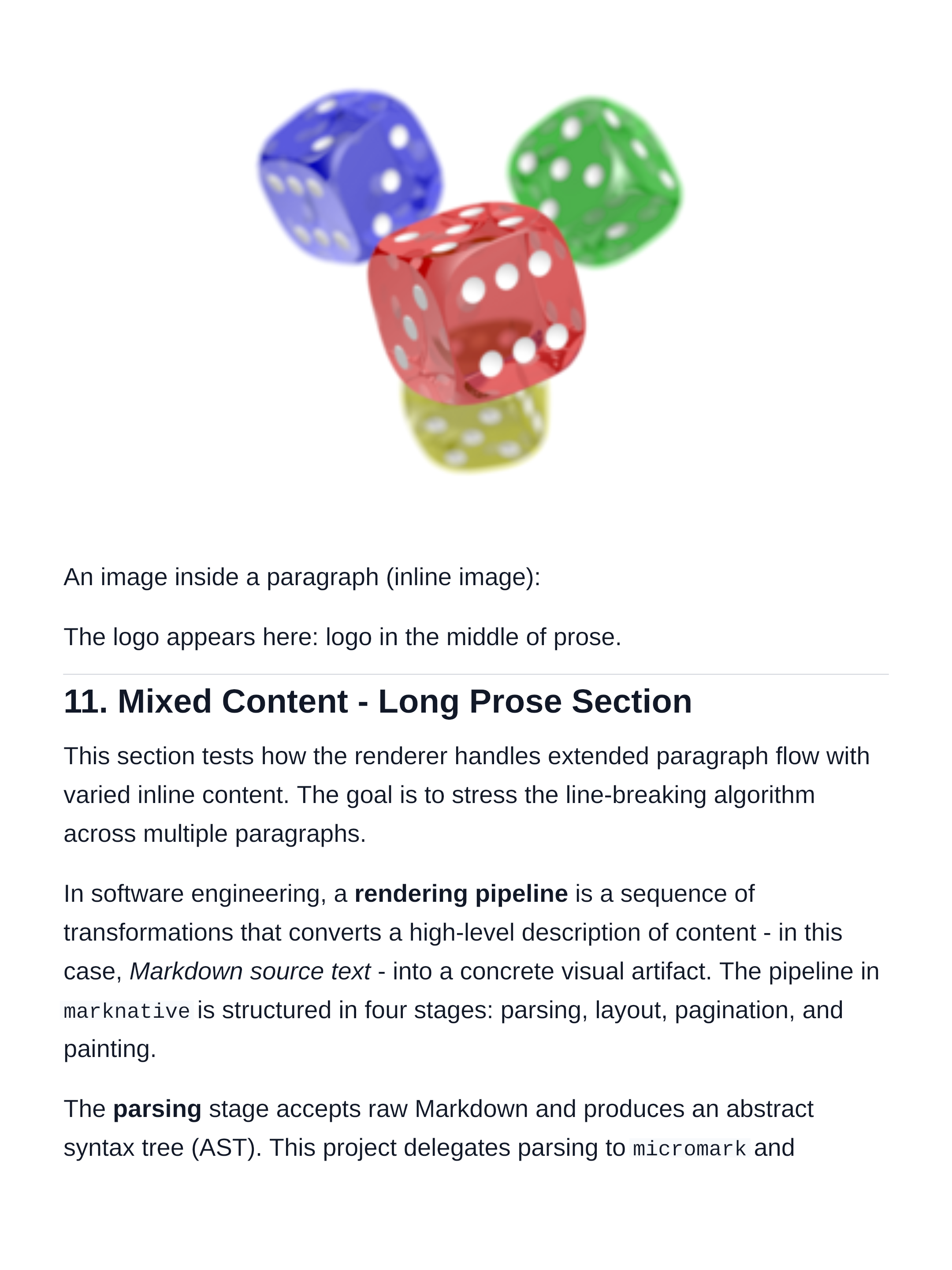
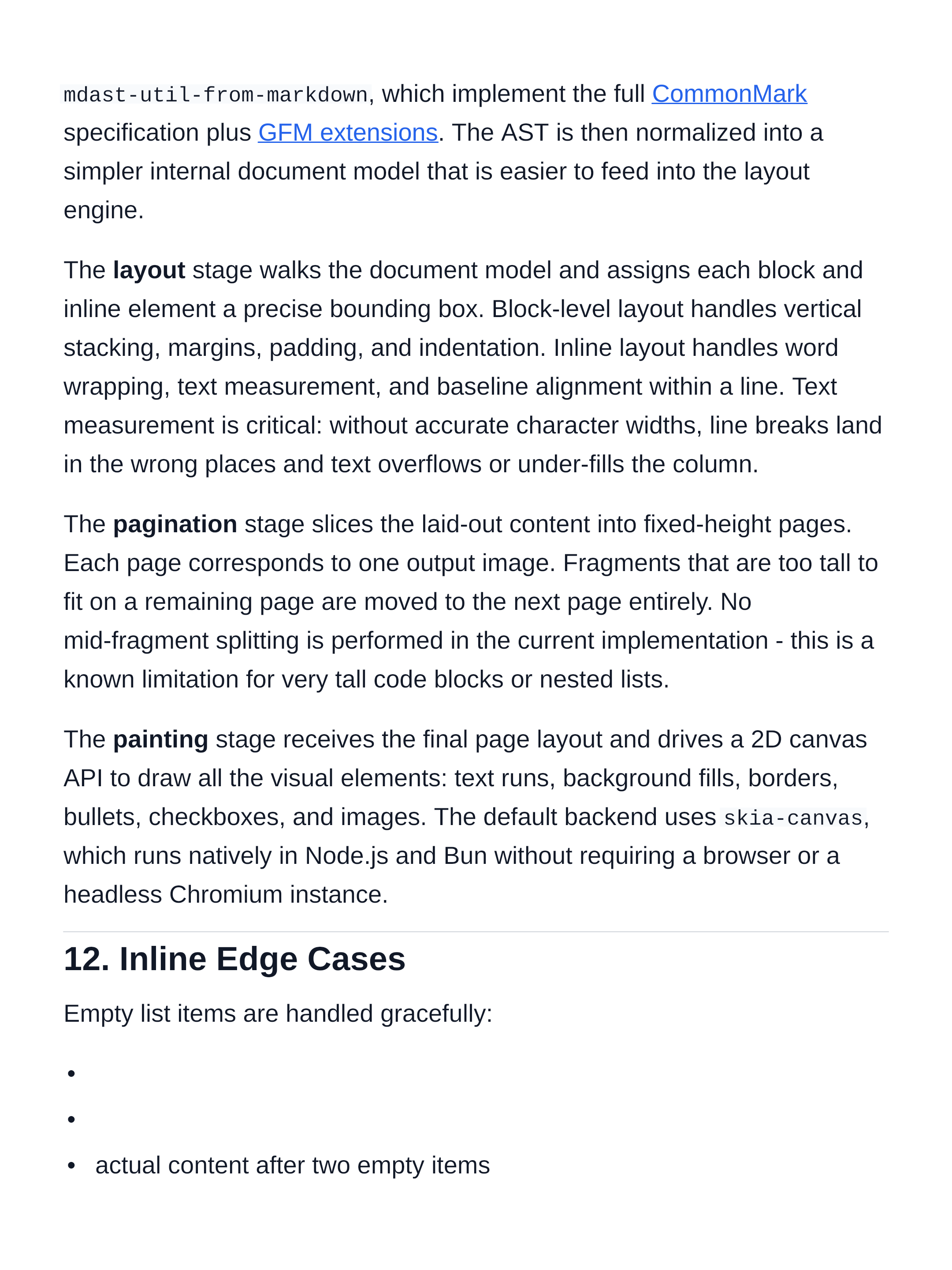
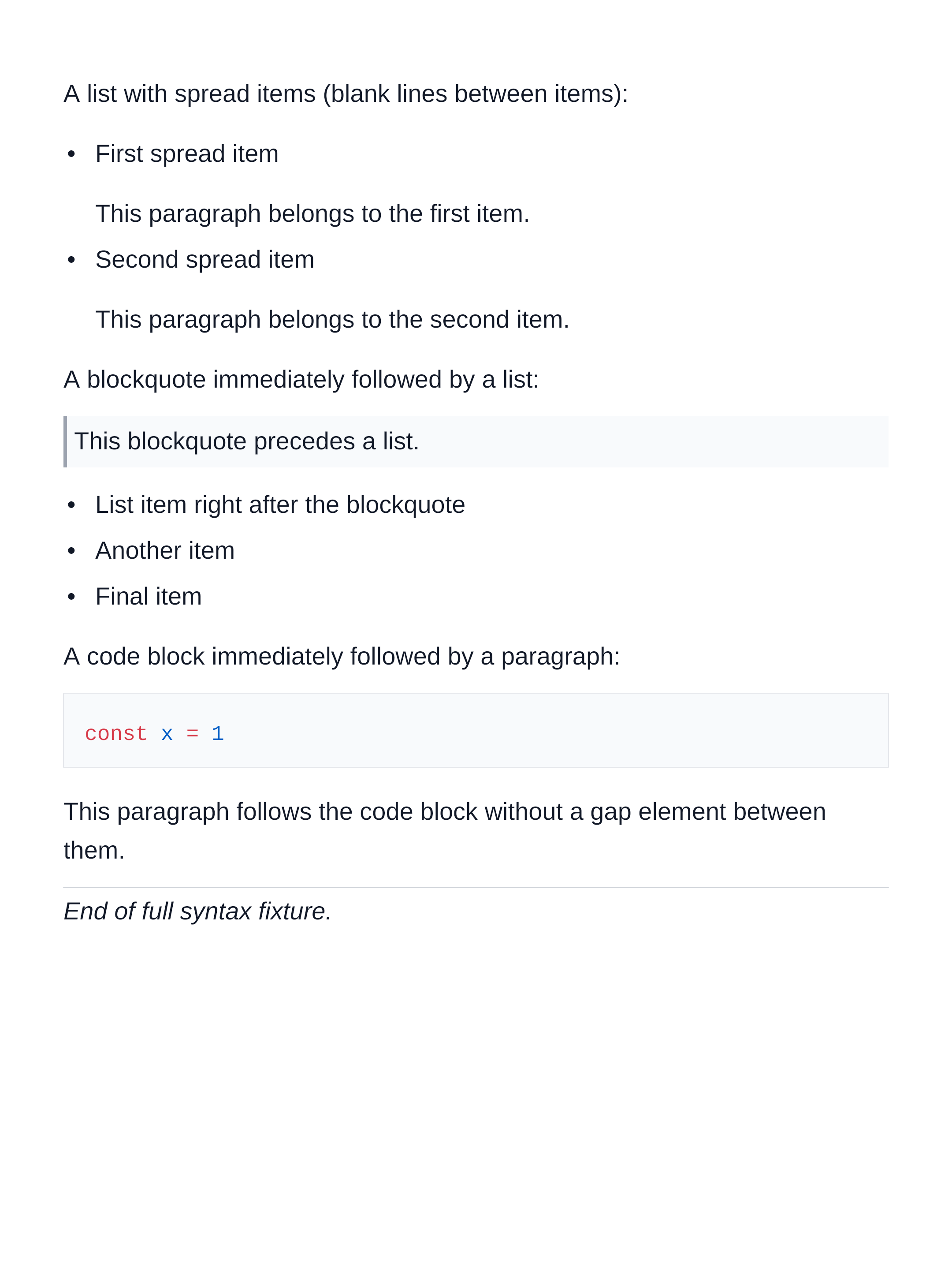
Full syntax fixture, rendered across 10 pages with syntax-highlighted fenced code blocks:
 |
 |
 |
 |
 |
 |
 |
 |
 |
 |
Why
| Requirement | Browser-based | marknative |
|---|---|---|
| Runs on the server without a browser | ✗ | ✓ |
| Deterministic page breaks across runs | ✗ | ✓ |
| Direct PNG / SVG output | ✗ | ✓ |
| LaTeX math formulas (server-side MathJax) | ✗ | ✓ |
| Syntax-highlighted code blocks (Shiki) | ✗ | ✓ |
| Batch rendering at scale | slow | fast |
| Embeddable as a library | heavy | lightweight |
Installation
bun add marknative
# or
npm install marknative
Peer dependency:
marknativeusesskia-canvasas its paint backend. It ships prebuilt native binaries for macOS, Linux, and Windows — no additional setup is needed in most environments.
Quick Start
import { renderMarkdown } from 'marknative'

const pages = await renderMarkdown(`
# Hello, marknative

A native Markdown rendering engine that produces **paginated PNG pages**
without a browser.

- CommonMark + GFM support
- Deterministic layout and pagination
- PNG and SVG output
`)

console.log(`Rendered ${pages.length} page(s)`)

for (const [i, page] of pages.entries()) {
  // page.format === 'png'
  // page.data   === Buffer
  await Bun.write(`page-${i + 1}.png`, page.data)
}
API
renderMarkdown(markdown, options?)
Parses, lays out, paginates, and paints a Markdown document. Returns one output entry per page.
function renderMarkdown(
  markdown: string,
  options?: {
    format?: 'png' | 'svg'                      // default: 'png'
    singlePage?: boolean                         // render into one image instead of paginating
    theme?: BuiltInThemeName | ThemeOverrides    // default: defaultTheme
    scale?: number                               // PNG pixel density multiplier — default: 2 (retina)
    painter?: Painter                            // override the paint backend
    codeHighlighting?: {
      theme?: string                             // Shiki theme — auto-detected from page background
    }
  },
): Promise<RenderPage[]>
Return type:
type RenderPage =
  | { format: 'png'; data: Buffer;  page: PaintPage }
  | { format: 'svg'; data: string;  page: PaintPage }
Each entry carries both the raw output (data) and the fully resolved page layout (page) so you can inspect fragment positions without re-rendering.
parseMarkdown(markdown)
Parses Markdown source into marknative's internal document model without running layout or paint. Useful for inspecting document structure or building custom renderers.
function parseMarkdown(markdown: string): MarkdownDocument
defaultTheme
The built-in default theme. Page size is 1080 × 1440 px (portrait card ratio). Font sizes, line heights, margins, and block spacing are all defined here.
import { defaultTheme } from 'marknative'

console.log(defaultTheme.page)
// { width: 1080, height: 1440, margin: { top: 80, right: 72, bottom: 80, left: 72 } }
Theme System
marknative ships with 10 built-in themes and a full theme customization API.
Built-in themes — pass a name string as the theme option:
// 'default' | 'github' | 'solarized' | 'sepia' | 'rose'
// 'dark' | 'nord' | 'dracula' | 'ocean' | 'forest'
const pages = await renderMarkdown(markdown, { theme: 'dark' })
const pages = await renderMarkdown(markdown, { theme: 'nord' })
Partial overrides — merged onto defaultTheme:
const pages = await renderMarkdown(markdown, {
  theme: {
    colors: { background: '#1e1e2e', text: '#cdd6f4' },
    page: { width: 800 },
  },
})
Full control with mergeTheme:
import { mergeTheme, getBuiltInTheme } from 'marknative'

const myTheme = mergeTheme(getBuiltInTheme('nord'), {
  colors: { link: '#ff6b6b' },
})

const pages = await renderMarkdown(markdown, { theme: myTheme })
Gradient backgrounds:
import { mergeTheme, defaultTheme } from 'marknative'

const theme = mergeTheme(defaultTheme, {
  colors: {
    background: '#0f0c29',
    backgroundGradient: {
      type: 'linear',
      angle: 135,
      stops: [
        { offset: 0,   color: '#24243e' },
        { offset: 0.5, color: '#302b63' },
        { offset: 1,   color: '#0f0c29' },
      ],
    },
    text: '#e8e0ff',
  },
})
See the Themes guide and Themes showcase for the full reference.
Performance
Benchmarks run on Apple M-series (warm, singletons already initialised). Run bun bench/perf.ts to reproduce.
Throughput by document type — PNG 2× (default)
| Document type | mean | p50 | p90 |
|---|---|---|---|
| Plain text (prose + lists + blockquotes) | 116 ms | 115 ms | 120 ms |
| Code-heavy (3 languages, shiki) | 101 ms | 101 ms | 104 ms |
| Math-heavy (4 block + 3 inline formulas) | 100 ms | 99 ms | 103 ms |
| Mixed (math + code) | 98 ms | 97 ms | 100 ms |
Output format — mixed doc
| Format | mean | p50 | p90 | note |
|---|---|---|---|---|
| SVG | 5.6 ms | 5.6 ms | 6.5 ms | layout + serialize only |
| PNG 2× | 99 ms | 98 ms | 102 ms | full rasterize + encode |
SVG is ~17× faster than PNG. canvas.toBuffer('png') (pure CPU PNG compression) accounts for 94% of PNG render time; all parsing, layout, and drawing are <8 ms/page.
Scale factor — mixed doc, PNG only
| Scale | Resolution | mean |
|---|---|---|
| 1 | 1080 × ~650 (0.7 MP) | 29 ms |
| 1.5 | 1620 × ~975 (1.6 MP) | 58 ms |
| 2 (default) | 2160 × ~1300 (2.8 MP) | 99 ms |
| 3 | 3240 × ~1950 (6.3 MP) | 214 ms |
PNG encode time scales linearly with pixel count. Use scale: 1 for previews, scale: 2 for retina output.
Concurrency — plain doc, PNG 2×
| Mode | mean per batch |
|---|---|
| 1× sequential | 118 ms |
| 2× parallel | 127 ms |
| 4× parallel | 192 ms |
| 8× parallel | 363 ms |
Parallel renders share CPU resources; throughput scales near-linearly up to core count.
Rendering Pipeline
Markdown source
  │
  ▼
CommonMark + GFM AST          (micromark, mdast-util-from-markdown)
  │
  ▼
MarkdownDocument               internal typed document model
  │
  ▼
BlockLayoutFragment[]          block + inline layout engine
  │
  ▼
Page[]                         paginator — slices fragments into fixed-height pages
  │
  ▼
PNG Buffer / SVG string        skia-canvas paint backend
Each stage is independently testable. The layout engine has no dependency on the paint backend, and the paint backend accepts a plain data structure — it does not re-run layout.
Supported Syntax
CommonMark
| Element | Support |
|---|---|
| Headings (H1–H6) | ✓ |
| Paragraphs | ✓ |
| Bold, italic, bold italic | ✓ |
Inline code |
✓ |
| Links | ✓ |
| Fenced code blocks | ✓ |
| Blockquotes (nested) | ✓ |
| Ordered lists | ✓ |
| Unordered lists (nested) | ✓ |
| Images (block + inline) | ✓ |
| Thematic breaks | ✓ |
| Hard line breaks | ✓ |
GFM Extensions
| Element | Support |
|---|---|
| Tables (with alignment) | ✓ |
| Task lists | ✓ |
| Strikethrough | ✓ |
Math (LaTeX via MathJax)
| Element | Support |
|---|---|
Block formulas $$...$$ |
✓ |
Inline formulas $...$ |
✓ |
| Math in blockquotes / lists / tables | ✓ |
| AMSmath, boldsymbol, mathtools | ✓ |
Recipes
Save all pages as PNG files
import { renderMarkdown } from 'marknative'
import { writeFile } from 'node:fs/promises'

const markdown = await Bun.file('article.md').text()
const pages = await renderMarkdown(markdown)

await Promise.all(
  pages.map((page, i) =>
    writeFile(`out/page-${String(i + 1).padStart(2, '0')}.png`, page.data)
  )
)
Serve rendered pages over HTTP with Bun
import { renderMarkdown } from 'marknative'

Bun.serve({
  routes: {
    '/render': {
      async POST(req) {
        const { markdown } = await req.json()
        const pages = await renderMarkdown(markdown, { format: 'png' })
        const first = pages[0]

        if (!first || first.format !== 'png') {
          return new Response('no output', { status: 500 })
        }

        return new Response(first.data, {
          headers: { 'Content-Type': 'image/png' },
        })
      },
    },
  },
})
Export as SVG
const pages = await renderMarkdown(markdown, { format: 'svg' })

for (const page of pages) {
  if (page.format === 'svg') {
    console.log(page.data) // inline SVG string
  }
}
Math formulas
Block and inline LaTeX — rendered server-side via MathJax, no browser required. Formula colors follow the active theme automatically.
const pages = await renderMarkdown(`
## Fourier Transform

$$
\\hat{f}(\\xi) = \\int_{-\\infty}^{\\infty} f(x)\\,e^{-2\\pi ix\\xi}\\,dx
$$

The gradient $\\nabla f$ points in the direction of steepest ascent.
Entropy: $H(X) = -\\sum p \\log p$.

\`\`\`python
import numpy as np
def dft(x):
    N, n = len(x), np.arange(len(x))
    return np.exp(-2j * np.pi * n.reshape(N,1) * n / N) @ x
\`\`\`

Complexity: $O(N^2)$ naïve, $O(N\\log N)$ with FFT.
`)
MathJax is initialised lazily on first use (~180 ms cold start). All subsequent renders reuse the singleton and cached SVGs — warm overhead is < 2 ms.
See the Math guide for the full reference.
Syntax highlighting for code blocks
// Auto-detected from page background (light → github-light, dark → github-dark)
const pages = await renderMarkdown(markdown)
const pages = await renderMarkdown(markdown, { theme: 'dark' })   // uses github-dark automatically

// Override the Shiki theme explicitly
const pages = await renderMarkdown(markdown, {
  codeHighlighting: { theme: 'nord' },
})
The Shiki theme is auto-selected based on the WCAG relative luminance of the page background — dark page themes automatically get a dark code theme. Code blocks without a language tag fall back to plain monochrome text.
Control PNG resolution with scale
const pages = await renderMarkdown(markdown, { scale: 1 })   // ~29 ms/page — fast preview
const pages = await renderMarkdown(markdown, { scale: 2 })   // ~99 ms/page — retina (default)
const pages = await renderMarkdown(markdown, { scale: 3 })   // ~214 ms/page — print quality
Tech Stack
| Layer | Library |
|---|---|
| Markdown parsing | micromark + mdast-util-from-markdown |
| GFM extensions | micromark-extension-gfm + mdast-util-gfm |
| Math rendering | mathjax-full (server-side SVG, liteAdaptor) |
| Syntax highlighting | shiki |
| Text shaping | @chenglou/pretext |
| 2D rendering | skia-canvas |
| Language | TypeScript |
Roadmap
- Improve paragraph line-breaking quality for English prose
- Refine CJK and mixed Chinese-English line-breaking rules
- Syntax highlighting for code blocks (Shiki, all themes, auto-detected from theme)
- LaTeX math rendering (MathJax, block + inline, all block types)
- Expose public theme and page configuration API
- PNG resolution control (
scaleoption) - Support custom fonts
- Complete GFM coverage (footnotes, autolinks)
License
MIT & Linux Do
Explorer des projets similaires
Chargement…