
jakevdp/PythonDataScienceHandbook
jakevdp/PythonDataScienceHandbook has 50,358 GitHub stars and 19,158 forks. GitHot measured +12 stars in 24 hours. Last checked 2026-11-04 09:17 UTC. Last push 2024-06-26.
Comment ces chiffres sont mesurés
Python Data Science Handbook : texte intégral dans des notebooks Jupyter
Progression mesurée des étoiles
- in 24h
- +12
- in 7 days
- Mise à jour retardée
- in 15 days
- Mise à jour retardée
- in 1 month
- Mise à jour retardée
Variations nettes sur des périodes qui se chevauchent, pas des totaux quotidiens. Les mesures absentes restent vides. Les étoiles indiquent l’intérêt, pas la qualité.
README.md
OriginalPython Data Science Handbook


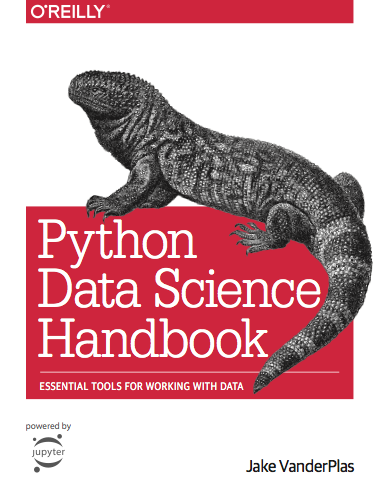
This repository contains the entire Python Data Science Handbook, in the form of (free!) Jupyter notebooks.
How to Use this Book
Read the book in its entirety online at https://jakevdp.github.io/PythonDataScienceHandbook/
Run the code using the Jupyter notebooks available in this repository's notebooks directory.
Launch executable versions of these notebooks using Google Colab:
Launch a live notebook server with these notebooks using binder:
Buy the printed book through O'Reilly Media
About
The book was written and tested with Python 3.5, though other Python versions (including Python 2.7) should work in nearly all cases.
The book introduces the core libraries essential for working with data in Python: particularly IPython, NumPy, Pandas, Matplotlib, Scikit-Learn, and related packages. Familiarity with Python as a language is assumed; if you need a quick introduction to the language itself, see the free companion project, A Whirlwind Tour of Python: it's a fast-paced introduction to the Python language aimed at researchers and scientists.
See Index.ipynb for an index of the notebooks available to accompany the text.
Software
The code in the book was tested with Python 3.5, though most (but not all) will also work correctly with Python 2.7 and other older Python versions.
The packages I used to run the code in the book are listed in requirements.txt (Note that some of these exact version numbers may not be available on your platform: you may have to tweak them for your own use). To install the requirements using conda, run the following at the command-line:
$ conda install --file requirements.txt
To create a stand-alone environment named PDSH with Python 3.5 and all the required package versions, run the following:
$ conda create -n PDSH python=3.5 --file requirements.txt
You can read more about using conda environments in the Managing Environments section of the conda documentation.
License
Code
The code in this repository, including all code samples in the notebooks listed above, is released under the MIT license. Read more at the Open Source Initiative.
Text
The text content of the book is released under the CC-BY-NC-ND license. Read more at Creative Commons.
Explorer des projets similaires
Asabeneh/30-Days-Of-Python
Le défi de programmation 30 Days of Python est un guide pas à pas pour apprendre le langage de programmation Python en 30 jours. Ce défi peut prendre plus de 100 jours. Avancez à votre rythme. Ces vidéos peuvent aussi vous aider : https://www.youtube.com/channel/UC7PNRuno1rzYPb1xLa4yktw
78,085 étoilesgrafana/grafana
Plateforme ouverte et composable d’observabilité et de visualisation de données. Visualise les métriques, les journaux et les traces issus de plusieurs sources, comme Prometheus, Loki, Elasticsearch, InfluxDB, Postgres et bien d’autres.
77,699 étoilesredis/redis
Pour les développeurs qui créent des applications en temps réel pilotées par les données, Redis est le cache, le serveur de structures de données et le moteur de requêtes documentaires et vectorielles préféré, le plus rapide et le plus riche en fonctionnalités.
77,173 étoilesapache/superset
Apache Superset est une plateforme de visualisation et d'exploration de données.
75,413 étoiles