
damiansire/angular-signals-playground
damiansire/angular-signals-playground has 92 GitHub stars and 1 forks. Star changes are not measured yet. Last checked 2026-11-11 04:07 UTC. Last push 2026-11-10.
Comment ces chiffres sont mesurés
An interactive playground and introduction to learning Angular Signals (computed, effect, linkedSignal, resource) hands-on.
Progression mesurée des étoiles
- in 24h
- Mise à jour retardée
- in 7 days
- Mise à jour retardée
- in 15 days
- Mise à jour retardée
- in 1 month
- Mise à jour retardée
Variations nettes sur des périodes qui se chevauchent, pas des totaux quotidiens. Les mesures absentes restent vides. Les étoiles indiquent l’intérêt, pas la qualité.
README.md
OriginalAngular Signals — Interactive Introduction
An interactive playground for learning Angular Signals from the ground up.
Instead of reading about reactivity, you watch it happen: every concept is a
small, self-contained screen where you can click, type and toggle to see how
signals, computed, effect and change detection actually behave.
▶ Open the live playground — no install, runs in the browser.
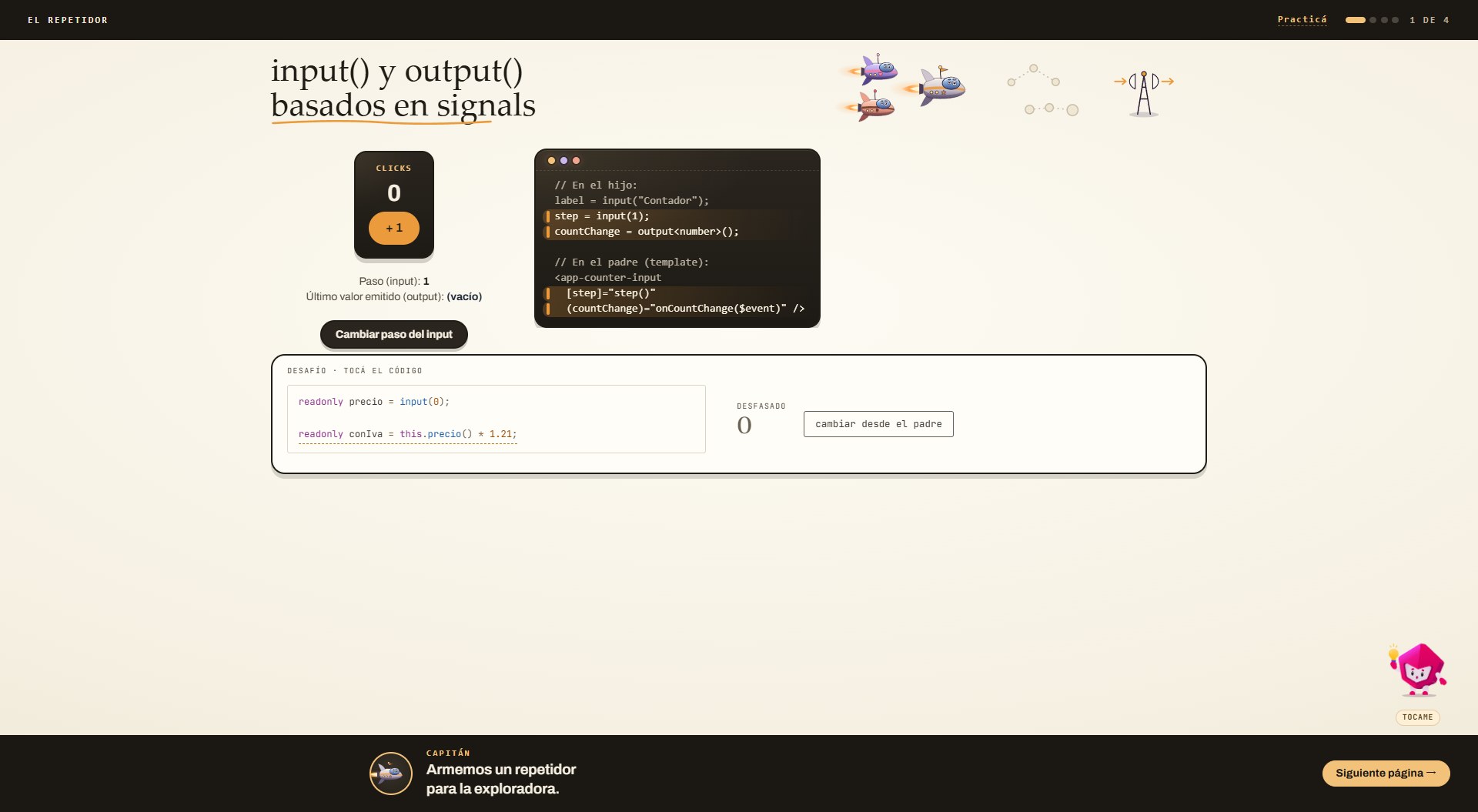
The default entry (/) is the integrated view: a "reactive molecule" tour
where each of the 11 chapters is an atom. Scroll to dive into an atom and its
sub-levels orbit the card, each one embedding the real demo component of that
lesson. Deep-links are shareable: ?nivel=1&sub-nivel=2 reopens exactly where
you were.
Played like a small RPG
The tour has a story. A crew of RxJS ships is dragged out of "Zone.js space" into a world of molecules where none of their operators work, and a guide (the Angular mascot) offers to teach them the rules. Each concept is a chapter of that trip:
- A cinematic per chapter. The first time you stop at a concept, a short cutscene sets up
the rule of that chapter as an incident of the crew (portrait and name of who speaks, one line
at a time).
Enteradvances,Escskips. The finale lights up only the chapters you actually established, so unfinished ones stay visible as debt. - Challenges you solve by touching the code. Every sub-level ends with a system whose code has a movable part and a reading that answers. The reading stays neutral until there is enough evidence, turns red if the system is broken and green once you fix it. No "well done" banner: the numbers are the answer.
- Saved progress. What you establish is stored in your browser (
localStorage,signals-cuaderno): reload and the molecule keeps its bonds. The prologue still plays after the hill every time, because it continues that scene; "Saltar intro →" skips it. - The logbook ("Bitácora", top bar): the chapters you established, the rule of the world you wrote in each one, and replays of the cinematics and the prologue.
- Sound that works on any machine. Everything is synthesized with one Web Audio context (characters "talk" with RPG-style blips); without audio support it simply stays silent. One switch mutes everything.
- Screening room.
/cine/6plays a chapter's cinematic directly, and/cine/6?cuadro=<beat>freezes one frame, useful to review scenes.
Scripted motion is CSS (springs solved by hand and fed to linear(), View Transitions for the iris,
lazy-loaded scenes). What answers the pointer (the mascot you can grab and stretch, the signal graphs
you can poke) runs on hand-rolled springs sharing one clock that sleeps when nothing moves: no
perpetual requestAnimationFrame, no expensive filters on moving things, and everything freezes when
the tab is hidden or honors prefers-reduced-motion.
Built with Angular 22 (standalone components, OnPush everywhere, signal-first
APIs) and styled with Tailwind CSS.
Why this exists
Signals are the biggest shift in Angular's reactivity model in years. This repo turns the official mental model into a guided, hands-on tour — useful both as a self-teaching resource and as a live demo for talks and workshops.
Learning path
The content is organized as progressive levels, each with focused sub-levels:
| Level | Topic | What you explore |
|---|---|---|
| 0 | Introduction | How Angular renders the DOM tree, classic change detection vs. signal-based change detection, HTML-to-tree visualization |
| 1 | Interacting with signals | Writable signals, set vs. update, read-only signals, the different kinds of signals |
| 2 | Computed signals | Derived state, dynamic dependencies, lazy evaluation & memoization |
| 3 | Effects | effect(), cleanup, manual destruction, what happens when a component is destroyed |
| 4 | Equality functions | Custom equality and when a signal doesn't notify its consumers |
| 5 | linkedSignal |
Writable state derived from a source: reset on change, or preserve if still valid |
| 6 | resource / rxResource / httpResource |
Async signals: value/status/error/isLoading with a Promise, an RxJS stream, or a real HTTP request |
| 7 | input · model · output · forms |
Signal-based component APIs: input()/output(), two-way model(), input.required() and transform, and Signal Forms (form(), validators, [formField]) |
| 8 | Queries & interop | viewChild()/viewChildren() and contentChild()/contentChildren() as signals, toSignal()/toObservable(), untracked() |
| 9 | afterRenderEffect & onCleanup |
Reading/measuring the DOM after render, and cleaning up effects without leaks |
| 10 | Debounced signals | A debounced value, three ways: RxJS (debounceTime), by hand (effect + onCleanup), and the native debounced() (experimental in v22) |
| 11 | Capstone: zoneless | Why signals + OnPush let Angular drop Zone.js (the default since v21; provideZoneChangeDetection() brings it back) |
Getting started
# 1. Install dependencies
npm install

# 2. Start the dev server (http://localhost:4200)
npm start
Requirements: Node.js 22 or newer (that is what
package.jsonenginesand.nvmrcpin, and what CI runs) and a Chromium-based browser for the unit tests.
Available scripts
| Script | Description |
|---|---|
npm start |
Dev server with HMR at http://localhost:4200 |
npm run build |
Production build into dist/angular-examples |
npm run watch |
Rebuild on change (development configuration) |
npm test |
Unit tests (Karma + Jasmine) |
npm run lint |
Lint with ESLint + angular-eslint |
npm run format |
Format src/ with Prettier |
npm run format:check |
Check formatting without writing |
npm run gate:prosa |
Prose budget per screen (ratchet: fails if a screen gets wordier) |
npm run test:scripts |
Unit tests for the gate scripts themselves (node --test) |
CI runs lint, format:check, test:scripts, gate:prosa, test and the
production build on every pull request, and GitHub Pages only deploys a commit
whose CI run went green.
Tech stack
- Angular 22 — standalone components, signals,
@if/@forcontrol flow @angular/build— esbuild/Vite-based toolchain- Tailwind CSS — utility-first styling
- ESLint + angular-eslint — linting and Angular best-practice rules
Project structure
src/app/
├── integrada-vista/  # The default entry (/): the "reactive molecule" tour of the 11 chapters
│   ├── cinematicas/  # Chapter cinematics: player, scripts and one lazy scene per chapter
│   └── bitacora/     # The logbook: established chapters, their rules, replays
├── signals/          # The learning levels (0–11) and their sub-levels
├── practice/         # Applied examples that use what you learned (/practica/*)
├── components/       # Feature components (histories, trees, forms…)
├── components-atom/  # Atomic UI building blocks (code block, concept card, title…)
├── components-draw/  # Drawing/visualization components (variable boxes, node tree)
├── layouts/          # Reusable page layouts (two-column, column + code)
├── libs/             # Framework-agnostic helpers (HTML parser, saved game, sound, springs)
├── interfaces/       # Shared TypeScript types
└── app.routes.ts     # Route tree that powers the leveled navigation
Conventions
- Change detection: every component uses
ChangeDetectionStrategy.OnPush. State that drives the view is held in signals; the few cases that aren't (e.g. router-event-driven menu state) explicitly callmarkForCheck(). - Standalone components with explicit
imports— noNgModules.
Non-goals
This is a teaching playground, not a library:
- It is not a reusable component or state library to
npm install. The demos are meant to be read and run, not consumed as a dependency. - It does not try to cover all of Angular, only the signals surface (reactivity,
computed,effect,resource, zoneless). - The integrated "molecule" view is a visual explainer, not a production UI pattern to copy verbatim.
Contributing
Bug fixes, new signals lessons and documentation improvements are welcome — see CONTRIBUTING.md. To report a security issue, see SECURITY.md.
License
Released under the MIT License.
Explorer des projets similaires
sindresorhus/awesome
😎 Listes Awesome sur toutes sortes de sujets intéressants [NOTE : les pull requests sont temporairement désactivées jusqu’à ce que j’aie l’occasion de rattraper celles qui existent déjà]
535,539 étoilesEbookFoundation/free-programming-books
:books: Livres de programmation librement disponibles
401,457 étoilesnilbuild/developer-roadmap
Feuilles de route interactives, guides et autres contenus éducatifs pour aider les développeurs à progresser dans leur carrière.
371,860 étoilesvinta/awesome-python
La liste de référence qui répond à « Je veux faire X en Python : quel outil dois-je utiliser ? ».
334,168 étoiles