
crystalidea/qt6windows7
crystalidea/qt6windows7 has 330 GitHub stars and 41 forks. GitHot measured 0 stars in 24 hours. Last checked 2026-11-20 05:09 UTC. Last push 2026-10-26.
Progression mesurée des étoiles
- in 24h
- 0
- in 7 days
- Historique en cours
- in 15 days
- Historique en cours
- in 1 month
- Historique en cours
Variations nettes sur des périodes qui se chevauchent, pas des totaux quotidiens. Les mesures absentes restent vides. Les étoiles indiquent l’intérêt, pas la qualité.
À propos
Run your Qt 6 apps on Windows 7/8
Outils de développementREADME.md
OriginalThis repository provides a backport of Qt 6, tailored for compatibility with Windows 7, 8 and 8.1. It contains patched source files, along with some additional required files.
Each top-level folder here mirrors one Qt repository: apply a patch set by copying the contents of that folder over your checkout of the same name, replacing the existing files. qtbase is the backport proper and is always needed; qtmultimedia and qtwebengine are only needed if you build those modules. Every module is covered in its own section below.
The most recent supported version is 6.8.5 however many older versions are supported as well.
The backport approach includes important fallbacks to the default Qt 6 behavior when running on newer versions of Windows.
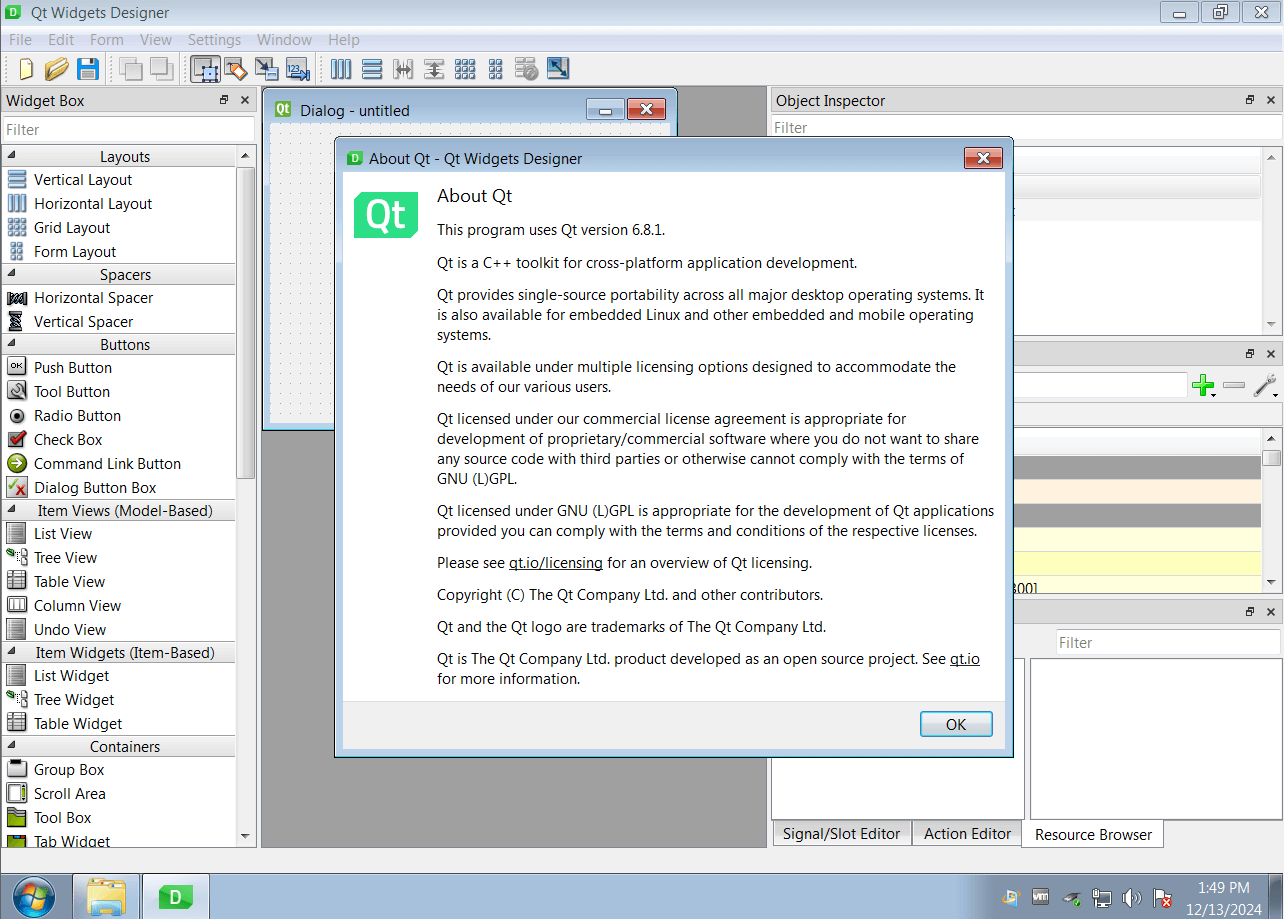
You can compile it yourself using your preferred compiler and build options or can use our compile_win.pl build script, which utilizes Visual C++ 2022 and includes OpenSSL 3.0.13 statically linked. Alternatively, you can download our prebuild Qt dlls, which also include the Qt Designer binary for demonstration purposes.
Qt 6.8.4 designer running on Windows 7:
qtbase
The patched files, one by one
src/corelib/io/qstandardpaths_win.cpp— low-integrity process detection asksGetTokenInformation()for the current process token through the-4pseudo handle, and token pseudo handles only work from Windows 8 on, so it reports a "normal" process below that. Decided withQOperatingSystemVersion, notIsWindows8OrGreater(), for the manifest reason described below. Also fixes the buffer-size probe ofGetTokenInformation().src/corelib/kernel/qeventdispatcher_win.cpp—SetCoalescableTimer(), falling back to plainSetTimer().src/corelib/kernel/qfunctions_win.cpp—GetCurrentPackageFullName(); without it the process is simply not a packaged app.src/corelib/platform/windows/qt_winrtbase_p.h— resolves the C++/WinRT entry points (RoGetActivationFactory()and friends) throughcombase.dllat run time. Without it the WinRT imports alone keep the process from starting on Windows 7 — and because other modules compile against this header too, it is what lets qtmultimedia use WinRT without extra patches of its own. Whether those imports exist at all depends on the Windows SDK: C++/WinRT 2.0.220110, the copy in SDK 10.0.22621, resolved these functions out ofcombase.dllitself and declared noWINRT_IMPL_Ro*symbol to import, while 2.0.250303, in SDK 10.0.26100, declares them with an/alternatenamedirective and so brings the static imports back. The patch is written for both: where C++/WinRT does its own resolving nothing refers to the definitions here and they cost nothing, andcombase.dllis loaded through the Win32 API rather than through theWINRT_IMPL_*loader helpers, which are internal to C++/WinRT and get renamed along with it.src/corelib/thread/qfutex_p.h,src/corelib/thread/qmutex.cpp,src/corelib/thread/qmutex_p.h,src/corelib/thread/qmutex_win.cpp(new) — the futex path usesWaitOnAddress()(Windows 8), so it is disabled andQMutexgets an event-based Windows implementation instead.src/corelib/thread/qthread_win.cpp—SetThreadDescription()(Windows 10) for thread names, falling back to the classic debugger exception.src/gui/rhi/qrhid3d11.cpp,src/gui/rhi/qrhid3d11_p.h—CreateDXGIFactory2()(Windows 8.1), falling back toCreateDXGIFactory1(); without it the backend gives up before it reaches a swapchain and cannot draw at all. Plus a second swapchain path, the BitBlt model throughIDXGIFactory::CreateSwapChain(), for everything below Windows 10 — the first one asks forDXGI_SWAP_EFFECT_FLIP_DISCARD, which is Windows 10 and later. Which of the two is taken is decided withQOperatingSystemVersionand notIsWindows10OrGreater(), deliberately: that helper goes throughVerifyVersionInfo(), which reports 6.2 to any process whose manifest does not list the Windows 10supportedOSGUID — so an application without such a manifest would be sent down the Windows 7 path while actually running on Windows 10.QOperatingSystemVersionreads the real version through ntdll'sRtlGetVersion(), which no manifest can influence.src/gui/rhi/qrhid3d12.cpp—CreateDXGIFactory2(),D3D12CreateDevice()andD3D12GetDebugInterface(); when they are absent the D3D12 backend just reports itself unavailable.src/gui/text/windows/qwindowsfontdatabase.cpp— not an import either, but the system setting "Smooth edges of screen fonts" (SPI_GETFONTSMOOTHING). This GDI-based font database is the one used on Windows 7, 8 and 8.1, and as soon as the device pixel ratio is not 1 it hands every font with the default hinting preference to DirectWrite. GDI follows the setting by itself; DirectWrite knows nothing about it, and Qt only ever tells the engine the smoothing type (ClearType or standard). So with smoothing switched off, text that every other application draws aliased came out with grayscale antialiasing at any scaling other than 100% (issue 63). Builds before 6.8.4 did not show it only because scaling did not work on Windows 7 then, which kept the device pixel ratio at 1 and all of the text with GDI. The DirectWrite engines this database creates now getQFont::NoAntialiaswhen smoothing is off, unless the font asks for antialiasing — the same rule GDI applies — so they render aliased. Windows 10 and later use the DirectWrite font database, which this patch leaves untouched.src/gui/text/windows/qwindowsfontdatabasebase.cpp—SystemParametersInfoForDpi()(Windows 10), falling back toSystemParametersInfo().src/gui/text/windows/qwindowsfontenginedirectwrite.cpp— not a missing import but a missing fallback. BothimageForGlyph()andalphaMapBoundingBox()ask the shared factory forIDWriteFactory2(Windows 8.1) and use the DirectWrite 1 glyph run analysis only when that query fails, which covers Windows 7 but not Windows 8 and 8.1, where the interface is present andCreateGlyphRunAnalysis()itself can still fail — and nothing catches that. What follows is worse than one missing glyph:alphaMapBoundingBox()hands back a default-constructedglyph_metrics_t, whose width and height are zero, andQTextureGlyphCache::populate()files a glyph of that size away as unprintable, so every string in the application comes out blank — and stays blank, because the empty result is what gets cached. Both functions go through one place now, which asks for exactly what Qt asks for, then repeats the call with an explicit grid fit mode —IDWriteFactory2::CreateGlyphRunAnalysis()documentsgridFitModeas "This must be non-default", while Qt passesDWRITE_GRID_FIT_MODE_DEFAULTfor every hinting preference exceptPreferNoHinting— and only then drops to the DirectWrite 1 entry point Windows 7 has been using all along. On Windows 10 and later the first call succeeds and is the only one made, so rendering there is untouched, and going through one place is what keeps the bounding box and the image that has to fit it measured by the same call. The warning this file printed on every glyph on Windows 7, where the query cannot succeed, is said once now as debug output, and theIDWriteFactory2andIDWriteGlyphRunAnalysisreferences both functions leaked are released.src/network/kernel/qdnslookup_win.cpp—DnsQueryEx()(Windows 8); the olderDnsQuery()path is restored for Windows 7.src/plugins/platforms/windows/vxkex.h(new) — Windows 7 stand-ins for the per-monitor DPI helpers (GetSystemMetricsForDpi(),AdjustWindowRectExForDpi()and friends), which simply scale the DPI-unaware originals.src/plugins/platforms/windows/qwindowscontext.h,src/plugins/platforms/windows/qwindowscontext.cpp— the central place where the optional user32/shcore entry points are resolved: the pointer input API (Windows 8), the per-DPI metrics and the shcore DPI awareness calls (Windows 8.1/10). The rest of the plugin asks this struct instead of calling the imports directly.src/plugins/platforms/windows/qwindowsdrag.cpp,src/plugins/platforms/windows/qwindowskeymapper.cpp,src/plugins/platforms/windows/qwindowspointerhandler.cpp,src/plugins/platforms/windows/qwindowsscreen.cpp,src/plugins/platforms/windows/qwindowswindow.cpp,src/plugins/platforms/windows/qwindowsintegration.cpp— use those resolved pointers, with thevxkex.hfallbacks where a DPI-aware metric is needed.qwindowsintegration.cppalso decides which font database to use by asking forIDWriteFactory6instead of inferring it from the Windows version:QWindowsDirectWriteFontDatabase::populateFontDatabase()needs that interface and, where it is missing, returns without registering a single family, leaving an empty font database. Its warning ("Use GDI font engine instead") is addressed to the user, not a fallback the code performs.src/plugins/platforms/windows/qwindowstheme.cpp— accent colours come from WinRTUISettingson Windows 10; on Windows 7 the palette falls back to the system colours.src/plugins/platforms/windows/qwin10helpers.cpp— loadscombase.dlldynamically instead of importing it, so the WinRT helpers degrade gracefully when it is not there.src/plugins/platforms/windows/uiautomation/qwindowsuiawrapper_p.h,src/plugins/platforms/windows/uiautomation/qwindowsuiawrapper.cpp(new),src/plugins/platforms/windows/uiautomation/qwindowsuiamainprovider.cpp,src/plugins/platforms/windows/uiautomation/qwindowsuiaaccessibility.cpp— accessibility goes through a wrapper that resolves the UI Automation entry points at run time, since Windows 7 ships an olderuiautomationcore.dll.src/widgets/styles/qwindowsstyle.cpp— the same per-DPI metric helpers as above, viavxkex.h.
qtmultimedia
Playing media needs both the FFmpeg plugin, which would not load at all, and the WASAPI audio backend, which could not open a device and then crashed on shutdown. Four patches are provided in the qtmultimedia folder.
The first two concern the WinRT window capture support, compiled in whenever the cpp_winrt feature is enabled. Without them the plugin cannot be loaded on Windows 7, which leaves Qt Multimedia without a backend — QMediaPlayer reports itself unavailable and nothing plays.
The four patches, one by one
src/plugins/multimedia/ffmpeg/CMakeLists.txtThe plugin linked
WindowsApp.lib, the UWP umbrella import library. Linking it makes every plain kernel32 function resolve throughapi-ms-win-core-*API sets instead of KERNEL32.dll, and several of those sets only exist from Windows 8 onwards (libraryloader-l1-2-0is Windows 8.1;synch-l1-2-0,localization-l1-2-0,heap-l2-1-0andprocessthreads-l1-1-1are Windows 8), so the plugin cannot be loaded on Windows 7 at all. Every other Qt module imports KERNEL32.dll directly. Nothing is lost by dropping it: the WinRT entry points the plugin needs are resolved at run time through theqt_winrtbase_p.hreplacement from the qtbase part of this backport, whichqffmpegwindowcapture_uwp.cpppicks up viaqfactorycacheregistration_p.h, so no static WinRT imports are left andWindowsApp.libwas only acting as the kernel32 umbrella.src/plugins/multimedia/ffmpeg/qffmpegwindowcapture_uwp.cppThe same plugin statically imports
CreateDirect3D11DeviceFromDXGIDevicefrom d3d11.dll, and that export was only added in Windows 8.1. d3d11.dll itself is available on Windows 7 SP1 with the Platform Update (KB2670838, which patched qtbase needs anyway), so the module is found and just this one export is missing — enough to make the whole plugin unloadable withERROR_PROC_NOT_FOUND. The function only hands a D3D11 device to the WinRT capture API, so the entire media backend was being lost for a feature unrelated to playback. The patch resolves it at run time: nothing changes on Windows 8.1 and later, while on Windows 7 only window capture fails, through the samehresulterror path its callers already handle.
Both keep the cpp_winrt feature enabled, so WinRT window capture is still built and behaves exactly as before on Windows 8.1 and later; only the two Windows 8-and-later dependencies are moved from load time to run time. Configuring Qt with -no-feature-cpp-winrt would sidestep both problems without patching qtmultimedia, but it drops the feature everywhere, including on the newer Windows versions where it works — which is what this backport exists to avoid.
Audio needs the WASAPI backend. createAudioClient() activates IAudioClient3, an interface that only exists from Windows 10 on, so on Windows 7 activation fails and no audio device can be opened at all — and worse, openAudioClient() then leaves the audio client empty while the stream object lives on, so QWASAPIAudioSinkStream::stop() still called audioClientStop() on it and crashed the application with an access violation as soon as playback was closed.
src/multimedia/windows/qwindowsaudioutils.cpp,qwindowsaudioutils_p.h,qwindowsaudiosink_p.h,qwindowsaudiosource_p.hThe audio client is now held as the base
IAudioClient, which has been around since Vista and carries every method the playback and capture paths actually use.createAudioClient()still asks forIAudioClient3first, so on Windows 10 and later the very same object is obtained as before and nothing changes there; only when that fails does it fall back toIAudioClient. Setting the endpoint role goes throughIAudioClient2::SetClientPropertiesand is therefore skipped when only the base interface is available — on Windows 7 the role stays at its default. TheaudioClientStart/Stop/Reset()helpers additionally return false on an empty client instead of dereferencing it, which is what their callers already expect from a failed call and which fixes the crash on close. Both playback and capture go through these helpers, so both are covered.
Verified with Qt 6.8.4: video plays with sound on Windows 7 SP1.
qtwebengine (Qt WebEngine and Qt PDF)
Neither module works on Windows 7 out of the box, even with patched qtbase. Qt PDF needs the two patches described at the end of this section; Qt WebEngine needs those plus the rest of the qtwebengine folder.
The reason there is so much to do here is that Chromium dropped Windows 7 and 8 in M110, and Qt 6.8 carries Chromium 122. Almost every patch below is therefore not an invention but a restoration: the same file in Chromium 109.0.5414.120 — the last release that supported Windows 7 — resolved the entry point at run time or skipped it behind a version check, and M110 deleted that code. Each patch is marked in place with a Windows 7 backport: comment, and the handful of cases where 109 has no equivalent are called out below. As everywhere else in this repository, the fallback only engages when GetProcAddress() comes back empty, so Windows 8 and later keep taking exactly the path they take today.
Every patch, one by one
Loading the library at all
Stock Qt6WebEngineCore.dll imports about thirty entry points that Windows 7 does not have, so it cannot be loaded there — and neither can QtWebEngineProcess.exe, webenginedriver.exe or qwebengine_convert_dict.exe, which pull the same code in statically. Whole API-set DLLs are involved, not just individual exports, and an absent API set is as fatal as an absent function.
base/win/core_winrt_util.cc,base/win/scoped_winrt_initializer.cc,base/win/scoped_hstring.cc,base/win/hstring_reference.cc— the WinRT and HSTRING entry points (RoInitialize(),RoGetActivationFactory(),WindowsCreateString()and friends), imported throughapi-ms-win-core-winrt-l1-1-0.dllandapi-ms-win-core-winrt-string-l1-1-0.dll. They are resolved out ofcombase.dllinstead, which is the same code the API set forwards to on newer Windows. On Windows 7 they are simply missing, and the WinRT-backed features — Web Bluetooth, WinRT MIDI, WinRT geolocation,UISettingsaccent colours, the on-screen keyboard — return the failures their callers already handle. This mirrors whatqt_winrtbase_p.hdoes for qtbase.base/win/win_util.cc— the same WinRT wrapper for tablet-mode detection, plusGetProcessMitigationPolicy()(Windows 8) andSetProcessDpiAwareness()(shcore, Windows 8.1). Where win32k syscalls cannot be disabled at all, user32 and gdi32 are by definition available; where shcore is absent, the existingSetProcessDPIAware()fallback runs, which is all Windows 7 offers.base/time/time_win.cc—QueryUnbiasedInterruptTimePrecise()(api-ms-win-core-realtime-l1-1-1.dll, Windows 10), falling back toQueryUnbiasedInterruptTime(), in kernel32 since Windows 7. Same clock, same 100 ns units, same unbiased semantics — only tick resolution instead of interpolated. This one has no 109 equivalent:LiveTicksdid not exist yet.base/power_monitor/speed_limit_observer_win.cc,third_party/crashpad/crashpad/snapshot/win/system_snapshot_win.cc—CallNtPowerInformation(), which current SDKs route throughapi-ms-win-power-base-l1-1-0.dll. It is loaded frompowrprof.dll, where it has lived since Windows XP and where the API set forwards to anyway.base/power_monitor/power_monitor_device_source_win.cc—RegisterSuspendResumeNotification()(Windows 8). On Windows 7 registration is not needed at all:WM_POWERBROADCAST/PBT_APMSUSPENDreaches every top-level window, and registering is only required for modern-standby machines, which is exactly what the comment above the call says.base/memory/discardable_shared_memory.cc,base/allocator/.../page_allocator_internals_win.h—DiscardVirtualMemory()(Windows 8.1). TheVirtualAlloc(MEM_RESET)fallback is already written directly below each call, because the function is buggy on Windows 10 SP0; v8 in the same source tree still resolves it this way.base/files/file_util_win.cc—PrefetchVirtualMemory()(Windows 8), falling back to the existingPreReadFileSlow(), which warms the same pages with a sequential read.base/threading/platform_thread_win.cc,base/process/process_win.cc—SetThreadInformation()andSetProcessInformation()(Windows 8). They configure thread memory priority and EcoQoS power throttling, neither of which exists on Windows 7; both call sites already treat failure as expected, one of them saying so in its own comment.base/trace_event/trace_logging_minimal_win.cc—EventSetInformation()(Windows 8), which attaches provider traits to an ETW provider. The call is documented in place as best-effort; Microsoft's own message-compiler output offers this veryGetProcAddress()mode for pre-Windows 8 targets.EventRegister()/EventWrite()are unaffected, so tracing keeps working.v8/src/libplatform/etw/etw-provider-win.h— the sameEventSetInformation(), reached from a completely different direction and easy to miss: v8 registers its ETW providers through the SDK'sTraceLoggingProvider.h, whoseTraceLoggingRegister()callsTraceLoggingSetInformation()to attach provider traits. Because Chromium targets Windows 10, the header compiles that into a direct call. SettingTLG_HAVE_EVENT_SET_INFORMATIONto 2 before including it selects the SDK's own documented pre-Windows 8 behaviour — look the function up throughGetModuleHandleExW/GetProcAddressand return an error when it is absent. TraceLogging is documented to work correctly without it, so providers keep registering and events keep being written. This header is the only place in the whole tree that includesTraceLoggingProvider.h, which is what makes the one-line fix sufficient.media/midi/midi_manager_winrt.cc—CM_Get_DevNode_PropertyW()(Windows 8). The WinRT MIDI backend is behind a feature that is disabled by default, and Windows 7 uses the winmm-based manager regardless.services/proxy_resolver_win/winhttp_api_wrapper_impl.cc— the asynchronous proxy resolution APIs (WinHttpCreateProxyResolver()and friends, Windows 8).WindowsSystemProxyResolutionService::IsSupported()already requires Windows 10 1607, so nothing reaches them; proxy resolution goes throughWinHttpGetIEProxyConfigForCurrentUser()and PAC evaluation, both fine on Windows 7.ui/display/win/screen_win.cc,third_party/webrtc/.../win/screen_capture_utils.cc—GetDpiForMonitor()(shcore, Windows 8.1). Both callers already fall back to the system DPI, which on Windows 7 is not an approximation but the correct answer: per-monitor DPI does not exist there.ui/gfx/win/d3d_shared_fence.cc,gpu/command_buffer/service/dxgi_shared_handle_manager.cc—CompareObjectHandles(). This is the one function with no Windows 7 equivalent at all, since it wrapsNtCompareObjects()and that kernel has no such call. Both uses need NT handles for D3D11 shared resources, i.e. Windows 8 and later, so they are unreachable on Windows 7; the fallbacks are conservative anyway — compare the handle values in one case, skip a consistency assertion in the other.sandbox/win/src/process_mitigations.cc—GetProcessMitigationPolicy(),SetProcessMitigationPolicy(),SetDefaultDllDirectories()andSetThreadInformation(), restored to the 109 arrangement together with its version gates. With the supported-mitigations mask reading back as zero, no mitigation attribute is attached when a child process is created, so the sandbox falls back to the restricted token, job object, alternate desktop and integrity level — precisely the profile Chromium used on Windows 7. The 32-bitDWORD-sized mitigation mask that Windows 7 expects comes back too; without itUpdateProcThreadAttribute()fails and no child process starts at all on x86. One genuine loss:SetDefaultDllDirectories()needs KB2533623 on Windows 7, and where that update is missing the DLL search-order hardening is skipped rather than the process refusing to start.sandbox/win/src/app_container_base.cc—CreateAppContainerProfile()andDeriveAppContainerSidFromAppContainerName()(Windows 8), loaded fromuserenv.dllat run time. Qt already disables AppContainer entirely (sandbox/features.ccreturns false underTOOLKIT_QT), so this is purely about the import.
Crashes that remain once it loads
third_party/boringssl/src/crypto/rand_extra/windows.c,base/rand_util_win.cc,sandbox/policy/win/sandbox_warmup.cc,third_party/ipcz/src/reference_drivers/random.ccFour more copies of the
bcryptprimitives!ProcessPrngpattern already patched for Qt PDF, and each one is fatal on its own. The DLL exists on Windows 7 soLoadLibraryW()succeeds and only the export lookup fails, which the surrounding check turns into a deliberate abort. All four fall back toRtlGenRandom()(advapi32!SystemFunction036), which is what Chromium used before the switch and which is the same system DRBG. The switch away from it was made to avoid opening a handle to\Device\KsecDDin the renderer; on Windows 7 the sandbox warmup opens that handle before the token is lowered anyway, which is exactly what the untaken branch of that feature already did.The BoringSSL one is the copy that actually brings the browser down, and it is the easiest to overlook because it is the only one written in C rather than C++:
CRYPTO_sysrand()is reached as soon as the network stack wants randomness, which is moments after the first page starts loading, and it calls plainabort()— not aCHECK, so it does not even leave the usual Chromium breakpoint behind, justSTATUS_FATAL_APP_EXIT(0x40000015) raised from insideucrtbase. Inbase::RandBytes()the same failure is the first random number anything asks for, and in the sandbox warmup it is every sandboxed process at startup, since theWinSboxWarmupProcessPrngfeature is enabled by default. The ipcz copy is the nastiest in principle — it asserts withABSL_ASSERT, which compiles to nothing in release builds and would leave a null function pointer to be called — but that file is not part of the current build and is patched defensively.base/memory/platform_shared_memory_region_win.ccChromium puts an empty DACL on its shared memory sections so that a read-only region cannot be duplicated back into a writable one, and
Take()verifies that with aCHECK: it triesDuplicateHandle()withFILE_MAP_WRITEand requires the outcome to match the region's declared mode. Windows before 8.1 ignores the DACL on unnamed objects, sections included, so on Windows 7 the read-only handle duplicates just fine, the verification disagrees with the mode and theCHECKtakes the browser process down with a breakpoint (0x80000003) the first time a region changes hands — which is moments after the first page starts loading. Chromium handled this until 109.0.5414.120 by giving the section a random name below Windows 8.1, since a named object does get its DACL honoured; M110 deleted the block but leftstd::u16string name;and thename.empty() ? nullptr : as_wcstr(name)argument in place, so restoring it is a matter of filling that variable in again. Sections stay unnamed on Windows 8.1 and later, exactly as now.Restoring the name is necessary but not sufficient, and the rest only shows up in a sandboxed renderer: a name has to go into the object namespace, and a lockdown token is not allowed to put one there —
CreateFileMappingreturnsERROR_ACCESS_DENIED. Chromium logs that withDPLOG, compiled out of release builds, so failing to allocate shared memory is indistinguishable from having run out of it: the caller reports OOM and the process dies with0xE0000008explaining nothing. With a working GPU this stays hidden; without onecc::BitmapRasterBufferProviderwants a shared memory bitmap per tile, so the first paint kills the renderer.So the patch logs the real error with
PLOG(ERROR), falls back to an unnamed section when the name is refused, and downgrades the read-only verification below Windows 8.1 from a fatalCHECKto a one-time warning — otherwise the fallback would trade an OOM for a breakpoint. The cost, plainly: when the fallback engages the kernel does not enforce read-only on that region, which is how this Windows behaved before the workaround existed. The alternative is a renderer that cannot draw.base/task/thread_pool/thread_group.ccA thread pool worker that asks for
WorkerEnvironment::COM_MTAgets its apartment fromScopedWinrtInitializer, which callsRoInitialize()— and that lives in combase.dll, so with the WinRT patch above doing the honest thing and reporting failure, those workers ended up with no apartment initialised at all. Everything on them that needs COM then fails; the browser process survived it, since the check there isDUMP_WILL_BE_CHECKrather than a realCHECK, but the renderer did not, and the only visible symptom was the renderer dying at startup. Chromium chose between WinRT and plain COM by version until 109.0.5414.120 —CoInitializeEx(COINIT_MULTITHREADED)gives those workers exactly the MTA they asked for — and that choice is restored here. This one is worth remembering as a lesson in its own right: making an unavailable API fail gracefully is necessary but not sufficient, because somewhere else code may depend on it succeeding.content/browser/renderer_host/dwrite_font_proxy_impl_win.ccDWriteFontProxyImpl::InitializeDirectWrite()queried the factory forIDWriteFactory2andIDWriteFactory3and asserted both succeed, the comment reading "This should succeed since we only support >= Win10". On Windows 7 neither does —IDWriteFactory2arrived with Windows 8.1 andIDWriteFactory3with Windows 10 — and sinceDCHECKcompiles out in release builds the emptyfactory3_travelled straight intoGetLocalFontCollection()and faulted on its first virtual call, taking the browser process down as soon as a page needed fonts. Chromium up to 109.0.5414.120 took the collection from the base factory and said plainly that the two queries may fail on older DirectWrite; the patch restores that, keeping the newer path (and with it the side-loaded font support, which exists for tests) whereverIDWriteFactory3really is available. The other two uses of these members in the file were already safe: one checksfactory2_for null, the other bails out whenIDWriteFontCollection1cannot be obtained.third_party/skia/src/ports/SkFontMgr_win_dw.cppThe same missing interface, one layer down, and this one takes the renderer with it.
IDWriteFontFallbackarrived in Windows 8.1, so on Windows 7 Skia'sfFontFallbackis always null and every character needing a substitute font fell through tolayoutFallback()— which, as the comment inside it says, cannot be stopped from using the system font collection. A sandboxed renderer is precisely what cannot reach that collection, and DirectWrite answers not with a failingHRESULTbut by throwing a C++ exception. Nothing in Chromium catches it, so the process dies the moment a page lays out text. Chromium avoided this until 109.0.5414.120 by telling Blink not to use Skia's font fallback below Windows 8.1; that API went away with Windows 7 support, soonMatchFamilyStyleCharacter()now reports "no match" instead, which sends Blink to its own fallback logic — the same outcome the old flag arranged for.Two details made this expensive to find. The exit code is a plain 3 — what the CRT exits with after
abort(), and also the value ofRESULT_CODE_KILLED_BAD_MESSAGE, so it reads like the browser killing the renderer over a bad IPC message. Andsignal(SIGABRT, ...)never sees it:DWrite.dllis linked against the oldmsvcrt.dllwhile everything else usesucrtbase.dll, and the two CRTs keep separate handler state. What catches it is interceptingExitProcessin the import tables of every loaded module.sandbox/win/src/win_utils.ccBefore a target lowers its token it closes the handles the policy tells it to, and to do that it first has to enumerate its own handle table.
GetCurrentProcessHandles()asksNtQueryInformationProcess()forProcessHandleTable, an information class that only exists from Windows 8.1 on — the file even says as much, declaring it as a value "not in PROCESS_INFO_CLASS". On Windows 7 the call returnsSTATUS_INVALID_INFO_CLASS, the function returns nothing,CloseHandles()fails and the target kills itself withSBOX_FATAL_CLOSEHANDLES— the same 7010 as above, reached by a completely different route, so both have to be fixed before a renderer will start. Chromium walked the table by hand on these systems until 109.0.5414.120, in a function calledGetCurrentProcessHandlesWin7(): handle values are always a multiple of four, so it tries them in order until it has found as many live handles as the process reports, giving up after a hundred consecutive invalid ones. That function is restored here and used whenever the information class call fails, rather than behind a version check, so any other reason for failing also lands on a working path. One adjustment was needed against the original:GetTypeNameFromHandle()returned a bool and an out-parameter in 109 and returnsstd::optional<std::wstring>in 122.sandbox/win/src/sandbox_policy_base.ccThe sandbox disconnects its targets from csrss.exe by closing the ALPC port handle to it. To leave the process usable afterwards it first destroys the heap it shares with csrss, and it finds that heap by walking the undocumented
_HEAPstructure at the hardcoded offsets insandbox/win/src/heap_helper.cc— offsets that only describe the Windows 8 and later layout. On Windows 7 the search comes up empty,CloseOpenHandles()fails and the target executesTerminateProcess(GetCurrentProcess(), SBOX_FATAL_CLOSEHANDLES), so every renderer dies at startup with exit code 7010 and no page can ever be displayed. Chromium gated the whole thing onGetVersion() >= WIN10until 109.0.5414.120; restoring that check leaves csrss connected below Windows 10, which is how the sandbox always behaved there. Everything else — the restricted token, the job object, the alternate desktop and the integrity level — is unaffected. Rewriting the heap walk for the Windows 7 layout would be the wrong trade: those offsets are undocumented and vary between builds, and getting them wrong corrupts the heap of the process doing the walking.sandbox/win/src/startup_information_helper.h,startup_information_helper.cc,target_process.ccThe job object is handed to the child through
PROC_THREAD_ATTRIBUTE_JOB_LIST, an attribute that only exists from Windows 10 on. On Windows 7UpdateProcThreadAttribute()rejects it,BuildStartupInformation()fails and no renderer, GPU or utility process can be started at all. Below Windows 10 the attribute is now left out and the still-suspended target is assigned withAssignProcessToJobObject()before it is resumed, which is how Chromium did it up to 109;CREATE_BREAKAWAY_FROM_JOBcomes back for pre-Windows 8, where nested jobs do not exist. The only difference is that the process exists outside the job for the moment between creation and assignment, while suspended.sandbox/policy/win/sandbox_win.ccThree version gates that 109 had and M110 dropped, restored. None of them turned out to be fatal in testing; they are here because the assumptions behind them are false on Windows 7.
The renderer's handle to
\Device\KsecDDis closed just before lockdown, behind a feature enabled by default. That is free on Windows 10, where randomness comes frombcryptprimitives!ProcessPrng; on Windows 7 there is no such export, so everything falls back toadvapi32!RtlGenRandom— forwarded tocryptbase.dll, which opens that very handle during sandbox warmup and holds it for the life of the process. Chromium 109 closed no such handle. The close is now gated on Windows 10. (It can also be switched off without rebuilding:--disable-features=WinSboxRendererCloseKsecDD.)AddWin32kLockdownPolicy()lost itsGetVersion() < WIN8early return. Win32k lockdown is a Windows 8 mitigation; without the gate a Windows 7 renderer asks for one the kernel cannot apply and switches on the sandbox's fake GDI initialisation, a path that only ever ran where win32k really was locked down.\Device\DeviceApiis closed unconditionally, where 109 did so only from Windows 8 on — the version that introduced the device.
Delay-loaded Media Foundation entry points
media/base/win/dxgi_device_manager.cc,media/renderers/win/media_foundation_renderer.cc,media/gpu/windows/media_foundation_video_encode_accelerator_win.ccMFCreateDXGIDeviceManager(),MFCreateDXGISurfaceBuffer()andMFLockDXGIDeviceManager()/MFUnlockDXGIDeviceManager()were added in Windows 8. These are delay-loaded, so they do not stop the library from loading — insteadmfplat.dllis found, the export is not, and the delay-load helper faults the first time a camera is opened or hardware encoding is attempted. Each is resolved by hand and reported as a plainHRESULTfailure, which the callers already handle: capture falls back to CPU frames, encoding to software, and the Media Foundation renderer to the ordinary pipeline.
Qt PDF
src/pdf/configure/BUILD.root.gn.inQtPdf linked
dloadhelper.lib, the delay-load helper intended for UWP builds. It callskernel32!ResolveDelayLoadedAPIandDelayLoadFailureHookthrough static imports, and both were introduced in Windows 8, soQt6Pdf.dllcould not be loaded at all on Windows 7 (the plugin fails withERROR_PROC_NOT_FOUND— "The specified procedure could not be found"). Chromium itself linksdelayimp.libfor non-UWP builds and the patch does the same.delayimp.liblooks the OS helper up at run time and falls back to its own implementation when it is absent, so delay loading keeps working on every Windows version.src/3rdparty/chromium/base/allocator/partition_allocator/src/partition_alloc/partition_alloc_base/rand_util_win.ccPartitionAlloc obtains random bytes through
bcryptprimitives!ProcessPrng, which exists only on Windows 10 and later. The DLL itself is present on Windows 7, soLoadLibraryW()succeeds and only the export lookup fails — which the surroundingCHECKturns into a deliberate abort (STATUS_BREAKPOINT), crashing the application the first time a PDF is opened. The patch falls back toRtlGenRandom(advapi32!SystemFunction036), which is what Chromium used before it switched toProcessPrng.ProcessPrngis still preferred whenever it is available, so behaviour on Windows 10 and later is unchanged.
Verified with Qt 6.8.4 on Windows 7 SP1: viewing PDFs works, and Qt WebEngine renders pages with the sandbox enabled — QTWEBENGINE_DISABLE_SANDBOX is not needed and should not be set.
Getting Chromium to say anything at all is its own obstacle, and worth knowing before debugging this yourself. Qt forces the log destination in content_main_delegate_qt.cpp, so --log-file is ignored and everything goes to stderr — which a Windows GUI application does not have, so the CRT's file descriptor 2 has to be pointed at a real handle with _dup2() first. And even then a sandboxed child writes into a void: sandbox_win.cc passes the parent's stdout and stderr to the child only #if !defined(OFFICIAL_BUILD), and Qt builds Chromium as an official build. Dropping that guard locally is what made the renderer's own output readable, and it is how the two sandbox bugs above were found — but it is a debugging change, not a Windows 7 fix, so it is not part of the patch set.
Other modules
Many other Qt 6 modules need no patches at all: built against patched qtbase, they run on Windows 7 as they are. Verified:
- qt5compat
- qtimageformats
- qtsvg
- qttools
- ... please let me know which work and which don't !
Known issues:
- QRhi using DirectX 12 is not ported; the D3D12 backend reports itself unavailable on Windows 7 and Qt falls back to another one. D3D11 is ported now —
createDXGIFactory2()falls back toCreateDXGIFactory1(), andQD3D11SwapChain::createOrResizeWin7()implements the BitBlt presentation model for everything below Windows 10 — but it has so far only been compiled, not run on Windows 7. Until that is confirmed,QSG_RHI_BACKEND=opengl(needs a driver with OpenGL 2.1 or newer, and then everything works including WebGL) andQT_QUICK_BACKEND=software(no driver needed at all, no WebGL) remain the reliable options for Qt Quick and anything embedding it, Qt WebEngine included. - The sandbox cannot put a target into a job object on Windows 7 if the browser process is itself already in one without
JOB_OBJECT_LIMIT_BREAKAWAY_OK, because nested jobs only arrived in Windows 8. Chromium checked for this inShouldSetJobLevel()and ran the target without a job level; that check was deleted with Windows 7 support and is not restored here yet, so an application launched from inside a job may fail to start child processes. - On Windows 7, Qt WebEngine gives up the features the OS never had: WinRT-backed ones (Web Bluetooth, WinRT MIDI, WinRT geolocation), hardware video encoding and Media Foundation camera capture through DXGI, per-monitor DPI, and the Windows 8-and-later sandbox mitigations
SetDefaultDllDirectories()needs KB2533623 on Windows 7; without that update the sandbox skips its DLL search-order hardening (KB2670838, already required by patched qtbase, is needed for the GPU stack)
License
The repository shares Qt Community Edition terms which imply Open-Source terms and conditions (GPL and LGPL).