
braisdom/ObjectiveSql
braisdom/ObjectiveSql has 1,258 GitHub stars and 157 forks. GitHot measured 0 stars in 24 hours and 0 in 7 days. Last checked 2026-11-11 17:08 UTC. Last push 2024-05-06.
Comment ces chiffres sont mesurés
Writing SQL using Java syntax
What you can do
- With one annotation your Class has fully featured capabilities of SQL programming
- Easy to relational(has_one, has_many and belongs_to) query and paged query
- Writing SQL expressions(arithmetic, comparison and logical) using Java syntax
Progression mesurée des étoiles
- in 24h
- 0
- in 7 days
- 0
- in 15 days
- Mise à jour retardée
- in 1 month
- Mise à jour retardée
Variations nettes sur des périodes qui se chevauchent, pas des totaux quotidiens. Les mesures absentes restent vides. Les étoiles indiquent l’intérêt, pas la qualité.
README.md
OriginalObjectiveSQL is an ORM framework in Java based on ActiveRecord pattern, which encourages rapid development and clean, codes with the least, and convention over configuration.
Key Features
- With one annotation your
Classhas fully featured capabilities of SQL programming - Easy to relational(
has_one,has_manyandbelongs_to) query and paged query - Writing SQL expressions(
arithmetic,comparisonandlogical) using Java syntax
Why ObjectiveSQL
- If your project focuses on data analysis based on relation database, and a lot of arithmetic expressions in SQL statement. ObjectiveSQL will help you write expressions conveniently and safely using Java syntax
- If you don’t want to write Java codes of database access and various configuration files, ObjectiveSQL's dynamic code generation will help you access the database without coding
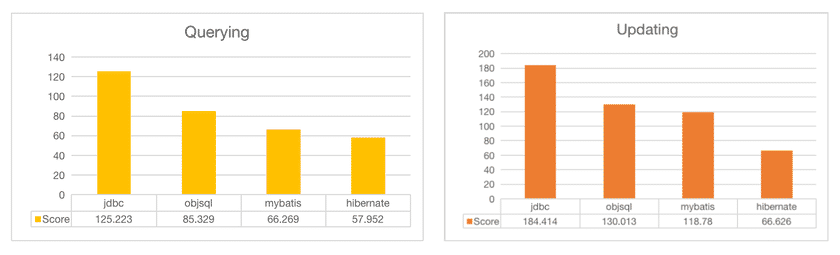
Performance(Oracle JMH)
Installation
IntelliJ IDEA plugin installation
Preferences/Settings -> Plugins -> Search with "ObjectiveSql" in market -> Install
Maven dependencies
<!-- In standalone -->
<dependency>
    <groupId>com.github.braisdom</groupId>
    <artifactId>objective-sql</artifactId>
    <version>1.4.6</version>
</dependency>
<!-- In Spring Boot -->
<dependency>
  <groupId>com.github.braisdom</groupId>
  <artifactId>objsql-springboot</artifactId>
  <version>1.3.4</version>
</dependency>
Refer to the pom.xml for more configuration
Examples
ObjectiveSQL provides full example for various databases below, You can open it directly with IntelliJ IDEA as a standalone project. In fact, they are not just examples, but also unit tests of ObjectiveSQL in various databases.
If you want to run without configuration, you can try: SQLite
Others: MySQL, Oracle, MS SQL Server, PostgreSQL, Spring Boot
Simple SQL programming without coding
You define just a JavaBean with annotations
@DomainModel
public class Member {
    private String no;

    @Queryable
    private String name;
    private Integer gender;
    private String mobile;
    private String otherInfo;

    @Relation(relationType = RelationType.HAS_MANY)
    private List<Order> orders;
}
Persistence
Member.create(newMember);
Member.create(new Member[]{newMember1, newMember2, newMember3}, false);

Member.update(1L, newMember, true);
Member.update("name = 'Smith => Jackson'", "name = ?", "Alice");

Member.destroy(1L);
Member.destroy("name = ?", "Mary");
Counting and querying
Member.countAll();
Member.count("id > ?", 1);
Member.queryByPrimaryKey(1);
Member.queryFirst("id = ?", 1);
Member.query("id > ?", 1);
Member.queryAll();
Paged querying
Page page = Page.create(0, 10);
PagedList<Member> members = Member.pagedQueryAll(page, Member.HAS_MANY_ORDERS);
Relation querying
Member.queryAll(Member.HAS_MANY_ORDERS);
Member.queryByPrimary(1, Member.HAS_MANY_ORDERS);
Member.queryByName("demo", Member.HAS_MANY_ORDERS);
...
Complex SQL programming
Order.Table orderTable = Order.asTable();
Select select = new Select();

// In ObjectiveSQL, Java operator can be overloaded
select.project(sum(orderTable.amount) / sum(orderTable.quantity) * 100)
        .from(orderTable)
        .where(orderTable.quantity > 30 &&
            orderTable.salesAt.between("2020-10-10 00:00:00", "2020-10-30 23:59:59"))
        .groupBy(orderTable.productId);
SELECT SUM(`T0`.`amount`) / SUM(`T0`.`quantity`) * 100
FROM `orders` AS `T0`
WHERE `T0`.`quantity` > 30 AND
       `T0`.`sales_at` BETWEEN '2020-10-10 00:00:00' AND '2020-10-30 23:59:59')
GROUP BY `T0`.`product_id`
Reference documentation
Explorer des projets similaires
Asabeneh/30-Days-Of-Python
Le défi de programmation 30 Days of Python est un guide pas à pas pour apprendre le langage de programmation Python en 30 jours. Ce défi peut prendre plus de 100 jours. Avancez à votre rythme. Ces vidéos peuvent aussi vous aider : https://www.youtube.com/channel/UC7PNRuno1rzYPb1xLa4yktw
78,560 étoilesgrafana/grafana
Plateforme ouverte et composable d’observabilité et de visualisation de données. Visualise les métriques, les journaux et les traces issus de plusieurs sources, comme Prometheus, Loki, Elasticsearch, InfluxDB, Postgres et bien d’autres.
77,830 étoilesredis/redis
Pour les développeurs qui créent des applications en temps réel pilotées par les données, Redis est le cache, le serveur de structures de données et le moteur de requêtes documentaires et vectorielles préféré, le plus rapide et le plus riche en fonctionnalités.
77,395 étoilesapache/superset
Apache Superset est une plateforme de visualisation et d'exploration de données.
75,473 étoiles