
baidu/tera
baidu/tera has 1,905 GitHub stars and 431 forks. GitHot measured 0 in 7 days and +1 in 15 days. Last checked 2026-11-10 01:29 UTC. Last push 2024-06-05.
Comment ces chiffres sont mesurés
An Internet-Scale Database.
What you can do
- Linear and modular scalability
- Automatic and configurable sharding
- Ranged and hashed sharding strategies
- Column-oriented storage and locality group support
Progression mesurée des étoiles
- in 24h
- Mise à jour retardée
- in 7 days
- 0
- in 15 days
- +1
- in 1 month
- Mise à jour retardée
Variations nettes sur des périodes qui se chevauchent, pas des totaux quotidiens. Les mesures absentes restent vides. Les étoiles indiquent l’intérêt, pas la qualité.
README.md
OriginalTera - An Internet-Scale Database


Copyright 2015, Baidu, Inc.
Tera is a high performance distributed NoSQL database, which is inspired by google's BigTable and designed for real-time applications. Tera can easily scale to petabytes of data across thousands of commodity servers. Besides, Tera is widely used in many Baidu products with varied demands,which range from throughput-oriented applications to latency-sensitive service, including web indexing, WebPage DB, LinkBase DB, etc. (中文)
Features
- Linear and modular scalability
- Automatic and configurable sharding
- Ranged and hashed sharding strategies
- MVCC
- Column-oriented storage and locality group support
- Strictly consistent
- Automatic failover support
- Online schema change
- Snapshot support
- Support RAMDISK/SSD/DFS tiered cache
- Block cache and Bloom Filters for real-time queries
- Multi-type table support (RAMDISK/SSD/DISK table)
- Easy to use C++/Java/Python/REST-ful API
Data model
Tera is the collection of many sparse, distributed, multidimensional tables. The table is indexed by a row key, column key, and a timestamp; each value in the table is an uninterpreted array of bytes.
- (row:string, (column family+qualifier):string, time:int64) → string
To learn more about the schema, you can refer to BigTable.
Architecture
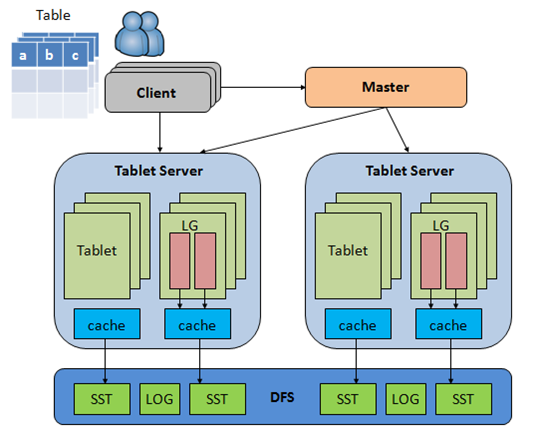
Tera has three major components: sdk, master and tablet servers.
- SDK: a library that is linked into every application client to access Tera cluster.
- Master: master is responsible for managing tablet servers and tablets, automatic load balance and garbage collection of files in filesystem.
- Tablet Server: tablet server is the core module in tera, and it uses an enhance Leveldb as a basic storage engine. Tablet server manages a set of tablets, handles read/write/scan requests and schedule tablet split and merge online.
Building blocks
Tera is built on several pieces of open source infrastructure.
Filesystem (required)
Tera uses the distributed file system to store transaction log and data files. So Tera uses an abstract file system interface, called Env, to adapt to different implementations of file systems (e.g., BFS, HDFS, HDFS2, POXIS filesystem).
Distributed lock service (required)
Tera relies on a highly-available and persistent distributed lock service, which is used for a variety of tasks: to ensure that there is at most one active master at any time; to store meta table's location, to discover new tablet server and finalize tablet server deaths. Tera has an adapter class to adapt to different implementations of lock service (e.g., ZooKeeper, Nexus)
High performance RPC framework (required)
Tera is designed to handle a variety of demanding workloads, which range from throughput-oriented applications to latency-sensitive service. So Tera needs a high performance network programming framework. Now Tera heavily relies on Sofa-pbrpc to meet the performance demand.
Cluster management system (not necessary)
A Tera cluster in Baidu typically operates in a shared pool of machines that runs a wide variety of other distributed applications. So Tera can be deployed in a cluster management system Galaxy, which uses for scheduling jobs, managing resources on shared machines, dealing with machine failures, and monitoring machine status. Besides, Tera can also be deployed on RAW machine or in Docker container.
Documents
Quick start
How to build
Use sh ./build.sh to build Tera.
How to deploy
How to access
Contributing to Tera
Contributions are welcomed and greatly appreciated.
Read Roadmap to get a general knowledge about our development plan.
See Contributions for more details.
Follow us
To join us, please send resume to tera-user at baidu.com.
Explorer des projets similaires
Asabeneh/30-Days-Of-Python
Le défi de programmation 30 Days of Python est un guide pas à pas pour apprendre le langage de programmation Python en 30 jours. Ce défi peut prendre plus de 100 jours. Avancez à votre rythme. Ces vidéos peuvent aussi vous aider : https://www.youtube.com/channel/UC7PNRuno1rzYPb1xLa4yktw
78,560 étoilesgrafana/grafana
Plateforme ouverte et composable d’observabilité et de visualisation de données. Visualise les métriques, les journaux et les traces issus de plusieurs sources, comme Prometheus, Loki, Elasticsearch, InfluxDB, Postgres et bien d’autres.
77,830 étoilesredis/redis
Pour les développeurs qui créent des applications en temps réel pilotées par les données, Redis est le cache, le serveur de structures de données et le moteur de requêtes documentaires et vectorielles préféré, le plus rapide et le plus riche en fonctionnalités.
77,395 étoilesapache/superset
Apache Superset est une plateforme de visualisation et d'exploration de données.
75,473 étoiles