
airboxlab/rllib-energyplus
airboxlab/rllib-energyplus has 62 GitHub stars and 12 forks. GitHot measured 0 stars in 24 hours and 0 in 7 days. Last checked 2026-11-12 07:33 UTC. Last push 2026-10-23.
Comment ces chiffres sont mesurés
Simple EnergyPlus environments for control optimization using reinforcement learning
Progression mesurée des étoiles
- in 24h
- 0
- in 7 days
- 0
- in 15 days
- Historique en cours
- in 1 month
- Historique en cours
Variations nettes sur des périodes qui se chevauchent, pas des totaux quotidiens. Les mesures absentes restent vides. Les étoiles indiquent l’intérêt, pas la qualité.
README.md
Original
EnergyPlus environments for Reinforcement Learning
This project implements a gym environment that handles EnergyPlus simulations for Reinforcement Learning (RL) experiments, using the EnergyPlus Python API. It also provides a set of examples and tools to train RL agents.
Requires Python 3.12, EnergyPlus 9.3+.
Torch CPU-only is included in this project, but you can install a GPU version of torch if you want to use a GPU.
Setup
Using docker image
Look for a pre-built docker image in packages and follow instructions to pull it.
Alternatively, build the docker image:
docker build . -f docker/Dockerfile -t rllib-energyplus
Run the container
docker run --rm --name rllib-energyplus -it rllib-energyplus
Notes:
- Remove
--rmto keep the container after exiting. - If you want to use tensorboard, start the container with
--network hostparameter. - If you want to use a GPU, start the container with
--gpus allparameter.
Inside the container, run the experiment
cd /root/rllib-energyplus
# run the Amphitheater example
python3 rleplus/train/rllib.py --env AmphitheaterEnv
Using a virtual environment
Using poetry
Install Poetry if you don't have it already:
curl -sSL https://install.python-poetry.org | python3 -
See more installation options here.
This project comes with a pyproject.toml file that lists all dependencies.
Packages versions are pinned (in poetry.lock) to ensure reproducibility.
Install the project dependencies with:
poetry install
Using pip
The poetry lock file is automatically converted to a requirements file, so you can also install dependencies with pip:
# Create a virtual environment
python3 -m venv env
# Activate the virtual environment
source env/bin/activate
# Install dependencies
pip install -r requirements.txt
Path dependencies
This project depends on the EnergyPlus Python API. An auto-discovery mechanism is used to find the API,
but in case it fails, you can manually add the path to the API to the PYTHONPATH environment variable
using the following:
export PYTHONPATH="/usr/local/EnergyPlus-23-2-0/:$PYTHONPATH"
Make sure you can import EnergyPlus API by printing its version number
$ python3 -c 'from pyenergyplus.api import EnergyPlusAPI; print(EnergyPlusAPI.api_version())'
0.2
Run example
Run the amphitheater example with default parameters using Ray RLlib PPO algorithm:
Using Poetry
# Using Ray Rllib
poetry run rllib --env AmphitheaterEnv
# Using Meta Pearl
poetry run pearl --env AmphitheaterEnv
Using Python
If you installed dependencies with pip, you can run the example with:
# Using Ray Rllib
python3 rleplus/train/rllib.py --env AmphitheaterEnv
# Using Meta Pearl
python3 rleplus/train/pearl.py --env AmphitheaterEnv
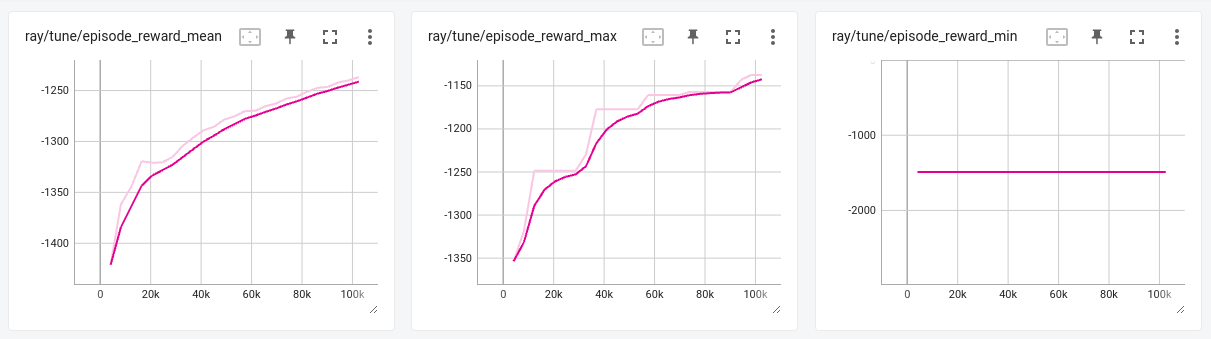
Example of episode reward stats obtained training with PPO, 1e5 timesteps, 2 workers, with default parameters + LSTM, short E+ run period (2 first weeks of January). Experiment took ~20min.
Creating a new environment
To create a new environment, you need to create a new class that inherits from rleplus.envs.EnergyPlusEnv
and implement abstract methods. See existing environments for examples.
Once your environment is ready, it must be declared in the rleplus.examples.registry module, so it gets registered.
Tracking an experiment
Tensorboard is installed with requirements.
To track an experiment running in a docker container, the container must be started with --network host parameter.
Start tensorboard with:
tensorboard --logdir ~/ray_results --bind_all
Explorer des projets similaires
tensorflow/tensorflow
Un framework open source d'apprentissage automatique pour tous
201,505 étoileshuggingface/transformers
🤗 Transformers : le framework de définition de modèles pour les modèles d'apprentissage automatique de pointe en texte, vision, audio et multimodal, pour l'inférence et l'entraînement.
168,815 étoilesAUTOMATIC1111/stable-diffusion-webui
Interface web de Stable Diffusion
165,300 étoilesComfy-Org/ComfyUI
La GUI, l'API et le backend les plus puissants et modulaires pour les modèles de diffusion, avec une interface de graphes et de nœuds. Le moteur d'inférence local le plus rapide au monde.
146,472 étoiles