
Tencent/wcdb has 11,648 GitHub stars and 1,500 forks. GitHot measured -1 stars in 24 hours and -4 in 7 days. Last checked 2026-11-09 08:28 UTC. Last push 2026-10-08.
Comment ces chiffres sont mesurés
WCDB is a cross-platform database framework developed by WeChat.
Progression mesurée des étoiles
- in 24h
- -1
- in 7 days
- -4
- in 15 days
- Mise à jour retardée
- in 1 month
- Mise à jour retardée
Variations nettes sur des périodes qui se chevauchent, pas des totaux quotidiens. Les mesures absentes restent vides. Les étoiles indiquent l’intérêt, pas la qualité.
README.md
OriginalWCDB


中文版本请参看这里
WCDB is an efficient, complete, easy-to-use mobile database framework used in the WeChat application. It's based on SQLite and SQLCipher, and supports five languages: C++, Java, Kotlin, Swift and Objective-C.
Feature
Easy-to-use
- ORM (Object Relational Mapping): WCDB provides a flexible, easy-to-use ORM for creating tables, indices and constraints, as well as CRUD through C++/Java/Kotlin/Swift/Objc objects.
- WINQ (WCDB language integrated query): WINQ is a native data querying capability which frees developers from writing glue code to concatenate SQL query strings.
With ORM and WINQ, you can insert, update, query and delete objects from database in one line code:
// C++
database.insertObjects<Sample>(Sample(1, "text"), myTable);
database.updateRow("text2", WCDB_FIELD(Sample::content), myTable, WCDB_FIELD(Sample::id) == 1);
auto objects = database.getAllObjects<Sample>(myTable, WCDB_FIELD(Sample::id) > 0);
database.deleteObjects(myTable, WCDB_FIELD(Sample::id) == 1);
// Java
database.insertObject(new Sample(1, "text"), DBSample.allFields(), myTable);
database.updateValue("text2", DBSample.content, myTable, DBSample.id.eq(1));
List<Sample> objects = database.getAllObjects(DBSample.allFields(), myTable, DBSample.id.gt(0));
database.deleteObjects(myTable, DBSample.id.eq(1));
// Kotlin
database.insertObject<Sample>(Sample(1, "text"), DBSample.allFields(), myTable)
database.updateValue("text2", DBSample.content, myTable, DBSample.id.eq(1))
val objects = database.getAllObjects<Sample>(DBSample.allFields(), myTable, DBSample.id.gt(0))
database.deleteObjects(myTable, DBSample.id.eq(1))
// Swift
try database.insert(Sample(id:1, content:"text"), intoTable: myTable)
try database.update(table: myTable,
                    on: Sample.Properties.content,
                    with: "text2"
                    where:Sample.Properties.id == 1)
let objects: [Sample] = try database.getObjects(fromTable: myTable,
                                                where: Sample.Properties.id > 0)
try database.delete(fromTable: myTable where: Sample.Properties.id == 1)
// Objc
[database insertObject:sample intoTable:myTable];
[database updateTable:myTable
          setProperty:Sample.content
              toValue:@"text2"
                where:Sample.id == 1];
NSArray* objects = [database getObjectsOfClass:Sample.class
                                     fromTable:myTable
                                         where:Sample.id > 0];
[database deleteFromTable:myTable where:Sample.id == 1];
Efficient
Through the framework layer and sqlcipher source optimization, WCDB have more efficient performance.
- Multi-threaded concurrency: WCDB supports concurrent read-read and read-write access via connection pooling.
- Deeply optimized: WCDB has deeply optimized the source code and configuration of SQLite to adapt to the development scenarios of mobile terminals. At the same time, WCDB has also been optimized for common time-consuming scenarios, such as writing data in batches.
Complete
WCDB summarizes common problems in practice to provide a more complete development experience for database development:
- Encryption Support: WCDB supports database encryption via SQLCipher.
- Corruption recovery: WCDB provides a built-in repair kit for database corruption recovery.
- Anti-injection: WCDB provides a built-in protection from SQL injection.
- Database model upgrade: The database model is bound to the class definition, so that the addition, deletion and modification of database fields are consistent with the definition of class variables.
- Full-text search: WCDB provides an easy-to-use full-text search interface and includes tokenizers for multiple languages.
- Data Migration: WCDB supports to migrate data from one databasse to another with simple configuration. And developers don't need to care about the intermediate status and progress of the migration.
- Data Compression: WCDB supports to compress content via Zstd within specific fields of a database table through a simple configuration. Once configured, the details of data compression and decompression become transparent to developers, and WCDB can automatically compress existing data.
Compatibility
WCDB has interfaces in five languages: C++, Java, Kotlin, Swift, and Objc. Interfaces in different languages share the same underlying logic. The code structure of WCDB is shown in the figure below:
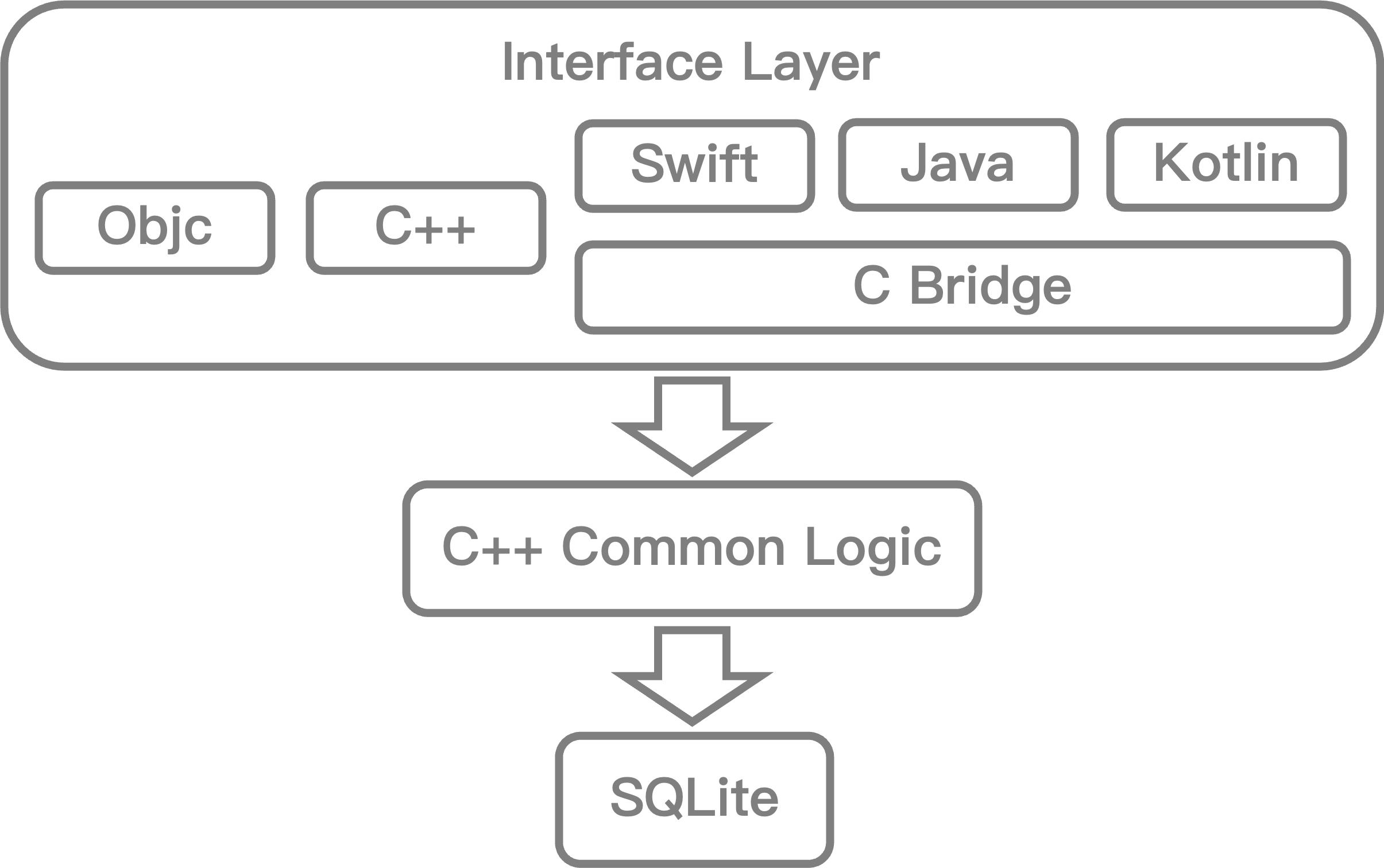
Under such architecture, WCDB in different languages can have the same interface structure and interface capabilities. In one project, you can write database code in different languages with one WCDB. Database logic in different languages will not conflict. Some global interfaces such as error monitoring can work on database logic in different languages at the same time.
Build and Install
Following wikies contain the detailed instructions about building and installing of WCDB.
- Building and Installing of WCDB C++
- Building and Installing of WCDB Java/Kotlin
- Building and Installing of WCDB Swift
- Building and Installing of WCDB Objc
Tutorials
Tutorials of different languages can be found below:
- Tutorials for WCDB C++
- Tutorials for WCDB Java/Kotlin
- Tutorials for WCDB Swift
- Tutorials for WCDB Objc
Contributing
If you are interested in contributing, check out the [CONTRIBUTING.md], also join our Tencent OpenSource Plan.
WCDB 正式加入TDS 腾讯端服务产品联盟,携手联盟其他成员,共同致力于构建开放共赢的大前端技术产品生态。
信息公示
开发者: 深圳市腾讯计算机系统有限公司
Explorer des projets similaires
Asabeneh/30-Days-Of-Python
Le défi de programmation 30 Days of Python est un guide pas à pas pour apprendre le langage de programmation Python en 30 jours. Ce défi peut prendre plus de 100 jours. Avancez à votre rythme. Ces vidéos peuvent aussi vous aider : https://www.youtube.com/channel/UC7PNRuno1rzYPb1xLa4yktw
78,486 étoilesgrafana/grafana
Plateforme ouverte et composable d’observabilité et de visualisation de données. Visualise les métriques, les journaux et les traces issus de plusieurs sources, comme Prometheus, Loki, Elasticsearch, InfluxDB, Postgres et bien d’autres.
77,790 étoilesredis/redis
Pour les développeurs qui créent des applications en temps réel pilotées par les données, Redis est le cache, le serveur de structures de données et le moteur de requêtes documentaires et vectorielles préféré, le plus rapide et le plus riche en fonctionnalités.
77,332 étoilesapache/superset
Apache Superset est une plateforme de visualisation et d'exploration de données.
75,455 étoiles