
SpaceCell/Wired
SpaceCell/Wired has 44 GitHub stars and 1 forks. Star changes are not measured yet. Last checked 2026-11-12 10:06 UTC. Last push 2026-11-12.
Comment ces chiffres sont mesurés
Fast data transport : Apache Arrow, Protobuf and Message Pack data on the one stream. Measured faster than Arrow Flight on all open benchmarks. HTTP, TCP, QUIC, Websocket, Webtransport, Stdio, UDS, all interchangeable, with 64-byte SIMD compatibilty maintained over the network and to/from disk via custom Arrow Mmap and Parquet Readers and Writers
Progression mesurée des étoiles
- in 24h
- Historique en cours
- in 7 days
- Historique en cours
- in 15 days
- Historique en cours
- in 1 month
- Historique en cours
Variations nettes sur des périodes qui se chevauchent, pas des totaux quotidiens. Les mesures absentes restent vides. Les étoiles indiquent l’intérêt, pas la qualité.
README.md
OriginalSpaceCell Wired
Send and receive typed Arrow and Protobuf data easily across networks and processes at speed.
for batch in ls.read("tcp://feed.example.com:9000"):
    process(batch)
Supported URI schemes include:
| Transport | URI |
|---|---|
| TCP | tcp://host:port |
| Unix domain socket | uds:///path/to/socket |
| WebSocket | ws://host/path |
| Secure WebSocket | wss://host/path |
| HTTP | http://host/path |
| HTTPS | https://host/path |
| QUIC | quic://host:port |
| WebTransport | wt://host/path |
| Standard input/output | stdio:// |
Installation
Rust
cargo install lightstream
Python
pip install lightstream-io
See the Python README and Rust README for setup details.
Quick Start
Rust
Send Tables
use lightstream::models::writers::tcp::TcpTableWriter;

let mut writer = TcpTableWriter::connect("127.0.0.1:9000", schema, None).await?;
writer.write_table(batch_1).await?;
writer.finish().await?;
Receive Tables
use futures_util::StreamExt;
use lightstream::models::readers::tcp::TcpTableReader;

let mut reader = TcpTableReader::connect("127.0.0.1:9000").await?;

while let Some(result) = reader.next().await {
    let table = result?;
    process(table);
}
Lightstream protocol
Multiplex Protobuf messages and Arrow tables on the one connection.
use lightstream::models::protocol::connection::TcpLightstreamConnection;
use lightstream::models::protocol::LightstreamMessage;

let mut conn = TcpLightstreamConnection::from_tcp(stream);
conn.register_message("event");
conn.register_table("metrics", schema);

conn.send("event", b"user-login").await?;
conn.send_table("metrics", &table).await?;

while let Some(msg) = conn.recv().await {
    match msg? {
        // Protobuf message
        LightstreamMessage::Message { tag, payload } => { /* … */ }
        // Arrow table
        LightstreamMessage::Table { table, .. } => { /* … */ }
    }
}
Memory-mapped Arrow IPC
use lightstream::models::readers::ipc::mmap_table::MmapTableReader;

let reader = MmapTableReader::open("data.arrow")?;
for i in 0..reader.num_batches() {
    let table = reader.read_batch(i)?;
    process(table);
}
Python
Read and writing
# Read the whole dataset.
table = ls.read("quotes.arrow").read_all()

# Stream batches without loading the complete dataset into memory.
for batch in ls.read("large.parquet"):
    process(batch)

# Write any Arrow-compatible object.
with ls.write("output.parquet", compression="zstd") as writer:
    writer.write(table)
Hit your favourite tools
Every reader implements the Arrow PyCapsule stream protocol, so Arrow-compatible libraries can consume a Lightstream reader directly.
import duckdb
import lightstream as ls

reader = ls.read("quotes.arrow")

result = duckdb.sql(
    "SELECT SUM(qty) FROM reader"
)
Protobuf and Arrow moving across process
reader = ls.read(
    "uds:///tmp/feed.sock",
    protocol="lightstream",
)

reader.register_table(
    "quotes",
    representative_table,
)
reader.register_message("health")

for frame in reader:
    if frame.is_table():
        on_quotes(frame.table)
    else:
        on_health(frame.payload)
Why it exists
Moving bytes between processes is easy. Sending and receiving typed tabular data, typed messages and metadata together, at high throughput, across interchangeable transports typically needs many custom engineering hours, and it is work that’s difficult to get right.
A typical high-performance data path therefore ends up combining several independent pieces:
- Arrow IPC for tabular data
- Protobuf for strongly typed messages and metadata
- TCP, HTTP, WebSocket, QUIC or another transport
- custom framing to multiplex them onto the same connection
- custom ordering and reconstruction when parallel connections are used
- separate implementations for files, streams and memory-mapped data
At that point, the application has effectively acquired its own transport protocol.
That protocol becomes another thing to implement, benchmark and maintain. More importantly, when independently deployed producers and consumers need to agree on metadata, relying on loosely typed fields or application-specific conventions makes contract drift easy.
So why not bake that in?
SpaceCell Wired provides that layer highly optimised, out of the box reusable and interchangeable. Don’t like the bread? It’s composable, so you can pick it up at the layer that works for your problem.
What it does
SpaceCell Wired separates data encoding, reading and writing, and transport, so each can be switched independently without rebuilding the data path.
It gives you:
- Arrow, Protobuf and MessagePack on the same stream - tabular data, strongly typed messages and key/value data can share one protocol.
- Plus other protocols - You still get Arrow IPC
- Interchangeable transports - TCP, HTTP, WebSocket, WebTransport, QUIC, Unix domain sockets and standard I/O use the same interface.
- Globally ordered parallel streams - Lightstream protocol connections can be parallelised for throughput while presenting a single ordered stream to the application.
- High-performance Arrow I/O - Arrow IPC and Parquet readers and writers, including memory-mapped Arrow.
- 64-byte alignment end to end - SIMD friendly alignment is preserved across readers, writers, files and network transports.
- Composable abstractions - new transports, readers or writers can be implemented and/or tweaked without reproducing the protocol or data layer.
- Rust performance with Python bindings - pick your poison.
Easy to use data from disk to network
The result is a highly optimised data path that makes it dead simple to send/receive data over networks or local IPC.
The same interface can read an Arrow or Parquet file, memory-map Arrow IPC, stream batches between local processes, send them over TCP or QUIC, or pipe them through standard I/O.
And when the stream needs more than tabular data, the same connection can transport strongly typed Protobuf messages or MessagePack alongside it.
for batch in ls.read("tcp://feed.example.com:9000"):
    process(batch)
Consider changing the URI instead of your architecture:
quotes.arrow
large.parquet
uds:///tmp/feed.sock
tcp://feed.example.com:9000
quic://feed.example.com:9000
wss://feed.example.com/stream
stdio://
In summary, SpaceCell Wired is one typed, high-performance streaming layer across files, processes and networks without all the DIY steps in-between.
For the compute layer that pairs with it, checkout SpaceCell Lightning.
Performance
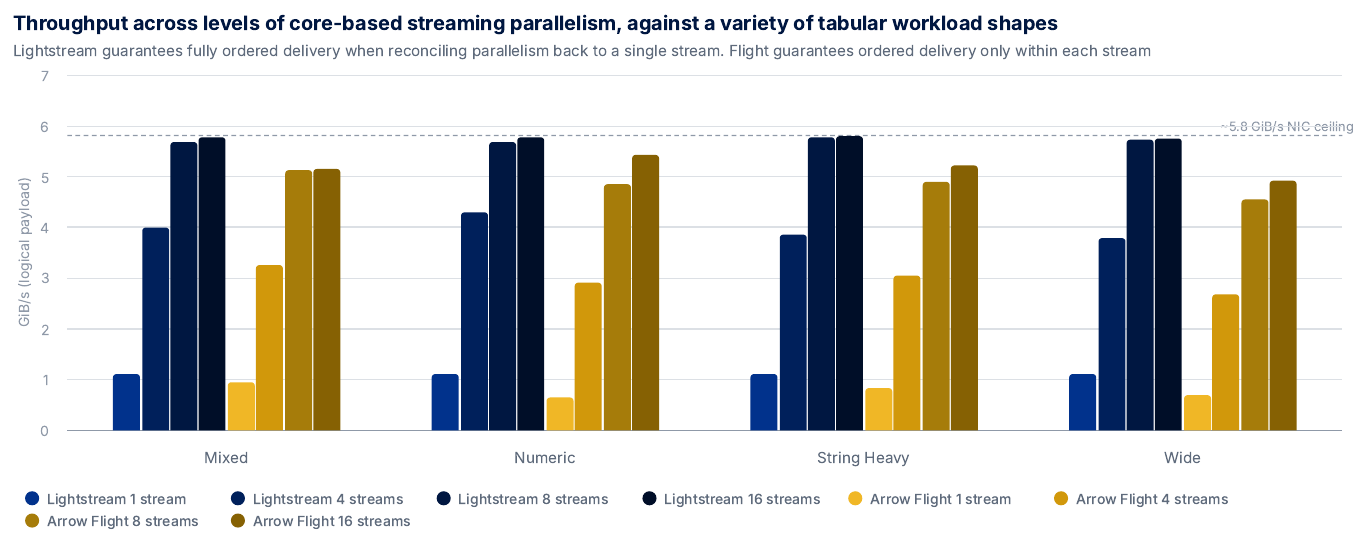
Wired's Lightstream protocol performed faster than an industry-standard alternative in every measured comparison on open AWS EC2 benchmarks (see benchmarks/). This includes returning a single globally ordered stream after parallelising connections for delivery, which the other measured framework does not offer natively, and wearing that cost in the reported figures.
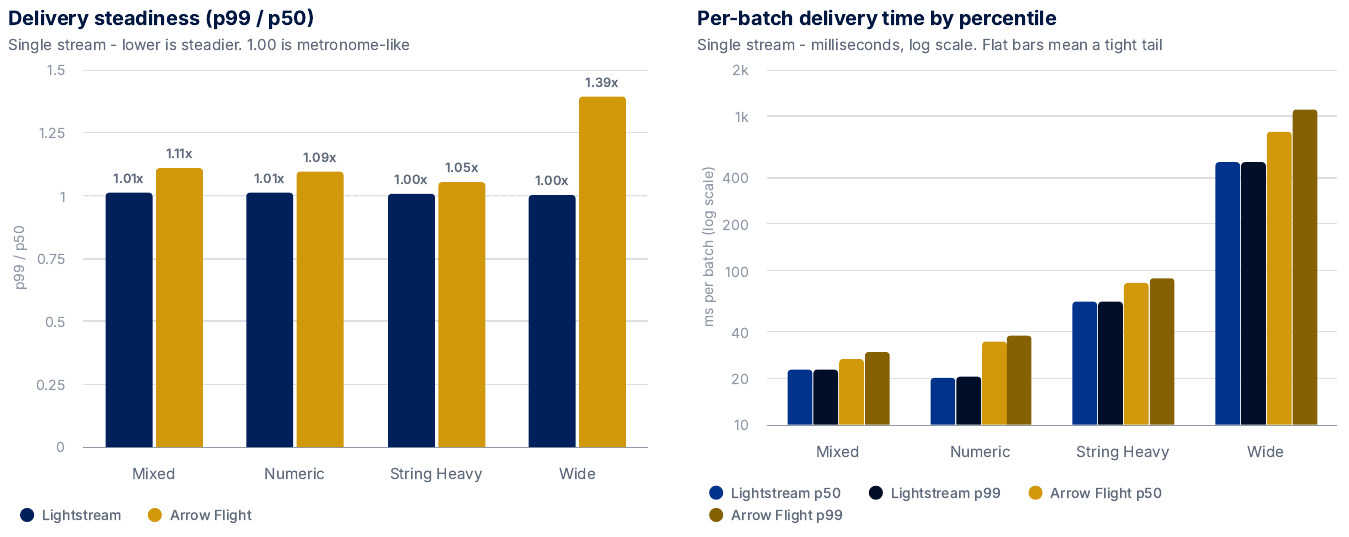
It’s p99 landed within 1% of p50. I.e., consistent, low-jitter performance.
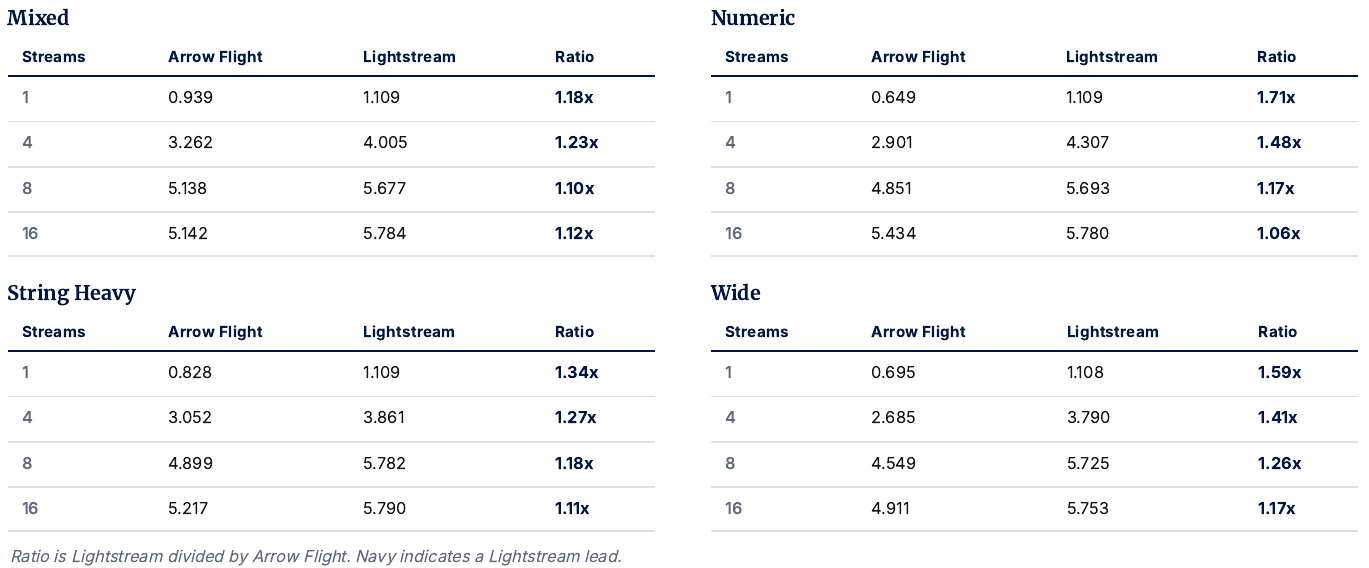
The full warm-median throughput results across every workload shape and measured level of stream parallelism are included below for reference.
Methodology
Both systems serve the same RAM-resident Apache Arrow table, so the measured path is transport and network delivery only. The open benchmark is in this repository.
- Identical hardware - two AWS i3en.12xlarge instances, one placement group, and 50 Gbit/s network.
- Median of five - every cell is the warm median of five runs, smoothing transient cloud variance.
- Arrow Flight configuration - the official arrow-flight crate over gRPC/HTTP/2, Arrow-RS defaults, string data not re-materialised, with multiple connections to avoid multiplex throttling.
- Receiver-verified - throughput is logical payload in GiB/s, timed from request to final verified arrival.
- Four schema shapes - numeric, mixed, string-heavy and wide. One million rows per batch, from a 300 GB pool (before transport batch framing).
- Ordered reconstruction - Lightstream reconstructs one globally ordered stream across all connections, which counts against its own throughput (it wears the cost in the results). Arrow Flight orders only within each endpoint and leaves parallel streams separate. Both therefore use their strongest ordering guarantees and stream configurations without stepping outside the framework boundaries.
User Guide
See the individual Rust or Python READMEs, or dive straight into the repository examples. A User Guide is under development.
Like what you see?
Please consider leaving a star on the repository or sharing it, as it helps others find it.
Licence
Mozilla Public License 2.0. © 2025–2026 Peter Garfield Bower.
See MPL 2.0 FAQ if you are unfamiliar with this open-source licence.
Wired is maintained by SpaceCell. Check out some of the latest data technology.
Explorer des projets similaires
Asabeneh/30-Days-Of-Python
Le défi de programmation 30 Days of Python est un guide pas à pas pour apprendre le langage de programmation Python en 30 jours. Ce défi peut prendre plus de 100 jours. Avancez à votre rythme. Ces vidéos peuvent aussi vous aider : https://www.youtube.com/channel/UC7PNRuno1rzYPb1xLa4yktw
78,618 étoilesgrafana/grafana
Plateforme ouverte et composable d’observabilité et de visualisation de données. Visualise les métriques, les journaux et les traces issus de plusieurs sources, comme Prometheus, Loki, Elasticsearch, InfluxDB, Postgres et bien d’autres.
77,859 étoilesredis/redis
Pour les développeurs qui créent des applications en temps réel pilotées par les données, Redis est le cache, le serveur de structures de données et le moteur de requêtes documentaires et vectorielles préféré, le plus rapide et le plus riche en fonctionnalités.
77,472 étoilesapache/superset
Apache Superset est une plateforme de visualisation et d'exploration de données.
75,495 étoiles