
Praveenkottari/BD3-Dataset
Praveenkottari/BD3-Dataset has 40 GitHub stars and 7 forks. Star changes are not measured yet. Last checked 2026-11-14 11:12 UTC. Last push 2026-10-25.
Progression mesurée des étoiles
- in 24h
- Historique en cours
- in 7 days
- Historique en cours
- in 15 days
- Historique en cours
- in 1 month
- Historique en cours
Variations nettes sur des périodes qui se chevauchent, pas des totaux quotidiens. Les mesures absentes restent vides. Les étoiles indiquent l’intérêt, pas la qualité.
À propos
This repository provides the BD3 dataset, containing over 3,965 annotated RGB images. It supports evaluating computer vision techniques for automatic defect identification to improve building inspections. A comprehensive study and comparison results simulate the identification and classification of defects in various real-world built environments.
Apprentissage automatiqueREADME.md
OriginalBD3: Building Defects Detection Dataset
Check Paper here
Down lode dataset from kaggle here
The inspection of urban built environments are critical to maintaining structural integrity and safety. However, traditional manual inspection methods are often time-consuming, labor-intensive, prone to human error, and difficult to scale across large urban environments. These limitations become particularly evident in fast-growing cities, where aging infrastructure and the demand for regular inspection outpace the capacity of human inspectors. To overcome these challenges, the use of automated building inspection techniques powered by computer vision has gained significant interest. By employing technologies such as drones and multi-robot systems, these techniques promise to make building inspections faster, more accurate, and scalable. Despite these advances, a major barrier to the development and deployment of robust automated inspection systems is the lack of comprehensive and publicly available datasets. Most existing datasets fail to capture a wide range of structural defects or do not provide enough diversity in image samples, limiting the ability of machine learning models to generalize across different environments and defect types.
To address this gap, we present BD3: Building Defects Detection Dataset, specifically designed to evaluate and develop computer vision techniques for automated building inspections. BD3 consists of two subsets:
- Original dataset: 3,965 RGB images annotated to cover six common structural defects, along with normal wall images.
- Augmented dataset: 14,000 images created using geometric transformations (rotations, flips) and color adjustments (brightness, contrast, saturation, and hue). This augmentation datset is intended to enhance the dataset's diversity, improving the robustness and generalizability of models trained on BD3.
By making BD3 publicly available, we aim to accelerate the development of reliable and scalable automated inspection systems that can help ensure the safety and longevity of our urban infrastructure.
Building Defects Details
The BD3 dataset contains six defect classes and normal wall images. Below are the descriptions of these defect classes along with the number of image samples available for each:
| Defect Name | Description | Number of Images |
|---|---|---|
| Algae | Fungi resembling green, brown, or black patches or slime on the surface | 624 |
| Major Crack | Cracks with visible gaps | 620 |
| Minor Crack | Cracks without visible gaps | 580 |
| Peeling | Loss of the outer covering of paint | 520 |
| Spalling | Surface break exposing inner material | 500 |
| Stain | Visible man-made or natural color marks | 521 |
| Normal | Clean walls with no visible signs of defects | 600 |
Sample Images
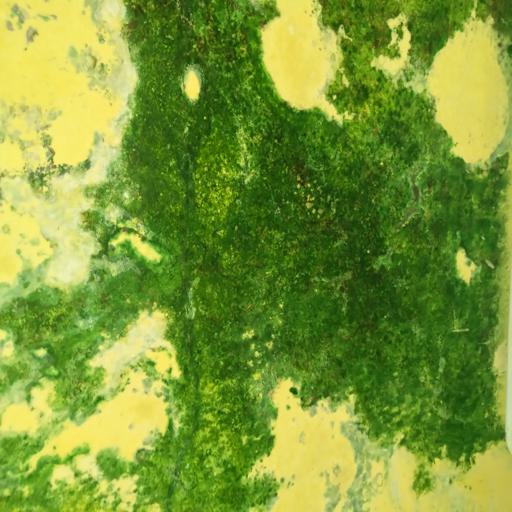 (a) Algae |
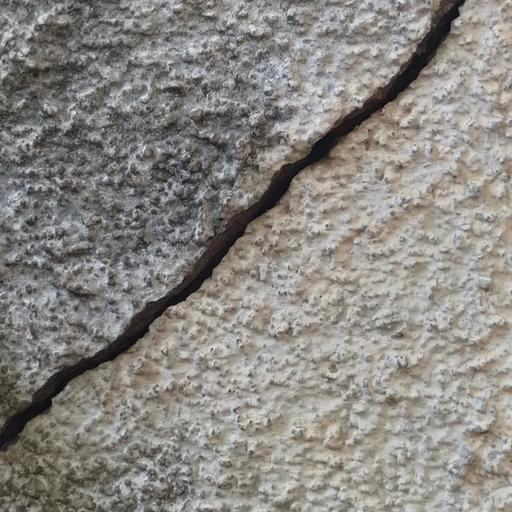 (b) Major Crack |
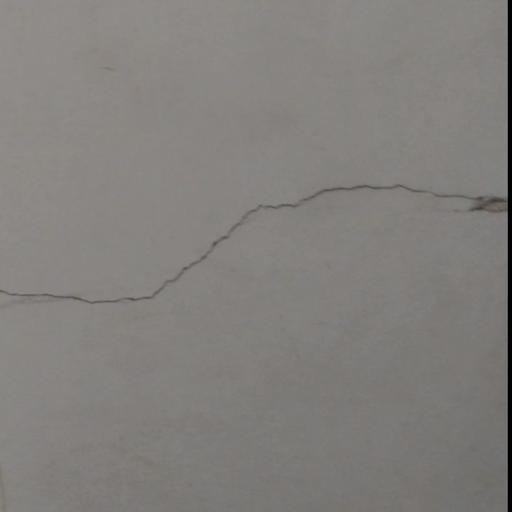 (c) Minor Crack |
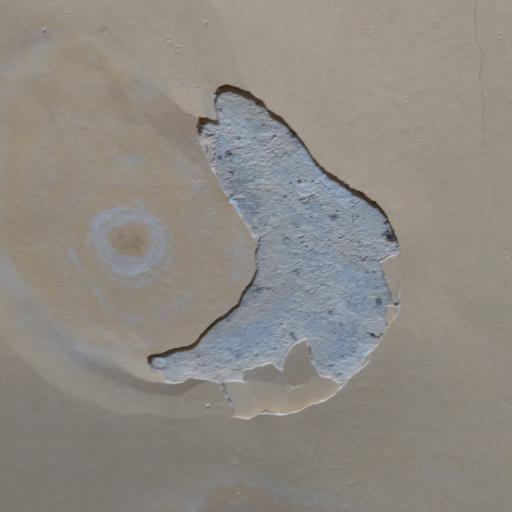 (d) Peeling |
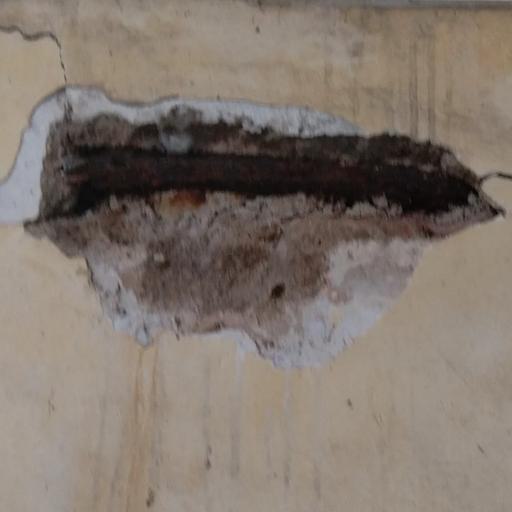 (e) Spalling |
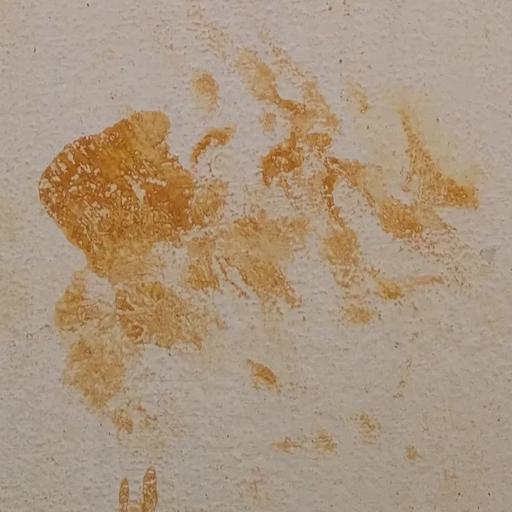 (f) Stain |
 (g) Normal |
Dataset preparation
The image dataset collection began by inspecting and identifying building structures that were in a maintained condition. More than 50 buildings, constructed at different times and with ages ranging from 10 to 60 years, were visited. For image capture, we used a smartphone with a high-resolution camera, and all samples were taken approximately 1 meter away from the walls. The images were collected both indoors and outdoors across various campus buildings, which had different material surfaces such as concrete and stone. Afterward, the collected data were assembled for preprocessing and cleaning. Annotation was then performed with respect to the specific defect classes, generating the final dataset.
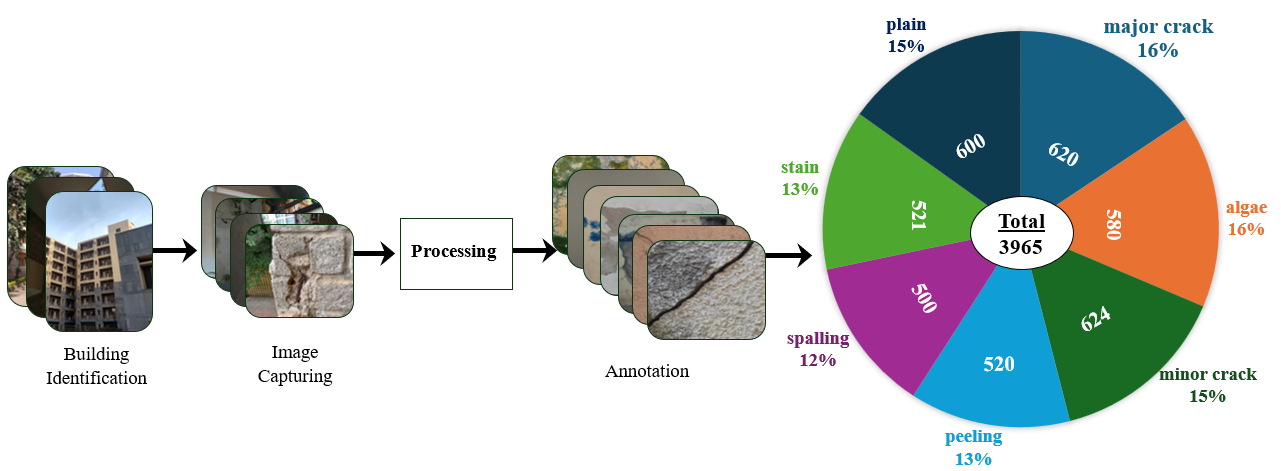
Figure : Dataset preparation work-flow
Benchmarking
To assess the utility and practical usefulness of the BD3 dataset, we benchmarked five deep learning-based image classifiers: Vision Transformers (ViT), VGG16, ResNet18, AlexNet, and MobileNetV2. These models are implemented using pre-trained torchvision.models. The training, validation and test splits are: 60%, 20% and 20%.
| Model | Original dataset | Augmented dataset | ||||
|---|---|---|---|---|---|---|
| Precision | Recall | F1-score | Precision | Recall | F1-score | |
| ResNet18 | 0.8320 | 0.8308 | 0.8301 | 0.9915 | 0.9516 | 0.9711 |
| VGG16 | 0.8409 | 0.8359 | 0.8363 | 0.9066 | 0.9057 | 0.9056 |
| MobileNetV2 | 0.8479 | 0.8422 | 0.8419 | 0.8756 | 0.8750 | 0.8746 |
| AlexNet | 0.8842 | 0.8801 | 0.8803 | 0.9399 | 0.9389 | 0.9391 |
| ViTpatch16 | 0.9342 | 0.9318 | 0.9323 | 0.9880 | 0.9879 | 0.9879 |
| Class | Original dataset | Augmented dataset | ||||
|---|---|---|---|---|---|---|
| Precision | Recall | F1-score | Precision | Recall | F1-score | |
| Algae | 0.9915 | 0.9516 | 0.9711 | 1.0000 | 0.9975 | 0.9987 |
| Major crack | 0.8761 | 0.8534 | 0.8646 | 0.9794 | 0.9550 | 0.9670 |
| Minor crack | 0.8417 | 0.9435 | 0.8897 | 0.9612 | 0.9925 | 0.9766 |
| Peeling | 0.9595 | 0.9134 | 0.9359 | 0.9851 | 0.9925 | 0.9887 |
| Stain | 0.9166 | 0.9519 | 0.9339 | 0.9950 | 0.9975 | 0.9962 |
| Normal | 1.0000 | 0.9916 | 0.9958 | 0.9974 | 0.9925 | 0.9949 |
Confusion matrix
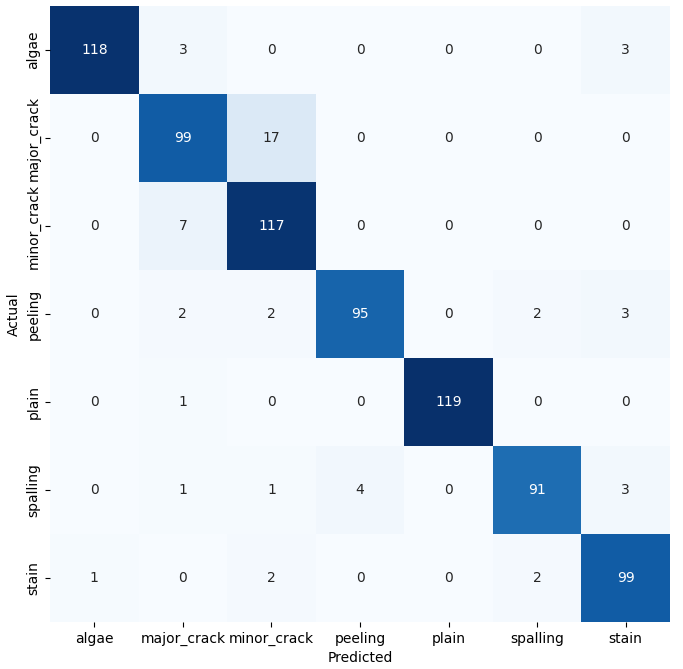
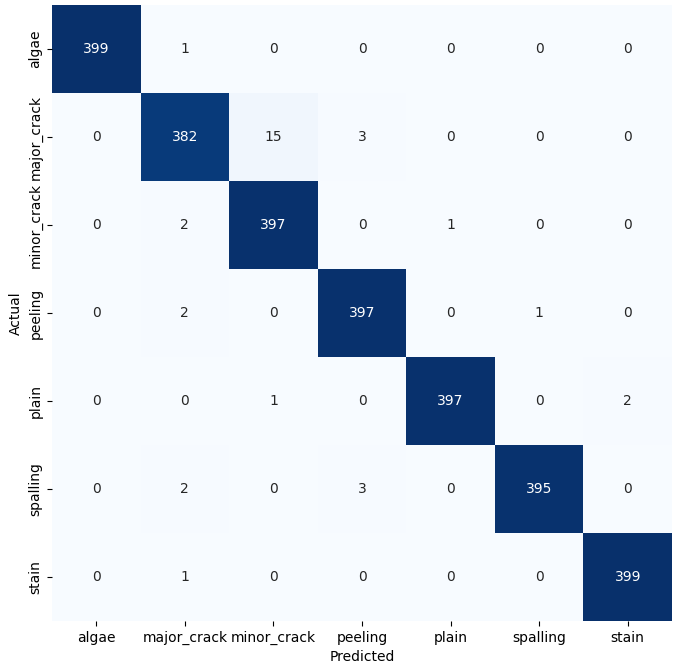
Figure: Vision Transformer model confusion matrices on Original and Augmented dataset.
Code
- Data Pre-processing - This folder contains Python scripts for renaming images, resizing, and other preprocessing functions.
- Image Augmentation -Python code for generating augmented dataset.
- Dataset Splitting - Python code for splitting the dataset into training, validation, and test sets.
- Model Training and Evaluation - Scripts for training and evaluation of different deep learning models.
- Result Analysis - Python scripts to analyze and visualize the results.
Directory structure
.
├── code                         # All Python codes
│   ├── data-process             # Data pre-processing code
│   ├── data-augment-Technq      # Image augmentation code
│   ├── train-test-split         # Data split code
│   ├── model-train              # Model training and evaluation code
│   └── Results                  # Results analysis
├── sample images               # Dataset image sample files
|   ├── class_images
|   |    ├── Algae
|   |    |    ├── ...cls00_001.jpg
|   |    :    :          :
|   |    :    :
├── Results
    ├── model-wise results
    |          :
Citation
@inproceedings{10.1145/3671127.3698789,
author = {Kottari, Praveen and Arjunan, Pandarasamy},
title = {BD3: Building Defects Detection Dataset for Benchmarking Computer Vision Techniques for Automated Defect Identification},
year = {2024},
isbn = {9798400707063},
publisher = {Association for Computing Machinery},
address = {New York, NY, USA},
url = {https://doi.org/10.1145/3671127.3698789},
doi = {10.1145/3671127.3698789},
abstract = {The current manual visual inspection of built environments is time-consuming, labor-intensive, prone to errors, costly, and lacks scalability. To address these limitations, automated building inspection techniques have emerged in recent years, leveraging low-cost computer vision systems, drones and mobile robots. However, the practical implementation of these systems is hindered by the lack of robust and generalizable models trained on comprehensive defect image datasets. In this paper, we present BD3: Building Defects Detection Dataset, a comprehensive image dataset designed to benchmark computer vision techniques aimed at improving the robustness and generalizability of automated building inspection systems. The BD3 dataset contains 3,965 high-quality, manually collected, and annotated images. Unlike other datasets that primarily focus on crack and non-crack images, BD3 includes images of six distinct building defects (algae, major crack, minor crack, peeling, spalling, and stain), as well as images representing normal building conditions. We benchmarked the BD3 using five state-of-the-art computer vision models to classify defect and normal images. The experimental results indicate that the Vision Transformer (ViT) model achieved the highest F1-scores of 0.9342 and 0.9879 on the original and augmented datasets, respectively. The BD3 dataset and its accompanying reproducible codebase are publicly available for benchmarking other defect detection algorithms.},
booktitle = {Proceedings of the 11th ACM International Conference on Systems for Energy-Efficient Buildings, Cities, and Transportation},
pages = {297–301},
numpages = {5},
keywords = {Building Defect Dataset, Building Defects, Building Inspection, Computer Vision, Deep Learning, Defect Identification},
location = {Hangzhou, China},
series = {BuildSys '24}
}
Explorer des projets similaires
tensorflow/tensorflow
Un framework open source d'apprentissage automatique pour tous
201,595 étoileshuggingface/transformers
🤗 Transformers : le framework de définition de modèles pour les modèles d'apprentissage automatique de pointe en texte, vision, audio et multimodal, pour l'inférence et l'entraînement.
168,963 étoilesAUTOMATIC1111/stable-diffusion-webui
Interface web de Stable Diffusion
165,311 étoilesComfy-Org/ComfyUI
La GUI, l'API et le backend les plus puissants et modulaires pour les modèles de diffusion, avec une interface de graphes et de nœuds. Le moteur d'inférence local le plus rapide au monde.
146,774 étoiles