
zju3dv/OnePose
zju3dv/OnePose has 1,011 GitHub stars and 84 forks. GitHot measured -1 stars in 24 hours and -1 in 7 days. Last checked 2026-11-11 03:03 UTC. Last push 2024-12-17.
Code for "OnePose: One-Shot Object Pose Estimation without CAD Models", CVPR 2022
Crecimiento de estrellas medido
- in 24h
- -1
- in 7 days
- -1
- in 15 days
- Actualización retrasada
- in 1 month
- Actualización retrasada
Cambios netos en períodos que se solapan, no totales diarios. Los datos no disponibles se dejan en blanco. Las estrellas indican interés, no calidad.
README.md
OriginalOnePose: One-Shot Object Pose Estimation without CAD Models
Project Page | Paper
OnePose: One-Shot Object Pose Estimation without CAD Models
Jiaming Sun*, Zihao Wang*, Siyu Zhang*, Xingyi He, Hongcheng Zhao, Guofeng Zhang, Xiaowei Zhou
CVPR 2022
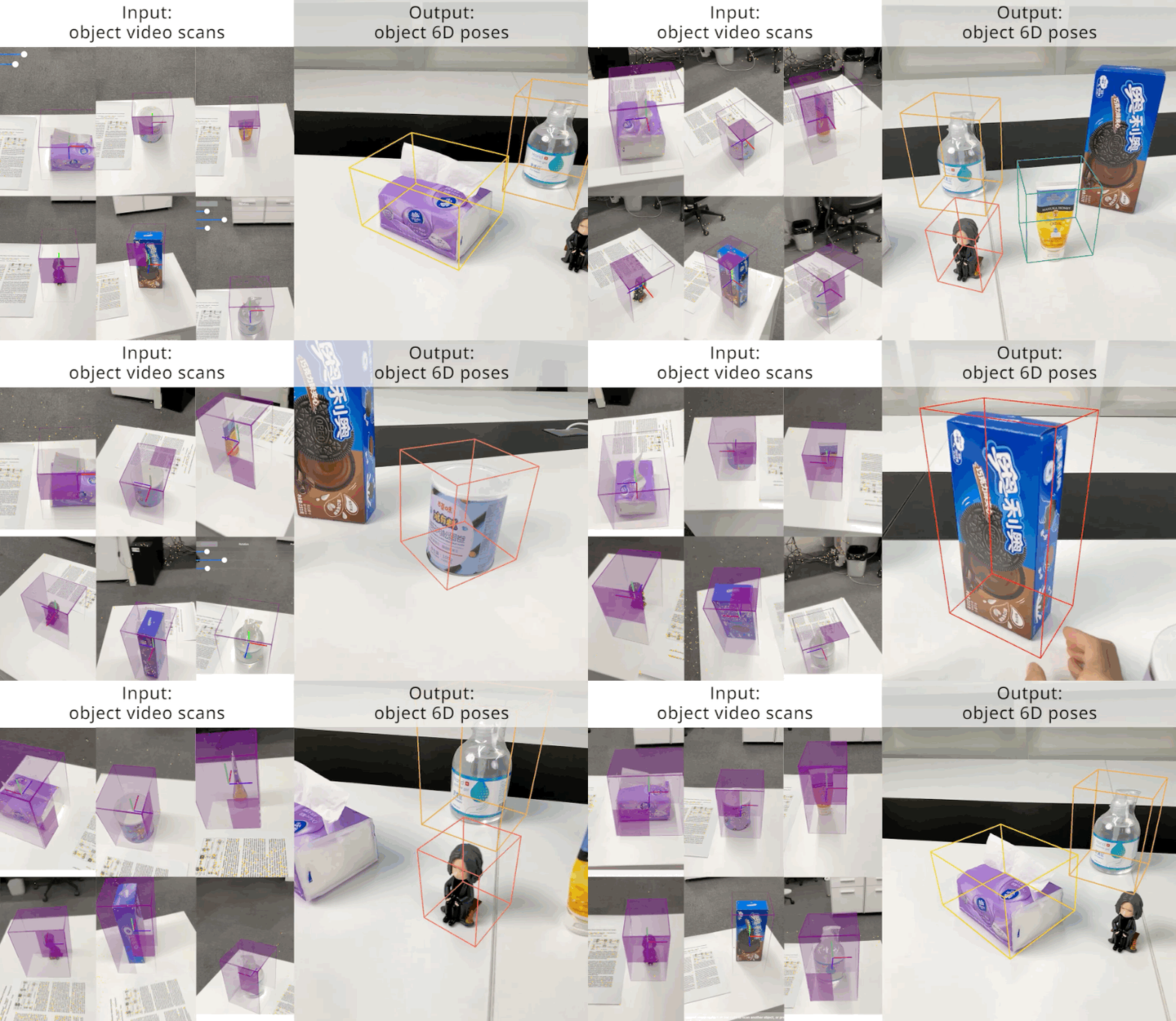
TODO List
- Training and inference code.
- Pipeline to reproduce the evaluation results on the proposed OnePose dataset.
-
OnePose Capapp is available at the App Store (iOS only) to capture your own training and test data. - Demo pipeline for running OnePose with custom-captured data.
Installation
conda env create -f environment.yaml
conda activate onepose
We use SuperPoint and SuperGlue for 2D feature detection and matching in this project. We can't provide the code directly due its LICENSE requirements, please download the inference code and pretrained models using the following script:
REPO_ROOT=/path/to/OnePose
cd $REPO_ROOT
sh ./scripts/prepare_2D_matching_resources.sh
COLMAP is used in this project for Structure-from-Motion. Please refer to the official instructions for the installation.
[Optional, WIP] You may optionally try out our web-based 3D visualization tool Wis3D for convenient and interactive visualizations of feature matches. We also provide many other cool visualization features in Wis3D, welcome to try it out.
# Working in progress, should be ready very soon, only available on test-pypi now.
pip install -i https://test.pypi.org/simple/ wis3d
Training and Evaluation on OnePose dataset
Dataset setup
Download OnePose dataset from onedrive storage and extract them into
$/your/path/to/onepose_datasets. The directory should be organized in the following structure:|--- /your/path/to/onepose_datasets | |--- train_data | |--- val_data | |--- test_data | |--- sample_dataBuild the dataset symlinks
REPO_ROOT=/path/to/OnePose
ln -s /your/path/to/onepose_datasets $REPO_ROOT/data/onepose_datasets
Run Structure-from-Motion for the data sequences
Reconstructed the object point cloud and 2D-3D correspondences are needed for both training and test objects:
python run.py +preprocess=sfm_spp_spg_train.yaml # for training data
python run.py +preprocess=sfm_spp_spg_test.yaml # for testing data
python run.py +preprocess=sfm_spp_spg_val.yaml # for val data
python run.py +preprocess=sfm_spp_spg_sample.yaml # an example, if you don't want to test the full dataset
Inference on OnePose dataset
Download the pretrain weights pretrained model and move it to
${REPO_ROOT}/data/model/checkpoints/onepose/GATsSPG.ckpt.Inference with category-agnostic 2D object detection.
When deploying OnePose to a real world system, an off-the-shelf category-level 2D object detector like YOLOv5 can be used. However, this could defeat the category-agnostic nature of OnePose. We can instead use a feature-matching-based pipeline for 2D object detection, which locates the scanned object on the query image through 2D feature matching. Note that the 2D object detection is only necessary during the initialization. After the initialization, the 2D bounding box can be obtained from projecting the previously detected 3D bounding box to the current camera frame. Please refer to the supplementary material for more details.
# Obtaining category-agnostic 2D object detection results first.
# Increasing the `n_ref_view` will improve the detection robustness but with the cost of slowing down the initialization speed.
python feature_matching_object_detector.py +experiment=object_detector.yaml n_ref_view=15

# Running pose estimation with `object_detect_mode` set to `feature_matching`.
# Note that enabling visualization will slow down the inference.
python inference.py +experiment=test_GATsSPG.yaml object_detect_mode=feature_matching save_wis3d=False
Running inference with ground-truth 2D bounding boxes
The following command should reproduce results in the paper, which use 2D boxes projected from 3D boxes as object detection results.
# Note that enabling visualization will slow down the inference.
python inference.py +experiment=test_GATsSPG.yaml object_detect_mode=GT_box save_wis3d=False # for testing data
[Optional] Visualize matching and estimated poses with Wis3D. Make sure the flag
save_wis3dis set as True in testing and the full images are extracted fromFrames.m4vby scriptscripts/parse_full_img.sh. The visualization file will be saved undercfg.output.vis_dirdirectory which is set asGATsSPGby default. Run the following commands for visualization:sh ./scripts/parse_full_img.sh path_to_Frames_m4v # parse full image from m4v file cd runs/vis/GATsSPG wis3d --vis_dir ./ --host localhost --port 11020This would launch a web service for visualization at port 11020.
Training the GATs Network
Prepare ground-truth annotations. Merge annotations of training/val data:
python run.py +preprocess=merge_anno task_name=onepose split=train
python run.py +preprocess=merge_anno task_name=onepose split=val
Begin training
python train.py +experiment=train_GATsSPG task_name=onepose exp_name=training_onepose
All model weights will be saved under ${REPO_ROOT}/data/models/checkpoints/${exp_name} and logs will be saved under ${REPO_ROOT}/data/logs/${exp_name}.
Citation
If you find this code useful for your research, please use the following BibTeX entry.
@article{sun2022onepose,
	title={{OnePose}: One-Shot Object Pose Estimation without {CAD} Models},
	author = {Sun, Jiaming and Wang, Zihao and Zhang, Siyu and He, Xingyi and Zhao, Hongcheng and Zhang, Guofeng and Zhou, Xiaowei},
	journal={CVPR},
	year={2022},
}
Copyright
This work is affiliated with ZJU-SenseTime Joint Lab of 3D Vision, and its intellectual property belongs to SenseTime Group Ltd.
Copyright SenseTime. All Rights Reserved.

Licensed under the Apache License, Version 2.0 (the "License");
you may not use this file except in compliance with the License.
You may obtain a copy of the License at

    http://www.apache.org/licenses/LICENSE-2.0

Unless required by applicable law or agreed to in writing, software
distributed under the License is distributed on an "AS IS" BASIS,
WITHOUT WARRANTIES OR CONDITIONS OF ANY KIND, either express or implied.
See the License for the specific language governing permissions and
limitations under the License.
Acknowledgement
Part of our code is borrowed from hloc and SuperGlue, thanks to their authors for the great works.
Explorar proyectos relacionados
codecrafters-io/build-your-own-x
Domina la programación recreando desde cero tus tecnologías favoritas.
561,873 estrellaspublic-apis/public-apis
Una lista colectiva de API gratuitas
498,237 estrellasmorluto/rea
Ingeniería inversa de cualquier cosa con agentes, desde el comportamiento de la aplicación hasta los binarios nativos.
452,669 estrellasopenclaw/openclaw
La IA que de verdad hace las cosas. Cualquier sistema operativo y cualquier plataforma. Al estilo langosta. 🦞
394,367 estrellas