
xmindflow/cenet
xmindflow/cenet has 41 GitHub stars and 2 forks. GitHot measured +1 in 7 days. Last checked 2026-11-09 20:13 UTC. Last push 2026-10-22.
[MICCAI 2025] CENet: Context Enhancement Network for Medical Image Segmentation
Crecimiento de estrellas medido
- in 24h
- Actualización retrasada
- in 7 days
- +1
- in 15 days
- Actualización retrasada
- in 1 month
- Actualización retrasada
Cambios netos en períodos que se solapan, no totales diarios. Los datos no disponibles se dejan en blanco. Las estrellas indican interés, no calidad.
README.md
OriginalCENet: Context Enhancement Network for Medical Image Segmentation


MICCAI 2025 Early Accept (Top 9%) — Code released 10.07.2025
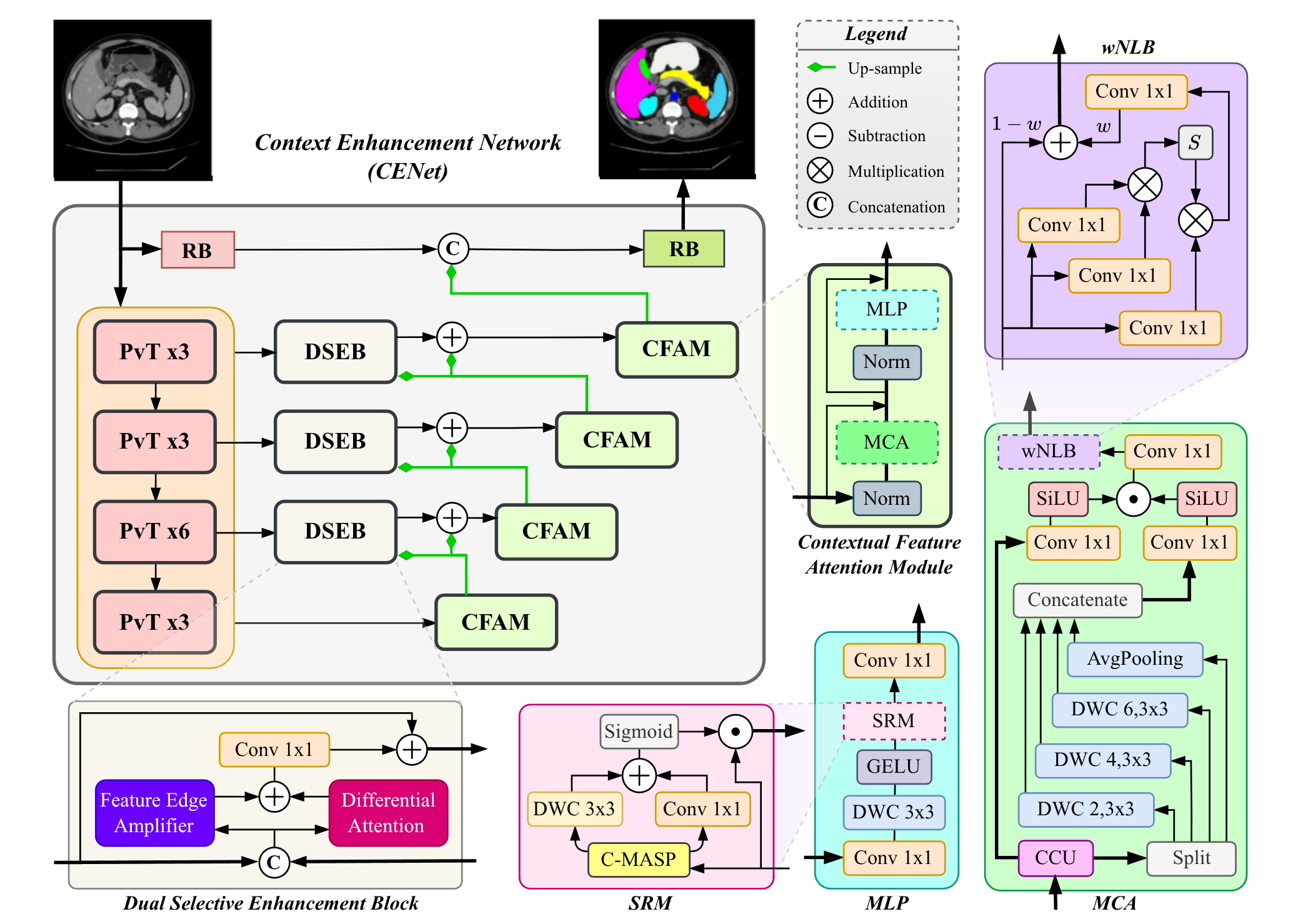
A unified PyTorch implementation of CENet, our Context Enhancement Network for robust, high-resolution segmentation across multiple medical domains (cardiac MRI, abdominal CT, dermoscopy).
📖 Table of Contents
- Abstract
- Quick Start (no cloning)
- Installation
- Repository Structure
- Pre-trained Weights
- Data Preparation
- Usage
- Results
- Citation
- Acknowledgements
📝 Abstract
Medical image segmentation, particularly in multi-domain scenarios, requires precise preservation of anatomical structures across diverse representations. While deep learning has advanced this field, existing models often struggle with accurate boundary representation, variability in organ morphology, and information loss during downsampling, limiting their accuracy and robustness. To address these challenges, we propose the Context Enhancement Network (CENet), a novel segmentation framework featuring two key innovations. First, the Dual Selective Enhancement Block (DSEB) integrated into skip connections enhances boundary details and improves the detection of smaller organs in a context-aware manner. Second, the Context Feature Attention Module (CFAM) in the decoder employs a multi-scale design to maintain spatial integrity, reduce feature redundancy, and mitigate overly enhanced representations. Extensive evaluations on both radiology and dermoscopic datasets demonstrate that CENet outperforms state-of-the-art (SOTA) methods in multi-organ segmentation and boundary detail preservation, offering a robust and accurate solution for complex medical image analysis tasks.
⚡ Quick Start (no cloning)
Load a pretrained model with PyTorch Hub. The code is fetched from this repository and the weights from Hugging Face:
pip install torch torchvision timm==1.0.16 monai==1.4.0 "numpy<2" scipy SimpleITK huggingface_hub
import torch

# A predictor applies the same preprocessing as in training and returns a mask
# with the size of your input. Datasets: "synapse", "acdc", "ham10000", "ph2".
predictor = torch.hub.load("xmindflow/cenet", "predictor", dataset="ham10000")
mask = predictor.predict("lesion.jpg")           # (H, W), 0 = background, 1 = lesion

ct = torch.hub.load("xmindflow/cenet", "predictor", dataset="synapse")
mask = ct.predict("abdomen_ct.nii.gz")           # (D, H, W), slice by slice
print(ct.classes)                                 # label names

# Or just the model: (B, C, 224, 224) -> (B, num_classes, 224, 224) logits
model = torch.hub.load("xmindflow/cenet", "cenet", dataset="synapse")
Inputs the predictor expects:
- ham10000 / ph2: an RGB dermoscopy image (path, PIL image or array).
- synapse: an axial abdominal CT slice or volume. Raw Hounsfield units are windowed to [-125, 275] as in training; images already scaled to [0, 1] or 0–255 are used as they are.
- acdc: a short-axis cardiac MRI slice or volume. Intensities are min-max scaled to [0, 1].
These models are for research only and are not intended for clinical use.
⚙️ Installation
Clone this repository
git clone https://github.com/xmindflow/cenet.git
cd cenet
Install PyTorch & core libraries
pip install torch==2.7.0 torchvision==0.22.0 torchaudio==2.7.0 \
  --index-url https://download.pytorch.org/whl/cu128
Install remaining dependencies
pip install -r requirements.txt
ℹ️ Tested on Python 3.10.16 and CUDA 12.9.
📂 Repository Structure
.
├── pretrained_pth/
│   └── pvt/
│       └── pvt_v2_b2.pth           # Pre-trained PVTv2 backbone
├── weights/                        # Downloaded checkpoints (see below)
├── scripts/
│   ├── acdc.sh                     # ACDC train/test
│   ├── synapse.sh                  # Synapse train/test
│   └── skin.sh                     # HAM10000 & PH2 train/test
├── src/                            # Code
│   ├── datasets/                   # Data loaders
│   ├── networks/                   # Model definitions
│   ├── utils/                      # Training & eval utilities
│   └── main_*.py                   # Entry points
├── hubconf.py                      # PyTorch Hub entry points
├── requirements.txt
└── README.md
📦 Pre-trained Weights
All dataset- and network-specific checkpoints are available on Hugging Face: afshinbigboy/CENet. The model card shows how to load each one with hf_hub_download. To download them all into weights/:
pip install huggingface_hub
hf download afshinbigboy/CENet --include "*.pth" --local-dir weights
They are also hosted on Mega.nz (~590 MB):
Download & extract
Manual
- Open in your browser:
https://mega.nz/file/MRdDHSwL#tJLJf_JUixmsxC2DRMcP0XZMBdQ6CVLTgxImH_PBdOo - Download the file named
cenet_weights.zip. - From your terminal, unzip into the
weights/folder:unzip cenet_weights.zip -d weights
- Open in your browser:
CLI (using megatools)
# install megatools if you don't have it
sudo apt-get update && sudo apt-get install -y megatools

# download directly from Mega.nz
megadl 'https://mega.nz/file/MRdDHSwL#tJLJf_JUixmsxC2DRMcP0XZMBdQ6CVLTgxImH_PBdOo'

# unzip into weights/
unzip MRdDHSwL.zip -d weights
After extraction,
weights/should contain:acdc_2418732.pth ham10k_2418602.pth ph2_2418571.pth synapse_2418962.pth synapse_cenet_org_2352272.pth
The PVTv2 encoder (
pvt_v2_b2.pth) is already inpretrained_pth/pvt/and is only required for training.
🗄️ Data Preparation
Organize your datasets as follows:
ACDC (2D Cardiac MRI)
/path/to/ACDC_2D/
├── list_ACDC/
│   ├── train.txt   # one filename per line, relative to train/
│   ├── valid.txt   # one filename per line, relative to valid/
│   └── test.txt    # one filename per line, relative to test/
├── train/          # one .npz per 2D slice
├── valid/          # one .npz per 2D slice
└── test/           # one .npz per case (full volume)
The loader (src/datasets/dataset_acdc.py) reads every sample with np.load and expects two arrays in each .npz file:
| Key | Content |
|---|---|
img |
the MRI image (a 2D slice for train/ and valid/, the whole volume for test/) |
label |
the integer segmentation mask with the same shape (4 classes: background, RV, Myo, LV) |
Slices are resized to --img_size (224 by default) on the fly during training. Each line in a list file is the exact filename inside the matching folder, for example case_patient001_frame01_slice_0.npz.
The preprocessed ACDC files are not included in this repository. Download the public 2D release used in our experiments from Google Drive. It is the same processed ACDC data used by Swin-Unet. After unzipping you will have train/, valid/, test/ and lists_ACDC/. Rename lists_ACDC to list_ACDC so that it matches scripts/acdc.sh. No further conversion is required.
Synapse (Abdominal CT)
/path/to/Synapse/
├── lists/        # Train/test split lists
├── train_npz/    # Preprocessed .npz volumes
└── test_vol_h5/  # HDF5 volumes for evaluation
Skin Lesion (HAM10000 & PH2)
/path/to/Skin/
├── HAM10000/     # Raw images + labels
└── PH2/          # Raw images + labels
🚀 Usage
Each script in scripts/ automates both training and evaluation. Open the script and set:
# 1. CENET_DIR    → Full path to this repository
# 2. DATA_DIR     → Full path to the dataset (see Data Preparation)
# 3. RESULTS_DIR  → Full path to save results
# 4. PT_DIR       → Path to pre-trained encoder:
#                   $CENET_DIR/pretrained_pth/pvt
# 5. EVAL_PT      → Path to the dataset-specific CENet checkpoint
#                   weights/*.pth
# 6. EVAL_PT_ORG  → [Synapse only] Path to original-CENet checkpoint
ACDC (2D Cardiac MRI)
bash scripts/acdc.sh TRAIN   # trains from PVTv2
bash scripts/acdc.sh TEST    # evaluates using $EVAL_PT
Synapse (Abdominal CT)
bash scripts/synapse.sh TRAIN      # trains clean CENet
bash scripts/synapse.sh TEST       # eval clean CENet
bash scripts/synapse.sh TEST_ORG   # eval original CENet (paper)
Skin Lesion (HAM10000 & PH2)
# HAM10000
bash scripts/skin.sh HAM TRAIN
bash scripts/skin.sh HAM TEST

# PH2
bash scripts/skin.sh PH2 TRAIN
bash scripts/skin.sh PH2 TEST
Tip: Uncomment
--ampfor mixed precision or--compileto usetorch.compile().
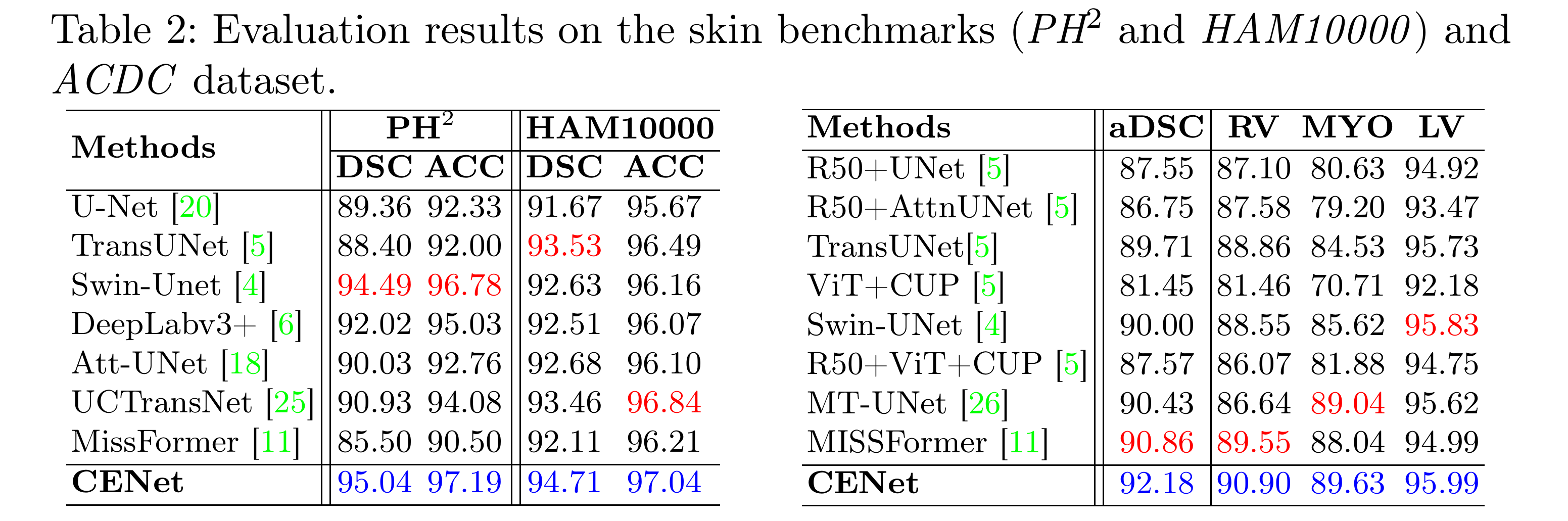
📈 Results
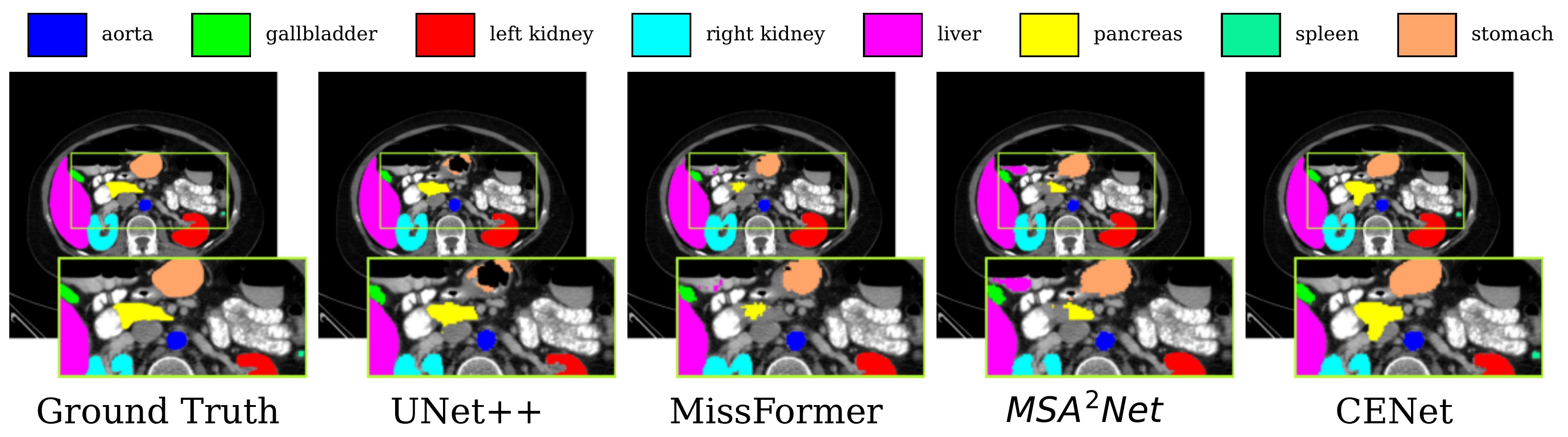
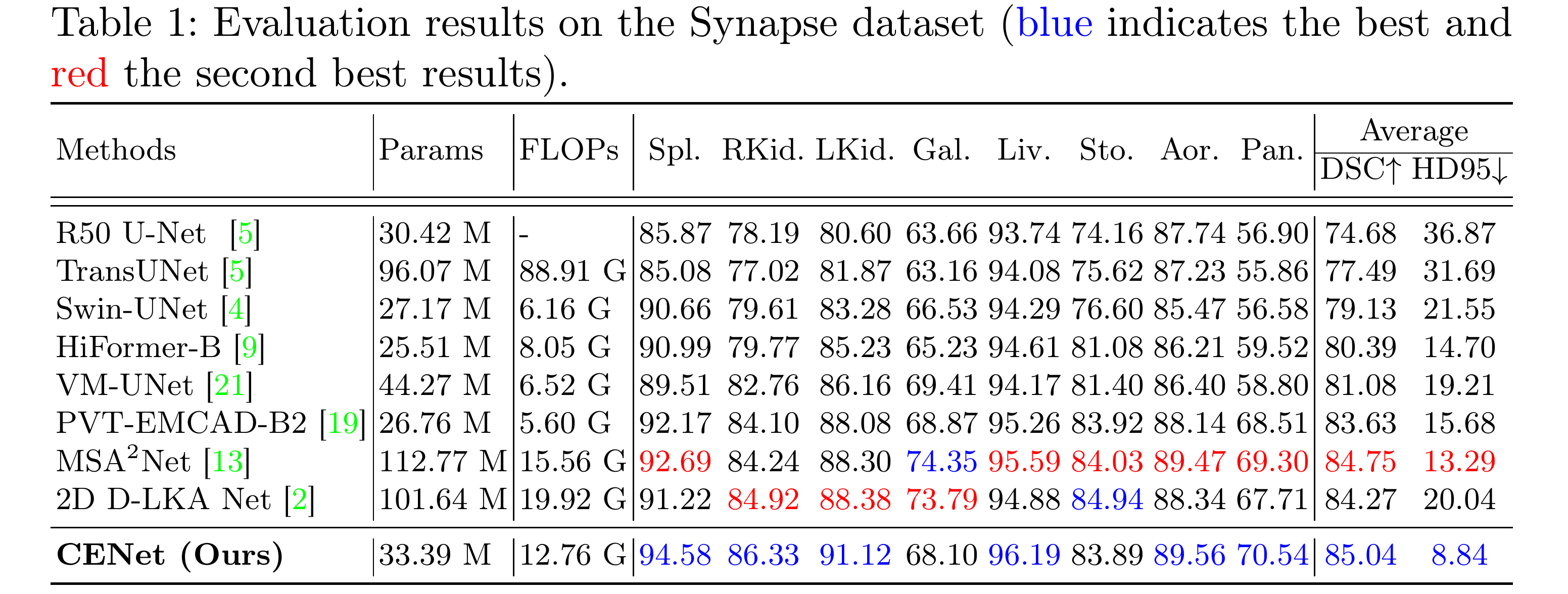
Visual comparison of the proposed method versus others on the Synapse dataset.
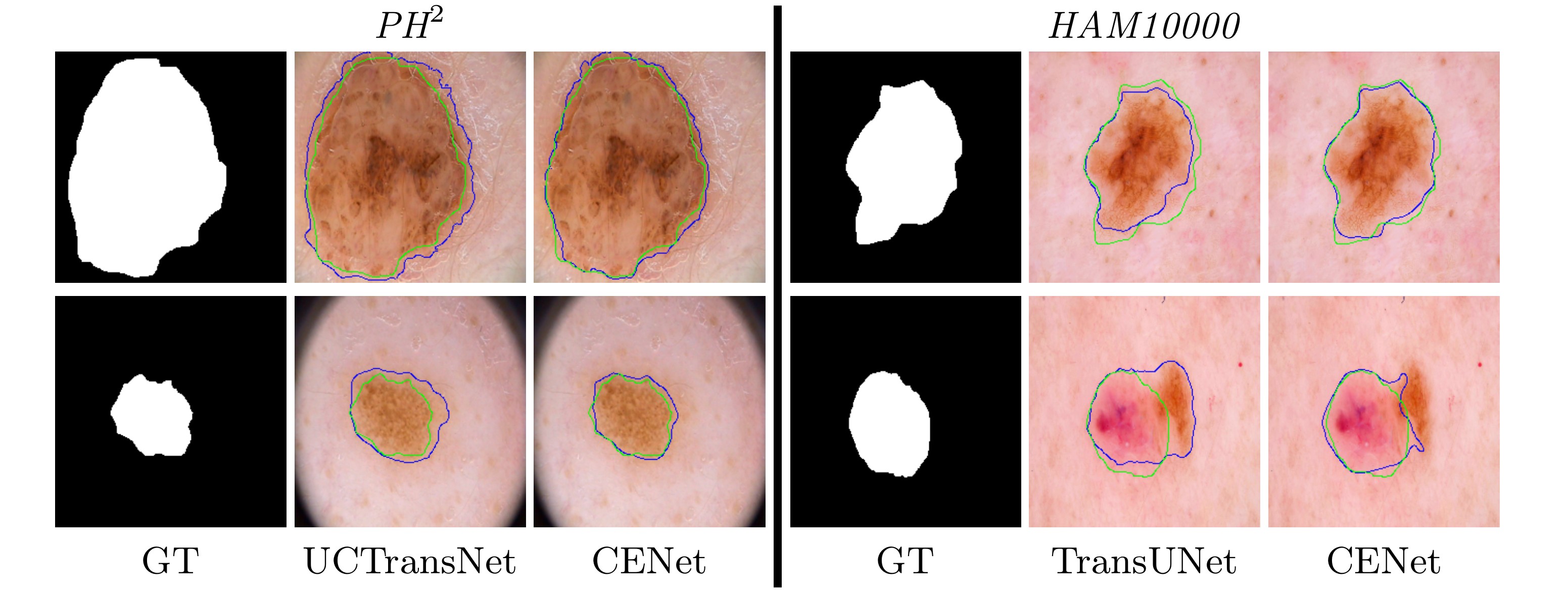
Qualitative comparison of CENet and previous methods across skin benchmarks.
📚 Citation
Please cite our paper if you use this code:
@InProceedings{BozAfs_CENet_MICCAI2025,
  author    = {Bozorgpour, Afshin and Kolahi, Sina Ghorbani and Azad, Reza and Hacihaliloglu, Ilker and Merhof, Dorit},
  title     = {{CENet}: Context Enhancement Network for Medical Image Segmentation},
  booktitle = {Medical Image Computing and Computer Assisted Intervention -- MICCAI 2025},
  series    = {Lecture Notes in Computer Science},
  volume    = {15960},
  pages     = {120--129},
  year      = {2025},
  publisher = {Springer Nature Switzerland},
  address   = {Cham},
  doi       = {10.1007/978-3-032-04927-8_12}
}
🤝 Acknowledgements
- This implementation leverages design ideas and utilities from EMCAD.
- We also incorporate modules inspired by MogaNet.
- Thanks to the authors of those projects for their open-source contributions.
Enjoy! Feel free to open an issue or pull request with any questions or improvements.
Explorar proyectos relacionados
tensorflow/tensorflow
Un framework de código abierto de aprendizaje automático para todos
201,427 estrellashuggingface/transformers
🤗 Transformers: el framework de definición de modelos para modelos de aprendizaje automático de vanguardia en texto, visión, audio y multimodal, tanto para inferencia como para entrenamiento.
168,711 estrellasAUTOMATIC1111/stable-diffusion-webui
Interfaz web de Stable Diffusion
165,274 estrellasComfy-Org/ComfyUI
La GUI, la API y el backend más potentes y modulares para modelos de difusión, con una interfaz de grafos y nodos. El motor de inferencia local más rápido del mundo.
146,024 estrellas