
webprogramming260/webprogramming
webprogramming260/webprogramming has 44 GitHub stars and 150 forks. Star changes are not measured yet. Last checked 2026-11-13 04:07 UTC. Last push 2026-11-09.
Web Programming 260 Instruction
Crecimiento de estrellas medido
- in 24h
- Recopilando historial
- in 7 days
- Recopilando historial
- in 15 days
- Recopilando historial
- in 1 month
- Recopilando historial
Cambios netos en períodos que se solapan, no totales diarios. Los datos no disponibles se dejan en blanco. Las estrellas indican interés, no calidad.
README.md
Original
BYU Web Programming cs260

Welcome to Introduction to Web Programming. In this course, you will learn to design, build, and deploy full-stack web applications that serve real users and solve meaningful problems. Along the way, you’ll engage in the practices of modern software developers—reasoning about system architecture, using AI as a collaborative tool, and taking responsibility for the security, performance, and impact of the systems you create. More than just learning technologies, this course is about developing the habits of thoughtful, capable engineers who can adapt, continue learning, and use their skills to contribute positively to others.
Learning with MasteryLS
This course uses MasteryLS for learning the content. To get started:
- Navigate to MasteryLS.
- Register for an account. Use your BYU email address so that your grades can be recorded in Canvas. This will send you a one-time password to your BYU email to complete the registration.
- Click on the CS 260 Web Programming course for enrollment.
- Click on the newly enrolled CS 260 Web Programming course to start learning.
- Watch the Learner Tutorial on how to use MasteryLS.
Outcomes
By the end of this course you will be able to:
Full-Stack Web Application Development: Design and implement interactive, full-stack web applications using modern web technologies, applying computational thinking and user-centered design to solve meaningful problems that serve others.
Web Architecture: Design and reason about web architectures, including client-server communication, APIs, authentication, real-time interaction, and data persistence, with an awareness of the responsibility to build systems that meet present needs and continue to serve well as those needs change over time.
AI-Augmented Development: Use AI tools as a collaborative partner to support design, implementation, debugging, and learning, while critically evaluating their outputs for correctness and long-term maintainability.
Security and Societal Impact: Apply secure coding practices and evaluate the ethical implications of web technologies, including privacy, accessibility, and eternal impact of the systems they build.
Deployment and Application Management: Deploy and manage web applications, demonstrating responsibility for reliability, performance, and the experience of real users in production environments.
{"id":"ef2f9d20-99b5-4adc-ab98-3a6536234103", "title":"Course Outcomes", "type":"likert", "showResults":"editor", "required":"true"}
How familiar are you currently with the course outcomes?

Scale: Beginner|Intermediate|Proficient|Advanced|Expert


| id | statement |
|----|-----------|
|dev|**Full-Stack Web Application Development**|
|arch|**Web Architecture**|
|ai|**AI-Augmented Development**|
|sec|**Security and Societal Impact**|
|devop|**Deployment and Application Management**|
Technologies
The course covers a full stack of web programming technologies and topics.
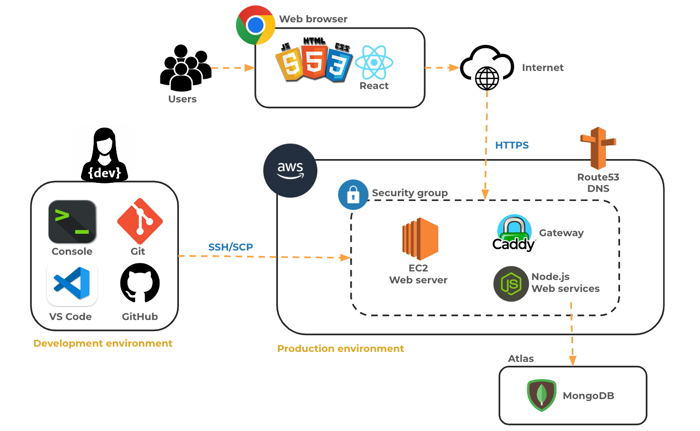
- Web design
- Command console
- HTML
- CSS
- JavaScript
- Responsive design
- Domain Names and DNS
- HTTP, HTTPS, and web certificates
- Realtime peer to peer interaction with WebSocket
- Web Servers using AWS
- Web Services
- Web Frameworks focusing on React
- Data Services using MongoDB
- Mobile devices with installable applications
- Security
- UX design and accessibility
Acknowledgements
The instruction makes extensive use of MDN Web Docs and we highly encourage you to spend many hours studying in their exceptional content.
React is used to demonstrate the power of web frameworks. Without the significant contributions of the React community we would not be able to stand on the shoulders of giants.
Amazon Web Services made it possible to experiment with DNS, create web servers, and host the project content.
The demonstration application Simon is based on the game by Milton-Bradley. Simon is a registered trademark of Hasbro. Our use of the name and the game is for non-profit educational use only. No part of the Simon code should be used outside of that definition.
Explorar proyectos relacionados
freeCodeCamp/freeCodeCamp
Base de código abierto y plan de estudios de freeCodeCamp.org. Aprende matemáticas, programación y ciencias de la computación gratis.
459,068 estrellasdonnemartin/system-design-primer
Aprende a diseñar sistemas a gran escala y prepárate para la entrevista de diseño de sistemas. Incluye fichas de Anki.
377,732 estrellasreact/react
La biblioteca para interfaces de usuario web y nativas.
252,565 estrellasvuejs/vue
Este es el repositorio de Vue 2. Para Vue 3, visita https://github.com/vuejs/core
212,527 estrellas