
unslothai/hyperlearn
unslothai/hyperlearn has 2,532 GitHub stars and 169 forks. GitHot measured +1 stars in 24 hours, -1 in 7 days, and +2 in 15 days. Last checked 2026-11-22 09:59 UTC. Last push 2024-11-19.
Crecimiento de estrellas medido
- in 24h
- +1
- in 7 days
- -1
- in 15 days
- +2
- in 1 month
- Recopilando historial
Cambios netos en períodos que se solapan, no totales diarios. Los datos no disponibles se dejan en blanco. Las estrellas indican interés, no calidad.
Acerca de
Algoritmos de aprendizaje automático entre 2 y 2000 veces más rápidos y un 50 % menos de uso de memoria. Funciona con hardware nuevo y antiguo.
Aprendizaje automáticoREADME.md
Original

2-2000x faster algos, 50% less memory usage, works on all hardware - new and old.
If you want to collab on fast algorithms - msg me!! Join our Discord server on making AI faster, or if you just wanna chat about AI!! https://discord.gg/unsloth
Documentation
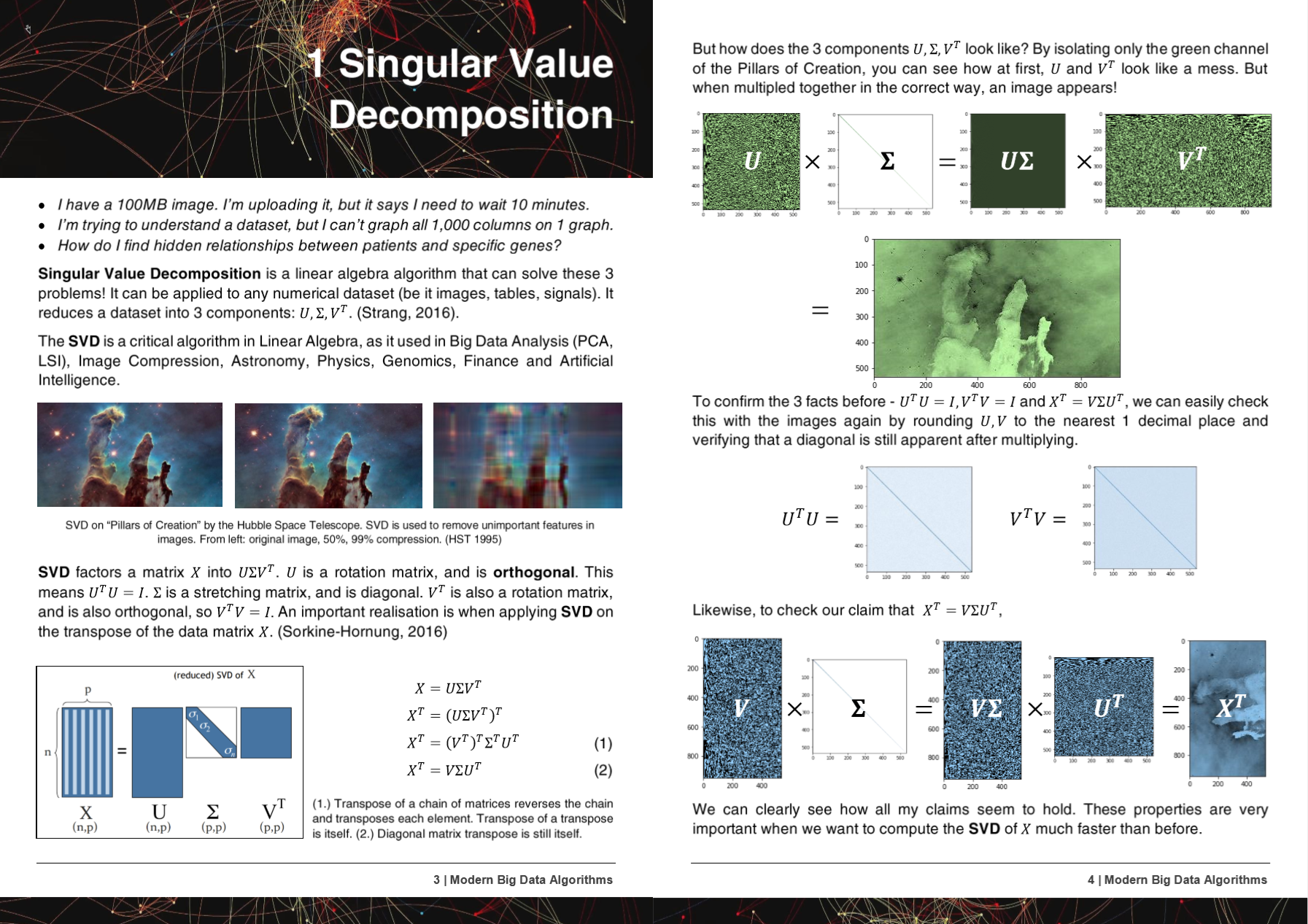
50 Page Modern Big Data Algorithms PDF
Hyperlearn's algorithms, methods and repo has been featured or mentioned in 5 research papers!
+ Microsoft, UW, UC Berkeley, Greece, NVIDIA
- Microsoft: Yu et al. Making Classical Machine Learning Pipelines Differentiable http://learningsys.org/nips18/assets/papers/45CameraReadySubmissionfinetune.pdf
- University of Washington: Ariel Rokem, Kendrick Kay. Fractional ridge regression: a fast, interpretable reparameterization of ridge regression https://arxiv.org/abs/2005.03220
- National Center for Scientific Research 'Demokritos', Greece: Christos Platias, Georgios Petasis. A Comparison of Machine Learning Methods for Data Imputation https://dl.acm.org/doi/10.1145/3411408.3411465
- UC Berkeley David Chan. GPU Accelerated T-Distributed Stochastic Neighbor Embedding https://digitalassets.lib.berkeley.edu/techreports/ucb/incoming/EECS-2020-89.pdf (Incorporated Hyperlearn methods into NVIDIA RAPIDS TSNE)
- NVIDIA: Raschka et al. RAPIDS: Machine Learning in Python: Main developments and technology trends in data science, machine learning, and artificial intelligence https://arxiv.org/abs/2002.04803 (Incorporated Hyperlearn methods into NVIDIA RAPIDS TSNE)
Hyperlearn's methods and algorithms have been incorporated into more than 6 organizations and repositories!
+ NASA + Facebook's Pytorch, Scipy, Cupy, NVIDIA, UNSW
- Facebook's Pytorch: SVD very very slow and GELS gives nans, -inf #11174 https://github.com/pytorch/pytorch/issues/11174
- Scipy: EIGH very very slow --> suggesting an easy fix #9212 https://github.com/scipy/scipy/issues/9212
- Cupy: Make SVD overwrite temporary array x https://github.com/cupy/cupy/pull/2277
- NVIDIA: Accelerating TSNE with GPUs: From hours to seconds https://medium.com/rapids-ai/tsne-with-gpus-hours-to-seconds-9d9c17c941db
- UNSW Abdussalam et al. Large-scale Sku-level Product Detection In Social Media Images And Sales Performance https://www.abstractsonline.com/pp8/#!/9305/presentation/465
During Hyperlearn's development, bugs and issues were notified to GCC!
- GCC 10 ignoring function attribute optimize for all x86 since r11-1019 https://gcc.gnu.org/bugzilla/show_bug.cgi?id=96535
- Vector Extensions aligned(1) not generating unaligned loads/stores https://gcc.gnu.org/bugzilla/show_bug.cgi?id=98317
- GCC >= 6 cannot inline _mm_cmp_ps on SSE targets https://gcc.gnu.org/bugzilla/show_bug.cgi?id=98387
- GCC 10.2 AVX512 Mask regression from GCC 9 https://gcc.gnu.org/bugzilla/show_bug.cgi?id=98348

HyperLearn is written completely in PyTorch, NoGil Numba, Numpy, Pandas, Scipy & LAPACK, C++, C, Python, Cython and Assembly, and mirrors (mostly) Scikit Learn. HyperLearn also has statistical inference measures embedded, and can be called just like Scikit Learn's syntax.
Some key current achievements of HyperLearn:
- 70% less time to fit Least Squares / Linear Regression than sklearn + 50% less memory usage
- 50% less time to fit Non Negative Matrix Factorization than sklearn due to new parallelized algo
- 40% faster full Euclidean / Cosine distance algorithms
- 50% less time LSMR iterative least squares
- New Reconstruction SVD - use SVD to impute missing data! Has .fit AND .transform. Approx 30% better than mean imputation
- 50% faster Sparse Matrix operations - parallelized
- RandomizedSVD is now 20 - 30% faster
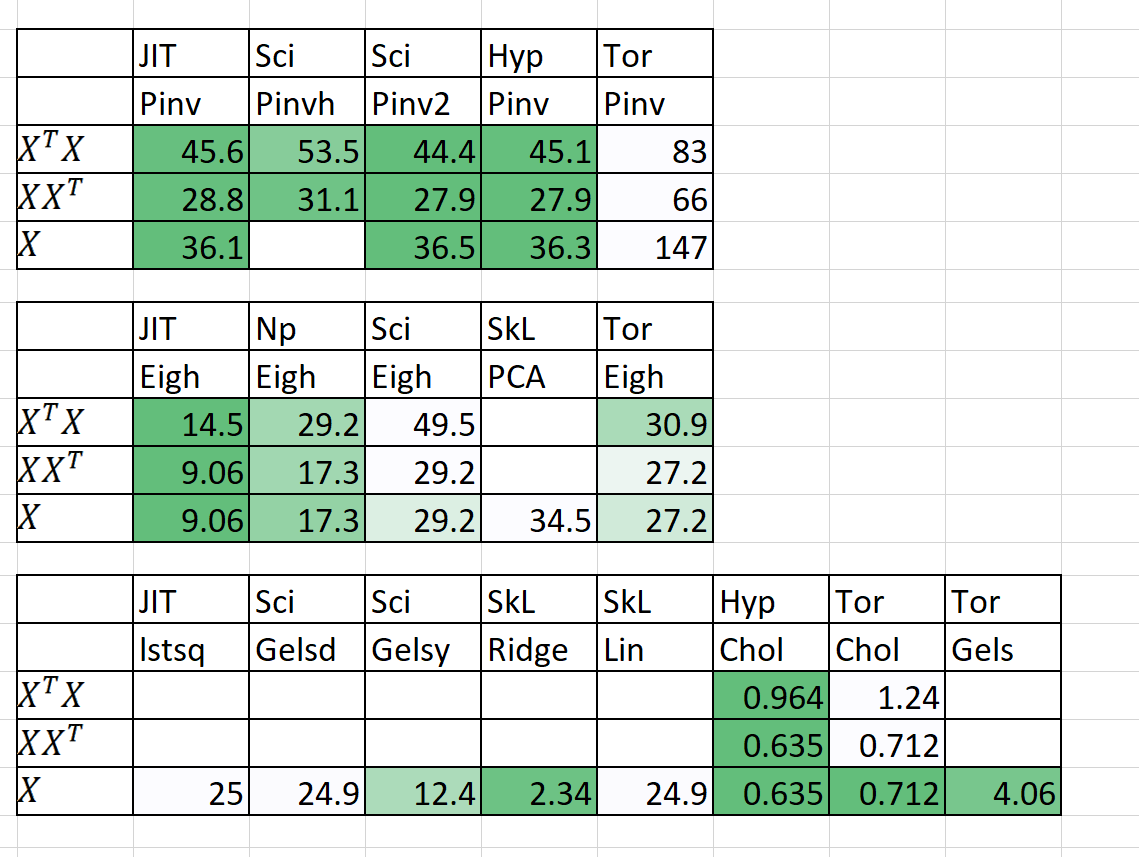
Comparison of Speed / Memory
| Algorithm | n | p | Time(s) | RAM(mb) | Notes | ||
|---|---|---|---|---|---|---|---|
| Sklearn | Hyperlearn | Sklearn | Hyperlearn | ||||
| QDA (Quad Dis A) | 1000000 | 100 | 54.2 | 22.25 | 2,700 | 1,200 | Now parallelized |
| LinearRegression | 1000000 | 100 | 5.81 | 0.381 | 700 | 10 | Guaranteed stable & fast |
Time(s) is Fit + Predict. RAM(mb) = max( RAM(Fit), RAM(Predict) )
I've also added some preliminary results for N = 5000, P = 6000
Help is really needed! Message me!
Key Methodologies and Aims
1. Embarrassingly Parallel For Loops
2. 50%+ Faster, 50%+ Leaner
3. Why is Statsmodels sometimes unbearably slow?
4. Deep Learning Drop In Modules with PyTorch
5. 20%+ Less Code, Cleaner Clearer Code
6. Accessing Old and Exciting New Algorithms
1. Embarrassingly Parallel For Loops
- Including Memory Sharing, Memory Management
- CUDA Parallelism through PyTorch & Numba
2. 50%+ Faster, 50%+ Leaner
- Matrix Multiplication Ordering: https://en.wikipedia.org/wiki/Matrix_chain_multiplication
- Element Wise Matrix Multiplication reducing complexity to O(n^2) from O(n^3): https://en.wikipedia.org/wiki/Hadamard_product_(matrices)
- Reducing Matrix Operations to Einstein Notation: https://en.wikipedia.org/wiki/Einstein_notation
- Evaluating one-time Matrix Operations in succession to reduce RAM overhead.
- If p>>n, maybe decomposing X.T is better than X.
- Applying QR Decomposition then SVD might be faster in some cases.
- Utilise the structure of the matrix to compute faster inverse (eg triangular matrices, Hermitian matrices).
- Computing SVD(X) then getting pinv(X) is sometimes faster than pure pinv(X)
3. Why is Statsmodels sometimes unbearably slow?
- Confidence, Prediction Intervals, Hypothesis Tests & Goodness of Fit tests for linear models are optimized.
- Using Einstein Notation & Hadamard Products where possible.
- Computing only what is neccessary to compute (Diagonal of matrix and not entire matrix).
- Fixing the flaws of Statsmodels on notation, speed, memory issues and storage of variables.
4. Deep Learning Drop In Modules with PyTorch
- Using PyTorch to create Scikit-Learn like drop in replacements.
5. 20%+ Less Code, Cleaner Clearer Code
- Using Decorators & Functions where possible.
- Intuitive Middle Level Function names like (isTensor, isIterable).
- Handles Parallelism easily through hyperlearn.multiprocessing
6. Accessing Old and Exciting New Algorithms
- Matrix Completion algorithms - Non Negative Least Squares, NNMF
- Batch Similarity Latent Dirichelt Allocation (BS-LDA)
- Correlation Regression
- Feasible Generalized Least Squares FGLS
- Outlier Tolerant Regression
- Multidimensional Spline Regression
- Generalized MICE (any model drop in replacement)
- Using Uber's Pyro for Bayesian Deep Learning
Extra License Terms
- The Apache 2.0 license is adopted.
Explorar proyectos relacionados
Cargando…