
shehzaadzd/MINERVA
shehzaadzd/MINERVA has 323 GitHub stars and 90 forks. GitHot measured 0 stars in 24 hours, 0 in 7 days, and +1 in 15 days. Last checked 2026-11-19 10:19 UTC. Last push 2026-10-27.
Crecimiento de estrellas medido
- in 24h
- 0
- in 7 days
- 0
- in 15 days
- +1
- in 1 month
- Recopilando historial
Cambios netos en períodos que se solapan, no totales diarios. Los datos no disponibles se dejan en blanco. Las estrellas indican interés, no calidad.
Acerca de
Meandering In Networks of Entities to Reach Verisimilar Answers
Aprendizaje automáticoREADME.md
OriginalMINERVA
Meandering In Networks of Entities to Reach Verisimilar Answers
Code and models for the paper Go for a Walk and Arrive at the Answer - Reasoning over Paths in Knowledge Bases using Reinforcement Learning
Authors: Rajarshi Das, Shehzaad Dhuliawala, Manzil Zaheer, Luke Vilnis, Ishan Durugkar, Akshay Krishnamurthy, Alex Smola, Andrew McCallum
MINERVA is a RL agent which answers queries in a knowledge graph of entities and relations. Starting from an entity node, MINERVA learns to navigate the graph conditioned on the input query till it reaches the answer entity. For example, give the query, (Colin Kaepernick, PLAYERHOMESTADIUM, ?), MINERVA takes the path in the knowledge graph below as highlighted. Note: Only the solid edges are observed in the graph, the dashed edges are unobsrved.
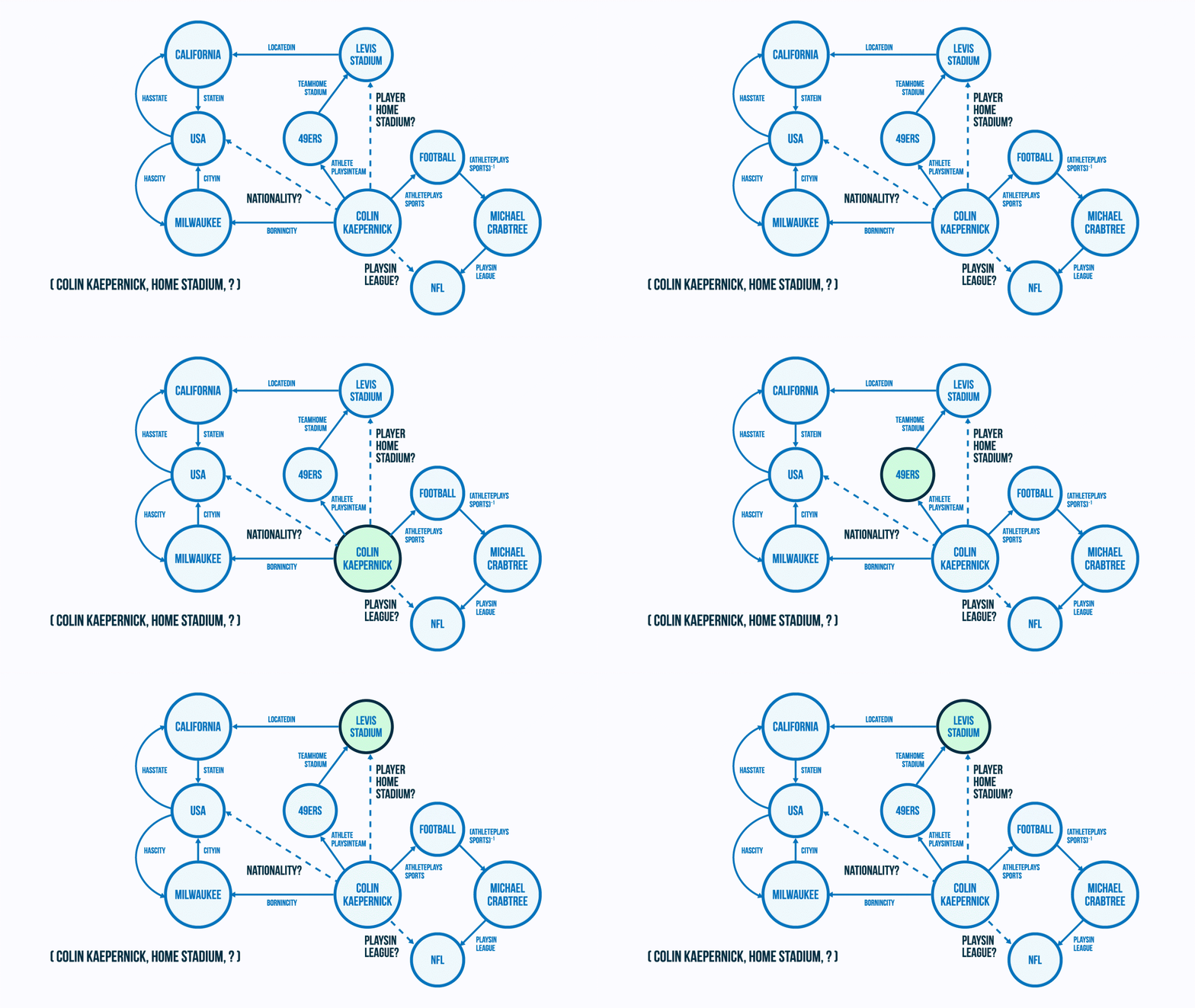 gif courtesy of Bhuvi Gupta
Requirements
To install the various python dependencies (including tensorflow)
pip install -r requirements.txt
Training
Training MINERVA is easy!. The hyperparam configs for each experiments are in the configs directory. To start a particular experiment, just do
sh run.sh configs/${dataset}.sh
where the ${dataset}.sh is the name of the config file. For example,
sh run.sh configs/countries_s3.sh
Testing
We are also releasing pre-trained models so that you can directly use MINERVA for query answering. They are located in the saved_models directory. To load the model, set the load_model to 1 in the config file (default value 0) and model_load_dir to point to the saved_model. For example in configs/countries_s2.sh, make
load_model=1
model_load_dir="saved_models/countries_s2/model.ckpt"
Output
The code outputs the evaluation of MINERVA on the datasets provided. The metrics used for evaluation are Hits@{1,3,5,10,20} and MRR (which in the case of Countries is AUC-PR). Along with this, the code also outputs the answers MINERVA reached in a file.
Code Structure
The structure of the code is as follows
Code
├── Model
│    ├── Trainer
│    ├── Agent
│    ├── Environment
│    └── Baseline
├── Data
│    ├── Grapher
│    ├── Batcher
│    └── Data Preprocessing scripts
│            ├── create_vocab
│            ├── create_graph
│            ├── Trainer
│            └── Baseline
Data Format
To run MINERVA on a custom graph based dataset, you would need the graph and the queries as triples in the form of (e1,r, e2).
Where e1, and e2 are nodes connected by the edge r.
The vocab can of the dataset can be created using the create_vocab.py file found in data/data preprocessing scripts. The vocab needs to be stores in the json format {'entity/relation': ID}.
The following shows the directory structure of the Kinship dataset.
kinship
    ├── graph.txt
    ├── train.txt
    ├── dev.txt
    ├── test.txt
    └── Vocab
            ├── entity_vocab.json
            └── relation_vocab.json
Citation
If you use this code, please cite our paper
@inproceedings{minerva,
  title = {Go for a Walk and Arrive at the Answer: Reasoning Over Paths in Knowledge Bases using Reinforcement Learning},
  author = {Das, Rajarshi and Dhuliawala, Shehzaad and Zaheer, Manzil and Vilnis, Luke and Durugkar, Ishan and Krishnamurthy, Akshay and Smola, Alex and McCallum, Andrew},
  booktitle = {ICLR},
  year = 2018
}